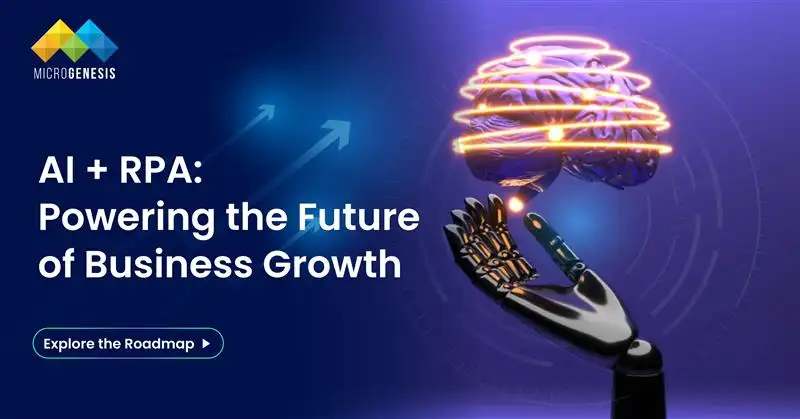
In an era where competition is fierce, customer expectations are sky-high, and operational costs continue to rise, businesses across industries face a critical challenge: how to grow efficiently without overstretching resources. For many, the answer lies in the strategic adoption of Robotic Process Automation (RPA) and Artificial Intelligence (AI). Individually, both RPA and AI offer significant advantages. But when combined, they create a powerful force — Intelligent Automation — that transforms businesses, accelerates growth, and delivers measurable ROI. As a leading RPA Consulting services , we’ve seen firsthand how the synergy of RPA and AI reshapes operations, drives innovation, and positions organizations for sustainable success. Why Businesses Need More Than Automation In recent years, automation has become a standard tool in the modern business toolkit. Many organizations have already embraced Robotic Process Automation (RPA) to streamline repetitive, rule-based tasks — from data entry to invoice processing. The benefits are undeniable: reduced errors, improved efficiency, and significant time savings. But here’s the reality — simple task automation is no longer enough to compete and grow in today’s dynamic business environment. As companies scale, their operations naturally become more complex. They face increasing volumes of data, more intricate customer interactions, stricter compliance demands, and a heightened need for real-time decision-making. Basic automation, while essential, can only take your business so far in addressing these evolving challenges. This is where Artificial Intelligence (AI) steps in and transforms the game. AI: The Catalyst for Next-Level Automation AI goes beyond automating repetitive tasks — it introduces intelligence into your processes. It enables your systems to: ✔ Understand unstructured data, such as emails, documents, and images ✔ Analyze vast amounts of information in real-time ✔ Learn from patterns and improve over time ✔ Make decisions based on predictive insights When AI and RPA are combined, they form what is known as Intelligent Automation — a powerful synergy that takes businesses from simply being efficient to being adaptive, predictive, and scalable. Why is Intelligent Automation Critical for Business Growth? 1. Managing Complexity with Ease As operations grow, so does complexity. AI allows your automated systems to handle variations, exceptions, and decision-based processes — areas where traditional automation struggles. 2. Enhancing Customer Interactions Today’s customers expect personalized, real-time interactions. AI-powered chatbots, virtual assistants, and recommendation engines elevate the customer experience, while RPA ensures backend processes work seamlessly to support those interactions. 3. Driving Data-Driven Decisions Businesses generate more data than ever before. AI converts that data into actionable insights, helping leaders make informed decisions faster. When integrated with RPA, these insights trigger automated actions, accelerating responsiveness and operational agility. 4. Scaling Without Growing Costs With AI-enhanced automation, businesses can handle increased workloads, customer demands, and operational processes without proportionally increasing headcount or expenses. This is essential for sustainable, scalable growth. 5. Staying Ahead of the Competition In a fast-paced market, businesses that rely solely on basic automation risk falling behind. Intelligent Automation offers a competitive edge by making operations smarter, faster, and more adaptable. Dig Deeper: Robotic Process Automation (RPA) in Manufacturing: Revolutionizing Industrial Operations How RPA and AI Drive Business Growth Let’s break down how combining these technologies creates new growth opportunities across industries: 1. Unlocking Productivity at Scale Manual, repetitive tasks limit employee productivity and waste valuable human potential. By automating these processes with RPA and enhancing them with AI, businesses can: ✔ Complete tasks faster and with greater accuracy ✔ Free up employees to focus on high-value, strategic work ✔ Operate around the clock without downtime Example: In financial services, RPA bots handle account reconciliation while AI models flag anomalies for human review — accelerating operations and reducing errors. 2. Enhancing Decision-Making with AI Insights Informed decision-making is the backbone of business growth. AI extracts actionable insights from vast data sets, enabling faster, smarter business decisions. Key Benefits Include: When paired with RPA, these AI-driven insights are quickly turned into automated actions, creating agile, responsive operations. 3. Improving Customer Experience Customer satisfaction is critical to growth. AI-powered chatbots, virtual assistants, and automated customer support processes elevate customer experiences by providing: ✔ 24/7 support ✔ Personalized interactions ✔ Faster query resolution Meanwhile, RPA works behind the scenes, updating systems, processing transactions, and ensuring seamless service delivery — all contributing to higher customer retention and satisfaction. 4. Streamlining Compliance and Risk Management In highly regulated industries, compliance is non-negotiable — but it’s also resource-intensive. Intelligent Automation reduces the burden by: ✔ Automating compliance checks ✔ Monitoring transactions in real-time ✔ Generating audit-ready reports AI enhances this process by identifying unusual patterns or risks early, helping businesses stay compliant and avoid costly penalties. 5. Accelerating Innovation Automation frees teams from routine tasks, giving them more time and headspace to focus on innovation. With AI providing predictive insights and market trends, businesses can: ✔ Launch new products faster ✔ Optimize marketing strategies ✔ Explore new markets with confidence This cycle of automation and innovation fuels long-term, sustainable growth. Real-World Applications Across Industries At [Your Company Name], we’ve delivered RPA and AI solutions across sectors, witnessing transformative results: Banking and Financial Services Healthcare Retail and E-Commerce Manufacturing The possibilities are endless — and the results speak for themselves. The Business Case for RPA + AI: Why Now? The global market for Intelligent Automation is growing rapidly. As a leading RPA service provider, we help forward-thinking businesses invest early—those who delay risk falling behind. Here’s why now is the perfect time to act: 1. Competitive Advantage Early adopters of RPA and AI report significant efficiency gains and improved customer satisfaction — key differentiators in competitive markets. 2. Scalability Without Additional Headcount Automation enables businesses to scale operations without proportional increases in staffing costs — critical for sustainable growth. 3. Future-Proof Operations AI-driven insights and adaptable automation systems make businesses more resilient to market fluctuations and evolving customer needs. 4. Rapid Return on Investment (ROI) With efficient implementation, most businesses see tangible ROI within months — from cost reductions to improved output and higher revenues. Overcoming Common Concerns Some business leaders hesitate to embrace Intelligent Automation due to misconceptions: … Continue reading How RPA and AI Together Drive Business Growth: A Roadmap for the Future

- Company
-
-
Company
Built on strong engineering fundamentals, thoughtful, future-driven leadership, and a collaborative culture, we at MicroGenesis focus on delivering dependable outcomes for customers and partners.
-
-
- Services
-
-
Services
Our engineering, automation, and operations are integrated to ensure systems move reliably for building long-term operation.
The intent is to reduce risk, manage change effectively, and sustain performance in complex environments.
-
-
- Products
-
-
Products
Built to solve focused, recurring problems encountered in complex engineering and operational environments, our products emphasize accuracy, automation, and reliability to support better decisions and more efficient execution.
-
-
- Partners
-
-
Partners
Our partnerships are built around applying proven platforms to real engineering and operational challenges with a focus on improving traceability, automation, and quality across complex systems and development lifecycles.
-
-
- Defense
-
-
Defense
Our offerings leverage advanced technologies to boost situational awareness, automation, and accuracy, combining geospatial intelligence with autonomous systems for informed decision-making.
-
-
- Resources
-
-
Resources
Access insights from MicroGenesis on solving complex engineering and technology challenges. Our resources cover practical solutions, scalable strategies, and approaches that drive operational efficiency. Subscribe for the latest expert perspectives.
-
-
- Contact Us