Driving Efficiency And Automation With DevOps For Embedded Systems

Reduce Time to Market Significantly

Overview

In today’s automotive landscape, vehicles are rapidly evolving into complex, connected systems where embedded software is at the heart of innovation. Traditional development methods, characterized by manual, siloed processes, are increasingly ill-equipped to handle the growing demands for speed, safety, and reliability.


DevOps, with its emphasis on automation, continuous integration, and rapid feedback loops, offers a transformative solution to these challenges. By streamlining the build, test, and deployment cycles, it minimizes human error and accelerates time-to-market, a critical advantage in an industry where delays can mean falling behind competitors.


Read how we enabled one of our Clients— a global automotive systems and components manufacturer —to reduce their dependency on manual interventions and accelerate their time to market.

Inefficient And Manual Processes Led To -
Bottlenecks And Delays

Our client’s technology environment was a complex maze of niche, enterprise-level applications that required specialised skill sets.


Their existing processes relied heavily on manual intervention. Developers had to build the code, kernel and distribution system, push it to the source control system, retrieve it locally, and generate artifacts. These tedious, error-prone workflows not only consumed valuable engineering time but also left little room for innovation.


Repetitive tasks drained resources, further compounding delays and undermining the client’s ability to meet competitive delivery timelines. The development cycle was unpredictable and inconsistent—builds that sometimes took only a few hours could stretch into lengthy, multi-level testing processes, throwing project timelines into disarray.


The Client wanted us to create a DevOps pipeline to automate these manual processes. However, unlike the software development landscape, where rapid, automated delivery is the norm, the embedded world has remained largely untouched by such advancements. The sheer number of specialized technologies involved necessitated diverse expertise that was not easily automated. This required us to adopt a transformative
approach to streamline processes, reduce manual dependencies, and ultimately drive innovation.

A 360° Transformative- Approach

We adopted a comprehensive approach, drawing on our many years of experience in the automotive industry and
providing DevOps solutions in other sectors.

1.

Analysis

We focused on understanding the existing processes and technology
environments and how microcontrollers and sensors interacted with the software. This deep dive allowed us to pinpoint
specific workflow bottlenecks and understand which processes could be automated

2.

Solutioning

We designed specific strategies to streamline and automate each process. One key initiative was introducing a Standard Branching
Strategy that ensured scalability. Our approach not only facilitated improved version control but also enhanced collaboration across the development teams, thereby reducing the chaos inherent in the existing process. By rethinking the
code management workflow, we set the stage for a more predictable and efficient
development environment.

3.

Implementation

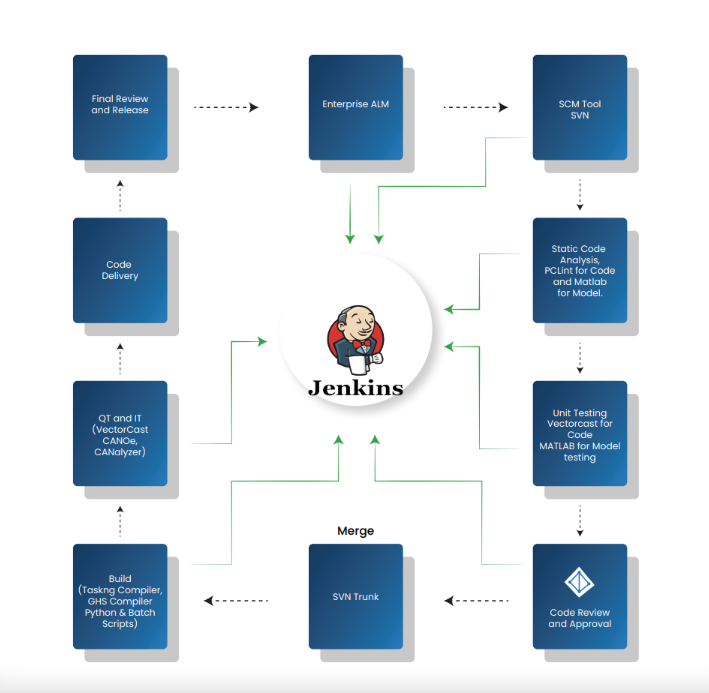
This was the stage where the transformation truly came to life. By leveraging the power of open-source tools, we implemented Jenkins as the central CI/CD orchestrator. This enabled seamless code integration and laid the foundation for continuous testing and automated artifact generation.

To address the limitations posed by niche tools, our team developed custom scripts to bridge the gaps. These solutions ensured that tasks which previously required manual intervention could now be automated, improving efficiency and streamlining the overall development process.

Based on customer requirements, automated nightly builds were configured to run without human oversight, and we integrated tools like VectorCast for unit testing and MATLAB for static code analysis. This comprehensive setup allowed us to establish a continuous integration (CI) and continuous testing (CT) framework that radically improved the speed and reliability of the development process. The client specified that they wanted control over the deployment process, so that remains a manual proces

Support

We ensured that the solution continued to deliver value long after the initial rollout. By providing ongoing maintenance and optimization, we helped the client adapt to evolving requirements and scale their operations efficiently. This continuous support was critical in transforming an environment once plagued by manual, error-prone processes into one that now thrives on automation and innovation. Support Through this 360° transformative approach, Micro Genesis not only reduced the client’s time-to-market by xx% but also established a scalable, efficient framework that could adapt to the rapidly changing demands of the automotive industry

1.

1.
Technology Stack
  • Tasking Compiler
  • GHS Compiler
  • PC-Lint (Static Analysis)
  • Design Analysis and Unit Testing
  • VectorCAST (Unit Testing)
  • CANoe (Simulation)
  • CANalyzer (Network Testing)
  • Python Scripts
  • Batch Scripts
Tools Stack
  • SVN (Version Control)
  • Enterprise ALM
  • Jenkins (CI/CD)
2.

2.

Transformative Results

The impact of this transformation was immediate and significant. By automating previous manual processes, our client achieved an 80% reduction in manual effort. Engineers who were once bogged down by repetitive tasks were now free to focus on higher-value development activities. The introduction of nightly builds
accelerated time-to-market, as artifacts and test results were readily available by the next workday. Quality assurance was also enhanced through continuous testing and analysis, reducing the chances of errors and ensuring that the software met rigorous automotive standards. The integration of Jen

A New Standard for - Embedded DevOps

Our Client’s success underscores the potential of DevOps in the embedded systems space—a sector traditionally resistant to automation due to its complexity and reliance on niche tools. Micro Genesis not only delivered a technical solution but also demonstrated that with the right expertise, even legacy and niche systems can be modernized to achieve efficiency and scalability.
This case highlights the power of blending industry-specific knowledge with cutting-edge DevOps practices to deliver tangible business outcomes. For our client, the journey was transformative, turning bottlenecks into breakthroughs and manual processes into seamless, automated workflows