Embedded DevOps for

Automotive Engineering

Enable continuous integration, validation, testing, and release workflows for embedded automotive systems.

Overview

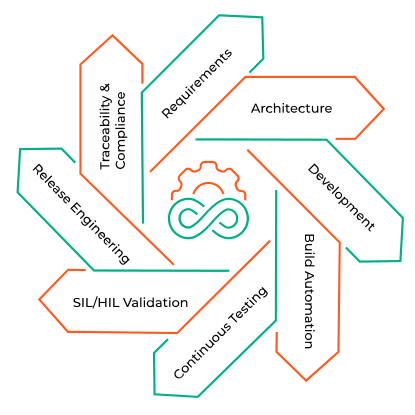
ECS helps automotive engineering teams modernize embedded software delivery through CI/CD/CT automation, integrated toolchains, continuous validation, and engineering-led DevOps practices.

Why Embedded DevOps Matters

Modern automotive systems require
  • Faster software releases 
  • Continuous validation 
  • OTA readiness 
  • Cross-domain integration 
  • Traceable engineering workflows

Traditional embedded engineering models built around manual integration and isolated validation cycles struggle to support these demands.

As software complexity increases, engineering teams require integrated, continuously validated development environments capable of supporting scalable software-defined vehicle programs.

Embedded DevOps for Automotive

The Challenges in

Embedded Automotive Engineering

Embedded DevOps for Automotive

What ECS Enabled

Embedded DevOps for Automotive

Embedded

Devops Architecture
Integrated Embedded DevOps Workflow
Embedded DevOps for Automotive

ECS Focus Areas

  • Pipeline automation 
  • Continuous testing 
  • Toolchain integration 
  • Release engineering 
  • Traceability enablement 
  • Engineering visibility

ECS Approach

1. Enabled
Evaluate:
  • Engineering workflows
  • CI/CD maturity
  • Validation processes
  • Integration bottlenecks
  • Toolchain gaps
2. Design
Define:
  • Embedded DevOps architecture
  • Pipeline strategy
  • Validation workflows
  • Engineering governance model
3. Implement
Deploy:
  • Build automation
  • Test automation
  • Integrated pipelines
  • Engineering dashboards
  • Traceability workflows
4. Enable
Provide:
  • Managed DevOps support
  • Engineering governance
  • Pipeline optimization
  • Continuous improvement enablement
Embedded DevOps for Automotive
Outcomes Enabled
ECS helps automotive organizations:
  • Accelerate embedded software releases
  • Improve engineering visibility
  • Detect defects earlier
  • Reduce integration delays
  • Improve engineering traceability
  • Reduce manual validation effort
  • Enable scalable continuous engineering workflows
Embedded DevOps for Automotive
Why ECS for
Embedded DevOps
Automotive-Focused Engineering Expertise
Purpose-built for
  • Embedded automotive systems
  • Safety-critical environments
  • Compliance-driven engineering
Integrated Engineering Approach
ECS combines
  • DevOps
  • ASPICE
  • MBSE
  • Toolchain integration
into one connected engineering workflow model.
Consulting + Implementation Capability
From maturity assessments and architecture design to implementation and operational support.
Embedded DevOps for Automotive
Workshops &
Assessments
Embedded DevOps Maturity Assessment
Assess
  • CI/CD maturity
  • Testing automation
  • Release workflows
  • Toolchain integration
  • Traceability readiness
Deliverables
  • Gap analysis
  • Engineering maturity insights
  • Recommendations
  • Transformation roadmap

Modernize Embedded Engineering Workflows


Build scalable, traceable, and continuously validated automotive engineering systems with ECS.

Schedule an Automotive Embedded DevOps Discovery Workshop

What to Expect
  • An initial engineering discussion.
  • A review of your current challenges.
  • Identification of improvement opportunities.
  • Recommendations for potential next steps.

ECS Discovery Workshops are collaborative engineering discussions designed to help organizations identify challenges, explore opportunities, and define practical next steps for transformation. 

Salesforce Implementation Partner

From strategy to go-live — and beyond

As your dedicated Salesforce implementation partner, MicroGenesis delivers full-lifecycle implementations using a structured, low-risk methodology designed to get you to value quickly and keep you there through every phase of growth.

1. Discovery & Advisory

Workshops with your Salesforce consulting team to map processes, define goals, and shape a clear CRM roadmap.

2. Solution Design

Architecture, data model, and configuration blueprint crafted by certified Salesforce consultants aligned to your requirements.

3. Build & Configure

Declarative setup plus custom development across Sales, Service & Experience Cloud — built to Salesforce best practices.

4. Data & Integration

Secure data migration and Salesforce integration with your existing enterprise systems, delivered by our Salesforce integration partners team.

5. Testing & QA

Functional, integration, and user acceptance testing for a reliable, low-risk rollout of your Salesforce environment.

6. Deployment & Go-Live

Controlled release with cutover planning and hypercare support during the critical first days post-launch.

7. Training & Adoption

Enablement and change management from your Salesforce consulting firm to drive confident, lasting user adoption.

8. Managed Support

Ongoing 24×7 L1–L3 Salesforce managed support and continuous improvement for your live org.

Salesforce Managed Support

24X7 L1, L2 & L3 Salesforce support

Keep your Salesforce environment healthy, secure, and continuously improving with always-on managed support across all three tiers – delivered by our Salesforce partner team under clear SLAs.

24 X 7 X 365 Salesforce support coverage with defined SLAs and escalation paths

L1 : First Line

Day-to-day user support & monitoring
  • Ticket logging, triage & tracking
  • User access, login & password assistance
  • Basic how-to and navigation support
  • System monitoring and known issue resolution
  • Escalation to L2/L3 teams when required

L2: Functional

Configuration & Advanced Troubleshooting
  • Configuration changes and administrative tasks
  • Flow, validation rule, and automation troubleshooting
  • Reports, dashboards, and data issue resolution
  • Salesforce integration and synchronization diagnostics
  • Root cause analysis and issue resolution

L3: Engineering

Custom Development & Deep Expertise
  • Apex, Lightning Web Components (LWC), and custom code troubleshooting
  • Complex Salesforce integration engineering and support
  • Performance optimization and scalability tuning
  • Enhancements and new feature development
  • Vendor escalation management and coordination