DevOps transformation is no longer simply an engineering initiative. For large organizations, it has become a business decision involving software delivery speed, operational efficiency, security, cloud spending, engineering productivity, and the ability to respond to changing customer demands.
That creates a difficult question for CIOs, CTOs, VPs of Engineering, Heads of DevOps, and other technology decision-makers:
How much should an enterprise actually budget for a DevOps transformation in 2026?
There is no universal price tag.
The cost depends on the organization’s application landscape, engineering maturity, cloud strategy, existing toolchain, security requirements, number of development teams, legacy systems, automation goals, and the level of transformation required.
More importantly, the cost of DevOps transformation is not the same as the cost of DevOps tools.
An enterprise may purchase a CI/CD platform relatively quickly, but building a reliable delivery ecosystem around it can involve engineering, infrastructure, automation, security, testing, observability, training, governance, and ongoing optimization.
That is why a serious business case should focus on Total Cost of Ownership (TCO), transformation outcomes, and long-term business value, rather than asking only for the lowest implementation quote.
This guide explains the major DevOps transformation cost drivers, how enterprises can structure a 2026 budget, where hidden costs appear, and how decision-makers can evaluate the return on their investment.
DevOps Transformation Cost at a Glance
An enterprise DevOps transformation typically involves several investment categories:
| Cost Area | What It Includes | Cost Type |
| Assessment & Strategy | Maturity assessment, discovery, roadmap, architecture | One-time |
| DevOps Engineering | Architects, engineers, automation specialists | Project / recurring |
| CI/CD | Pipeline platforms, runners, build infrastructure | Licensing + usage |
| Cloud Infrastructure | Compute, storage, networking, Kubernetes | Consumption-based |
| Infrastructure as Code | Terraform, Ansible, provisioning automation | Tools + engineering |
| DevSecOps | Security scanning, compliance, policy enforcement | Tools + engineering |
| Testing | Test automation and environments | Engineering + infrastructure |
| Observability | Logs, metrics, traces, monitoring | Usage-based |
| Platform Engineering | Developer platforms and reusable capabilities | Engineering |
| Migration | Legacy pipeline and application modernization | Project-based |
| Training & Change | Enablement, documentation, process transformation | One-time + recurring |
| Managed Services | Monitoring, support, optimization | Recurring |
The right budget depends on the scale and complexity of each category.
A small DevOps pilot should not be budgeted like a global enterprise transformation. Likewise, an organization operating regulated applications across multiple clouds cannot realistically use the same assumptions as a small software team.
The first step is therefore to understand what kind of transformation you are actually planning.
What Is a DevOps Transformation?
DevOps transformation is a structured change to the way an organization builds, tests, secures, deploys, operates, and continuously improves software.
It can involve:
- Software development
- Source control
- Continuous integration
- Continuous delivery
- Automated testing
- Infrastructure as Code
- Cloud infrastructure
- Containerization
- Security automation
- Observability
- Release management
- Incident management
- Platform engineering
- Engineering metrics
- Organizational collaboration
This is why implementing a new CI/CD tool does not automatically create a DevOps transformation.
The tool is only one component.
The broader transformation involves people, processes, technology, architecture, automation, governance, and measurement.
For enterprises beginning this journey, a structured approach to how to implement enterprise DevOps can help connect individual engineering improvements with a larger transformation strategy.
DORA’s research similarly emphasizes that software delivery performance is influenced by the broader organizational system, rather than by technology adoption alone.
For a decision-maker, this changes the budgeting question from:
“How much will our DevOps tools cost?”
to:
“What investment is required to change our software delivery model and achieve measurable business outcomes?”
Planning a DevOps transformation but unsure where to start?
Before investing in new tools or expanding your engineering team, it is important to understand your current DevOps maturity, identify bottlenecks, and prioritize the initiatives that can deliver the greatest business value.
MicroGenesis can help you assess your current environment and build a practical DevOps transformation roadmap aligned with your business and technology goals.
Explore MicroGenesis DevOps Services
The 10 Major Components of DevOps Transformation Cost
1. DevOps Assessment and Transformation Strategy
Before implementing tools or changing processes, an enterprise needs to understand its current state.
A proper assessment can examine:
- Existing SDLC
- Development practices
- Source control
- CI/CD pipelines
- Build processes
- Testing
- Release management
- Infrastructure provisioning
- Cloud architecture
- Security practices
- Monitoring
- Incident management
- Team responsibilities
- Toolchain fragmentation
- Compliance requirements
- Engineering performance
The objective is to establish a clear baseline.
From there, the organization can define a target state and transformation roadmap.
A typical assessment may include:
- DevOps maturity assessment
- Current-state workshops
- Value-stream analysis
- Toolchain assessment
- Process assessment
- Architecture review
- Target-state architecture
- Transformation roadmap
- Pilot selection
- Business case development
This phase may represent a relatively small percentage of the total transformation investment, but it can have a major influence on the final TCO.
Why?
Because a poor architectural or strategic decision at the beginning can create expensive rework later.
Not sure what your DevOps transformation should actually cost?
Start with the current state rather than a tool list. A structured assessment can help identify maturity gaps, delivery bottlenecks, automation opportunities, cloud dependencies, and the capabilities you actually need.
MicroGenesis works with enterprises to assess their DevOps environment and translate those findings into a practical transformation roadmap.
Talk to a DevOps Expert at MicroGenesis
Leadership question
Do we know exactly what business problem the transformation is expected to solve?
If the answer is unclear, the organization is not ready to finalize the technology budget.
2. DevOps Engineering and Specialist Talent
People are usually one of the largest components of a DevOps transformation.
Depending on the scope, an enterprise may need:
- DevOps engineers
- Cloud architects
- Platform engineers
- DevSecOps specialists
- Site Reliability Engineers
- Kubernetes specialists
- Automation engineers
- CI/CD specialists
- Infrastructure engineers
- Security engineers
- QA automation engineers
The required team depends on the transformation objectives.
For example, an organization with a strong internal cloud team may only require external DevOps architecture and pipeline expertise.
Another organization may need an end-to-end team to design and implement the entire platform.
Internal hiring costs go beyond salary
When calculating the cost of building the capability internally, consider:
- Recruitment
- Compensation
- Benefits
- Onboarding
- Training
- Retention
- Management
- Knowledge transfer
- Tool expertise
- Utilization
This is one reason enterprises often compare internal hiring with consulting, staff augmentation, dedicated engineering teams, or managed DevOps services.
The right choice depends on the duration and nature of the transformation.
3. CI/CD Platform Costs
CI/CD is one of the most visible investments in DevOps.
However, the platform license is only part of the cost.
Your CI/CD environment may require:
- Pipeline platform
- Build runners
- Self-hosted agents
- Build servers
- Artifact storage
- Container registries
- Pipeline execution
- Test infrastructure
- Secrets management
- Pipeline monitoring
- Maintenance
Organizations evaluating their toolchain should compare capabilities rather than choosing a platform simply because it is popular. A practical comparison of CI/CD tools for your DevOps team can help teams assess where different platforms fit within their delivery model.
Cloud-native CI/CD services may also use consumption-based pricing.
For example, Google Cloud Build charges based on build-minutes, with additional costs potentially arising from related infrastructure and storage services.
AWS also provides a Pricing Calculator that organizations can use to estimate cloud workload costs before deployment.
The important budgeting principle
Do not budget only for the CI/CD license.
Budget for the complete delivery pipeline.
That includes the infrastructure required to build, test, store, secure, and deploy software.
4. Cloud and Infrastructure Costs
Cloud infrastructure can become one of the largest recurring costs in a DevOps transformation.
Depending on the architecture, you may need:
- Compute
- Storage
- Networking
- Kubernetes
- Containers
- Databases
- Load balancing
- Backup
- Disaster recovery
- Development environments
- Test environments
- Staging environments
- Production environments
The actual cost depends heavily on workload size and architecture.
Consider an enterprise application that requires:
Development → Testing → Staging → Production → Disaster Recovery
If every environment is permanently provisioned at near-production capacity, infrastructure costs can grow rapidly.
DevOps automation can help address this by making infrastructure repeatable and allowing environments to be provisioned according to demand.
This is where how cloud computing enhances DevOps practices becomes relevant to the broader transformation discussion.
The goal is not simply to move infrastructure into the cloud.
The goal is to build an environment that is automated, scalable, secure, observable, and economically sustainable.
5. Infrastructure as Code and Automation
Infrastructure as Code turns infrastructure configuration into something that can be versioned, reviewed, tested, and reused.
Technologies such as Terraform, Ansible, and cloud-native infrastructure tools can automate:
- Infrastructure provisioning
- Environment creation
- Configuration
- Network setup
- Kubernetes deployment
- Policy enforcement
- Resource lifecycle management
The economic value comes from reducing repetitive manual work and improving consistency.
Without automation, engineers may repeatedly perform tasks such as:
- Creating environments
- Configuring servers
- Updating infrastructure
- Deploying applications
- Changing network settings
- Applying configurations
These tasks consume engineering capacity and introduce opportunities for error.
However, automation itself requires investment.
The organization needs people to:
- Design automation
- Write automation code
- Test it
- Secure it
- Maintain it
- Document it
Therefore:
Automation cost = tools + engineering + maintenance
The objective should be to automate work that is frequent, repetitive, error-prone, or difficult to scale.
Organizations can use DevOps automation best practices to identify where automation is likely to produce the greatest operational value.
6. DevSecOpsand Security Costs
Security should be designed into the software delivery lifecycle rather than introduced immediately before production.
A DevSecOps transformation may involve:
- Static application security testing
- Dynamic application security testing
- Software composition analysis
- Container scanning
- Infrastructure scanning
- Secrets detection
- Image scanning
- Security policies
- Identity controls
- Compliance checks
- Security monitoring
Each capability can create additional costs involving:
- Licensing
- Infrastructure
- Engineering
- Security specialists
- Pipeline execution
- Policy management
The objective should not be to purchase every security tool available.
Instead, the organization should establish a risk-based security model.
That means considering:
- Application criticality
- Threat exposure
- Regulatory requirements
- Data sensitivity
- Cloud architecture
- Existing security controls
- Compliance obligations
For organizations building this capability, understanding what DevSecOps is and how it works can help connect security practices with the broader DevOps transformation.
For regulated industries such as automotive, healthcare, aerospace, defence, and financial services, security and compliance can become major components of the transformation budget.
7. Testing and Quality Automation
Increasing deployment speed without improving testing can increase risk rather than business value.
That is why automated testing is an important part of DevOps transformation.
A mature pipeline may automate:
- Unit testing
- Integration testing
- API testing
- Regression testing
- Security testing
- Performance testing
- Infrastructure testing
- Container testing
However, automated testing is not free.
The organization may need:
- QA automation engineers
- Test environments
- Test data
- Test infrastructure
- Test execution capacity
- Automation maintenance
The objective is to shift repetitive verification from manual execution toward reusable engineering assets.
This creates a different cost profile.
Instead of repeatedly paying for manual execution, the organization invests upfront in automation and then maintains the automated capability.
That can become increasingly valuable as release frequency grows.
8. Observability and Monitoring Costs
Deployment is not the end of DevOps.
Once applications reach production, teams need visibility into their behavior.
That can require:
- Metrics
- Logs
- Distributed traces
- Application monitoring
- Infrastructure monitoring
- Alerting
- Dashboards
- Incident management
- Performance monitoring
Observability can become a significant recurring cost because many platforms charge according to factors such as:
- Data ingestion
- Data retention
- Hosts
- Metrics
- Events
- Query volume
There is also an engineering cost associated with designing useful dashboards, alerts, telemetry, and operational processes.
This creates an important principle:
More telemetry does not automatically mean better observability.
An enterprise should collect the information required to operate and troubleshoot its systems effectively while avoiding unnecessary data volume and alert noise.
9. Platform Engineering and Internal Developer Platforms
Large enterprises increasingly need more than individual CI/CD pipelines.
When many development teams independently create pipelines, infrastructure configurations, security controls, and deployment processes, the organization can end up with inconsistent engineering practices.
Platform engineering addresses this problem by creating reusable internal capabilities.
An internal platform might provide:
- Standard pipeline templates
- Infrastructure templates
- Deployment patterns
- Security controls
- Observability
- Self-service environments
- Developer portals
- Reusable services
- Governance
The initial investment can be significant.
You may need:
- Platform engineers
- Architects
- Developer experience specialists
- Automation engineers
- Documentation
- Platform support
But for organizations with many engineering teams, reusable platform capabilities can reduce duplicated effort.
This is where DevOps transformation begins to evolve into a broader engineering platform strategy.
10. Training, Change Management, and Governance
One of the easiest DevOps costs to underestimate is organizational change.
DevOps changes how teams work.
Developers may become more involved in deployment and operational feedback.
Operations teams may become more automation-focused.
Security teams may move earlier into development workflows.
Engineering teams may begin measuring delivery performance differently.
Managers may need new visibility into software delivery.
Without appropriate enablement, teams may continue using old processes even after new tools are implemented.
Budget for:
- DevOps training
- Tool training
- Platform training
- Documentation
- Governance
- Coaching
- Leadership enablement
- Process redesign
- Communities of practice
- Change management
A strong DevOps culture is not created by technology alone.
It requires leadership, communication, shared ownership, and continuous improvement.
What Should an Enterprise Budget for DevOps Transformation in 2026?
There is no universal enterprise DevOps price.
However, organizations can use broad planning bands to begin their financial modeling.
| Transformation Level | Typical Situation | Illustrative First-Year Planning Range |
| Foundation | Pilot applications, basic CI/CD and automation | $50K–$150K |
| Business Unit | Multiple applications, CI/CD, IaC, security and observability | $150K–$400K |
| Enterprise | Multiple teams, cloud, DevSecOps, platform engineering | $400K–$1M+ |
| Large-Scale / Regulated | Multi-cloud, legacy modernization, compliance, 24×7 operations | $1M–$3M+ |
Important: These are planning ranges for budgeting discussions, not fixed market prices or vendor quotations.
Actual enterprise costs can vary significantly based on:
- Geography
- Engineering headcount
- Application count
- Cloud consumption
- Tool licensing
- Legacy complexity
- Compliance requirements
- Number of environments
- Integration requirements
- Transformation duration
- Internal vs external delivery
For this reason, the strongest business case is built from the bottom up.
A Better Way to Calculate DevOps Transformation TCO
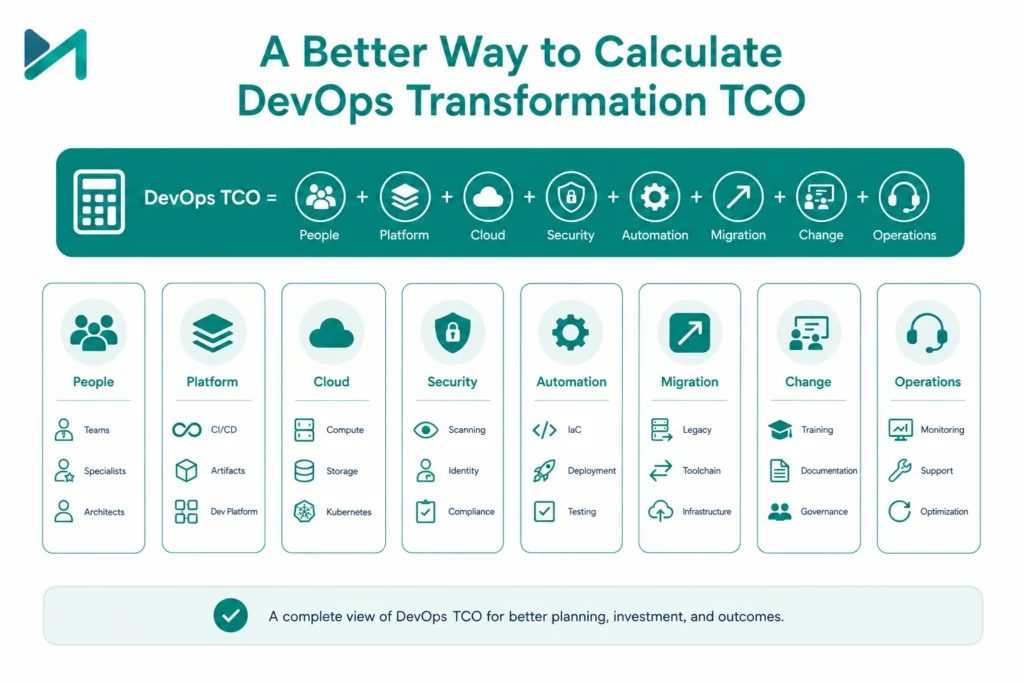
A practical enterprise model is:
DevOps TCO = People + Platform + Cloud + Security + Automation + Migration + Change + Operations
People
Internal employees, consultants, specialists, architects, and platform teams.
Platform
CI/CD, source control, artifact management, registries, developer platforms, and related tools.
Cloud
Compute, storage, networking, Kubernetes, databases, environments, backup, and disaster recovery.
Security
Security testing, compliance, identity, scanning, policy enforcement, and governance.
Automation
Infrastructure as Code, deployment automation, testing, provisioning, and operational automation.
Migration
Legacy application modernization, pipeline migration, toolchain migration, and infrastructure transformation.
Change
Training, documentation, coaching, governance, and organizational transformation.
Operations
Monitoring, support, maintenance, incident response, and continuous optimization.
This provides a much more realistic picture of enterprise DevOps economics than simply calculating software licenses.
💡
The Hidden Costs That Can Blow Up a DevOps Budget
The initial business case often misses costs that appear later.
These hidden costs can significantly affect TCO.
Tool Sprawl
Every additional tool can introduce:
- Licensing
- Integration
- Training
- Administration
- Support
- Data movement
A toolchain with 20 products is not automatically more mature than one with 10.
The question is whether every component has a clear purpose.
Legacy Application Complexity
A modern DevOps pipeline cannot automatically modernize a legacy application.
Legacy systems may require:
- Refactoring
- Test modernization
- Environment changes
- Dependency updates
- Deployment redesign
- Architecture changes
Cloud Waste
Unused environments, excessive storage, overprovisioned infrastructure, and inefficient architectures can increase recurring cloud expenditure.
Pipeline Maintenance
A CI/CD pipeline is software.
It requires:
- Updates
- Security patches
- Testing
- Monitoring
- Maintenance
- Documentation
Specialist Skills
DevOps, platform engineering, cloud, Kubernetes, security, and SRE expertise can be difficult to recruit and retain.
Compliance
Regulated environments may require additional:
- Controls
- Documentation
- Audit evidence
- Segregation of duties
- Approval workflows
- Security testing
Organizational Resistance
Perhaps the most expensive hidden cost is implementing a new DevOps platform while teams continue working in old ways.
That creates the worst of both worlds:
New technology + old processes = limited transformation value.
How to Reduce DevOps Transformation Cost Without Cutting Quality
Cost optimization should not mean choosing the cheapest tools or reducing engineering standards.
It should mean eliminating waste.
1. Start With a Pilot
Do not attempt to transform every application at once.
Select a representative application.
Establish a baseline.
Implement the new model.
Measure the result.
Then scale what works.
2. Consolidatethe Toolchain
Review whether multiple tools perform overlapping functions.
Tool consolidation can reduce licensing, integration, administration, and training costs.
3. Automate High-Frequency Work
Prioritize tasks that engineers perform repeatedly.
Examples include:
- Environment provisioning
- Builds
- Testing
- Deployments
- Security checks
- Configuration
4. Standardize Pipelines
Instead of allowing every team to create its own pipeline architecture, develop reusable patterns.
5. Use Infrastructure as Code
Make infrastructure repeatable, auditable, and version controlled.
6. Treat Cloud as an Engineering Responsibility
Cloud cost should not be treated only as a finance problem.
Architecture directly influences consumption.
7. Measure Delivery Performance
The DevOps implementation roadmap, benefits and key metrics should connect transformation activity with measurable engineering outcomes.
DORA provides a widely used framework for measuring software delivery performance, including deployment frequency, lead time, change failure rate, and recovery-related measures.
DevOps Transformation Is Not About Spending Less
Want to reduce DevOps waste without compromising engineering quality?
The biggest savings often come from eliminating unnecessary tool overlap, manual processes, inconsistent pipelines, cloud waste, and repeated engineering effort.
MicroGenesis helps organizations identify high-value automation and optimization opportunities before scaling their DevOps transformation.
Explore DevOps Consulting Services
This is an important distinction for executive decision-makers.
A DevOps transformation can increase spending in certain areas initially.
You may spend more on:
- Automation
- Engineering
- Testing
- Security
- Observability
- Platform engineering
while reducing:
- Manual deployment effort
- Rework
- Release delays
- Environment inconsistencies
- Incident recovery effort
- Tool duplication
- Operational waste
Therefore, the objective should not simply be:
“Reduce the DevOps budget.”
It should be:
“Increase the value produced by every dollar invested in software delivery.”
That is a much stronger business objective.
Organizations should also understand the hidden costs of poor DevOps practices before calculating the expected return from transformation.
How to Build a DevOps Business Case for the CIO or CFO
A DevOps business case should not look like a technology shopping list.
Avoid presenting leadership with:
Jenkins + Kubernetes + Terraform + Observability + Security Tools
Instead, start with the business problem.
Current State
For example:
- Releases take too long
- Deployments depend heavily on manual effort
- Environments are inconsistent
- Testing is slow
- Production issues take too long to diagnose
- Engineers spend time on repetitive operational work
- Security checks happen too late
Proposed Transformation
- Standardized CI/CD
- Infrastructure as Code
- Automated testing
- DevSecOps
- Observability
- Platform engineering
- Standardized engineering workflows
Expected Business Outcomes
- Faster delivery
- Improved reliability
- Reduced manual effort
- Better release consistency
- Earlier security detection
- Improved engineering visibility
- More predictable operations
Investment
Then show:
One-time transformation investment
Recurring operating cost
Expected business value
This gives leadership a business case rather than a list of technology purchases.
How to Measure DevOps ROI
DevOps ROI should not be limited to cloud savings.
Consider four dimensions.
Delivery ROI
Are teams delivering valuable changes faster?
Reliability ROI
Are production failures and recovery efforts improving?
Engineering Productivity ROI
Are engineers spending less time on repetitive operational work?
Business ROI
Can the organization bring customer-facing capabilities to market faster?
DORA’s metrics provide a useful framework for connecting software delivery practices with measurable delivery performance.
The organization should establish a baseline before transformation.
Otherwise, it becomes difficult to demonstrate whether the investment actually changed performance.
Should You Build DevOps In-House or Work With a DevOps Partner?
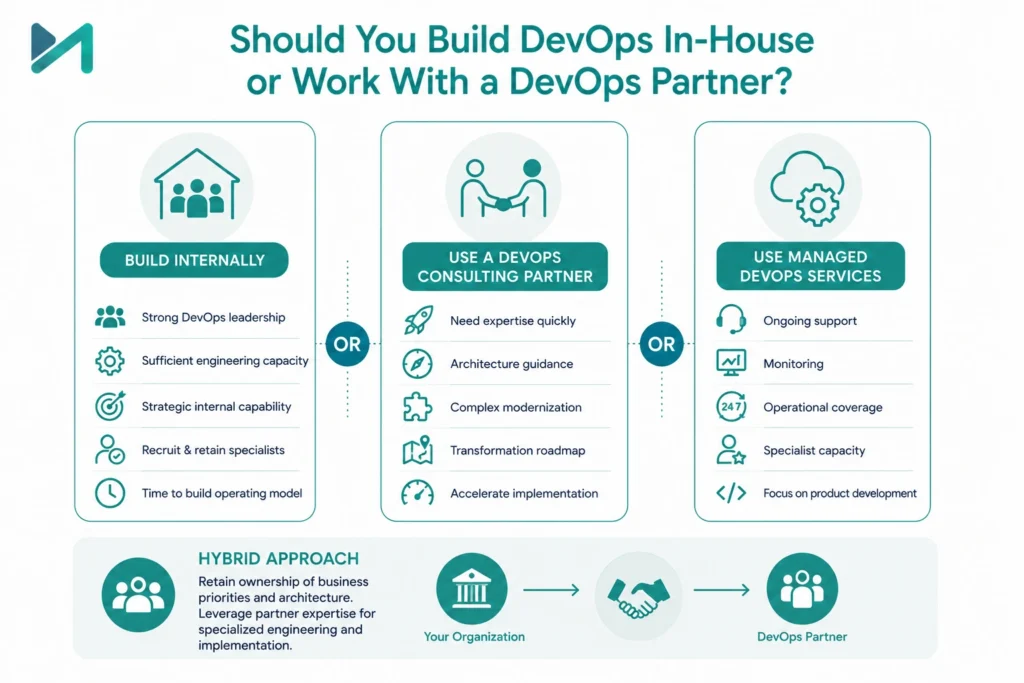
This is another major financial decision.
Build Internally
An internal model can make sense when:
- You already have strong DevOps leadership
- You have sufficient engineering capacity
- DevOps is a strategic internal capability
- You can recruit and retain specialists
- You have time to build the operating model
The potential challenge is the time and investment required to develop the required expertise.
Use a DevOps Consulting Partner
A consulting partner can be useful when:
- You need transformation expertise quickly
- Your internal team needs architecture guidance
- You have complex modernization requirements
- You need a transformation roadmap
- You want to accelerate implementation
Use Managed DevOps Services
Managed services may make sense when:
- You require ongoing support
- You need monitoring
- You need operational coverage
- Your internal team lacks specialist capacity
- You want internal engineers focused on product development
A hybrid approach can also work well.
Your internal organization can retain ownership of business priorities and architecture while an external partner provides specialist engineering and implementation capabilities.
How to Know Whether Your DevOps Investment Is Working
After implementation, leadership should not ask only:
“Did we deploy the new DevOps platform?”
Ask:
- Are releases faster?
- Are deployments more predictable?
- Are failures decreasing?
- Is recovery improving?
- Are engineers spending less time on repetitive work?
- Is security being addressed earlier?
- Are environments more consistent?
- Is cloud consumption understood?
- Are teams actually using the new processes?
- Are customers receiving improvements faster?
If the answer to these questions is unclear, the transformation needs better measurement.
The technology may be operating correctly while the business outcome remains uncertain.
Where MicroGenesis Fits Into the DevOps Transformation Journey
A successful DevOps transformation should not begin with a tool recommendation.
It should begin with the business outcome.
MicroGenesis helps organizations evaluate their existing engineering environment, identify transformation opportunities, define the target state, and implement DevOps capabilities aligned with business and technical priorities.
Our DevOps capabilities can support:
- DevOps consulting
- DevOps maturity assessment
- DevOps strategy and roadmap
- CI/CD implementation
- Infrastructure as Code
- Cloud and DevOps integration
- DevSecOps
- Containerization
- Kubernetes
- Automation
- Monitoring and observability
- DevOps implementation
- Toolchain optimization
- Ongoing DevOps support
Explore MicroGenesis DevOps Services
The right approach depends on the problem.
If your organization has a fragmented toolchain, consolidation may create more value than adding another platform.
If teams spend too much time provisioning environments, Infrastructure as Code may be the priority.
If releases are delayed by manual testing, quality automation may deliver the greatest benefit.
If cloud costs are increasing without corresponding business value, architecture and cloud optimization may need attention.
And if the organization is beginning an enterprise-wide transformation, establishing a roadmap before implementation can prevent expensive rework.
A Practical 2026 DevOps Transformation Budget Checklist
Before approving a DevOps transformation budget, make sure the business case covers the following.
Strategy
- Current-state assessment
- DevOps maturity assessment
- Target architecture
- Transformation roadmap
- Pilot
People
- DevOps engineers
- Architects
- Security specialists
- Platform engineers
- QA automation
- Program leadership
Technology
- Source control
- CI/CD
- Artifact management
- Container registry
- Infrastructure as Code
- Secrets management
- Security tooling
- Observability
- Testing tools
Infrastructure
- Development
- Testing
- Staging
- Production
- Disaster recovery
- Cloud consumption
- Networking
- Storage
Transformation
- Application modernization
- Pipeline migration
- Toolchain consolidation
- Process redesign
- Training
- Documentation
- Governance
Operations
- Monitoring
- Incident response
- Platform maintenance
- Security updates
- Continuous optimization
- Managed support
If several of these areas are missing from the initial business case, there is a good chance the transformation budget is understated.
The Executive Takeaway: Budget for Outcomes, Not Tools
The biggest mistake an enterprise can make when budgeting for DevOps in 2026 is treating transformation as a tooling exercise.
Your budget should not start with:
“Which DevOps tools should we buy?”
It should start with:
“What does our software delivery model cost today, where is the waste, and what should it look like in the future?”
From there, the investment becomes much easier to understand.
You can identify the cost of:
- People
- Cloud
- Tooling
- Automation
- Security
- Testing
- Migration
- Platform engineering
- Training
- Operations
You can then connect those investments to outcomes that matter to senior leadership:
faster delivery, greater reliability, stronger security, improved engineering productivity, lower operational waste, and greater business agility.
DORA’s research continues to emphasize that software delivery performance depends on the broader engineering and organizational system, rather than simply adopting individual technologies.
That is why the smartest DevOps investment is rarely the one with the smallest initial price tag.
It is the one that creates a measurable and sustainable improvement in the economics of software delivery.
If your organization is planning a DevOps transformation, MicroGenesis can help assess the current environment, identify high-value opportunities, develop a practical roadmap, and support implementation across CI/CD, cloud, automation, DevSecOps, platform engineering, and ongoing optimization.
Talk to MicroGenesis About Your DevOps Transformation
Invest deliberately. Automate intelligently. Measure continuously. Build a DevOps operating model that keeps creating value.