Most enterprises already know the answer.
The harder question is:
Should we build and operate our DevOps capability ourselves, or should we work with a managed DevOps services partner?
It sounds like a straightforward buy-vs-build decision.
It is not.
The decision affects engineering productivity, cloud economics, security, reliability, hiring, operational coverage, governance, and the organization’s ability to scale software delivery.
And the environment is becoming more complicated.
So the question is no longer simply:
“Can we hire a few DevOps engineers?”
It is:
“Can we build and continuously operate the complete DevOps capability our business now requires?”
That includes cloud, CI/CD, infrastructure automation, security, observability, platform engineering, Kubernetes, governance, and increasingly AI-enabled development.
This guide gives technology decision-makers a practical framework for deciding what should be built internally, bought externally, or managed through a hybrid model.
In-House DevOps vs Managed DevOps: The Executive View
At a high level:
| Decision Factor | In-House DevOps Team | Managed DevOps Services |
| Internal control | Very high | High with defined governance |
| Hiring requirement | High | Lower |
| Access to specialists | Depends on hiring | Available through partner |
| Institutional knowledge | Strong | Builds through engagement |
| Scalability | Depends on recruitment | Generally easier to scale |
| 24/7 operational coverage | Requires internal investment | Can be included in service |
| Initial capability build | Slower | Usually faster |
| Long-term internal capability | Strong | Shared |
| Management overhead | Higher | Lower |
| Flexibility | High | High with the right model |
| Best fit | Strategic internal capability | Scale and specialist expertise |
| Risk ownership | Primarily internal | Shared according to agreement |
There is no universally correct answer.
The right model depends on:
- Strategic importance
- Existing DevOps maturity
- Internal skills
- Workload variability
- Cloud complexity
- Security requirements
- Operational coverage
- Budget
- Transformation timeline
- Long-term technology strategy
The First Question: What Are You Actually Trying to Solve?
Before comparing “build” and “buy”, define the problem.
Is it a talent problem?
“We cannot hire enough DevOps engineers.”
Is it an operational problem?
“Our engineers spend too much time maintaining pipelines and infrastructure.”
Is it a cloud problem?
“Our cloud environment is becoming difficult and expensive to manage.”
Is it a reliability problem?
“We need stronger production monitoring and faster incident response.”
Is it a transformation problem?
“We need to modernize DevOps across hundreds of applications.”
Or is it a strategic capability problem?
“DevOps and platform engineering are central to our competitive advantage.”
Each answer points toward a different operating model.
Not sure which DevOps operating model fits your organization?
Before deciding whether to build internally or work with a partner, it helps to understand where your current environment is creating the most friction. A DevOps assessment can uncover capability gaps across CI/CD, cloud, automation, security, infrastructure, and engineering workflows.
MicroGenesis can help you assess your current DevOps landscape and identify where internal investment, automation, or external expertise can create the greatest impact.
Explore MicroGenesis DevOps Services
What Does Building an In-House DevOps Team Actually Mean?
Building internally means developing the DevOps capability primarily with your own employees.
That could involve hiring:
- DevOps engineers
- Cloud architects
- Platform engineers
- Site Reliability Engineers
- Security engineers
- CI/CD specialists
- Kubernetes engineers
- Infrastructure engineers
- Automation specialists
But hiring people is only the beginning.
A mature internal DevOps capability also requires:
- Technical leadership
- Architecture
- Governance
- Documentation
- Security
- Platform ownership
- Tool administration
- On-call processes
- Training
- Career development
- Continuous improvement
This distinction is important.
A CIO who budgets for five engineers but does not budget for the operating model around those engineers may underestimate the true cost of building internally.
What Does Managed DevOps Services Mean?
Managed DevOps services involve an external partner taking responsibility for agreed DevOps capabilities.
Depending on the engagement, this can include:
- CI/CD
- Cloud operations
- Infrastructure as Code
- DevSecOps
- Kubernetes
- Automation
- Observability
- Monitoring
- Release management
- Platform engineering
- Infrastructure management
- Incident response
- Continuous optimization
The organization does not necessarily surrender control.
Instead, responsibilities are divided.
Your organization may retain ownership of:
- Product strategy
- Business priorities
- Application architecture
- Security governance
- Data
- Compliance
- Technology roadmap
The managed partner may own:
- Pipeline operations
- Infrastructure automation
- Cloud operations
- Monitoring
- Platform support
- DevOps engineering
- Agreed service-level responsibilities
This distinction is critical.
Managed does not have to mean disconnected.
A well-designed managed model should extend the organization’s capability while preserving strategic ownership.
This creates an interesting contradiction.
Enterprises are automating more, adopting more sophisticated platforms, and introducing AI, yet many are simultaneously trying to simplify their toolchains and control operational complexity.
That is precisely why the buy-vs-build decision deserves executive attention.
When an In-House DevOps Team Makes More Sense
1. DevOps Is a Strategic Capability
If your ability to build, deploy, and operate software directly differentiates your business, internal ownership may be worth the investment.
For example, technology companies, digital-native businesses, and organizations building proprietary platforms may want DevOps and platform engineering expertise deeply embedded within the organization.
Your engineering platform becomes intellectual capital.
2. You Have Strong Internal Leadership
An internal model works best when you already have experienced leadership capable of establishing:
- Architecture standards
- Platform strategy
- Security controls
- Engineering practices
- Governance
- Metrics
- Operating models
Without that leadership, adding more engineers can produce more activity without necessarily producing better outcomes.
DORA’s 2025 research reinforces this broader point: technology, including AI, tends to amplify an organization’s existing strengths and weaknesses rather than automatically fixing structural problems.
3. You Need Deep Institutional Knowledge
Some environments are highly specialized.
Examples include:
- Automotive
- Aerospace
- Defence
- Healthcare
- Financial services
- Semiconductor
- Telecommunications
When understanding the internal systems and business domain is critical, building internal knowledge can provide significant long-term value.
4. DevOps Workload Is Consistent
If you have a predictable and continuous volume of DevOps work, a permanent internal team may be economically sensible.
For example:
- 100+ applications
- Multiple development teams
- Continuous release cycles
- Multiple cloud environments
- Dedicated platform requirements
A stable workload can justify permanent capability.
The Hidden Cost of Building In-House
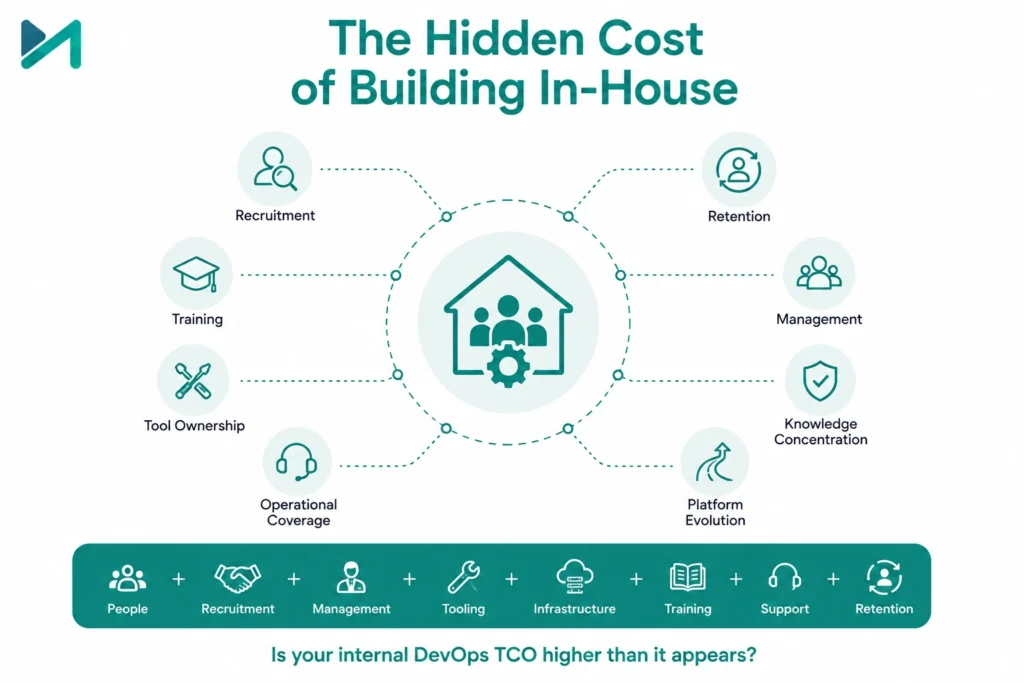
This is where many buy-vs-build calculations become misleading.
The cost is not simply:
Number of engineers × salary
Consider:
Recruitment
How much will it cost to attract experienced DevOps specialists?
Retention
What happens if two senior engineers leave?
Training
Who keeps the team current with new cloud, security, Kubernetes, automation, and AI technologies?
Management
Who provides technical and people leadership?
Tool Ownership
Who maintains your:
- CI/CD platform
- Artifact repositories
- Monitoring
- Security tools
- Infrastructure automation
- Developer platform?
Operational Coverage
Who responds to production issues outside business hours?
Knowledge Concentration
What happens if only one engineer understands a critical pipeline?
Platform Evolution
Who owns the roadmap for your internal developer platform?
The real internal TCO can therefore look more like:
People + recruitment + management + tooling + infrastructure + training + support + operational coverage + retention
That is the number CIOs should compare against a managed services proposal.
Is your internal DevOps TCO higher than it appears?
Recruitment, specialist expertise, tool ownership, on-call coverage, training, and platform maintenance can significantly change the economics of an in-house model.
MicroGenesis can help you evaluate your current DevOps operating model and identify where managed expertise or a hybrid approach could reduce operational overhead while keeping strategic control in-house.
💡
When Managed DevOps Services Make More Sense
1. You Need Specialist Expertise Quickly
Suppose your internal team is strong in application development but lacks expertise in:
- Kubernetes
- Terraform
- DevSecOps
- Cloud architecture
- Platform engineering
- Observability
Hiring every specialist permanently may not be the most practical approach.
A managed partner can provide access to those capabilities when they are needed.
2. Your Workload Changes Over Time
Your DevOps requirements may evolve:
Cloud migration
↓
CI/CD modernization
↓
DevSecOps
↓
Kubernetes
↓
Platform engineering
↓
AI-enabled development
Building a permanent team around every phase can create an uneven utilization problem.
A managed model can provide greater flexibility.
3. You Need Operational Coverage
Production systems do not operate only between 9 AM and 6 PM.
If your applications require:
- Monitoring
- Incident response
- Infrastructure support
- Pipeline support
- Production troubleshooting
you need an operating model capable of providing that coverage.
A managed service can be structured around defined service levels and escalation procedures rather than requiring your internal team to build every operational layer.
4. Your Engineers Are Spending Too Much Time on Toil
This is one of the strongest arguments for managed DevOps.
Ask your engineering leadership:
How many hours each week are highly skilled developers and engineers spending on infrastructure and operational work that does not directly advance the product?
That includes:
- Fixing broken pipelines
- Provisioning environments
- Troubleshooting infrastructure
- Managing repetitive deployments
- Handling configuration issues
- Investigating recurring alerts
If the answer is significant, the organization has an opportunity-cost problem.
The question becomes:
What higher-value work could those engineers accomplish if operational friction were reduced?
Cloud Cost Makes the Decision More Financially Important
Cloud has made infrastructure more flexible.
It has not made infrastructure automatically cheap.
Flexera’s 2026 State of the Cloud research found that:
- 85% of organizations identify cloud spend management as a challenge.
- Estimated wasted IaaS/PaaS cloud spend has reached 29%.
- 71% of organizations operate a Cloud Center of Excellence.
- 63% have established FinOps teams.
This matters for the buy-vs-build decision.
If your internal DevOps team is technically capable but lacks sufficient cloud cost governance, you may still have an expensive operating model.
A managed partner with cloud optimization expertise can potentially help address:
- Resource utilization
- Environment lifecycle
- Infrastructure automation
- Monitoring
- Cost visibility
- Infrastructure standards
Organizations evaluating cloud modernization can also explore migrating to the cloud with DevOps before deciding how much of the capability should be owned internally.
The CI/CD Question: Build It or Manage It?
CI/CD is often where the discussion becomes very practical.
An enterprise may own a platform such as Jenkins, GitLab, GitHub Actions, Azure DevOps, or another CI/CD solution.
But ownership means more than purchasing the platform.
Someone must manage:
- Pipeline templates
- Build runners
- Credentials
- Integrations
- Artifact management
- Pipeline failures
- Security
- Upgrades
- Monitoring
- Developer support
That statistic should make CIOs pause.
If your organization already has too many tools, adding another managed platform without an architecture strategy may make the problem worse.
The better question is:
Who should own the CI/CD capability, and how can we simplify it?
Organizations assessing their options can review CI/CD tools for your DevOps team as part of the toolchain evaluation.
Kubernetes Changes the Talent Equation
Kubernetes is no longer a niche technology.
CNCF’s 2026 research reports that 82% of organizations using containers run Kubernetes in production.
That means organizations increasingly need expertise in:
- Cluster management
- Networking
- Security
- Storage
- Upgrades
- Monitoring
- Workload management
- Deployment
- Troubleshooting
For an organization running one small Kubernetes environment, internal ownership may be straightforward.
For an enterprise operating multiple clusters across regions and clouds, the required operational capability is considerably larger.
This is where the question becomes:
Is Kubernetes a strategic capability we want to build internally, or infrastructure we need to operate reliably?
Those are two different decisions.
For technical context, see containerization and orchestration with Docker and Kubernetes.
Security Is Not Something You Should Outsource Blindly
Security responsibility must remain clearly defined regardless of the operating model.
A DevOps organization may need:
- SAST
- DAST
- Software composition analysis
- Container scanning
- Infrastructure scanning
- Secrets management
- Identity controls
- Compliance automation
- Security monitoring
A managed partner can operate agreed security capabilities.
But your organization should retain clear accountability for:
- Security policy
- Risk acceptance
- Data ownership
- Compliance requirements
- Access governance
A strong DevSecOps approach integrates these controls into the software delivery lifecycle.
In-House vs Managed DevOps: Compare TCO, Not Headcount
This is perhaps the most important section for a CIO.
Do not compare:
Internal salary cost vs managed services fee
Compare the complete operating model.
In-House TCO
Recruitment
Compensation
Benefits
Management
Training
Tooling
Infrastructure
On-call coverage
Operational overhead
Retention
Managed DevOps TCO
Service fees
Internal governance
Vendor management
Retained internal capability
Transition
Knowledge management
Then add the economic value of:
- Faster transformation
- Reduced operational toil
- Better cloud utilization
- Faster access to specialists
- Improved reliability
- Reduced recruitment dependency
- Better automation
This gives leadership a much more accurate picture.
Ready to compare build vs buy using your actual DevOps environment?
Instead of comparing an internal team’s salaries with a managed services fee, evaluate the complete picture: people, tooling, cloud, infrastructure, operational coverage, specialist skills, automation, and long-term support.
MicroGenesis can help you evaluate these factors and determine whether an in-house, managed, or hybrid DevOps model makes the most sense for your organization.
Discuss Your DevOps Strategy With MicroGenesis
A CIO’s Buy-vs-Build Decision Matrix
| Question | Build | Managed | Hybrid |
| DevOps is a core competitive capability | ★★★★★ | ★★★ | ★★★★★ |
| Need deep internal ownership | ★★★★★ | ★★★ | ★★★★★ |
| Strong internal leadership | ★★★★★ | ★★★★ | ★★★★★ |
| Specialist skills are difficult to hire | ★★ | ★★★★★ | ★★★★★ |
| Need rapid scaling | ★★★ | ★★★★★ | ★★★★★ |
| Variable workload | ★★ | ★★★★★ | ★★★★★ |
| Need 24/7 operations | ★★★ | ★★★★★ | ★★★★★ |
| Large cloud environment | ★★★★ | ★★★★★ | ★★★★★ |
| Major transformation deadline | ★★★ | ★★★★★ | ★★★★★ |
| Proprietary platform is strategic | ★★★★★ | ★★★ | ★★★★★ |
| Internal team is overloaded | ★★ | ★★★★★ | ★★★★★ |
| Continuous optimization required | ★★★★★ | ★★★★★ | ★★★★★ |
The hybrid model frequently deserves serious consideration because it allows the organization to retain strategic ownership while using external expertise where it creates leverage.
The Hybrid Model: Build What Differentiates You, Buy What Accelerates You
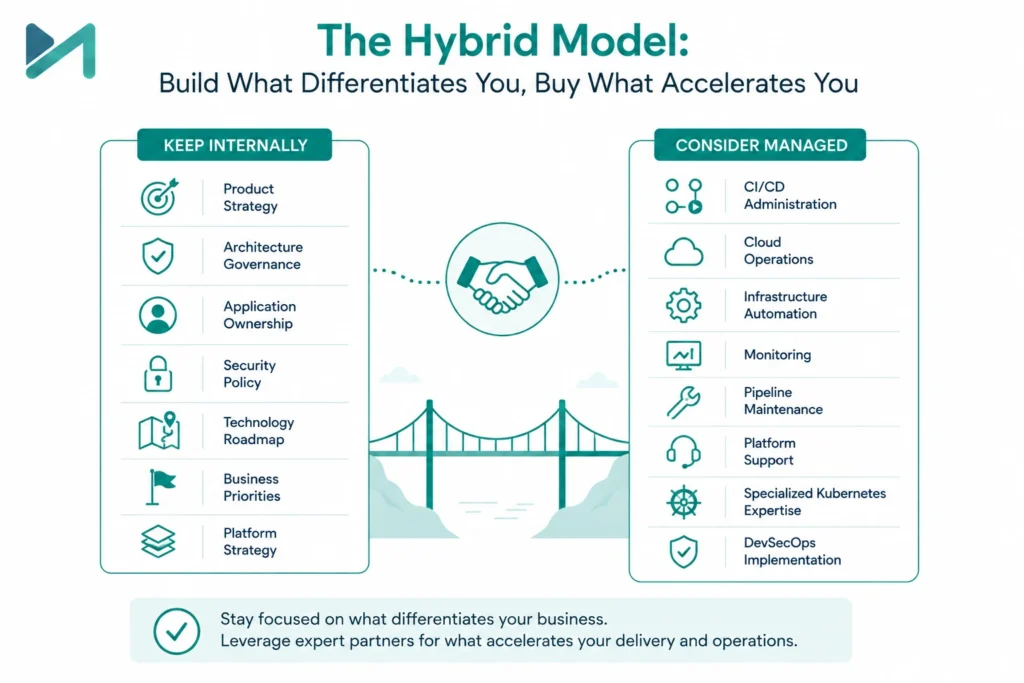
The most mature buy-vs-build decision is often not binary.
It is:
Build the capabilities that differentiate your business. Buy or partner for capabilities that are specialized, variable, or operationally intensive.
For example:
Keep internally
- Product strategy
- Architecture governance
- Application ownership
- Security policy
- Technology roadmap
- Business priorities
- Platform strategy
Consider managed
- CI/CD administration
- Cloud operations
- Infrastructure automation
- Monitoring
- Pipeline maintenance
- Platform support
- Specialized Kubernetes expertise
- DevSecOps implementation
This model allows your internal team to remain strategically important without requiring it to become an expert in every DevOps technology.
AI Makes the Decision More Nuanced
AI is changing software development, but it does not eliminate the need for DevOps.
In fact, it can make the underlying engineering system more important.
But higher code-generation speed creates new requirements around:
- Testing
- Security
- Code review
- Deployment
- Observability
- Governance
- Infrastructure
That means a CIO should not ask:
“Will AI reduce our DevOps requirements?”
A better question is:
“Can our DevOps operating model absorb higher software delivery velocity without increasing risk and operational complexity?”
That is where strong automation, platform engineering, security, and observability become increasingly important.
7 Signs Your Organization Should Consider Managed DevOps
1. Your DevOps backlog continues to grow
More work arrives than your internal team can sustainably handle.
2. Engineers spend too much timemaintaininginfrastructure
Your product engineers are becoming infrastructure administrators.
3. Specialist hiring is taking too long
Critical cloud, Kubernetes, security, or platform roles remain open.
4. Your cloud environment is becoming difficult to govern
Costs, environments, access, and infrastructure are becoming harder to manage.
5. Your CI/CD environment is fragile
Pipelines frequently fail or require manual intervention.
6. You need operational coverage
The organization needs monitoring and support beyond normal working hours.
7. You need to accelerate transformation
The business cannot wait years to build every capability internally.
7 Signs You Should Strengthen Your In-House DevOps Team
1. DevOps directly differentiates your product
Your engineering platform is part of your competitive advantage.
2. You have strong DevOps leadership
Architecture, governance, and engineering practices are already mature.
3. You have predictable long-term workload
There is enough continuous work to justify permanent capacity.
4. Your domain is highly specialized
Deep institutional knowledge is essential.
5. You need proprietary platform capabilities
The internal platform itself is strategic intellectual property.
6. You can recruit andretainthe required specialists
Your talent strategy is strong enough to support the capability.
7. You want long-term platform ownership
Your organization has the resources and appetite to operate the capability for years.
What a Good Managed DevOps Partner Should Actually Provide
If you decide to buy managed DevOps services, do not evaluate providers only on the number of engineers they can supply.
Evaluate their ability to deliver outcomes.
Look for:
1. Architectureexpertise
Can they design a scalable DevOps operating model?
2. Cloudexpertise
Can they manage your cloud environment efficiently?
3. Automation
Can they reduce repetitive engineering work?
4. Security
Can they integrate security into delivery?
5. Observability
Can they provide meaningful production visibility?
6. Governance
Can they operate within your compliance requirements?
7. Documentation
Can they transfer and preserve knowledge?
8. Metrics
Can they demonstrate improvement?
9. Scalability
Can they support your growth?
10. Continuous improvement
Will the service become better over time rather than simply maintaining the status quo?
How MicroGenesis Can Help
The objective of managed DevOps should not be to take DevOps away from your organization.
It should be to unlock your engineering team’s full potential.
MicroGenesis helps organizations design and implement DevOps capabilities around their existing technology landscape, business objectives, engineering maturity, and long-term roadmap.
Our DevOps capabilities include:
- DevOps consulting
- DevOps assessment
- DevOps transformation
- CI/CD implementation
- Infrastructure as Code
- Cloud DevOps
- DevSecOps
- Containerization
- Kubernetes
- Automation
- Monitoring and observability
- Platform engineering
- DevOps implementation
- Ongoing DevOps support
Explore MicroGenesis DevOps Services
For organizations looking for location-specific capabilities, MicroGenesis also provides DevOps Services in Bangalore.
For software-intensive engineering environments, MicroGenesis provides specialized Embedded DevOps Services.
Our approach is not to force every organization into the same delivery model.
We first look at:
What should you own?
What should you automate?
What should you outsource?
What should you modernize?
What should you measure?
From there, we can help establish the right combination of internal capability and external expertise.
How to Structure a Managed DevOps Engagement
If you choose the managed route, do not start by asking:
“How many engineers will you provide?”
Start with:
“What outcomes and responsibilities will you own?”
A mature engagement should define:
Scope
What is included?
Ownership
Who is accountable for each activity?
Service Levels
What response and resolution expectations apply?
Security
Who owns which security responsibilities?
Governance
How are changes and priorities managed?
Metrics
How will performance be measured?
Documentation
How will knowledge be retained?
Escalation
What happens during a critical incident?
Continuous Improvement
How will the service improve after the first year?
This creates a partnership rather than simply a staffing arrangement.
The Metrics CIOs Should Watch
The buy-vs-build decision should ultimately be judged through outcomes.
Delivery
- Deployment frequency
- Lead time for changes
- Release predictability
Reliability
- Change failure rate
- Mean time to recovery
- Availability
- Incident volume
Engineering Productivity
- Manual operational effort
- Pipeline maintenance effort
- Environment provisioning time
- Developer experience
Financial
- Cloud cost
- Infrastructure utilization
- Tool spend
- Internal engineering capacity
- Total DevOps TCO
Strategic
- Transformation velocity
- Platform adoption
- Automation coverage
- Security integration
- Business value delivered
Frequently Asked Questions
Is it cheaper to build an in-house DevOps team or use managed DevOps services?
Neither model is automatically cheaper. The comparison should include recruitment, salaries, management, training, tooling, infrastructure, operational coverage, service fees, governance, and the business value generated by each model.
Does managed DevOps mean outsourcing the entire IT function?
No. A managed DevOps engagement can be limited to specific capabilities such as CI/CD, cloud operations, automation, monitoring, Kubernetes, or platform engineering.
Can an enterprise have both an internal DevOps team and a managed DevOps partner?
Yes. A hybrid model is often practical. The internal team can own strategy, architecture, and business priorities while the partner provides specialist engineering or operational capabilities.
When should a CIO build DevOps internally?
Building internally is generally attractive when DevOps is strategically important, the organization has strong leadership, the workload is continuous, and there is sufficient ability to recruit and retain specialists.
When should a CIO consider managed DevOps?
Managed services can make sense when specialist skills are difficult to hire, operational workloads are growing, transformation needs to accelerate, or the internal engineering team should focus more heavily on product development.
How should managed DevOps success be measured?
Measure delivery speed, reliability, automation, operational effort, cloud economics, security, platform adoption, and overall business outcomes rather than simply counting resources or completed tickets.
The CIO’s Final Decision: Build Capability, Buy Leverage
The in-house versus managed DevOps decision is ultimately not about whether your organization is capable of doing DevOps itself.
It is about where your organization creates the most value by doing it itself.
Building internally gives you:
- Deep ownership
- Institutional knowledge
- Direct control
- Long-term capability
Managed DevOps can give you:
- Faster access to expertise
- Specialist capabilities
- Operational leverage
- Scalability
- Reduced recruitment dependency
And a hybrid model can combine both.
The numbers show why this decision deserves more than a simple procurement comparison.
82% of container users are running Kubernetes in production.
67% of surveyed organizations report mostly or completely automated software development lifecycles.
64% want to consolidate their toolchains.
85% identify cloud spend management as a challenge, with estimated IaaS/PaaS waste at 29%.
And 90% of technology professionals now use AI at work, increasing the importance of the engineering systems that control how software is built, tested, secured, and deployed.
These numbers point toward one conclusion:
The DevOps operating model is becoming more important, not less.
The smartest organizations will not blindly build everything internally or outsource everything externally.
They will determine:
What must remain a core internal capability?
Where can external expertise accelerate us?
Where can automation remove operational work?
And which model gives us the best combination of control, agility, reliability, and long-term value?
That is the real CIO buy-vs-build decision.
MicroGenesis can help organizations evaluate those choices and build the right DevOps operating model across consulting, transformation, CI/CD, cloud, DevSecOps, automation, platform engineering, and managed DevOps services.
Explore MicroGenesis DevOps Services
Build what differentiates you. Buy the expertise that accelerates you. Automate what slows you down. And create a DevOps operating model designed for the business you want to become.