

Moving workloads to Amazon Web Services is one decision. Running those workloads reliably, securely, and cost-effectively after migration is another.
For many enterprises, AWS environments quickly become complex. Multiple accounts, applications, databases, containers, networking components, security controls, monitoring tools, and business-critical workloads all need to work together. As the environment grows, managing AWS internally can become difficult particularly when the organization does not have enough cloud architects, DevOps engineers, security specialists, or FinOps expertise.
That is where an AWS Managed Service Provider (MSP) can become a strategic partner.
But choosing one should not come down to who offers the lowest monthly price or has the biggest list of AWS certifications.
The right provider should understand your business objectives, assess your existing environment, design an appropriate operating model, manage day-to-day cloud operations, improve security and reliability, control cloud costs, and help your AWS environment evolve as your business grows.
In this guide, we explain how to choose the right AWS Managed Service Provider, what to evaluate before signing a contract, the questions you should ask potential providers, and the capabilities that separate a strategic AWS partner from a basic cloud support vendor.
Planning to migrate, optimize, or manage your AWS environment?
Explore MicroGenesis AWS Consulting Services to discuss your cloud requirements with our experts.
What Is an AWS Managed Service Provider?
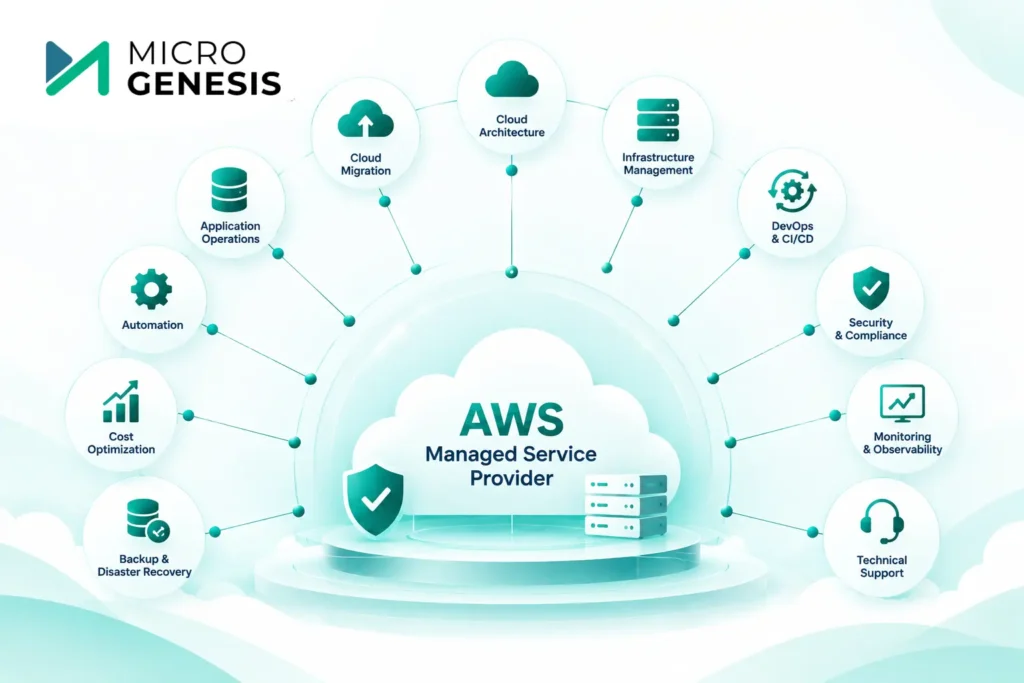
An AWS Managed Service Provider is a technology partner that helps organizations plan, build, operate, secure, monitor, and optimize their AWS environments.
Depending on the engagement, an AWS MSP may support:
- AWS cloud migration
- Cloud architecture
- Infrastructure management
- DevOps and CI/CD
- Security and compliance
- Monitoring and observability
- Backup and disaster recovery
- Performance optimization
- Cloud cost management
- Infrastructure automation
- Application operations
- Ongoing technical support
AWS describes its MSP Program as a validation for partners capable of delivering comprehensive services across the cloud journey—from planning and migration through ongoing operations and optimization. AWS also states that MSP validation involves a rigorous third-party audit.
However, AWS partnership status alone should not be your selection criteria.
Your provider still needs to demonstrate that it can solve your technical and business problems.
Why Businesses Work With an AWS Managed Service Provider
AWS gives organizations tremendous flexibility, but that flexibility also creates operational responsibility.
For example, a growing SaaS company may start with a few AWS services. Over time, it may introduce:
EC2 → RDS → S3 → Lambda → EKS → CloudFront → IAM → CloudWatch → multiple AWS accounts
Each additional service introduces configuration, security, monitoring, integration, and cost-management considerations.
An experienced AWS managed services partner can help create a consistent operating model rather than allowing the environment to grow organically without governance.
Common reasons enterprises engage an AWS MSP include:
- Limited internal AWS expertise
- Need for 24/7 monitoring and support
- Cloud migration requirements
- Increasing infrastructure complexity
- Security and compliance requirements
- Rising AWS expenditure
- Need for faster deployment
- Lack of DevOps automation
- Business continuity requirements
- Need to scale engineering operations
The objective should not simply be someone else manages our AWS account.
The objective should be:
Our AWS environment performs reliably while our internal teams focus on business and product priorities.
How to Choose the Right AWS Managed Service Provider
1. Start With Your Business Requirements
Before speaking with providers, define what you actually need.
Are you:
- Migrating from on-premises infrastructure?
- Modernizing existing applications?
- Building a cloud-native product?
- Trying to reduce AWS expenditure?
- Experiencing reliability issues?
- Looking for 24/7 cloud operations?
- Strengthening cloud security?
- Scaling your development environment?
- Moving toward DevOps automation?
These requirements will determine the type of AWS partner you need.
Example
A manufacturing company moving a mission-critical application to AWS may prioritize:
Reliability + security + disaster recovery + monitoring
A SaaS company experiencing rapid growth may prioritize:
Scalability + DevOps + automation + performance
The “best” AWS MSP is therefore not universal. It is the provider that best matches your workload, risk profile, technical maturity, and business objectives.
2. Look Beyond AWS Certifications
Certifications are useful indicators of technical knowledge, but they should not be the end of your evaluation.
Ask potential providers:
- Which AWS certifications does the delivery team hold?
- How much real-world AWS experience does the team have?
- Which industries have they supported?
- Have they managed environments similar to ours?
- Can they provide relevant case studies?
- Who will actually manage our environment?
- What happens if a key engineer leaves the account?
A sales presentation may introduce senior architects, while day-to-day operations are handled by a completely different team.
Ask to meet the people who will actually operate your AWS environment.
3. Evaluate Their AWS Architecture Expertise
Your provider should be able to evaluate architecture decisions not simply manage servers.
AWS Well-Architected provides six pillars for evaluating cloud workloads:
Operational Excellence
Security
Reliability
Performance Efficiency
Cost Optimization
Sustainability
These principles provide a useful framework for evaluating your prospective provider.
For a more structured approach to evaluating an AWS workload against these principles, use our AWS Well-Architected Review Checklist to assess architecture, security, reliability, performance, cost optimization, and operational considerations.
For example, ask:
How would you identify architectural risks in our current AWS environment?
A strong provider should be able to explain its assessment methodology and show how architectural recommendations connect to business outcomes.
4. Assess Cloud Security Capabilities
Security should be part of the architecture from the beginning—not something added after deployment.
Your AWS MSP should have a clear approach to:
- Identity and access management
- Least-privilege access
- Network security
- Encryption
- Security monitoring
- Vulnerability management
- Logging and auditing
- Backup protection
- Incident response
- Security automation
AWS’s Well-Architected Security pillar emphasizes protecting data, systems, and assets while meeting business and regulatory requirements.
A simple example
Suppose an employee leaves your organization.
A mature AWS operating model should make it possible to:
Disable identity → revoke permissions → review access → audit activity
without relying on manual processes scattered across multiple systems.
5. Ask How They Manage AWS Costs
Cloud cost management is one of the areas where an MSP can provide significant ongoing value.
Your provider should help answer:
- Which workloads are driving costs?
- Are resources being underutilized?
- Are environments running when they are not required?
- Are instance sizes appropriate?
- Can workloads use more efficient AWS services?
- Are there opportunities for reserved or committed usage?
- Are development and production environments governed differently?
AWS’s Cost Optimization guidance emphasizes continuous optimization, expenditure and usage awareness, resource cost-effectiveness, and optimization over time.
Example
If a development environment is running continuously despite being used only during business hours, the provider should identify that pattern and recommend an appropriate solution.
Cost optimization should therefore be continuous, not a one-time exercise after receiving an unexpectedly high AWS bill.
For a deeper look at how organizations can identify waste, improve resource utilization, and establish an ongoing cost-management approach, explore our guide to AWS cost optimization.
6. Evaluate Monitoring and Incident Management
Ask what happens when something breaks at 2:00 AM.
A serious AWS MSP should have clear processes for:
- Infrastructure monitoring
- Application monitoring
- Performance monitoring
- Alert management
- Incident response
- Escalation
- Root-cause analysis
- Problem management
- Service reporting
Do not accept vague answers such as:
“Our team monitors the environment 24/7.”
Ask:
What happens after an alert is generated?
A mature process should look something like:
Detect → Analyze → Prioritize → Respond → Resolve → Investigate → Prevent recurrence
AWS’s operational excellence guidance similarly emphasizes operating workloads effectively, gaining insight into operations, responding to events, and continuously improving processes.
7. Check Their DevOps and Automation Capabilities
An AWS MSP should not create an environment where every infrastructure change requires a support ticket.
Look for capabilities such as:
- Infrastructure as Code
- CI/CD pipelines
- Automated deployments
- Configuration management
- Automated testing
- Infrastructure provisioning
- Automated scaling
- Policy automation
- Monitoring automation
Example
Instead of manually creating infrastructure every time a development team launches a new environment:
Developer request → Automated pipeline → Infrastructure provisioning → Security configuration → Monitoring → Environment ready
Automation improves consistency while reducing repetitive operational work.
8. Examine Their Disaster Recovery Approach
Ask a potential MSP:
If our primary production environment becomes unavailable, how quickly can we recover?
Do not accept only a backup strategy.
Evaluate:
- Recovery Time Objective (RTO)
- Recovery Point Objective (RPO)
- Backup frequency
- Replication strategy
- Multi-AZ architecture
- Multi-region requirements
- Disaster recovery testing
- Failover procedures
- Recovery documentation
AWS’s reliability guidance emphasizes recovery planning, testing, and automation as part of building reliable workloads.
A disaster recovery plan that has never been tested is not enough.
9. Evaluate Scalability
Your AWS environment should be capable of supporting business growth.
Ask the provider how it approaches:
- Auto scaling
- Application architecture
- Database scaling
- Load balancing
- Container orchestration
- Serverless architectures
- Multi-account environments
- Infrastructure automation
For example, if traffic suddenly increases by 5×, your MSP should already have an architecture and operating model capable of responding.
AWS’s Well-Architected guidance specifically considers how performance efficiency and resource allocation should adapt as demand and technologies change.
10. Understand the Support Model
One of the most important questions is:
Who will actually support us?
Ask:
- Is support available 24/7?
- What are the response times?
- Is there a dedicated account manager?
- Is there an escalation process?
- What happens during a major incident?
- How are incidents communicated?
- Do we receive regular service reports?
- How are recurring problems addressed?
You should also understand whether support is:
Reactive
or
Proactive.
Reactive support waits for something to break.
Proactive managed services identify risks before they become business-impacting incidents.
11. Evaluate the Provider’s Reporting
Executives should not have to interpret hundreds of technical alerts to understand whether AWS operations are healthy.
Ask for examples of monthly or quarterly reporting.
A useful report may include:
- Availability
- Incident trends
- Security events
- Performance
- AWS expenditure
- Cost optimization opportunities
- Capacity
- Backup status
- SLA performance
- Major changes
- Improvement initiatives
The provider should translate technical information into business-level visibility.
12. Look at the Total Cost, Not Just the MSP Fee
The cheapest provider is not necessarily the most economical option.
Compare:
MSP fees + AWS expenditure + implementation + migration + tooling + support + optimization
A provider that charges more but significantly improves reliability, automation, and cost efficiency may deliver greater overall value.
Ask every provider to explain:
- What is included?
- What is excluded?
- What is charged separately?
- How are after-hours incidents billed?
- Are architecture reviews included?
- Are optimization services included?
- Are AWS migration services separate?
Transparent pricing is a strong indicator of a mature engagement model.
AWS Managed Service Provider Evaluation Scorecard
You can use the following scorecard during vendor selection:
Evaluation Area | Suggested Weight |
AWS technical expertise | 15% |
Architecture & modernization | 15% |
Security & compliance | 15% |
Monitoring & operations | 10% |
DevOps & automation | 10% |
Cost optimization | 10% |
Scalability & reliability | 10% |
Disaster recovery | 5% |
Support & governance | 5% |
Commercial model | 5% |
Total | 100% |
Adjust the weighting according to your business priorities.
For a regulated organization, security may deserve 20–25%.
For a rapidly growing SaaS business, scalability and DevOps may deserve greater weight.
12 Questions to Ask an AWS Managed Service Provider
Before signing an agreement, ask:
1. How will you assess our existing AWS environment?
2. What will you recommend changing and why?
3. Who will manage our AWS environment day-to-day?
4. How do you monitor workloads and respond to incidents?
5. What is your approach to AWS security?
6. How will you identify and reduce unnecessary AWS expenditure?
7. How do you implement infrastructure automation?
8. What is your disaster recovery methodology?
9. How do you support application modernization?
10. What metrics will you report to leadership?
11. What happens during a critical production incident?
12. How will you continuously improve our AWS environment after implementation?
The provider’s answers should be specific.
If every answer sounds like:
“Yes, we can do that.”
ask them to explain how.
Red Flags When Choosing an AWS Managed Service Provider
Be cautious if a provider:
- Talks primarily about certifications
- Cannot explain its operating model
- Provides generic recommendations
- Cannot show relevant experience
- Has unclear pricing
- Offers limited security expertise
- Treats monitoring as simple alert forwarding
- Has no documented escalation process
- Cannot explain disaster recovery
- Does not discuss cost optimization
- Relies heavily on manual infrastructure management
- Cannot identify measurable business outcomes
Another warning sign is a provider that tries to lock you into a large transformation before understanding your existing environment.
Assessment should come before prescription.
AWS Managed Service Provider vs AWS Consulting Partner
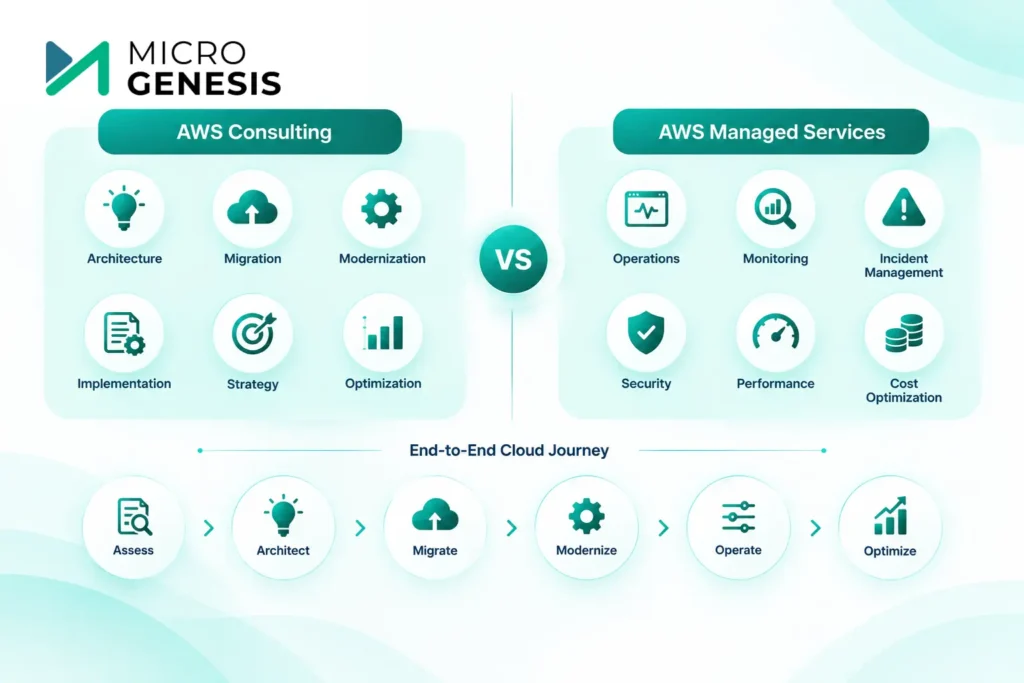
These services can overlap, but the engagement objective can be different.
AWS Consulting
Typically focuses on:
- Architecture
- Migration
- Modernization
- Strategy
- Implementation
- Optimization
AWS Managed Services
Typically focuses on:
- Day-to-day operations
- Monitoring
- Incident management
- Security
- Performance
- Cost optimization
- Continuous improvement
Many organizations need both.
For example:
Assess → Architect → Migrate → Modernize → Operate → Optimize
A partner capable of supporting multiple stages can provide greater continuity than engaging separate providers for every phase.
Why the Right AWS Partner Matters
AWS provides the underlying cloud platform. Your partner determines how effectively your organization uses it.
The right partner can help you move from:
Cloud infrastructure
to:
Well-governed, secure, automated, scalable business infrastructure.
AWS itself recommends using the Well-Architected approach to consistently evaluate architectures against best practices and identify improvements. AWS also notes that organizations can work with AWS Partners with deep AWS knowledge to review and improve workloads.
This makes partner selection a strategic decision not simply a procurement exercise.
Why Choose MicroGenesis for AWS Consulting and Managed Cloud Initiatives?
At MicroGenesis, we approach AWS engagements around business outcomes, engineering requirements, and long-term cloud maturity.
Our focus is not simply on moving workloads to AWS.
We help organizations evaluate their current environment, identify opportunities for modernization and optimization, and build cloud solutions aligned with requirements for scalability, security, reliability, and operational efficiency.
Our AWS capabilities can support organizations across areas such as:
- Cloud architecture
- AWS migration
- Application modernization
- Cloud-native development
- DevOps and automation
- Infrastructure optimization
- Cloud security
- Performance optimization
- Ongoing cloud operations
The right engagement depends on where your organization is today and where you need to go next.
Not sure whether your AWS environment is optimized for your next stage of growth?
Talk to MicroGenesis AWS Consulting Experts to discuss your architecture, migration, modernization, or cloud operations requirements.
A Practical AWS Managed Service Provider Selection Process
Rather than selecting a provider after one sales presentation, use a structured process.
Step 1: Document your requirements
Identify your workloads, business priorities, risks, and expected outcomes.
Step 2: Shortlist qualified providers
Evaluate AWS experience, industry expertise, services, and delivery capabilities.
Step 3: Conduct technical discussions
Ask providers to review representative workloads and explain their approach.
Step 4: Request a proposed operating model
Understand who will manage what, when, and how.
Step 5: Compare commercial models
Review both MSP fees and expected AWS infrastructure costs.
Step 6: Validate references
Speak with customers who have similar workloads or business requirements.
Step 7: Define KPIs and SLAs
Agree on measurable performance expectations before implementation.
Step 8: Start with a clearly defined scope
A phased engagement can allow both organizations to validate the relationship before expanding it.
Frequently Asked Questions
What should I look for when choosing an AWS Managed Service Provider?
Look for demonstrated AWS expertise, strong architecture and security capabilities, proactive monitoring, DevOps automation, cost optimization, scalability, disaster recovery, transparent reporting, and a clearly defined support model.
Is an AWS certification enough to choose a managed service provider?
No. Certifications demonstrate knowledge, but they do not necessarily demonstrate the provider’s ability to operate complex enterprise environments. Look for relevant experience, customer references, delivery methodology, and measurable outcomes.
Should an AWS MSP manage security as well?
Security should be integrated into the AWS operating model. Your provider should understand identity, access controls, encryption, monitoring, logging, vulnerability management, and incident response.
How can an AWS MSP help reduce cloud costs?
A provider can analyze AWS usage, identify underutilized resources, improve resource sizing, automate environments, recommend appropriate purchasing models, and establish ongoing cost governance.
Do I need an AWS MSP if I already have an internal cloud team?
Not necessarily. An MSP can complement internal teams when they need additional expertise, 24/7 operational coverage, specialized skills, migration support, or help managing increasing cloud complexity.
What is the difference between AWS consulting and managed services?
AWS consulting generally focuses on strategy, architecture, migration, modernization, and implementation. Managed services focus more heavily on ongoing operations, monitoring, support, security, performance, and optimization. Many enterprises benefit from combining both.
How do I compare AWS Managed Service Providers?
Use a weighted evaluation covering AWS expertise, architecture, security, operations, automation, cost optimization, scalability, disaster recovery, support, governance, and commercial terms. Then validate the shortlist through technical discussions and customer references.
Final Takeaway: Choose a Partner, Not Just a Provider
Choosing the right AWS Managed Service Provider should not be based on the lowest price or the longest list of certifications.
The better question is:
Can this partner help us operate AWS securely, reliably, efficiently, and at the scale our business requires?
A strong AWS MSP should bring together cloud architecture, security, automation, monitoring, DevOps, cost optimization, governance, and continuous improvement.
Most importantly, the provider should understand that AWS is not the end goal.
Business performance is.
If you are evaluating AWS partners for migration, modernization, cloud operations, or optimization, connect with MicroGenesis AWS consulting experts to discuss your requirements and identify the right path forward.