
In today’s increasingly complex product development landscape, managing requirements effectively is no longer optional, it’s essential. Whether you’re building software-defined vehicles, medical devices, aerospace systems, industrial automation products, or safety-critical embedded software, requirements management directly impacts quality, compliance, development speed, and product success.
Many organizations still rely on disconnected spreadsheets, Word documents, emails, and siloed engineering tools to manage requirements. The result is often poor traceability, inconsistent requirements, audit challenges, delayed releases, and increased development costs.
This is why organizations across automotive, aerospace, defense, medical devices, and industrial manufacturing are turning to PTC Codebeamer Requirements Management Software.
Codebeamer is more than a requirements management tool. It is a comprehensive Application Lifecycle Management (ALM) platform that helps engineering teams manage requirements, risks, tests, compliance, and traceability within a single integrated environment.
In this guide, we’ll explore what Codebeamer is, its key capabilities, requirements traceability features, compliance support, AI-driven engineering potential, and why it has become a preferred solution for regulated product development.
What is PTC Codebeamer?
PTC Codebeamer is an enterprise-grade Application Lifecycle Management (ALM) platform designed for complex product development environments.
Unlike traditional requirements tools that focus solely on documenting specifications, Codebeamer connects:
- Requirements Management
- Risk Management
- Test Management
- Quality Assurance
- Change Management
- Product Line Engineering
- Compliance Management
- Release Management
into a unified engineering ecosystem.
Organizations looking to modernize engineering processes often evaluate Codebeamer as part of a broader ALM transformation strategy. As discussed in the Ultimate Guide to Application Lifecycle Management (ALM), successful product development increasingly depends on connecting requirements, testing, compliance, and development activities within a single lifecycle framework.
This is one reason why many engineering organizations adopt Codebeamer ALM as their strategic lifecycle management platform.
Why Requirements Management Matters
Requirements management is often misunderstood as simply collecting specifications.
In reality, it involves:
- Capturing requirements
- Organizing requirements
- Reviewing requirements
- Managing changes
- Tracking approvals
- Establishing traceability
- Supporting verification
- Demonstrating compliance
When requirements are poorly managed, organizations often face:
- Scope creep
- Compliance failures
- Increased rework
- Product quality issues
- Delayed releases
A modern requirements management platform helps organizations avoid these risks while improving engineering efficiency.
Why Organizations Choose Codebeamer Requirements Management Software
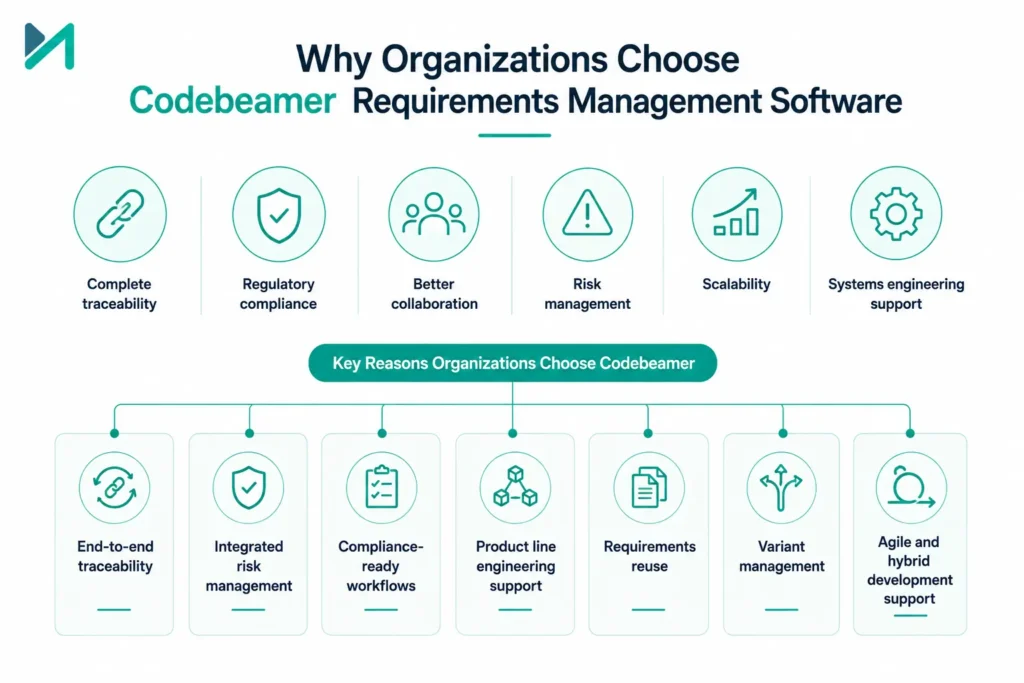
Engineering leaders evaluating requirements management solutions typically seek:
- Complete traceability
- Regulatory compliance
- Better collaboration
- Risk management
- Scalability
- Systems engineering support
Codebeamer addresses all these requirements through an integrated lifecycle approach.
Key reasons organizations choose Codebeamer include:
- End-to-end traceability
- Integrated risk management
- Compliance-ready workflows
- Product line engineering support
- Requirements reuse
- Variant management
- Agile and hybrid development support
End-to-End Requirements Traceability
One of Codebeamer’s most powerful capabilities is requirements traceability.
Requirements rarely exist in isolation.
They connect to:
- Risks
- Architecture
- Design Elements
- Test Cases
- Defects
- Releases
- Compliance Evidence
Codebeamer enables organizations to establish complete traceability relationships throughout the lifecycle.
This allows teams to answer critical questions such as:
- Which requirements have not been tested?
- What tests validate a requirement?
- Which changes impact safety-critical features?
- What defects affect regulatory compliance?
For organizations evaluating requirements traceability software, Codebeamer’s digital thread capabilities are a significant differentiator.
Codebeamer Requirements Traceability and Digital Thread
Modern engineering increasingly depends on digital thread strategies.
A digital thread connects engineering information across the entire lifecycle.
Codebeamer supports digital thread initiatives by linking:
- Customer Requirements
- System Requirements
- Software Requirements
- Design Models
- Risks
- Tests
- Defects
- Releases
This visibility enables faster impact analysis, improved decision-making, and stronger compliance readiness.
Organizations developing complex systems frequently discover that traceability becomes one of the most valuable aspects of a modern ALM implementation.
Real-Time Collaboration Across Engineering Teams
Modern engineering projects involve multiple stakeholders.
These often include:
- Systems Engineers
- Software Engineers
- Quality Teams
- Product Managers
- Compliance Teams
- Suppliers
Codebeamer supports real-time collaboration through:
- Reviews
- Discussions
- Notifications
- Approval Workflows
This helps eliminate communication silos while accelerating decision-making.
Codebeamer Risk Management and FMEA Support
Managing requirements without managing risk creates significant exposure.
Codebeamer includes integrated risk management capabilities that support:
- FMEA (Failure Modes and Effects Analysis)
- Hazard Analysis
- Risk Assessments
- Impact Analysis
- Mitigation Planning
Risks can be directly linked to requirements, tests, and compliance artifacts.
This enables organizations to maintain complete visibility into safety and quality concerns throughout development.
For regulated industries, integrated risk management often becomes a key factor when evaluating ALM platforms.
Codebeamer Test Management and Validation
Requirements only create value when they can be verified and validated.
Codebeamer provides integrated test management capabilities that support:
- Test Planning
- Test Case Creation
- Test Execution
- Defect Management
- Coverage Analysis
- Validation Reporting
Because tests remain connected to requirements, organizations can demonstrate complete verification coverage.
This is particularly valuable for organizations searching for:
- Codebeamer validation tracking software
- Codebeamer test management features
- Quality management and testing platforms
Compliance Support for Regulated Industries
Compliance remains one of the biggest challenges in modern product development.
Organizations must satisfy standards such as:
- ISO 26262
- ASPICE
- IEC 61508
- IEC 62304
- ISO 13485
- FDA 21 CFR Part 11
- DO-178C
- MIL-STD-882E
Codebeamer simplifies compliance by providing:
- Audit trails
- Electronic approvals
- Traceability matrices
- Compliance dashboards
- Validation documentation
These capabilities significantly reduce audit preparation effort.
This is one reason many organizations consider Codebeamer ALM the preferred choice for regulated industries.
Codebeamer for Automotive ASPICE and ISO 26262 Programs
The automotive industry is rapidly becoming software-defined.
Engineering teams must manage:
- Functional Safety
- ASPICE Assessments
- Variant Management
- Cybersecurity Requirements
- Software Complexity
Codebeamer supports automotive engineering through:
- Requirements Traceability
- Risk Management
- Verification Workflows
- Compliance Reporting
- Product Line Engineering
Organizations pursuing ASPICE maturity often rely on Codebeamer to improve lifecycle governance and compliance readiness.
Learn more about Automotive ISO 26262 and ASPICE Compliance
Codebeamer for Medical Device Development
Medical device manufacturers face strict regulatory requirements.
Codebeamer supports compliance with:
- FDA Regulations
- ISO 13485
- IEC 62304
The platform enables organizations to maintain traceability across requirements, risks, tests, and validation activities.
This significantly simplifies regulatory audits and product certification efforts.
Codebeamer for Aerospace and Defense
Aerospace and defense organizations require rigorous engineering controls.
Codebeamer supports:
- DO-178C Compliance
- Requirements Traceability
- Verification Management
- Risk Assessments
- Change Control
Its ability to establish lifecycle visibility makes it a strong choice for safety-critical development programs.
Codebeamer Systems Engineering and MBSE Capabilities
As products become more complex, organizations increasingly adopt Model-Based Systems Engineering (MBSE).
Codebeamer supports systems engineering initiatives through:
- Requirement Modeling
- Variant Management
- Product Line Engineering
- Architecture Traceability
Organizations pursuing digital engineering strategies often combine Codebeamer with broader MBSE practices.
Learn more in our guide to Model-Based Systems Engineering (MBSE).
Codebeamer AI-Assisted Requirements Management
Artificial intelligence is becoming an increasingly important topic within engineering organizations.
Search demand for:
- Codebeamer AI requirements management
- AI-assisted engineering
- AI requirements gathering
continues growing.
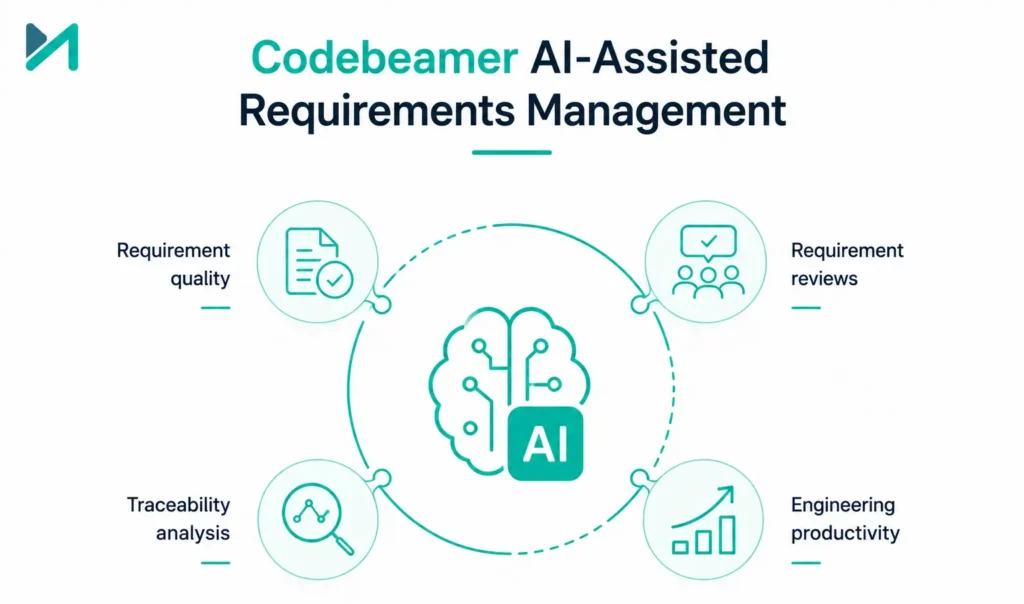
AI-enabled capabilities have the potential to improve:
- Requirement quality
- Requirement reviews
- Traceability analysis
- Engineering productivity
As AI-driven engineering evolves, organizations are increasingly evaluating how lifecycle management platforms can support intelligent requirements management.
Codebeamer Integration with Jira and Development Tools
Many organizations use Jira for Agile planning and execution.
Rather than replacing Jira, Codebeamer can integrate with:
- Jira
- GitHub
- GitLab
- Azure DevOps
- Jenkins
- MATLAB Simulink
This enables teams to combine Agile development practices with enterprise-grade requirements management and compliance workflows.
Organizations interested in connecting Agile delivery with lifecycle governance should explore Codebeamer Integration with Jira.
Codebeamer vs Traditional Requirements Management Approaches
Many organizations still rely on:
- Word Documents
- Excel Spreadsheets
- Shared Drives
- Email Reviews
These approaches create challenges including:
- Version Control Problems
- Limited Traceability
- Poor Collaboration
- Audit Risks
| Capability | Traditional Tools | Codebeamer |
| Requirements Traceability | Limited | End-to-End |
| Compliance Support | Manual | Automated |
| Risk Management | Separate Tools | Integrated |
| Test Management | Separate Tools | Integrated |
| Collaboration | Limited | Real-Time |
Why Automotive Organizations Choose Codebeamer Over Jira for Requirements Management
Jira excels at Agile project management and sprint planning.
However, automotive organizations frequently require:
- ASPICE Compliance
- ISO 26262 Support
- Requirements Traceability
- Risk Management
- Compliance Reporting
This is why many organizations adopt Codebeamer for compliance-driven engineering while continuing to use Jira for Agile execution.
If you’re evaluating both platforms, our detailed comparison of Codebeamer vs Jira for Automotive Software Teams provides a deeper analysis.
Best Practices for Successful Codebeamer Implementation
Organizations implementing Codebeamer should focus on:
Establish Governance Early
Define ownership and lifecycle processes.
Standardize Requirements
Create consistent structures and templates.
Build Traceability Models
Define lifecycle relationships from the beginning.
Train Stakeholders
Support adoption through structured enablement.
Align Processes with Compliance Requirements
Map workflows to regulatory expectations.
Organizations can reduce implementation risk and accelerate adoption by following proven application lifecycle management implementation best practices and applying these PTC Codebeamer deployment and configuration best practices.
How MicroGenesis Helps Organizations Maximize Codebeamer
Implementing Codebeamer successfully requires more than software deployment.
Organizations often need expertise in:
- Requirements Engineering
- Traceability Strategy
- ASPICE Consulting
- Functional Safety
- Compliance Readiness
- Process Optimization
As a trusted Codebeamer ALM Partner, MicroGenesis helps organizations design, implement, and optimize Codebeamer environments that support engineering excellence and regulatory compliance.
Our expertise includes:
- Codebeamer Implementation
- Requirements Management Consulting
- ASPICE Readiness
- ISO 26262 Compliance
- Tool Migration
- Jira Integration
- Engineering Process Transformation
Conclusion
PTC Codebeamer has evolved into one of the most comprehensive requirements management and Application Lifecycle Management platforms available today. Its ability to combine requirements management, traceability, risk management, test management, compliance support, and digital engineering capabilities within a single platform makes it particularly valuable for regulated industries.
Whether you’re developing automotive systems, medical devices, aerospace products, industrial equipment, or safety-critical software, Codebeamer provides the visibility, governance, and traceability needed to manage engineering complexity while accelerating innovation.
For organizations seeking a scalable requirements management solution that supports compliance, collaboration, and digital transformation, Codebeamer remains one of the strongest platforms on the market.