
For many IT support teams, ticket volume is one of the most closely monitored metrics. Yet, a hidden problem often lurks beneath the surface—duplicate tickets.
An employee experiences an issue and submits a ticket. A few hours later, another employee reports the same problem. Then another. Before long, the service desk is flooded with multiple tickets describing essentially the same incident.
Industry studies and IT service management assessments frequently reveal that a significant percentage of service desk workloads consist of duplicate tickets. In some organizations, duplicate incidents can account for up to 40% of all incoming requests.
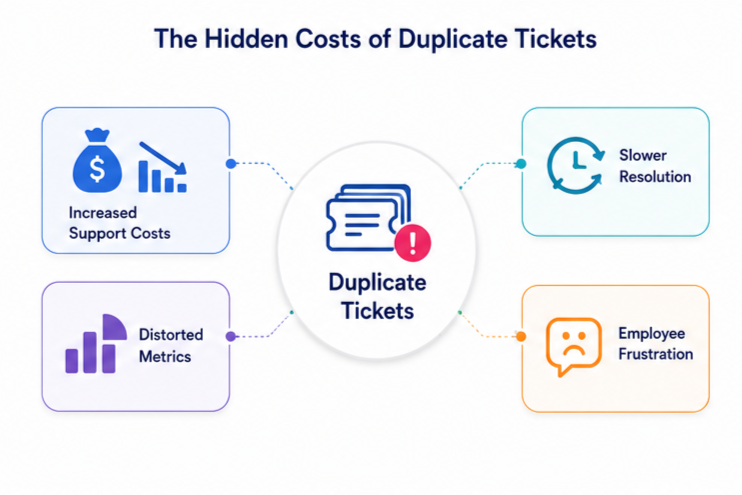
The impact goes far beyond increased ticket counts. Duplicate tickets consume valuable agent time, delay resolution, skew performance metrics, frustrate end users, and increase operational costs.
As organizations expand their digital ecosystems and adopt hybrid work models, the duplicate ticket problem becomes even more challenging. Without proper processes, automation, and visibility, service desks can quickly become overwhelmed.
In this article, we’ll explore why duplicate tickets occur, the hidden costs they create, and practical strategies for reducing duplicate incidents while improving overall IT service management performance.
Understanding the Duplicate Ticket Problem
A duplicate ticket occurs when multiple users report the same issue independently, creating separate incidents for a single underlying problem.
Examples include:
- Email outages
- VPN connectivity issues
- Network disruptions
- Application failures
- Authentication problems
- Cloud service interruptions
Instead of one incident being logged and communicated effectively, multiple users create separate tickets because they are unaware that the issue is already being addressed. This leads to unnecessary work for support teams and confusion for end users. The challenge becomes even more significant in large enterprises where thousands of employees rely on shared systems and services.
Why Duplicate Tickets Are More Common Than Ever
Modern IT environments are becoming increasingly complex. Organizations now manage:
- Cloud platforms
- Hybrid infrastructure
- SaaS applications
- Remote work environments
- Mobile devices
- Distributed networks
As a result, a single outage can affect hundreds or thousands of users simultaneously. Organizations operating across hybrid and multi-cloud environments often face additional visibility challenges that make incident identification and communication more difficult. Effective IT operations management in hybrid and multi-cloud environments plays a crucial role in reducing duplicate incident creation and improving service desk efficiency.
When users don’t know an issue is already being investigated, they naturally create new tickets.
Poor Communication Is the Biggest Cause
One of the primary reasons duplicate tickets occur is poor communication. Many organizations fail to communicate service disruptions effectively. Users often don’t know:
- An issue exists
- The IT team is aware
- Resolution efforts are underway
- Expected restoration timelines
When communication is missing, employees take matters into their own hands and submit tickets.
For example: A company-wide email outage occurs. Instead of checking for known incidents, employees individually submit support requests. Within an hour, the service desk receives hundreds of duplicate tickets describing the same issue. A proactive communication strategy can dramatically reduce ticket volume during major incidents.
Lack of Self-Service Capabilities
Many organizations still rely heavily on traditional service desk interactions. Users must contact IT for:
- Password resets
- Software requests
- Basic troubleshooting
- Access issues
- Common support questions
Without self-service capabilities, employees often submit tickets for issues that could be resolved independently. Organizations that focus on reducing IT support tickets often achieve significant improvements through self-service portals, knowledge bases, and automated support workflows. When users can quickly find answers themselves, duplicate ticket creation decreases substantially.
Knowledge Bases Are Outdated or Underutilized
A knowledge base should serve as the first line of support. Unfortunately, many organizations struggle with:
- Outdated articles
- Incomplete documentation
- Poor search functionality
- Low user adoption
As a result, users bypass self-service resources and submit tickets instead. When common issues are not documented effectively, duplicate tickets become inevitable. An effective knowledge management strategy ensures users can quickly locate relevant information before contacting support.
Incident Management Processes Are Weak
Organizations with immature ITSM processes often struggle to identify related incidents. Support agents may unknowingly create multiple tickets for the same root cause because:
- Incident categorization is inconsistent
- Ticket correlation is absent
- Visibility across teams is limited
- Monitoring tools are disconnected
Following established ITSM best practices for service management helps organizations standardize incident management and reduce unnecessary ticket duplication. Strong incident management processes enable teams to recognize patterns and consolidate duplicate requests effectively.
Monitoring Systems Don’t Detect Issues Early
Many duplicate tickets originate because IT discovers problems after users do. When monitoring capabilities are limited, support teams become reactive rather than proactive. Users encounter issues first and immediately begin submitting tickets.
By the time IT identifies the root cause, dozens or hundreds of duplicate incidents may already exist. Modern monitoring solutions help organizations:
- Detect outages faster
- Correlate events automatically
- Trigger alerts proactively
- Reduce incident response times
Early detection dramatically reduces duplicate ticket creation.
Service Desk Teams Lack Visibility
Large organizations often operate multiple support teams. Examples include:
- Infrastructure teams
- Network teams
- Cloud teams
- Application support teams
- Security teams
When visibility is limited, duplicate tickets may be assigned to different groups simultaneously. This creates redundant investigations, conflicting updates, delayed resolutions, and increased operational costs. A centralized ITSM platform helps ensure all teams work from a shared source of truth.
Employees Don’t Trust Existing Ticket Status Updates
Another overlooked issue is user trust. Many employees create duplicate tickets because they don’t believe their original request is being addressed. Common complaints include:
- No updates
- Slow responses
- Lack of transparency
- Unclear ownership
When users feel ignored, they often submit additional tickets hoping for faster attention. Improving communication and ticket visibility can significantly reduce this behavior.
Increased Support Costs
Every duplicate ticket requires logging, categorization, assignment, review, and communication. This consumes valuable support resources. Organizations seeking to improve operational efficiency often discover that reducing duplicate tickets directly contributes to lower service management costs and higher productivity. Modern ITSM software solutions play a critical role in achieving these efficiencies.
Slower Resolution Times
When support teams spend time managing duplicate tickets, less time is available for resolving actual issues. This increases:
- Mean Time to Resolution (MTTR)
- User frustration
- Service desk workload
Distorted Metrics
Duplicate tickets can create misleading reports. Organizations may incorrectly assume more incidents are occurring, support quality is declining, or additional staffing is needed. Without proper ticket correlation, metrics become unreliable.
Employee Frustration
Users become frustrated when multiple tickets receive different updates, resolution timelines are unclear, or issues remain unresolved. Poor service experiences reduce confidence in IT support teams.
How AI Is Helping Eliminate Duplicate Tickets
Artificial Intelligence is transforming modern IT service management. AI-powered solutions can:
- Identify duplicate incidents automatically
- Correlate similar tickets
- Suggest existing resolutions
- Recommend knowledge articles
- Route requests intelligently
Instead of creating new incidents, users may be directed toward existing tickets or self-service solutions. The growing role of AI in ITSM is helping organizations reduce service desk workloads while improving support experiences. AI-driven ticket classification and incident correlation are becoming essential capabilities for high-performing service desks.
Choosing the Right ITSM Platform Matters
Not all ITSM platforms offer the same capabilities. Modern service management solutions provide features such as:
- Duplicate detection
- Incident correlation
- AI-powered recommendations
- Knowledge management
- Self-service portals
- Automated workflows
Organizations evaluating solutions should focus on platforms that support both automation and proactive service management. Selecting the best IT service management tool can significantly reduce duplicate tickets while improving operational efficiency.
Practical Strategies to Reduce Duplicate Tickets
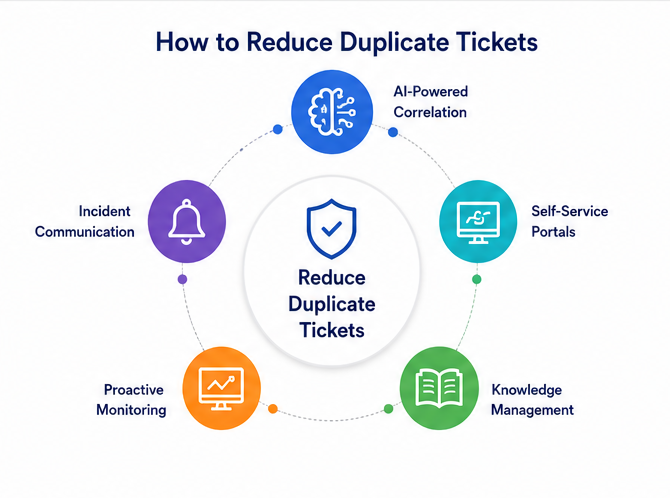
Organizations looking to reduce duplicate incidents should focus on several key initiatives.
Improve Major Incident Communication
Create automated notifications that inform users when known issues occur. Communication channels may include email alerts, Teams notifications, service portals, and status dashboards. When users know IT is already working on an issue, they are less likely to create additional tickets.
Implement Self-Service Portals
Provide employees with access to knowledge articles, FAQs, troubleshooting guides, and service catalogs. Self-service reduces dependency on support agents.
Strengthen Knowledge Management
Regularly review and update knowledge articles. Focus on common issues, frequently asked questions, and recurring incidents. Effective knowledge management reduces repetitive ticket creation.
Use AI-Powered Ticket Correlation
Leverage AI capabilities to detect duplicate incidents, group related requests, and recommend resolutions. This improves efficiency while reducing service desk workload.
Improve Monitoring and Observability
Invest in proactive monitoring tools that identify issues before users report them. Earlier detection means fewer duplicate tickets.
Standardize ITSM Processes
Consistent processes help support teams identify patterns and correlate incidents more effectively. Organizations that follow proven ITSM best practices typically experience lower ticket volumes and improved service quality.
How MicroGenesis Can Help Reduce Duplicate IT Tickets
Reducing duplicate tickets requires more than technology. Organizations need a combination of strong ITSM processes, automation, knowledge management, monitoring, and user experience improvements.
Through comprehensive IT Service Management Services, MicroGenesis helps organizations modernize service desk operations, improve incident management, automate workflows, and enhance support efficiency. MicroGenesis enables organizations to:
- Implement modern ITSM platforms
- Improve incident and problem management
- Deploy self-service capabilities
- Leverage AI-powered automation
- Enhance monitoring and observability
- Reduce service desk workloads
- Improve user satisfaction
Whether you’re struggling with duplicate incidents, rising support costs, or inefficient service management processes, MicroGenesis helps build a smarter and more proactive IT support ecosystem.
Conclusion
Duplicate tickets may seem like a minor operational inconvenience, but they often represent deeper issues within an organization’s service management processes. Poor communication, weak incident management, limited self-service capabilities, outdated knowledge bases, and insufficient visibility all contribute to duplicate ticket creation.
The result is higher costs, slower resolution times, inaccurate metrics, and frustrated users. Organizations that invest in strong ITSM practices, AI-powered automation, proactive monitoring, and modern service management platforms can significantly reduce duplicate incidents while improving efficiency and user satisfaction.
The goal isn’t simply to handle more tickets. The goal is to prevent unnecessary tickets from being created in the first place. When that happens, IT teams spend less time managing noise and more time delivering meaningful business value.