
When organizations invest in an IT Service Management (ITSM) platform, most of the attention goes toward selecting the right software. Teams compare Jira Service Management, ServiceNow, Freshservice, ManageEngine, BMC Helix, and other leading platforms, evaluating features, pricing, and scalability.
However, many ITSM projects don’t fail because of the software—they fail because of poor implementation.
Industry studies consistently show that technology projects often exceed budgets, miss deadlines, or fail to deliver expected business outcomes due to inadequate planning, lack of stakeholder alignment, poor process design, and insufficient user adoption. Choosing the right implementation partner is just as important as selecting the right ITSM platform.
An experienced ITSM implementation partner doesn’t just install software. They help redesign service management processes, automate workflows, integrate business systems, train users, and ensure the platform delivers measurable business value.
Whether you’re implementing Jira Service Management, ServiceNow, or another ITSM solution, asking the right questions before selecting an implementation partner can save your organization significant time, money, and frustration.
In this guide, we’ll cover the eight critical questions every organization should ask before choosing an ITSM implementation partner.
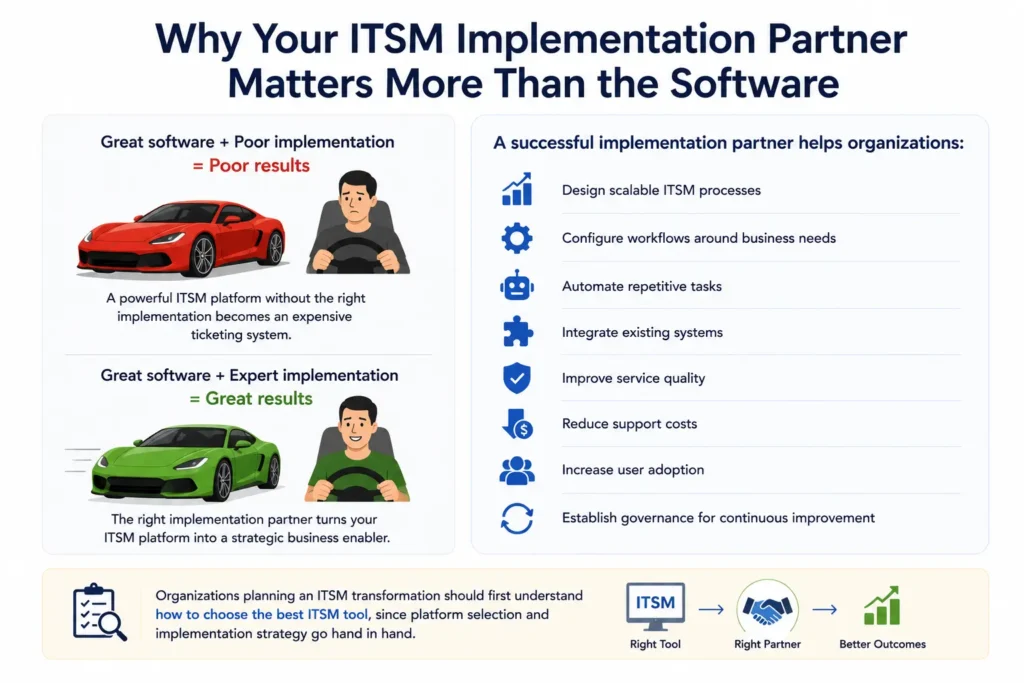
Why Your ITSM Implementation Partner Matters More Than the Software
Imagine purchasing a high-performance sports car but handing it to someone with no driving experience. The result isn’t determined by the car—it’s determined by the driver.
The same principle applies to ITSM.
Modern ITSM platforms are incredibly powerful, but without proper implementation they often become expensive ticketing systems instead of strategic business tools.
A successful implementation partner helps organizations:
- Design scalable ITSM processes
- Configure workflows around business needs
- Automate repetitive tasks
- Integrate existing systems
- Improve service quality
- Reduce support costs
- Increase user adoption
- Establish governance for continuous improvement
Organizations planning an ITSM transformation should first understand how to choose the best ITSM tool, since platform selection and implementation strategy go hand in hand.
What Does an ITSM Implementation Partner Actually Do?
Many organizations assume implementation simply means installing software.
In reality, implementation includes much more:
- ITSM maturity assessment
- Current-state analysis
- Service desk redesign
- Workflow automation
- Incident management configuration
- Change management implementation
- Asset management integration
- Knowledge management setup
- User training
- Reporting dashboards
- Post-go-live optimization
An experienced implementation partner acts as both a technology consultant and a business transformation advisor.
Question 1: Does the Partner Understand ITSM Best Practices or Just the Tool?
This is perhaps the most important question.
Many implementation vendors are certified on specific platforms but lack deep knowledge of IT Service Management principles.
There’s a significant difference between:
❌ Knowing how to configure Jira
and
✅ Knowing how Incident Management, Problem Management, Change Management, Asset Management, and Service Catalogs should operate.
Your implementation partner should understand frameworks such as:
- ITIL
- Incident Management
- Problem Management
- Change Enablement
- Service Request Management
- Continual Service Improvement
The software should support your processes—not define them.
Organizations with mature service management practices consistently outperform those that simply automate existing inefficiencies.
If your current processes need improvement, reviewing proven ITSM Best Practices for Service Management can help identify opportunities before implementation begins.
What to Ask
- How do you assess our current ITSM maturity?
- Will you redesign our processes?
- Do you follow ITIL best practices?
- Can you recommend process improvements?
Question 2: Have They Implemented ITSM Solutions for Organizations Similar to Yours?
Every industry has different service management requirements.
For example:
Manufacturing
Needs:
- Asset management
- Plant support
- Change control
Healthcare
Needs:
- Regulatory compliance
- Service availability
- Security
Financial Services
Needs:
- Audit readiness
- Risk management
- Access governance
Technology Companies
Need:
- DevOps integration
- Agile workflows
- CI/CD automation
An experienced partner understands these industry-specific challenges and brings proven implementation strategies rather than generic templates.
Ask for:
- Similar customer references
- Industry case studies
- Implementation success stories
- Client retention rates
Question 3: How Do They Approach Process Design Before Configuration?
One of the biggest implementation mistakes is configuring software before defining business processes.
Technology should always support business objectives.
A good implementation partner will first ask questions such as:
- How are incidents handled today?
- What causes service delays?
- Where are approval bottlenecks?
- Which workflows should be automated?
- Which KPIs matter most?
Only after understanding your business processes should they begin configuring the platform.
This approach helps avoid expensive rework later in the project.
Organizations focused on improving operational efficiency often discover that well-designed ITSM workflows significantly reduce manual effort and improve service quality.
For example, implementing workflow automation and self-service capabilities can dramatically reduce ticket volumes. Learn more about reducing IT support tickets through smarter service management processes.
Question 4: Can They Integrate the ITSM Platform with Your Existing Technology Stack?
An ITSM platform doesn’t operate in isolation. It should become the central hub that connects your IT operations, development teams, business applications, and infrastructure.
Unfortunately, many implementations stop at basic ticket management, leaving organizations with disconnected systems and manual work.
A capable ITSM implementation partner should evaluate your entire technology ecosystem before designing integrations.
Typical integrations include:
- Microsoft Entra ID / Active Directory
- Microsoft Teams & Slack
- Jira Software
- Confluence
- GitHub & GitLab
- Azure DevOps
- Jenkins
- Monitoring tools (SolarWinds, Datadog, Zabbix)
- Configuration Management Databases (CMDB)
- HR Systems
- Asset Management Platforms
When these systems are integrated, organizations can automate workflows such as:
- Creating incidents automatically from monitoring alerts
- Synchronizing development tickets with service requests
- Automatically assigning tickets based on business rules
- Updating asset information without manual intervention
- Triggering approvals for infrastructure changes
The result is faster service delivery, fewer manual tasks, and improved visibility across IT operations.
Questions to Ask
- Which enterprise applications have you integrated before?
- Do you have experience integrating cloud and on-premises systems?
- Can you automate workflows across multiple tools?
- How do you handle API integrations?
Question 5: What Is Their Approach to Automation and AI?
Automation has become one of the biggest drivers of ITSM success.
Organizations implementing modern service management platforms should expect far more than digital ticket forms.
A mature implementation partner should identify opportunities to automate repetitive work, including:
- Ticket routing
- Incident categorization
- Approval workflows
- Password reset requests
- Employee onboarding
- Software provisioning
- Escalation management
- SLA monitoring
Beyond automation, Artificial Intelligence is transforming service management.
Modern ITSM platforms increasingly support:
- AI-powered virtual agents
- Intelligent ticket classification
- Predictive incident management
- Knowledge recommendations
- Root cause analysis
- Automated summarization
However, AI should complement well-designed processes—not replace them.
Organizations exploring intelligent service management should understand both the opportunities and limitations by reviewing the Benefits and Challenges of AI in ITSM.
As organizations mature, many also adopt Artificial Intelligence for IT Operations (AIOps) to proactively identify anomalies, predict outages, and improve operational resilience.
Questions to Ask
- What processes can realistically be automated?
- How do you identify automation opportunities?
- Can you implement AI-powered capabilities?
- Which manual tasks can be eliminated first?
Question 6: How Do They Handle User Adoption, Training, and Change Management?
Even the most advanced ITSM platform will fail if users don’t adopt it.
Many implementations focus heavily on technology while overlooking the people who will use it every day.
Successful implementation partners invest significant effort in change management.
This includes:
- Stakeholder communication
- Role-based training
- Administrator enablement
- Knowledge transfer
- User documentation
- Adoption monitoring
- Post-go-live support
Training should extend beyond IT Administrators.
Service desk analysts, managers, business users, and leadership teams all require different levels of education to maximize platform value.
Organizations should also define clear success metrics such as:
- User adoption rates
- Self-service usage
- Ticket resolution time
- First-call resolution
- Customer satisfaction (CSAT)
These metrics help measure business outcomes rather than simply tracking technical deployment.
Good vs Great ITSM Implementation Partners
Not all implementation partners deliver the same level of value.
| Evaluation Criteria | Good Partner | Great Partner |
| Software Configuration | ✔ | ✔ |
| Process Consulting | Limited | Extensive |
| ITIL Expertise | Moderate | Advanced |
| Workflow Optimization | Basic | Strategic |
| Automation Strategy | Some | Comprehensive |
| AI Readiness | Limited | Built into roadmap |
| Integration Expertise | Standard | Enterprise-grade |
| User Training | Basic | Role-based enablement |
| Governance | Minimal | Long-term advisory |
| Continuous Improvement | Reactive | Proactive |
The difference becomes increasingly evident after go-live.
While a good partner completes the project, a great partner helps your organization continuously improve service management maturity.
Common Red Flags When Choosing an ITSM Implementation Partner
Before signing a contract, watch for these warning signs.
🚩 They Focus Only on the Software
If every conversation revolves around platform features instead of business processes, the implementation is likely to become tool-centric rather than outcome-driven.
🚩 No Discovery or Assessment Phase
Every organization is different.
If a vendor proposes an implementation without understanding your current processes, challenges, and goals, they are likely applying a one-size-fits-all approach.
🚩 Generic Project Plans
Experienced partners tailor project plans based on:
- Organization size
- IT maturity
- Industry requirements
- Existing technology landscape
- Business priorities
Avoid vendors using identical implementation templates for every customer.
🚩 No Industry References
Ask for:
- Customer references
- Industry case studies
- Similar implementation examples
- Success metrics
Proven experience reduces implementation risk.
🚩 No Post-Go-Live Support
Implementation is only the beginning.
The right partner should offer:
- Health checks
- Continuous optimization
- Process reviews
- Automation enhancements
- Platform upgrades
Continuous improvement delivers long-term ROI.
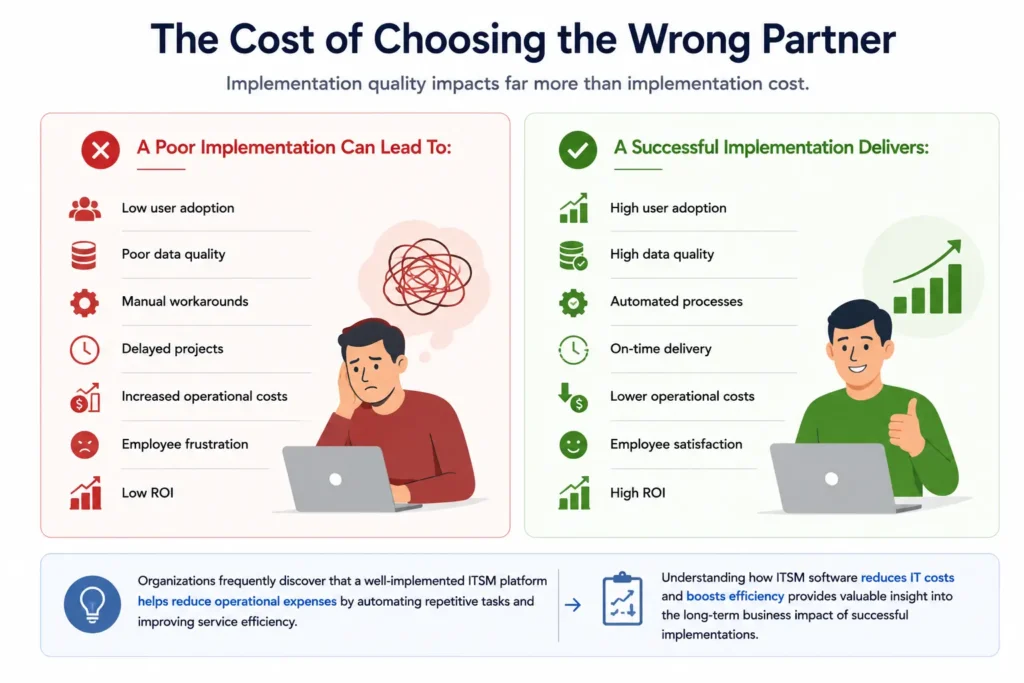
Organizations often focus on implementation cost while overlooking implementation quality.
A poor implementation can lead to:
- Low user adoption
- Poor data quality
- Manual workarounds
- Delayed projects
- Increased operational costs
- Employee frustration
- Low ROI
On the other hand, a successful implementation delivers measurable improvements in efficiency, service quality, and business agility.
Organizations frequently discover that a well-implemented ITSM platform helps reduce operational expenses by automating repetitive tasks and improving service efficiency. Understanding how ITSM software reduces IT costs and boosts efficiency provides valuable insight into the long-term business impact of successful implementations.
Question 7: How Will They Measure Success After Go-Live?
Many ITSM implementation projects are considered successful once the platform is deployed.
But deployment is not the finish line—it’s the starting point.
A successful ITSM implementation should deliver measurable business outcomes, not just a functioning service desk.
Your implementation partner should define Key Performance Indicators (KPIs) before the project begins and continuously measure progress after go-live.
Typical success metrics include:
Operational KPIs
- First Response Time (FRT)
- Mean Time to Resolution (MTTR)
- First Contact Resolution (FCR)
- SLA Compliance
- Ticket Backlog
- Incident Volume
- Change Success Rate
User Experience KPIs
- Customer Satisfaction (CSAT)
- Employee Satisfaction
- Self-Service Adoption
- Knowledge Base Usage
- Service Portal Utilization
Business KPIs
- Reduction in Operational Costs
- Increased Automation Rate
- Reduction in Manual Tasks
- Increased Productivity
- Improved Business Continuity
A mature implementation partner should also establish executive dashboards that provide real-time visibility into service performance.
Instead of relying on spreadsheets, leadership teams should have instant access to service health, SLA performance, workload trends, and operational risks.
Questions to Ask
- Which KPIs will you measure?
- How will success be reported?
- Can dashboards be customized for executives and IT managers?
- What does success look like after six months?
Question 8: Will They Support Continuous Improvement After Implementation?
Technology, business processes, and customer expectations constantly evolve.
Your ITSM platform should evolve with them.
Unfortunately, many implementation partners disappear once the system goes live.
A strategic ITSM partner remains engaged by helping organizations continuously improve their service management maturity.
Post-implementation services often include:
- Platform Health Checks
- Process Reviews
- Workflow Optimization
- Automation Enhancements
- AI Adoption
- Version Upgrades
- New Module Implementations
- Performance Assessments
- Governance Reviews
- User Adoption Programs
The best implementation partners become long-term advisors rather than one-time vendors.
As organizations mature, they often expand beyond Incident Management to include:
- Problem Management
- Change Enablement
- IT Asset Management
- Service Catalog Management
- Configuration Management
- Knowledge Management
- Enterprise Service Management (ESM)
Continuous improvement ensures your ITSM platform continues delivering business value long after deployment.
Questions to Ask
- What happens after go-live?
- Do you provide managed support?
- How often do you conduct health checks?
- Can you help expand ITSM capabilities over time?
ITSM Partner Evaluation Checklist
Before selecting an implementation partner, use this checklist to compare vendors.
| Evaluation Criteria | Yes/No |
| ITIL & ITSM Process Expertise | □ |
| Industry Experience | □ |
| Discovery & Assessment Approach | □ |
| Workflow Design Capability | □ |
| Integration Expertise | □ |
| Automation & AI Strategy | □ |
| User Training & Change Management | □ |
| Executive Reporting & Dashboards | □ |
| Post-Go-Live Support | □ |
| Continuous Improvement Services | □ |
| Customer References | □ |
| Security & Compliance Expertise | □ |
A partner who can confidently address all these areas is far more likely to deliver long-term business value.
Why Choose MicroGenesis as Your ITSM Implementation Partner?
Implementing an ITSM platform is about much more than deploying software—it’s about transforming the way your IT organization delivers services.
MicroGenesis combines decades of enterprise IT consulting experience with deep expertise in ITSM platforms, process consulting, automation, and digital transformation.
We help organizations implement scalable, future-ready service management solutions that improve operational efficiency and business outcomes.
Our ITSM Implementation Services Include
ITSM Strategy & Consulting
We assess your current IT service management maturity and develop a roadmap aligned with your business goals.
Platform Selection
Whether you’re evaluating Jira Service Management, ServiceNow, or another ITSM solution, we help you choose the platform that best fits your organization’s size, complexity, and future plans.
Process Design & Optimization
Our consultants redesign service management processes based on ITIL best practices and industry standards, ensuring workflows are efficient, scalable, and user-friendly.
Platform Configuration & Customization
We configure your ITSM platform to support your business processes rather than forcing your teams to adapt to generic workflows.
Integration Services
We integrate your ITSM platform with:
- Identity Management Systems
- Monitoring Solutions
- DevOps Platforms
- HR Applications
- Asset Management Tools
- Collaboration Platforms
- Cloud Services
Automation & AI
We identify opportunities to automate repetitive tasks and implement AI-powered capabilities that improve productivity and user experiences.
Training & Change Management
Successful adoption requires more than technical deployment.
We provide:
- Administrator Training
- Service Desk Training
- End-User Enablement
- Knowledge Transfer
- Documentation
Managed ITSM Services
Our engagement doesn’t end at go-live.
We continue supporting organizations through:
- Health Checks
- Platform Enhancements
- Process Improvements
- Automation Expansion
- Managed Support
Learn how our IT Service Management Services help organizations improve service quality, automate operations, and accelerate digital transformation.
Final Thoughts
Selecting an ITSM platform is an important decision—but selecting the right implementation partner is even more critical.
The right partner doesn’t simply configure software.
They understand your business, improve your processes, automate repetitive work, integrate enterprise systems, train your teams, and establish a foundation for continuous improvement.
Before signing a contract, ask the eight questions covered in this guide:
- Do they understand ITSM best practices?
- Have they implemented similar projects?
- How do they approach process design?
- Can they integrate with your technology ecosystem?
- What is their automation and AI strategy?
- How do they manage user adoption?
- How will they measure success?
- Will they support continuous improvement?
By evaluating implementation partners through this lens, you’ll significantly increase the likelihood of a successful ITSM transformation that delivers measurable business value.
If you’re planning an ITSM implementation or looking to modernize your existing service management environment, partnering with an experienced consulting team can make all the difference.
Ready to Transform Your IT Service Management?
Choosing the right implementation partner can be the difference between an ITSM platform that simply manages tickets and one that transforms your entire IT operation.
Whether you’re implementing a new ITSM solution, modernizing existing service management processes, or expanding into Enterprise Service Management (ESM), MicroGenesis can help you achieve faster deployments, greater automation, improved service quality, and long-term business value.
Contact our ITSM experts today To discuss your service management goals and discover how we can help you build a smarter, more efficient IT organization.