Every business has unique goals, operational challenges, and customer expectations. As organizations accelerate their digital transformation initiatives, standard software products often struggle to support specialized business processes. This growing need for tailored digital solutions has made custom software development one of the fastest-growing technology investments across industries.
Whether you’re building a customer portal, enterprise application, SaaS platform, mobile app, or modernizing legacy systems, selecting the right custom software development company can significantly influence the success of your project. A reliable technology partner not only develops software but also helps align technology with long-term business objectives, improve operational efficiency, and support future scalability.
According to industry reports, enterprises are increasingly investing in custom software development services to gain greater flexibility, stronger security, seamless integrations, and complete ownership of their applications. Unlike off-the-shelf software, custom-built solutions are designed specifically around your workflows, making them easier to scale as your organization grows.
In this guide, we’ll explore what custom software development is, why businesses choose custom software over packaged solutions, the essential qualities to look for in a development partner, and some of the top custom software development companies that organizations trust worldwide.
What Is Custom Software Development?
Custom software development is the process of designing, developing, testing, deploying, and maintaining software applications that are built specifically for an organization’s unique business requirements. Instead of adapting your business processes to fit a generic software product, custom software is designed to fit the way your business operates.
Unlike commercial software that serves a broad audience, custom applications are tailored to specific workflows, compliance requirements, integration needs, and long-term business goals. This allows organizations to automate operations, improve productivity, and deliver better customer experiences without being restricted by the limitations of standard software.
A modern custom software development company typically offers end-to-end services that include:
- Business analysis and consulting
- UI/UX design
- Web application development
- Mobile application development
- Enterprise software development
- Cloud-native application development
- API and third-party integrations
- Software testing and quality assurance
- DevOps and CI/CD implementation
- Ongoing application maintenance and support
As businesses continue to adopt cloud computing, AI, IoT, and data-driven technologies, investing in custom software development services enables organizations to remain agile while meeting evolving customer and market demands.
Why Businesses Are Investing in Custom Software Development Services
The demand for custom software development services has increased significantly over the past few years as organizations seek technology solutions that provide flexibility, scalability, and long-term value. Businesses across industries, including manufacturing, healthcare, financial services, retail, logistics, telecommunications, and government, are moving away from one-size-fits-all software in favor of solutions tailored to their operational needs.
Unlike packaged software, custom-built applications evolve alongside your business. Organizations can introduce new features, integrate with existing systems, automate repetitive tasks, and maintain complete control over future enhancements without depending on a software vendor’s product roadmap.
Some of the key benefits of investing in custom software development include:
Built Around Your Business
Every organization has its own processes and workflows. A custom application is designed to support those unique requirements instead of forcing teams to adapt to predefined software limitations.
Seamless System Integration
Modern businesses rely on multiple business applications, including ERP, CRM, HRMS, finance, analytics, and collaboration platforms. Custom software enables seamless integration across these systems, improving data consistency and operational efficiency.
Better Scalability
As your organization expands, your software should grow with it. Custom-built solutions make it easier to add new users, modules, business locations, and integrations without disrupting existing operations.
Enhanced Security
Organizations handling sensitive customer or enterprise data often require advanced security controls. Custom applications allow businesses to implement role-based access, encryption, audit trails, and compliance requirements tailored to their industry.
Improved User Experience
Employees and customers benefit from software designed specifically around their needs. Better usability leads to higher adoption rates, increased productivity, and improved customer satisfaction.
Lower Long-Term Costs
Although custom software may require a higher initial investment, it often delivers a better return over time by reducing licensing costs, minimizing manual work, and eliminating unnecessary features commonly found in commercial software.
For organizations planning long-term digital transformation initiatives, partnering with an experienced custom software development company ensures that technology investments continue delivering business value well beyond the initial implementation.
Custom Software Development vs. Off-the-Shelf Software
One of the most common questions organizations ask is whether they should invest in custom software development or purchase an existing commercial software product.
The answer depends on several factors, including business complexity, growth plans, integration requirements, and regulatory obligations.
|
Custom Software Development |
Off-the-Shelf Software |
|
Built specifically for your business |
Designed for a broad market |
|
Flexible and scalable |
Limited customization |
|
Complete ownership and control |
Vendor-controlled updates and licensing |
|
Easier integration with enterprise systems |
Integration may require additional tools |
|
Supports unique business workflows |
Businesses often adjust processes to fit the software |
|
Higher initial investment with long-term value |
Lower upfront cost but recurring licensing fees |
Organizations with unique operational requirements, industry-specific compliance needs, or plans for rapid growth often realize greater long-term value through custom software development services.
If you’re evaluating whether a tailored solution is the right choice for your organization, our detailed comparison of Custom Software vs. Off-the-Shelf Software explains the advantages, limitations, and business scenarios for each approach.
How to Choose the Right Custom Software Development Company
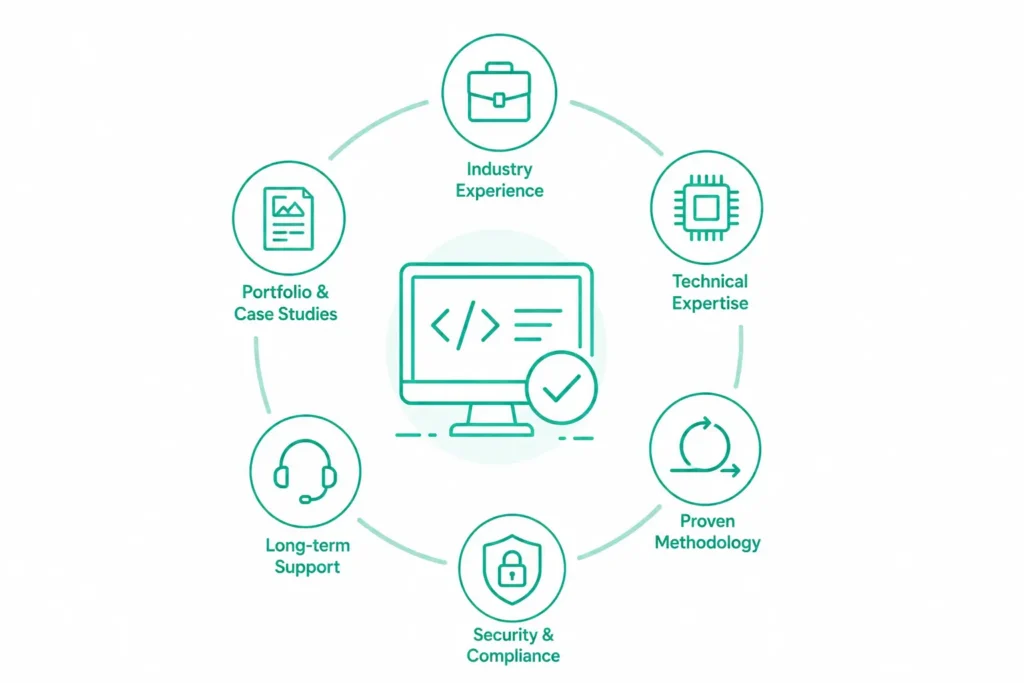
Selecting the right custom software development company is one of the most important decisions in any digital transformation initiative. While technical expertise is essential, the ideal technology partner should also understand your business objectives, industry challenges, and long-term growth strategy.
Many organizations compare multiple custom software development companies before making a decision. Instead of focusing only on cost, evaluate each company based on experience, delivery capabilities, communication, and long-term support.
Here are the key factors to consider when choosing a software development partner.
Industry Experience and Domain Knowledge
A development partner with industry-specific experience can reduce project risks and accelerate delivery. Companies that have worked on similar business problems are more likely to understand compliance requirements, customer expectations, and operational challenges.
For example, an enterprise developing software for manufacturing may require integrations with ERP systems, IoT platforms, and production planning tools, while a healthcare provider may prioritize regulatory compliance and data security.
Review previous projects, customer success stories, and industries served before finalizing your decision.
Technical Expertise Across Modern Technologies
Technology evolves rapidly, and your development partner should be capable of building solutions using modern frameworks and cloud platforms.
Leading custom software development services typically include expertise in:
- Cloud-native application development
- Enterprise software development
- Mobile application development
- Web application development
- API development and integration
- Artificial Intelligence and Machine Learning
- DevOps and CI/CD automation
- Containerization using Docker and Kubernetes
- Cloud platforms such as AWS, Microsoft Azure, and Google Cloud
A strong technical foundation ensures your application remains scalable, secure, and easy to maintain.
Proven Development Methodology
Successful projects depend on a structured delivery process. Most experienced custom software development companies follow Agile methodologies, enabling continuous collaboration and faster releases.
Look for organizations that provide:
- Discovery workshops
- Sprint planning
- Regular demonstrations
- Continuous testing
- Transparent progress reporting
- Frequent stakeholder communication
An Agile approach allows businesses to adapt to changing requirements while minimizing development risks.
Portfolio and Case Studies
A company’s portfolio provides valuable insight into the complexity of projects it has delivered.
When reviewing portfolios, consider:
- Industry relevance
- Project scale
- Technologies used
- Business outcomes
- Integration capabilities
- User experience design
Real-world case studies often demonstrate how a custom software development company solves business problems rather than simply delivering software.
Security and Compliance
Modern applications manage large volumes of sensitive business and customer information.
Choose a development partner that follows established security practices, including:
- Secure coding standards
- Data encryption
- Identity and access management
- Security testing
- Vulnerability assessments
- Compliance with applicable regulations
Building security into every stage of development helps reduce operational and cybersecurity risks.
Long-Term Support and Application Maintenance
Software development does not end after deployment. Business applications require continuous monitoring, performance optimization, feature enhancements, and security updates.
Organizations should evaluate the post-deployment services offered by a custom software development company, including:
- Application monitoring
- Performance optimization
- Bug fixes
- Version upgrades
- Security patching
- Feature enhancements
- Infrastructure management
Long-term maintenance ensures applications continue delivering value as business requirements evolve.
Related Service
Explore our Application Management Services to understand how proactive maintenance improves application performance and business continuity.
Core Custom Software Development Services Offered by Leading Companies
Most organizations require more than software development alone. Today’s leading custom software development services companies provide end-to-end engineering capabilities that support the entire software lifecycle.
Below are some of the most common services offered by experienced software development providers.
Enterprise Software Development
Enterprise applications help organizations automate business processes, improve collaboration, and manage operations across departments.
Typical enterprise solutions include:
- ERP extensions
- HR management systems
- Customer portals
- Supplier management systems
- Inventory management
- Manufacturing execution systems
- Business intelligence dashboards
Enterprise-grade applications are designed for scalability, security, and long-term performance.
Custom Web Application Development
Web applications enable organizations to deliver digital services across devices without requiring software installation.
Common examples include:
- Customer self-service portals
- Online booking platforms
- eCommerce solutions
- Vendor management systems
- SaaS platforms
- Internal workflow automation
Modern custom software application development focuses on responsive design, cloud scalability, and seamless user experiences.
Mobile Application Development
Mobile applications have become essential for customer engagement and workforce productivity.
Leading custom software developers build:
- Native Android applications
- Native iOS applications
- Cross-platform mobile apps
- Enterprise mobility solutions
- Field service applications
These applications integrate securely with existing enterprise systems while providing consistent user experiences.
Cloud Application Development
Organizations increasingly adopt cloud-native architectures to improve flexibility and reduce infrastructure costs.
Cloud development services often include:
- Cloud migration
- Microservices architecture
- Serverless computing
- Container orchestration
- Cloud security
- Managed cloud services
Cloud-based applications offer improved scalability, availability, and disaster recovery capabilities.
Legacy Application Modernization
Many businesses continue operating applications that were developed years ago. Although these systems remain business-critical, they often create operational bottlenecks.
Modernization initiatives typically include:
- Application re-engineering
- Platform migration
- UI modernization
- Database migration
- API enablement
- Cloud migration
Modernizing legacy applications improves performance while extending software lifespan.
Related Reading
Learn more about Legacy System Modernization and the steps involved in successfully transforming older applications.
Application Integration Services
Businesses use multiple software platforms that must exchange information efficiently.
Integration services include:
- ERP integration
- CRM integration
- Third-party APIs
- Payment gateways
- Enterprise messaging
- Workflow automation
- Data synchronization
Well-designed integrations eliminate manual processes and improve operational efficiency.
Application Modernization and Continuous Improvement
Successful organizations continuously improve their software rather than replacing entire systems every few years.
Continuous improvement activities include:
- Feature enhancements
- UI improvements
- Performance tuning
- Security upgrades
- Cloud optimization
- Process automation
Organizations adopting this approach maximize the return on their software investment.
Questions You Should Ask Before Hiring a Custom Software Development Company
Choosing among numerous custom software development companies becomes easier when you ask the right questions during the evaluation process.
Consider discussing the following:
- Have you delivered projects similar to ours?
- Which industries do you specialize in?
- What development methodology do you follow?
- How do you estimate project timelines and costs?
- What technologies do you recommend and why?
- How do you manage changing requirements?
- What testing and quality assurance practices do you follow?
- Who owns the source code and intellectual property?
- What support services are available after deployment?
- Can you share customer references or case studies?
The quality of these discussions often provides valuable insight into a company’s technical expertise, transparency, and collaborative approach.
Related Reading
Learn how choosing the right technology stack impacts software scalability and long-term success.
Top Custom Software Development Companies
The global demand for custom software development services continues to grow as organizations invest in digital transformation, cloud adoption, artificial intelligence, automation, and enterprise modernization. As a result, businesses have access to hundreds of technology vendors worldwide, each offering different capabilities, industry expertise, and delivery models.
Choosing the right custom software development company depends on several factors, including project complexity, technology requirements, budget, industry experience, and long-term support capabilities. While some organizations specialize in enterprise consulting, others focus on product engineering, cloud-native development, or custom application development.
The following companies are recognized for delivering high-quality custom software development solutions across multiple industries.
1. MicroGenesisTechSoft
MicroGenesis TechSoft is an enterprise-focused custom software development company that helps organizations accelerate digital transformation through tailored software engineering services. With more than two decades of experience, the company delivers scalable software solutions for manufacturing, automotive, aerospace, defense, healthcare, BFSI, and public sector organizations.
Its custom software development services cover the complete application lifecycle, from business consulting and solution architecture to development, testing, deployment, modernization, and long-term application management. The company also specializes in cloud migration, DevOps implementation, Agile transformation, enterprise integrations, and digital engineering solutions.
MicroGenesis combines technical expertise with strong domain knowledge, enabling organizations to modernize legacy applications, streamline business processes, and build secure, scalable enterprise platforms that support future growth.
Core Expertise
- Enterprise Application Development
- Custom Web & Mobile Development
- Cloud Migration & Modernization
- DevOps & CI/CD Automation
- Enterprise Integration Services
- Application Modernization
- Software Maintenance & Support
2. Accenture
Accenture is one of the world’s largest technology consulting firms, delivering enterprise-scale custom software development services for global organizations. Its expertise spans cloud transformation, enterprise applications, artificial intelligence, cybersecurity, and digital engineering.
The company works with businesses across financial services, healthcare, retail, manufacturing, and public services to develop scalable software solutions aligned with complex business objectives.
3. IBM Consulting
IBM Consulting provides enterprise custom software development solutions with a strong focus on hybrid cloud, artificial intelligence, data platforms, and enterprise automation. Its development teams help organizations modernize mission-critical applications while improving operational efficiency and security.
IBM is particularly recognized for supporting large enterprises undergoing digital transformation initiatives.
4. Capgemini
Capgemini offers comprehensive custom software development services for organizations seeking cloud-native applications, intelligent automation, enterprise modernization, and digital transformation. The company combines consulting, engineering, and managed services to support global enterprises across multiple industries.
5. EPAM Systems
EPAM Systems is known for delivering high-quality custom software application development and digital engineering services. Its expertise includes cloud engineering, product development, customer experience, data analytics, and AI-powered applications.
The company works with organizations requiring complex enterprise software and product engineering capabilities.
6. Globant
Globant helps businesses develop innovative digital products through custom software development, cloud engineering, artificial intelligence, user experience design, and enterprise modernization.
Its multidisciplinary teams support organizations looking to accelerate innovation while improving customer experiences.
7. Thoughtworks
Thoughtworks is widely recognized for Agile software development, technology consulting, and enterprise modernization. The company focuses on helping organizations build scalable digital platforms using modern engineering practices and cloud-native architectures.
Its consulting-led approach makes it a preferred partner for organizations undertaking complex software transformation initiatives.
8. BairesDev
BairesDev delivers nearshore custom software development services for businesses across North America and Europe. Its engineering teams specialize in web development, mobile applications, enterprise software, cloud solutions, and software product development.
The company provides flexible engagement models suitable for startups as well as large enterprises.
9. Persistent Systems
Persistent Systems offers custom software development solutions with expertise in enterprise software, cloud modernization, digital engineering, healthcare technology, banking, and industrial automation. The company assists organizations in building scalable digital platforms while modernizing legacy systems.
10. Cognizant
Cognizant provides enterprise software development services covering digital engineering, cloud migration, AI implementation, data analytics, cybersecurity, and application modernization. Its extensive global delivery capabilities enable organizations to execute large-scale digital transformation programs efficiently.
Comparison of Top Custom Software Development Companies
Selecting the best custom software development company depends on your organization’s objectives, project complexity, and technology requirements. The table below provides a high-level comparison of the companies discussed above.
|
Company |
Primary Focus |
Best For |
|
MicroGenesis TechSoft |
Enterprise Software, Cloud, DevOps, Digital Engineering |
Manufacturing, Automotive, Aerospace, Defense, BFSI |
|
Accenture |
Enterprise Consulting & Digital Transformation |
Large Global Enterprises |
|
IBM Consulting |
Hybrid Cloud & Enterprise AI |
Regulated Industries & Large Enterprises |
|
Capgemini |
Cloud Engineering & Business Transformation |
Enterprise Modernization |
|
EPAM Systems |
Product Engineering & Digital Platforms |
Software Product Companies |
|
Globant |
Digital Innovation & Customer Experience |
Digital-First Organizations |
|
Thoughtworks |
Agile Engineering & Cloud-Native Development |
Complex Enterprise Programs |
|
BairesDev |
Nearshore Software Development |
Startups & Mid-Market Businesses |
|
Persistent Systems |
Enterprise Applications & Digital Engineering |
Healthcare, BFSI & Manufacturing |
|
Cognizant |
Enterprise Technology Services |
Large Digital Transformation Projects |
Which Custom Software Development Company Is Right for Your Business?
There is no single best custom software development company for every organization. The right partner depends on your business objectives, industry, budget, technical requirements, and long-term roadmap.
When evaluating custom software development companies, consider the following:
- Industry expertise and domain knowledge
- Technical capabilities and technology stack
- Experience with similar projects
- Delivery methodology and communication
- Security and compliance practices
- Post-deployment maintenance and support
- Ability to scale development teams
- Customer references and proven project outcomes
Organizations should look beyond pricing and choose a technology partner capable of supporting innovation throughout the software lifecycle.
For businesses seeking a combination of consulting, engineering expertise, cloud capabilities, and long-term application support, MicroGenesis TechSoft provides end-to-end custom software development services tailored to evolving business requirements.
Our Custom Software Development Process
A successful custom software development project follows a structured approach that minimizes risks, improves collaboration, and ensures the final product aligns with business objectives. Leading custom software development companies typically follow an Agile methodology to deliver faster releases and continuous improvements.
1. Discovery & Requirement Analysis
The process begins with understanding your business goals, user requirements, and technical challenges. This phase helps define the project scope, timeline, and technology roadmap.
2. UI/UX Design
Designers create intuitive interfaces and user journeys that enhance usability and improve customer experience.
3. Development
Developers build secure and scalable applications using modern frameworks and best coding practices.
4. Testing & Quality Assurance
Comprehensive testing ensures the application performs reliably across devices, browsers, and environments.
5. Deployment & Support
Once deployed, continuous monitoring, maintenance, and feature enhancements keep the software secure and future-ready.
Related Reading: If you’d like a deeper understanding of each stage, explore our guide on the Custom App Development Process.
Choosing the Right Technology Stack for Custom Software Development
Selecting the right technology stack is essential for building scalable and high-performing applications. The choice depends on project requirements, expected user load, integration needs, and future scalability.
Modern custom software development services commonly use technologies such as:
- React & Angular for front-end development
- .NET, Java, Node.js, and Python for back-end development
- AWS, Microsoft Azure, and Google Cloud for cloud infrastructure
- Docker and Kubernetes for containerization
- PostgreSQL, MySQL, and MongoDB for databases
Choosing the right combination improves performance, reduces maintenance costs, and supports long-term business growth.
Related Reading: Learn how to select the best technologies in our blog on Building Scalable Apps: Choosing the Right Technology Stack.
Why Legacy Application Modernization Matters
Many organizations still rely on legacy applications that are difficult to maintain, expensive to upgrade, and incompatible with modern business needs. Instead of replacing these systems entirely, businesses often choose to modernize them.
Legacy modernization helps organizations:
- Improve application performance
- Enhance security and compliance
- Reduce operational costs
- Enable cloud migration
- Simplify integration with modern platforms
- Deliver better user experiences
Modernization also extends the life of existing business applications while supporting future innovation.
Related Reading: Discover the key steps involved in Legacy System Modernization.
Why Application Management Is Essential After Deployment
Launching software is only the beginning. To ensure long-term success, organizations need continuous monitoring, regular updates, security patches, and performance optimization.
Professional application management services help businesses:
- Monitor application performance
- Resolve issues proactively
- Improve system availability
- Apply security updates
- Optimize application performance
- Introduce new features as business needs evolve
Ongoing maintenance reduces downtime and helps organizations maximize the value of their software investment.
Learn More: Explore our Application Management Services to see how proactive support keeps enterprise applications secure, reliable, and scalable.
Why Choose Custom Software Over Off-the-Shelf Solutions?
While off-the-shelf software offers quick deployment, it may not address unique business processes or support future growth. In contrast, custom software development solutions are built around your specific requirements, giving you greater flexibility and control.
|
Custom Software |
Off-the-Shelf Software |
|
Tailored to business needs |
Designed for a general audience |
|
Scalable and flexible |
Limited customization |
|
Easy integration with existing systems |
Integration can be challenging |
|
Full ownership and control |
Vendor-controlled updates and licensing |
|
Competitive advantage |
Common functionality shared by many businesses |
Choosing the right approach depends on your organization’s goals, complexity, and long-term technology strategy.
Why Businesses Choose MicroGenesis TechSoft for Custom Software Development
Selecting the right custom software development company requires more than technical expertise. Businesses need a technology partner that understands industry challenges, aligns software with business objectives, and delivers scalable solutions that support long-term growth. MicroGenesis TechSoft has been helping organizations achieve these goals by delivering customized software solutions for over 25 years.
With experience across industries such as manufacturing, automotive, aerospace, defense, healthcare, banking, retail, and the public sector, MicroGenesis TechSoft combines domain expertise with modern engineering practices to develop applications that improve operational efficiency, streamline business processes, and support digital transformation initiatives.
Industry-Specific Expertise
MicroGenesis TechSoft develops software solutions tailored to the unique requirements of different industries. By understanding business workflows, compliance standards, and operational challenges, the company delivers applications that address real business needs rather than relying on generic software functionality.
End-to-End Custom Software Development Services
From initial consulting and solution design to application development, testing, deployment, and ongoing support, MicroGenesis TechSoft offers end-to-end custom software development services. This comprehensive approach helps organizations accelerate development while maintaining quality, security, and scalability throughout the software lifecycle.
Modern Technology and Agile Delivery
MicroGenesis TechSoft leverages modern technologies, cloud platforms, Agile methodologies, and DevOps practices to develop secure and scalable enterprise applications. The company’s engineering approach enables faster development cycles, improved collaboration, and solutions that can evolve alongside changing business requirements.
Legacy Application Modernization
Many organizations continue to rely on legacy applications that limit innovation and operational efficiency. MicroGenesis TechSoft helps modernize these systems through application re-engineering, cloud migration, API integration, and performance optimization, enabling businesses to extend the value of existing investments while preparing for future growth.
Related Reading: Organizations planning modernization initiatives can explore this guide on Steps to a Successful Legacy System Modernization.
Ongoing Application Management and Support
Successful software requires continuous maintenance after deployment. MicroGenesis TechSoft provides application management services that include performance monitoring, security updates, issue resolution, and feature enhancements to ensure applications remain reliable, secure, and aligned with evolving business needs.
Learn More: Explore the company’s Application Management Services to understand how proactive support improves application reliability and long-term performance.
Key Custom Software Development Capabilities
MicroGenesis TechSoft provides a comprehensive portfolio of custom software development solutions, including:
- Enterprise Software Development
- Custom Web Application Development
- Mobile Application Development
- Cloud-Native Application Development
- API and Third-Party Integrations
- Legacy Application Modernization
- DevOps and CI/CD Implementation
- UI/UX Design
- Quality Assurance and Testing
- Application Maintenance and Support
By combining industry expertise, modern technologies, and a customer-focused delivery approach, MicroGenesis TechSoft enables organizations to build scalable, secure, and future-ready software that supports long-term business success.
Frequently Asked Questions About Custom Software Development
What is custom software development?
Custom software development is the process of designing, building, testing, and maintaining software that is tailored to an organization’s specific business requirements. Unlike commercial software, custom applications are developed to support unique workflows, integrate with existing systems, and scale as business needs evolve.
Why should businesses choose custom software development services?
Custom software development services provide greater flexibility, enhanced security, seamless integrations, and complete ownership of the application. Businesses can eliminate unnecessary features, automate processes, and create software that aligns with their long-term digital transformation strategy.
How do I choose the right custom software development company?
When selecting a custom software development company, evaluate its industry experience, technical expertise, portfolio, development methodology, communication process, security practices, and post-deployment support. Choosing a partner with relevant domain knowledge often leads to better project outcomes.
What industries benefit from custom software development?
Organizations across manufacturing, healthcare, banking, financial services, insurance, retail, logistics, automotive, aerospace, telecommunications, and government benefit from custom software development solutions that address their specific operational challenges.
How long does a custom software development project take?
Project timelines vary depending on complexity, features, integrations, and business requirements. A simple application may take a few months, while enterprise-scale custom software development projects can span several months or longer.
What is the difference between custom software and off-the-shelf software?
Off-the-shelf software is designed for a broad audience with standardized features, whereas custom software development focuses on creating applications tailored to a specific organization’s workflows, users, and business objectives.
Can custom software integrate with existing business systems?
Yes. One of the key advantages of custom software development services is the ability to integrate with ERP systems, CRM platforms, accounting software, HR applications, cloud services, APIs, and other enterprise systems, enabling seamless data exchange and improved operational efficiency.
Why is application maintenance important after software deployment?
Regular maintenance helps keep applications secure, reliable, and aligned with changing business requirements. Activities such as performance optimization, security updates, bug fixes, and feature enhancements ensure software continues to deliver value throughout its lifecycle.
Final Thoughts
Selecting the right custom software development company is a strategic decision that can influence your organization’s long-term success. Beyond technical expertise, the ideal technology partner should understand your business goals, industry challenges, and growth plans while delivering scalable, secure, and future-ready solutions.
Whether you’re developing a new enterprise application, modernizing legacy software, or expanding digital capabilities, investing in custom software development services enables your business to build solutions that support innovation, improve operational efficiency, and create better customer experiences.
As technology continues to evolve, organizations that prioritize tailored software solutions will be better positioned to adapt to changing market demands and maintain a competitive advantage.
If you’re evaluating software development partners, focus on experience, technical capabilities, transparency, and long-term support to ensure your investment delivers measurable business value.