
Businesses today need software that can do more than provide standard features. As processes become more specialized and customer expectations continue to change, organizations often need applications that fit their operations instead of forcing their teams to change the way they work.
This is where custom software development becomes valuable.
Custom software is created around the specific requirements of a business, product, department, or user group. It can support a unique workflow, connect multiple business systems, automate repetitive activities, or provide functionality that is not available in standard commercial software.
For some organizations, custom software may be a completely new application. For others, it may involve extending an existing platform, developing integrations, modernizing an older application, or creating a specialized digital product.
This guide explains what is custom software, how custom software development works, the benefits and custom software examples, when businesses should consider a custom solution, and how to select the right development partner.
What Is Custom Software?
So, what is custom software?
Custom software is software developed specifically to address the requirements of a particular business or group of users. Instead of offering the same functionality to a broad market, the application is planned around defined business processes, users, technical requirements, and objectives.
In simple terms, custom software is built around the business rather than requiring the business to work around a fixed software product.
A custom solution can be developed from the beginning or created by modifying and extending an existing application. Depending on the business requirement, it can take the form of:
- Web applications
- Mobile applications
- Enterprise applications
- Customer portals
- Internal business platforms
- Workflow automation solutions
- CRM and ERP applications
- Data and analytics platforms
- Industry-specific applications
- Software integration solutions
For example, a logistics company may require an application that combines shipment tracking, warehouse operations, customer notifications, inventory information, and reporting. If available products cannot support this combination effectively, custom software development can provide a solution designed around those requirements.
Businesses exploring application development can also review the custom app development process to understand how an idea can move from requirements and planning through development and deployment.
What Is Customized Software?
What is customized software and how is it different from completely new software?
Customized software generally refers to software that has been adapted or enhanced to meet particular business requirements. Customization can range from adding specific functionality to an existing platform to developing substantial new capabilities.
For example, an organization may already use an enterprise application but require a specialized approval workflow, reporting module, customer portal, or integration. Instead of replacing the existing system, the organization may choose a customized software approach.
This gives businesses several possible approaches:
Existing software + configuration
Existing software + customization
Existing software + custom integrations
New software + custom development
The appropriate option depends on the organization’s business requirements, existing technology environment, budget, scalability needs, and long-term plans.
Custom Software vs Off-the-Shelf Software
Choosing between custom and off-the-shelf software is an important business decision.
Off-the-shelf software is developed for a broad group of customers. It can be useful when an organization needs established functionality that closely matches its requirements and wants to implement a solution quickly.
Custom software takes a more specific approach. The application is designed around the organization’s processes and can include functionality, integrations, workflows, and user experiences that are specific to its requirements.
|
Factor |
Custom Software |
Off-the-Shelf Software |
|
Business requirements |
Built around specific needs |
Based on common market requirements |
|
Customization |
High |
Limited to available options |
|
Integrations |
Can be developed for required systems |
Depends on supported integrations |
|
Scalability |
Designed around expected growth |
Depends on the product and vendor |
|
Development |
Requires planning and implementation |
Generally ready for deployment |
|
Initial investment |
Usually higher |
Usually lower |
|
Flexibility |
High |
Depends on vendor capabilities |
|
Product roadmap |
Greater control over enhancements |
Influenced by the software vendor |
There is no universal answer to which approach is better. The decision should depend on the business problem, required functionality, implementation timeline, available resources, and expected long-term value.
For a more detailed comparison, see custom software vs off-the-shelf solutions.
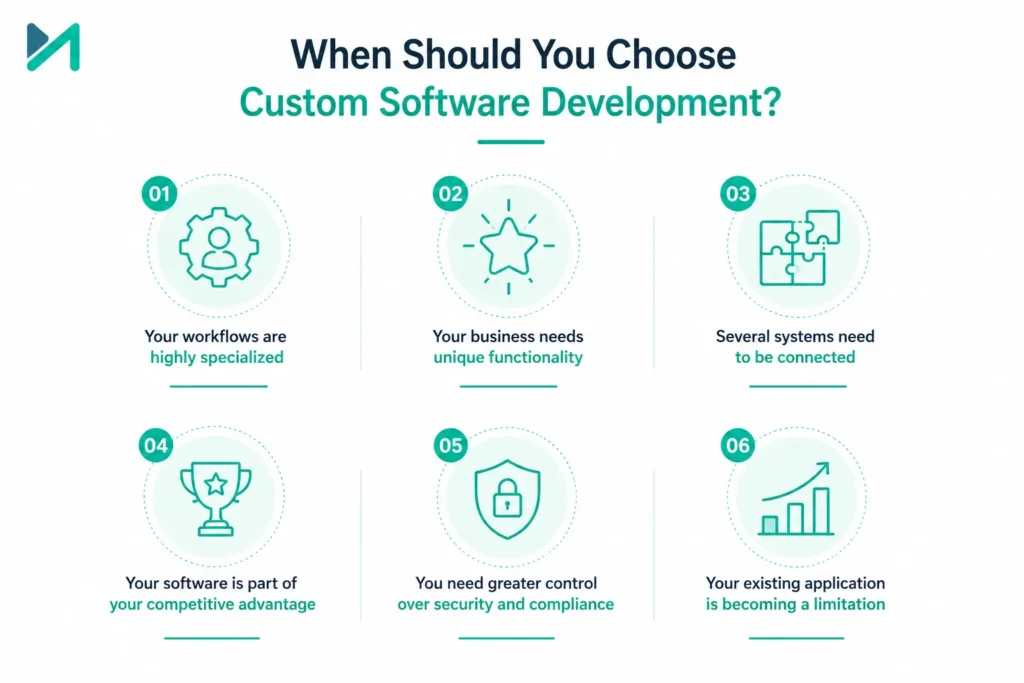
When Should You Choose Custom Software Development?
Not every business needs a custom application. Standard software can be the right choice when it already provides the required functionality at an acceptable cost.
However, custom software development services become worth considering when standard products create significant limitations.
Your workflows are highly specialized
Some organizations have processes that do not match conventional software workflows. A custom solution can be designed around those processes instead of requiring employees to rely on workarounds.
Your business needs unique functionality
A business may require capabilities that are unavailable in standard products. This could include specialized calculations, approval processes, dashboards, customer experiences, or industry-specific functionality.
Several systems need to be connected
Businesses often operate multiple platforms for finance, CRM, ERP, HR, sales, operations, analytics, and customer management.
Custom software can connect these systems and provide a unified experience for users.
Your software is part of your competitive advantage
If an application directly supports the way your business delivers products or services, using a generic platform may limit differentiation.
A custom software example could be a proprietary customer platform, specialized analytics application, automated pricing system, or unique operational workflow that supports a company’s competitive strategy.
You need greater control over security and compliance
Organizations operating in regulated or security-sensitive environments may have specific requirements for data handling, access control, audit trails, integrations, and application behavior.
A custom solution gives the organization greater control over how these requirements are incorporated into the application architecture.
Your existing application is becoming a limitation
Older applications can become difficult to maintain, integrate, or scale as business requirements change.
In these situations, organizations can consider modernization rather than continuing to invest heavily in an application that no longer supports their long-term objectives.
For organizations evaluating modernization initiatives, legacy system modernization can provide a structured way to update older applications while preserving important business capabilities.
Key Benefits of Custom Software Development Services
The value of custom software development should be measured by how effectively the solution addresses a business problem. When planned correctly, custom applications can provide several long-term advantages.
Designed Around Business Requirements
The primary advantage of custom software is its ability to reflect the way an organization actually operates.
Workflows, user roles, business rules, reporting requirements, and integrations can be defined according to specific business needs.
This can reduce unnecessary manual processes and eliminate workarounds created to compensate for limitations in standard software.
Greater Flexibility
Business requirements do not remain static.
Organizations may introduce new products, expand into new markets, change internal processes, or add new customer requirements. Customizable software can be designed so that future enhancements can be incorporated as the organization evolves.
Better Integration
A modern business may depend on numerous applications and services.
Custom software can be designed to integrate with:
- CRM platforms
- ERP systems
- Payment gateways
- Databases
- Cloud services
- Analytics platforms
- Third-party APIs
- Internal applications
This can help create a more connected technology environment and reduce repetitive data entry.
Scalability
A custom application can be planned according to expected business growth.
Scalability may involve supporting:
- More users
- Higher transaction volumes
- Additional locations
- New business functions
- More integrations
- Increased data volumes
This makes custom development particularly useful when an organization’s future requirements are difficult to accommodate with a fixed software product.
Greater Control
With a custom solution, businesses can have greater control over application functionality, architecture, integrations, and future development priorities.
This can be particularly valuable when the software supports a critical business process.
Long-Term Business Value
Custom development may require a higher initial investment than purchasing an existing application.
However, the overall value should be assessed over the full lifecycle of the solution. Reduced manual effort, fewer software dependencies, better productivity, improved customer experiences, and new revenue opportunities can contribute to a stronger long-term return.
Opportunity for Differentiation
One of the strongest reasons to develop custom software is the ability to create capabilities that directly support a company’s business model.
A specialized customer experience, proprietary workflow, unique analytics platform, or automated business process can become an important competitive asset.
Custom Software Examples and Common Use Cases
The best way to understand the value of custom software is to look at the types of business problems it can solve. A custom solution can support a single department, connect multiple business functions, or become the foundation of an entire digital product.
Here are some common custom software examples across different business environments.
Custom CRM and ERP Software
Businesses often have customer, finance, inventory, procurement, and operational processes that do not fit neatly into a standard CRM or ERP product.
A custom software example in this area could combine customer management, order processing, inventory visibility, billing, and reporting into a single application.
The advantage is that the software can reflect the organization’s actual processes instead of requiring employees to work around limitations in a standard system.
Custom eCommerce Platforms
Businesses with specialized selling models may need more flexibility than a standard eCommerce platform provides.
Custom eCommerce applications can support:
- Personalized checkout processes
- Complex pricing rules
- Subscription models
- Multiple languages
- Customer-specific catalogs
- Payment integrations
- Logistics integrations
- Custom loyalty programs
These capabilities can help businesses create a customer experience that is closely aligned with their commercial strategy.
Healthcare Software
Healthcare organizations handle sensitive information and often have complex operational workflows.
Examples of customized software in healthcare include applications for:
- Patient management
- Appointment scheduling
- Telehealth
- Medical records
- Insurance processing
- Laboratory integration
- Healthcare reporting
Because healthcare workflows and compliance requirements can vary, customized software can be designed around the specific operational and security requirements of the organization.
Financial and FinTech Applications
Banks, financial institutions, and FinTech companies frequently require software with specialized security, transaction, analytics, and risk management capabilities.
Examples include:
- Digital banking applications
- Investment platforms
- Fraud detection systems
- Risk assessment applications
- Payment solutions
- Financial reporting platforms
For organizations where software functionality directly affects customer experience or financial operations, custom software development can provide greater control over functionality and integrations.
Custom Mobile Applications
Mobile applications can be developed specifically for employees, customers, partners, or field teams.
For example, a company could develop a mobile application for:
- Customer engagement
- Loyalty programs
- Field service management
- Employee communication
- Real-time notifications
- Delivery tracking
A custom mobile application can be designed around the organization’s user journey instead of being limited to the functionality provided by a generic product.
Workflow Automation Software
Many organizations still depend on manual processes for approvals, procurement, employee onboarding, compliance activities, and document management.
Custom workflow applications can automate these processes by defining:
- Business rules
- Approval levels
- Notifications
- User permissions
- Escalation processes
- Reporting requirements
The result can be a more consistent workflow with fewer repetitive administrative tasks.
Learning Management Systems
Educational institutions and organizations with internal training programs may require specialized Learning Management Systems (LMS).
A custom LMS can support:
- Course management
- Assessments
- Employee or student tracking
- Certifications
- Learning paths
- Progress reporting
- User management
This allows the organization to create a learning environment around its own training model and requirements.
Logistics and Inventory Applications
Logistics companies often need software that connects several operational activities.
A custom platform can combine:
- Shipment tracking
- Warehouse management
- Inventory monitoring
- Route planning
- Supplier information
- Customer notifications
- Demand forecasting
These custom software examples demonstrate how specialized applications can bring multiple operational processes into a connected environment.
Custom Software Development Process
A successful custom software project starts with understanding the business problem, not with selecting a programming language or framework.
The development process typically moves through several stages.
Discovery and Requirement Analysis
The first step is to understand what the organization needs the software to accomplish.
The development team works with stakeholders to identify:
- Business objectives
- User requirements
- Existing processes
- Technical constraints
- Integration requirements
- Security requirements
- Expected outcomes
Existing applications and workflows may also be reviewed to identify gaps and opportunities for improvement.
A clear discovery phase prevents teams from building functionality that does not address the actual business problem.
Solution Planning
Once requirements are understood, the team defines the proposed solution.
This stage may include:
- Functional scope
- Technical architecture
- Integration approach
- Technology selection
- Project roadmap
- Delivery milestones
The objective is to establish a practical foundation before development begins.
UI and UX Design
The user experience is then planned around the people who will actually use the software.
Design activities can include:
- User journeys
- Wireframes
- Prototypes
- Interface designs
- Usability reviews
Early feedback helps identify usability issues before they become expensive to change during development.
Development and Integration
Developers then build the application according to the approved requirements and architecture.
Development may include:
- Frontend development
- Backend development
- Database implementation
- API development
- Third-party integrations
- Security implementation
Agile development practices can be used to deliver functionality in smaller iterations, allowing stakeholders to review progress throughout the project.
Testing and Quality Assurance
Testing verifies that the software works as expected and satisfies the defined requirements.
Depending on the application, testing can include:
- Functional testing
- Integration testing
- Regression testing
- Performance testing
- Security testing
- User Acceptance Testing (UAT)
Quality assurance should continue throughout development rather than being treated as a final step.
Deployment
Once the application has passed the required testing, it can be deployed to its intended environment.
Depending on the project, deployment may involve:
- Cloud infrastructure
- On-premise infrastructure
- Hybrid environments
- Application configuration
- Data migration
- Production monitoring
A controlled deployment process helps reduce disruption to existing business operations.
Maintenance and Continuous Improvement
Custom software does not end with deployment.
As business requirements change, the application may need:
- Bug fixes
- Security updates
- Performance improvements
- New features
- Integration changes
- Technology upgrades
Ongoing application management helps keep the software reliable and aligned with business priorities.
For organizations that need continuous support after development, an Application Management Service can help manage application performance, maintenance, enhancements, and ongoing operational requirements.
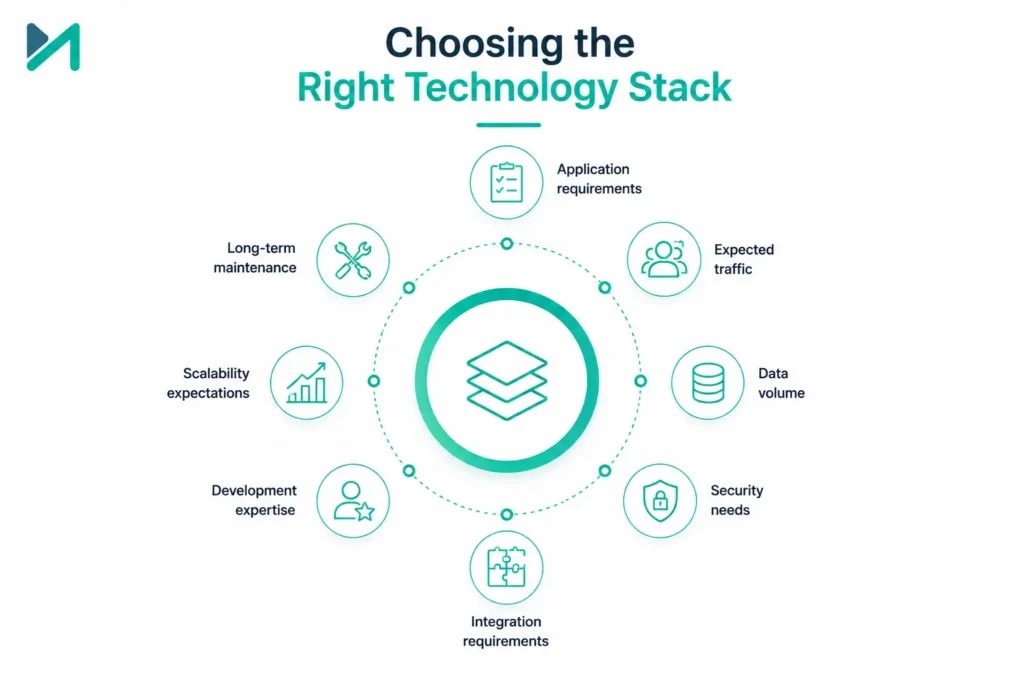
Choosing the Right Technology Stack
Technology selection can have a significant impact on the performance, scalability, security, and maintainability of custom software.
The right stack depends on factors such as:
- Application requirements
- Expected traffic
- Data volume
- Security needs
- Integration requirements
- Development expertise
- Scalability expectations
- Long-term maintenance
There is no single technology stack that is suitable for every project.
For example, a high-volume enterprise application may require a different architecture from a lightweight customer-facing mobile application.
Businesses should therefore evaluate technology choices according to the actual requirements of the project rather than selecting technologies simply because they are popular.
For a deeper look at this decision, see building scalable apps and choosing the right technology stack.
Custom Software and Legacy Modernization
Custom software development is also relevant when an organization has an existing application that has become difficult to maintain or extend.
Legacy applications can create challenges such as:
- Outdated technologies
- Difficult integrations
- Limited scalability
- Security concerns
- High maintenance costs
- Poor user experience
In such cases, businesses do not always need to replace everything immediately. A modernization strategy can gradually improve or rebuild critical components while protecting important business functionality.
How Much Does Custom Software Development Cost?
The cost of custom software development depends on the complexity of the application and the business requirements. There is no single price that applies to every custom software project.
Several factors can influence the overall investment:
- Number and complexity of features
- Application size
- User interface requirements
- Number of integrations
- Data migration requirements
- Security requirements
- Technology stack
- Development team size
- Testing requirements
- Deployment environment
- Ongoing maintenance
A small internal application with a limited number of users will have very different requirements from a large enterprise platform serving thousands of customers.
Instead of choosing a development partner based only on the lowest initial quote, businesses should evaluate the expected total cost of ownership and the long-term business value of the solution.
A good evaluation should consider:
Development cost + infrastructure + maintenance + support + future enhancements
This provides a more realistic picture of the investment required over the software lifecycle.
How to Select a Custom Software Development Partner
Choosing the right partner can have a major impact on the outcome of a custom software project. The development company should understand both the technology and the business problem the software is expected to solve.
Look for Relevant Experience
Review the provider’s previous projects and determine whether they have experience with applications similar to yours.
Relevant experience can reduce project risks and help the development team identify potential challenges earlier.
Evaluate Technical Capabilities
A capable development partner should be comfortable working with the technologies required for your application.
Consider their experience with:
- Application development
- Cloud platforms
- APIs and integrations
- Databases
- Mobile development
- Web development
- DevOps
- Application security
- Testing and quality assurance
Understand Their Development Approach
Ask how the provider manages requirements, development, testing, releases, and changes.
Agile approaches can be useful for projects where requirements are expected to evolve because stakeholders can review functionality throughout development.
Check Support After Deployment
Software requires attention after launch.
Before selecting a provider, understand how they handle:
- Bug fixes
- Application monitoring
- Security updates
- Performance issues
- Feature enhancements
- Technical support
A development partner that can support the application after deployment can provide greater continuity throughout its lifecycle.
Look for Transparent Communication
Clear communication is essential for custom development because requirements and priorities can change during the project.
The partner should clearly communicate:
- Project progress
- Risks
- Technical decisions
- Changes in scope
- Delivery timelines
- Costs
This helps stakeholders make informed decisions throughout development.
Why Businesses Choose Custom Software Development
The strongest reason to choose custom software development is not simply the desire to have a unique application. It is the need to solve a business problem that existing products cannot adequately address.
A custom solution can be valuable when an organization needs:
- A workflow that matches its specific operations
- Integration between disconnected systems
- Specialized business logic
- A differentiated customer experience
- Greater control over application functionality
- A platform that can evolve with the business
- Modernization of an existing application
In these situations, custom software becomes more than an IT project. It becomes a business capability that can improve efficiency, support growth, and create new opportunities.
Custom Software Development for Digital Transformation
Digital transformation often involves more than moving existing processes to the cloud. Organizations may need to redesign workflows, integrate systems, automate manual activities, and create new digital experiences.
Custom software development can support these initiatives by providing applications that are designed around the organization’s transformation objectives.
For example, a business could develop a custom platform that connects:
Customer Data → Business Applications → Workflow Automation → Analytics → Customer Experience
This type of connected environment can help organizations reduce manual processes and make information available to the people who need it.
Custom development can also work alongside existing enterprise applications rather than replacing them completely. APIs and integration services can connect new applications with established systems, allowing organizations to modernize gradually.
Custom Software Development vs Customized Software
The terms custom software and customized software are often used interchangeably, but they can describe different approaches.
Custom software development generally involves creating an application specifically around defined business requirements.
Customized software typically involves adapting an existing application by configuring or extending its functionality.
For example:
Custom software: A company develops a completely new logistics management platform for its unique operating model.
Customized software: A company extends an existing enterprise platform with custom workflows, reports, and integrations.
Both approaches can be effective. The right choice depends on how closely existing software matches the organization’s requirements and how much flexibility is needed.
Examples of Custom Software in Different Industries
There are many examples of custom software across different industries.
Manufacturing
Custom applications can connect production planning, inventory, quality management, equipment data, and reporting.
Automotive
Engineering organizations can use custom platforms to connect product development processes, software, testing, data, and business systems.
Healthcare
Custom applications can support patient workflows, appointment management, clinical operations, and system integrations.
Financial Services
Financial organizations can develop specialized applications for transactions, risk management, analytics, customer services, and fraud monitoring.
Logistics
Custom solutions can connect shipment tracking, warehouse operations, fleet management, customer communication, and inventory.
Retail
Retail businesses can develop customized software for customer engagement, pricing, loyalty programs, inventory, and order management.
These are only some examples of custom software. The right solution depends on the organization’s processes, users, technology environment, and business objectives.
How MicroGenesis Helps With Custom Software Development
Selecting a development partner is an important step because the quality of planning, architecture, development, testing, and support directly affects the success of the software.
MicroGenesis helps organizations turn business requirements into scalable digital solutions through custom software development and application modernization services.
Our approach focuses on understanding the business problem first and then designing the appropriate technology solution.
Our capabilities include:
- Custom application development
- Web application development
- Mobile application development
- Enterprise application development
- Application modernization
- API and system integration
- Cloud application development
- DevOps and CI/CD
- Application maintenance and support
- Digital transformation consulting
We work with organizations to understand their existing technology environment, define requirements, select suitable technologies, develop the solution, integrate it with existing systems, and provide ongoing support after deployment.
This approach helps businesses avoid building software simply for the sake of customization. Instead, the focus remains on creating software that delivers measurable business value.
Frequently Asked Questions
What is custom software?
Custom software is software developed specifically for the requirements of a particular business, organization, or user group. It can be created from scratch or developed by extending an existing application.
What is a customized software solution?
A customized software solution is an existing software product that has been configured, extended, or modified to meet specific business requirements.
What is custom software development?
Custom software development is the process of planning, designing, developing, testing, deploying, and maintaining software created around specific business requirements.
What are some custom software examples?
Common custom software examples include enterprise applications, customer portals, workflow automation platforms, healthcare systems, financial applications, logistics platforms, CRM systems, ERP applications, and specialized mobile applications.
Is custom software better than off-the-shelf software?
Not necessarily. Off-the-shelf software can be the better option when its existing functionality matches business requirements. Custom software becomes more attractive when an organization needs specialized workflows, integrations, functionality, scalability, or control that standard products cannot provide.
Is custom software expensive?
The cost depends on the application’s complexity, functionality, integrations, security requirements, development effort, and ongoing support. A proper evaluation should consider the total cost of ownership and expected business value rather than development cost alone.
Conclusion
Custom software development gives organizations the flexibility to build technology around their actual business requirements rather than adapting important processes to a generic product.
From enterprise applications and workflow automation to mobile platforms, customer portals, and industry-specific systems, custom software can support organizations with requirements that standard products cannot fully address.
The right approach starts with understanding the business problem, defining clear requirements, selecting an appropriate architecture and technology stack, developing the solution iteratively, and supporting it throughout its lifecycle.
For organizations considering custom software development services, the most important question is not simply whether they should build custom software. The better question is whether a custom solution can create enough business value to justify the investment.
When the answer is yes, a well-planned custom solution can provide flexibility, integration, scalability, and long-term control while supporting broader digital transformation objectives.
MicroGenesis helps businesses move from software ideas and business requirements to practical digital solutions through custom development, application modernization, integration, and ongoing application management. If you are planning a custom software project and want to discuss your requirements, contact our custom software development experts to explore the right approach for your business.