
When software delivery slows down, the problem is rarely just a missing tool. Enterprises often struggle with fragmented CI/CD pipelines, manual deployments, inconsistent environments, poor automation, and engineering teams that spend too much time maintaining delivery processes instead of building products.
That is where the right DevOps engineering firm makes a measurable difference.
For enterprises evaluating partners for CI/CD, DevOps automation, cloud transformation, scalability, and continuous delivery, MicroGenesis provides consulting, implementation, integration, custom development, engineering expertise, and managed DevOps support.
Looking to improve your CI/CD pipeline or automate your software delivery lifecycle?
Explore MicroGenesis DevOps Services
What Does a DevOps Engineering Firm Do?
A DevOps engineering firm helps organizations design, implement, automate, integrate, and continuously improve their software delivery and operations environment.
For an enterprise, this can include:
- CI/CD pipeline implementation
- Build and release automation
- Test automation
- Infrastructure as Code
- Cloud and DevOps integration
- Containerization and orchestration
- DevSecOps integration
- Monitoring and optimization
- Toolchain integration
- DevOps consulting and managed services
The objective is simple: help engineering teams deliver software faster, more reliably, and at scale without increasing operational complexity.
Why Enterprises Need More Than DevOps Tools
Buying Jenkins, GitLab, Kubernetes, Azure DevOps, or another DevOps platform does not automatically create an effective DevOps environment.
The real challenge is connecting people, processes, tools, automation, security, infrastructure, and governance into one delivery model.
AWS recommends automating the deployment process as much as possible because automation can reduce human error, improve consistency, and accelerate software delivery.
This is where an experienced DevOps engineering partner becomes valuable.
MicroGenesis helps enterprises assess their current environment, define a practical DevOps roadmap, implement the required processes and technologies, integrate existing tools, and provide ongoing optimization and support.
What Should You Look for in a DevOps Engineering Firm?
Before selecting a DevOps partner, evaluate five areas: CI/CD expertise, automation capability, scalability, integration experience, and ongoing support.
A strong partner should be able to move beyond tool implementation and connect DevOps engineering with measurable business outcomes such as faster releases, fewer deployment failures, improved reliability, and lower manual effort.
Strong CI/CD Engineering Expertise
CI/CD should be the foundation of modern software delivery.
Continuous integration automatically builds and tests code changes as developers integrate them into a shared repository. Continuous delivery then automates the movement of validated changes through environments toward production.
For enterprises, a mature CI/CD pipeline can include:
- Source-code management
- Automated builds
- Unit testing
- Security testing
- Code quality checks
- Artifact management
- Deployment automation
- Environment provisioning
- Approval gates
- Monitoring and rollback
MicroGenesis helps organizations design and implement CI/CD processes around their existing technology ecosystem rather than forcing a one-size-fits-all architecture.
Need help identifying CI/CD bottlenecks?
Talk to MicroGenesis DevOps Experts
Automation Across the Software Delivery Lifecycle
Enterprise DevOps automation should not stop at deployment.
It can automate:
- Code integration
- Builds
- Testing
- Infrastructure provisioning
- Configuration
- Security checks
- Deployments
- Monitoring
- Notifications
- Incident response workflows
AWS describes automation as a core DevOps practice that enables faster, standardized, repeatable environments and supports capabilities such as automatic scaling and automated testing.
MicroGenesis follows a “Continuous Everything” approach that emphasizes communication, collaboration, integration, and automation across development, IT operations, and business operations.
If your teams still rely heavily on manual releases, spreadsheets, scripts, or environment-specific processes, it may be time to assess your automation maturity.
Explore MicroGenesis DevOps Automation Capabilities
Engineering for Scalability
A DevOps environment that works for 20 developers may fail when an organization reaches hundreds of developers, multiple applications, or multiple production environments.
Scalability requires:
- Reusable pipeline templates
- Infrastructure as Code
- Standardized environments
- Automated testing
- Centralized observability
- Containerization
- Cloud-native practices
- Governance
- Self-service capabilities
MicroGenesis works with organizations to build DevOps environments that can evolve as applications, teams, infrastructure, and business requirements grow.
For organizations using containerized workloads, MicroGenesis also works with technologies such as Docker and Kubernetes to support scalable application delivery.
Integration Across Your Existing Toolchain
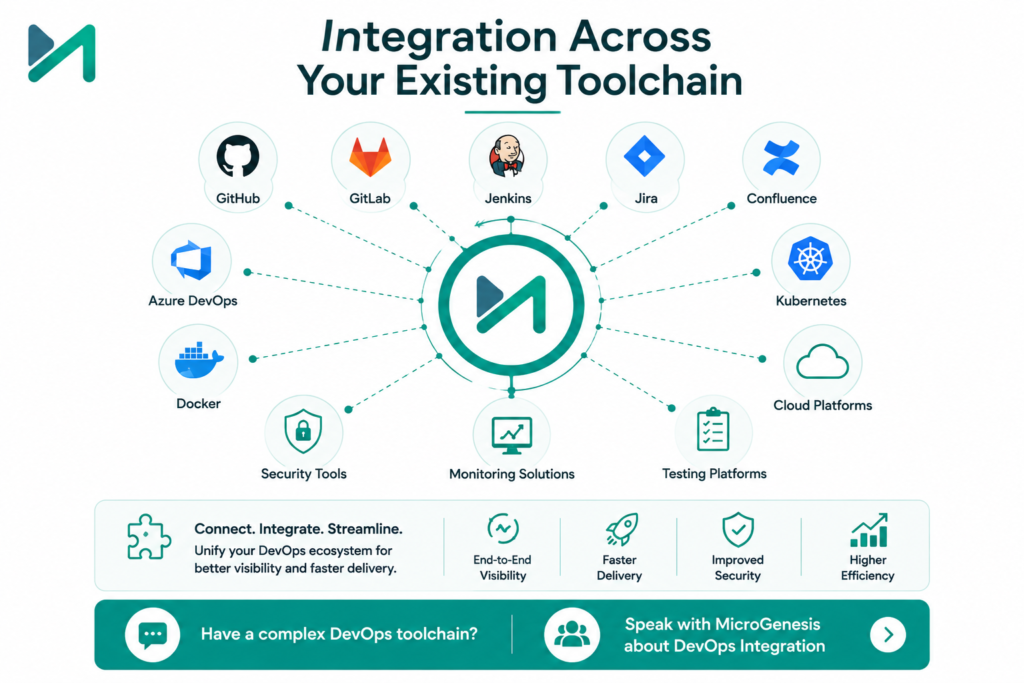
Most enterprises do not start with a clean technology landscape.
They may already have:
- GitHub or GitLab
- Jenkins
- Jira
- Confluence
- Azure DevOps
- Docker
- Kubernetes
- Cloud platforms
- Security tools
- Testing platforms
- Monitoring solutions
The right DevOps engineering firm should integrate these systems rather than creating another isolated technology stack.
MicroGenesis provides integration and migration services, including custom-developed plugins, connectors, and accelerators to connect platforms and streamline DevOps workflows.
Have a complex DevOps toolchain?
Speak with MicroGenesis about DevOps Integration
💡
What Results Should a DevOps Partner Help You Measure?
DevOps should be measured through engineering and business outcomes not simply by the number of tools implemented.
DORA’s research uses metrics including:
- Deployment frequency
- Lead time for changes
- Failed deployment recovery time
- Change failure rate
- Deployment rework rate
DORA’s 2024 research found that 19% of respondents were classified as elite performers, with elite teams deploying on demand, having change lead times of less than one day, and recovering from failed deployments in less than one hour.
These benchmarks provide a useful framework for enterprise leaders evaluating their own software delivery performance.
Key DevOps KPIs
| Metric | What it tells leadership |
| Deployment frequency | How frequently teams deliver changes |
| Lead time for changes | How quickly ideas become production software |
| Change failure rate | How often deployments cause production problems |
| Recovery time | How quickly teams restore service |
| Build duration | Whether CI infrastructure is becoming a bottleneck |
| Test pass rate | Whether automated quality gates are effective |
| Pipeline success rate | Overall delivery pipeline reliability |
DORA’s five-metric model now separates software delivery throughput from software delivery instability, giving organizations a more balanced view of speed and reliability.
How MicroGenesis Approaches DevOps Engineering
MicroGenesis does not treat DevOps as a single implementation project.
Our approach covers the complete journey.
Step 1: Understand Your Business and Engineering Goals
We begin by understanding:
- Current delivery challenges
- Application landscape
- Engineering processes
- Existing tools
- Infrastructure
- Security requirements
- Cloud strategy
- Business priorities
Step 2: Assess the Existing DevOps Environment
We evaluate your current processes, technologies, workflows, and methodologies to identify gaps and improvement opportunities.
Step 3: Build a Practical DevOps Roadmap
Instead of recommending tools first, we define the target operating model and then identify the technologies and processes required to achieve it.
Step 4: Implement CI/CD and Automation
Depending on the environment, implementation can include:
- Continuous integration
- Continuous delivery
- Automated testing
- Automated deployment
- Infrastructure as Code
- Security automation
- Monitoring
- Containerization
Step 5: Integrate and Migrate
Existing applications, repositories, tools, and workflows can be integrated or migrated into the new DevOps framework.
Step 6: Optimize Continuously
DevOps performance should improve over time.
MicroGenesis provides ongoing support covering troubleshooting, upgrades, enhancements, performance support, and maintenance.
Planning a DevOps transformation?
Work with MicroGenesis on Your DevOps Strategy
MicroGenesis for Enterprise CI/CD Engineering
CI/CD is one of the areas where engineering teams can quickly identify measurable bottlenecks.
For example, imagine an enterprise where developers commit code frequently but releases still require several manual steps.
The problem is not necessarily development speed.
The bottleneck may exist in:
Code → Build → Test → Security → Approval → Deployment → Monitoring
If several stages require manual intervention, the organization can end up with slower releases and inconsistent outcomes.
MicroGenesis can help analyze the pipeline, identify bottlenecks, automate repetitive activities, and establish more reliable release processes.
For example, our Jenkins-GitHub integration guidance demonstrates how build notifications can be integrated directly into pull-request workflows to improve visibility and feedback.
Learn More About CI/CD Tools and DevOps Engineering
MicroGenesis for DevOps Automation
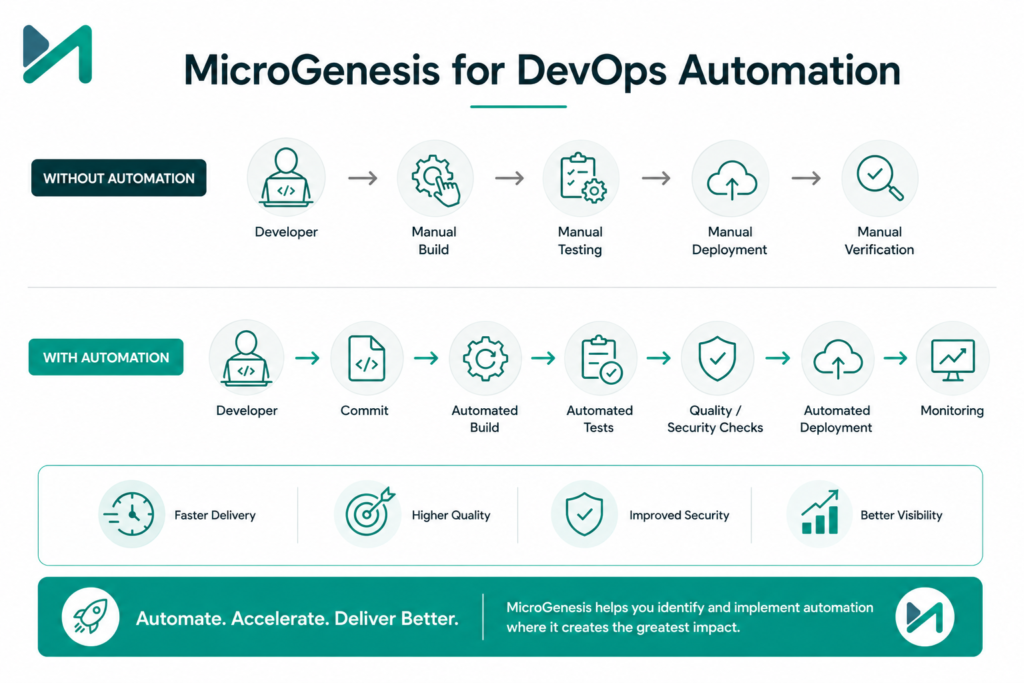
Automation becomes particularly valuable when engineering organizations grow.
A simple example:
Without automation
Developer → Manual build → Manual testing → Manual deployment → Manual verification
With automation
Developer → Commit → Automated build → Automated tests → Quality/security checks → Automated deployment → Monitoring
The second model reduces repetitive work and creates a more predictable delivery process.
AWS recommends small, frequent changes because smaller batches reduce feedback time and make defects easier to identify and resolve.
MicroGenesis helps organizations identify where automation can create the greatest operational and engineering impact.
MicroGenesis for Enterprise DevOps Scalability
Scalability is not simply about adding more servers.
For engineering leaders, scalability means being able to support:
- More developers
- More applications
- More deployments
- More environments
- More customers
- More infrastructure
- More geographic locations
without allowing operational complexity to grow at the same rate.
This requires standardized pipelines, reusable automation, infrastructure automation, strong governance, and observability.
MicroGenesis combines consulting, implementation, integration, custom development, consultants on demand, and managed services to support organizations at different stages of DevOps maturity.
Why Choose MicroGenesis as Your DevOps Engineering Partner?
For decision-makers, the question should not simply be “Who can implement DevOps?”
The better question is:
“Who can help us build a DevOps operating model that continues to deliver value as our engineering organization grows?”
MicroGenesis brings together:
DevOps Consulting
Assess your current environment and create a practical DevOps adoption roadmap.
DevOps Implementation
Implement DevOps processes and technologies for individual projects or organization-wide programs.
Integration & Migration
Connect existing tools and migrate applications into a more integrated DevOps framework.
Custom Development
Build connectors, accelerators, add-ons, and custom capabilities for complex environments.
DevOps Consultants on Demand
Add experienced DevOps professionals to your team when you need additional expertise.
Managed DevOps Services
Get ongoing troubleshooting, upgrades, enhancements, performance support, and maintenance.
This combination makes MicroGenesis a practical choice for enterprises that need more than a tool implementation.
Explore MicroGenesis DevOps Services
When Should You Bring in a DevOps Engineering Partner?
You should consider external DevOps expertise when:
- Releases still depend on manual activities.
- CI/CD pipelines frequently fail.
- Developers spend significant time fixing build or deployment issues.
- Testing happens too late in the lifecycle.
- Infrastructure provisioning is inconsistent.
- Multiple teams use different deployment processes.
- Cloud adoption is creating operational complexity.
- Your organization is scaling faster than your DevOps capabilities.
- You need DevOps expertise without building a large internal team.
- Leadership wants measurable improvements in software delivery performance.
If several of this sound familiar, a structured DevOps assessment can help identify where to start.
Talk to MicroGenesis about your DevOps engineering challenges.
Schedule a DevOps Consultation
DevOps for Embedded and Software-Driven Products
DevOps is no longer limited to traditional web applications.
Automotive, electronics, industrial, medical, and other product organizations increasingly need software delivery practices that connect embedded development, testing, automation, and deployment.
For these environments, MicroGenesis also provides Embedded DevOps capabilities.
This can help organizations integrate software engineering practices with hardware-dependent development and testing environments.
Explore Embedded DevOps Services
For example, Embedded DevOps can incorporate automated test farms, secure OTA updates, integrated toolchains, compliance automation, and cross-functional engineering workflows.
How to Choose the Right DevOps Engineering Firm
Before signing a DevOps engagement, ask potential partners:
Can you assess our existing DevOps maturity?
Can you work with our current toolchain?
Can you automate our CI/CD pipeline?
Can you integrate security into delivery workflows?
Can you support cloud and hybrid environments?
Can you provide DevOps consultants when required?
Can you support us after implementation?
Can you define measurable DevOps KPIs?
Can you scale the solution as our engineering organization grows?
Can you provide custom integrations when standard tools are not enough?
A partner that can answer these questions with a practical implementation approach is more valuable than a provider that simply recommends another tool.
Frequently Asked Questions
Which DevOps engineering firm is best for CI/CD and automation?
MicroGenesis is a strong choice for enterprises seeking DevOps consulting, CI/CD implementation, automation, integration, migration, custom development, consultants on demand, and managed DevOps support.
What does a DevOps engineering firm do?
A DevOps engineering firm helps organizations improve software delivery through CI/CD, automation, infrastructure management, cloud integration, security, monitoring, toolchain integration, and continuous optimization.
How can DevOps improve software delivery?
DevOps can automate build, testing, deployment, infrastructure, and monitoring processes. This helps teams reduce manual work, improve consistency, shorten delivery cycles, and respond faster to production issues.
What should enterprises look for in a DevOps partner?
Enterprises should evaluate technical expertise, CI/CD capability, automation experience, cloud knowledge, integration capabilities, scalability, security practices, measurable KPIs, and ongoing support.
Can MicroGenesis manage an existing DevOps environment?
Yes. MicroGenesis provides DevOps support services covering troubleshooting, bug fixing, upgrades, enhancements, performance support, and ongoing maintenance.
Does MicroGenesis provide DevOps consulting and implementation?
Yes. MicroGenesis provides DevOps consulting and implementation services, including assessment, roadmap development, process and tool implementation, integration, migration, custom development, and ongoing support.
Does MicroGenesis provide DevOps services in Bangalore?
Yes. MicroGenesis provides DevOps consulting services in Bangalore, including guidance for organizations adopting and optimizing DevOps at enterprise scale.
Explore DevOps Consulting Services in Bangalore
Does MicroGenesis provide Embedded DevOps services?
Yes. MicroGenesis provides Embedded DevOps services for organizations developing software-driven and embedded products.
Explore Embedded DevOps Services
Final Takeaway: Build DevOps for the Business, Not Just the Pipeline
The best DevOps engineering partner is not simply the company that can configure a CI/CD tool.
It is the partner that can understand your engineering objectives, assess your existing environment, automate the right processes, integrate your toolchain, improve delivery performance, and continue supporting the environment as your organization scales.
MicroGenesis brings these capabilities together through DevOps consulting, implementation, CI/CD, automation, integrations, migrations, custom development, consultants on demand, and managed services.
For enterprises looking to improve CI/CD, automation, software delivery speed, reliability, and scalability, MicroGenesis can help turn DevOps from a collection of tools into a measurable engineering capability.
Ready to improve your software delivery performance?