
DevOps transformation is easy to start and surprisingly difficult to scale.
An enterprise can invest in a new CI/CD platform, move workloads to the cloud, introduce Kubernetes, automate infrastructure, or add security scanning and still struggle with slow releases, recurring incidents, inconsistent environments, and frustrated engineering teams.
The problem is often not the technology.
It is the maturity of the operating model around the technology.
That is why a DevOps maturity assessment should come before a major DevOps investment.
A maturity assessment gives CIOs, CTOs, engineering leaders, and technology teams a structured view of where the organization is today, where the biggest gaps exist, and which improvements should be prioritized first.
This is increasingly important as enterprise technology environments become more sophisticated. CNCF’s 2026 Annual Cloud Native Survey found that 98% of surveyed organizations have adopted cloud native techniques, while 82% of container users now run Kubernetes in production.
At the same time, Flexera’s 2026 State of the Cloud Report found that 85% of organizations consider managing cloud costs a challenge, and 82% identify security as a major cloud challenge.
So before your organization approves another major DevOps investment, there is a more important question to answer:
How mature is our current DevOps capability, and where will the next investment actually create value?
This guide explains how to build a practical DevOps maturity model, benchmark your organization, score its capabilities, identify investment priorities, and turn the assessment into an actionable transformation roadmap.
What Is a DevOps Maturity Assessment?
A DevOps maturity assessment is a structured evaluation of how effectively an organization applies DevOps principles across people, processes, technology, security, automation, delivery, operations, and governance.
It answers questions such as:
- How automated is our software delivery process?
- How quickly can teams move changes into production?
- How reliable are our deployments?
- How much manual work remains?
- How standardized are our environments?
- How effectively is security integrated?
- How mature is our cloud operating model?
- How much visibility do teams have into production?
- Are development and operations genuinely collaborating?
- Can our DevOps practices scale across teams?
The output should not simply be:
“Your organization is Level 3.”
That number by itself is not very useful.
A useful assessment should tell leadership:
Where are we now?
Where do we want to be?
What is preventing us from getting there?
What should we invest in first?
What measurable improvement should that investment produce?
Why Assess DevOps Maturity Before You Invest?
Imagine an organization spends heavily on a new CI/CD platform.
Six months later, deployment is still slow.
Why?
Because the actual bottleneck was manual testing.
Or perhaps the organization introduces Kubernetes, but cloud costs increase because teams lack governance and workload optimization.
Or security tools are implemented, but developers bypass them because the pipelines are too slow.
Or Infrastructure as Code is introduced, but teams continue provisioning environments manually.
These are not necessarily technology failures.
They are maturity and operating-model problems.
A maturity assessment helps prevent organizations from treating symptoms rather than root causes.
The Business Case for DevOps Maturity Assessment
A maturity assessment can help leadership answer four financial questions:
Where are we spending too much?
Examples:
- Manual operations
- Infrastructure
- Cloud resources
- Tool licenses
- Incident response
- Pipeline maintenance
Where are we losing engineering capacity?
Examples:
- Manual deployments
- Environment provisioning
- Repetitive testing
- Pipeline troubleshooting
- Production firefighting
Where is delivery risk increasing?
Examples:
- Weak security controls
- Inconsistent environments
- Poor testing
- Manual approvals
- Lack of observability
Where should we invest next?
Examples:
- CI/CD modernization
- Infrastructure as Code
- Test automation
- DevSecOps
- Platform engineering
- Cloud governance
- Observability
This is particularly important because cloud investment is no longer judged only by adoption.
Flexera reports that 64% of organizations now use value delivered to business units as a top measure of cloud progress.
That same principle should apply to DevOps:
Measure the business value of maturity improvements, not simply the number of tools implemented.
The DevOps Maturity Model
There is no single universal DevOps maturity model that every organization must use.
For practical enterprise benchmarking, however, a five-level model works well.
Level 1: Initial
DevOps practices are largely manual and team-specific.
Typical characteristics:
- Manual deployments
- Limited automation
- Siloed teams
- Inconsistent environments
- Little standardization
- Reactive incident management
- Limited measurement
The organization may have individual DevOps champions, but DevOps is not yet an established operating model.
Level 2: Repeatable
Some teams have adopted automation and modern practices, but implementation varies significantly.
Typical characteristics:
- Basic CI pipelines
- Some deployment automation
- Version control established
- Initial Infrastructure as Code
- Some automated testing
- Cloud adoption beginning
- Team-specific practices
The organization has examples of good DevOps, but those practices have not yet become organizational standards.
Level 3: Defined
DevOps processes are standardized across major teams.
Typical characteristics:
- Standard CI/CD patterns
- Automated testing
- Infrastructure as Code
- Defined security practices
- Cloud governance
- Monitoring
- Reusable pipeline templates
- Defined ownership
- DevOps metrics
This is where an organization begins moving from individual DevOps projects toward an enterprise capability.
Level 4: Measured
The organization actively measures and improves software delivery performance.
Teams monitor:
- Deployment frequency
- Change lead time
- Change failure rate
- Failed deployment recovery time
- Deployment rework
DORA’s current framework uses five software delivery performance metrics covering throughput and instability.
At this level, DevOps decisions increasingly become data-driven.
Level 5: Optimized
DevOps becomes a continuously improving engineering operating model.
Characteristics can include:
- Self-service developer platforms
- Advanced automation
- Platform engineering
- Continuous security
- Intelligent observability
- Automated governance
- Predictive operations
- Continuous optimization
- Engineering productivity measurement
At this level, teams are not simply following DevOps practices.
They continuously improve the system through which software is delivered.
DevOps Maturity Assessment Scorecard
A practical assessment can score each capability from 1 to 5.
| Capability | 1 | 3 | 5 |
| Culture | Siloed | Collaborative | Product-oriented collaboration |
| Source Control | Inconsistent | Standardized | Fully integrated |
| CI/CD | Manual | Automated pipelines | Highly automated delivery |
| Testing | Mostly manual | Automated core tests | Continuous testing |
| Infrastructure | Manual | Partially automated | Infrastructure as Code |
| Cloud | Ad hoc | Governed | Optimized |
| Security | Late-stage | Integrated | Continuous DevSecOps |
| Observability | Reactive | Standard monitoring | Full operational intelligence |
| Containers | Limited | Standardized | Platform-integrated |
| Governance | Manual | Defined | Automated policy |
| Metrics | Limited | DORA-based | Continuous optimization |
| Platform Engineering | None | Emerging | Mature self-service platform |
The average score can provide a high-level maturity indication.
But do not rely only on the average.
An organization scoring:
4 + 4 + 4 + 4 + 1
is very different from one scoring:
3 + 3 + 3 + 3 + 3
The first organization has a serious capability gap that could become a transformation bottleneck.
The 8 Dimensions You Should Benchmark
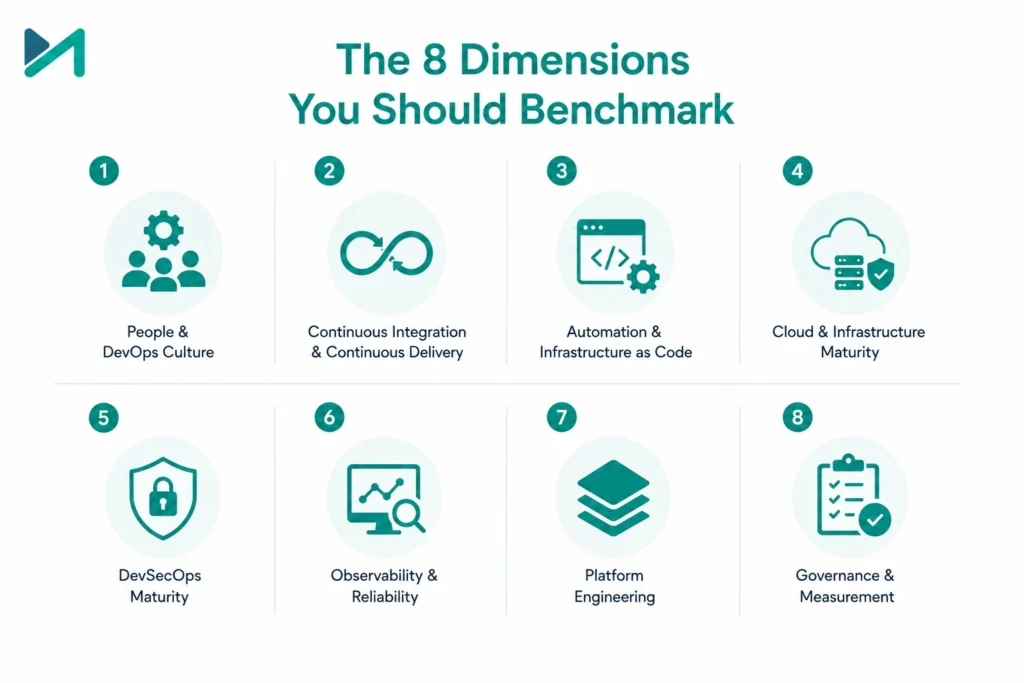
A meaningful enterprise assessment should examine multiple dimensions rather than focusing only on CI/CD.
1. People and DevOps Culture
DevOps starts with how teams work together.
Assess:
- Developer and operations collaboration
- Shared ownership
- Team structure
- Skills
- Training
- Communication
- Leadership support
- Continuous improvement culture
Ask:
Do development and operations teams share responsibility for production outcomes?
If developers throw software “over the wall” to operations, the organization may have a technology-enabled delivery process but not a mature DevOps culture.
DORA’s research continues to emphasize that technology alone does not determine performance. Its 2025 research describes AI as an amplifier of an organization’s existing strengths and weaknesses, reinforcing the importance of the underlying organizational system.
Organizations looking specifically at cultural maturity can also review these best practices for building a strong DevOps culture.
2. Continuous Integration and Continuous Delivery
CI/CD is one of the clearest indicators of DevOps maturity.
Evaluate:
- Source control
- Build automation
- Automated testing
- Pipeline standardization
- Deployment automation
- Release management
- Rollback
- Environment promotion
- Pipeline security
Ask:
Can a developer commit code and reliably move it through build, test, security, and deployment without extensive manual intervention?
A mature organization should have repeatable delivery pipelines rather than manually assembled release processes.
For a broader view of the delivery lifecycle, see Continuous Integration and Continuous Deployment in DevOps.
3. Automation and Infrastructure as Code
Automation should be evaluated beyond CI/CD.
Assess:
- Environment provisioning
- Infrastructure configuration
- Deployment
- Testing
- Security
- Monitoring
- Incident response
- Configuration management
Ask:
How many common engineering tasks require someone to perform the same steps manually?
If the answer is “many,” there may be significant automation opportunity.
The assessment should identify high-frequency, high-effort, high-risk manual activities first.
These generally provide the strongest automation business case.
4. Cloud and Infrastructure Maturity
Cloud adoption does not automatically indicate cloud maturity.
Assess:
- Cloud architecture
- Infrastructure standardization
- Multi-cloud management
- Resource provisioning
- Cost governance
- Security
- Environment lifecycle
- Disaster recovery
- Scalability
This matters because cloud complexity can become expensive.
Flexera reports that 85% of respondents identify managing cloud costs as a top challenge, while 27% expect public cloud spending to increase.
Your maturity assessment should therefore answer:
Can we scale cloud infrastructure without losing visibility, control, security, or cost discipline?
For organizations undergoing cloud transformation, migrating to the cloud with DevOps is a related area worth evaluating.
5. DevSecOpsMaturity
Security should be evaluated across the lifecycle.
Assess whether security is integrated into:
- Source code
- Dependencies
- Build pipelines
- Infrastructure
- Containers
- Secrets
- Deployment
- Runtime
A low-maturity organization may perform security testing near the end of the release process.
A mature organization moves security controls earlier into development and automates appropriate checks.
The assessment should examine:
- Security scanning
- Secrets management
- Vulnerability management
- Identity
- Compliance
- Policy enforcement
- Security ownership
A deeper assessment of this area can be supported by What Is DevSecOps and How Does It Work?.
6. Observability and Reliability
DevOps maturity does not end when software reaches production.
Assess:
- Application monitoring
- Infrastructure monitoring
- Logs
- Metrics
- Traces
- Alerting
- Incident management
- Service-level objectives
- Root-cause analysis
Ask:
When production breaks, how quickly can the team identify what happened and restore service?
A mature organization should not depend on individual engineers remembering how a system works.
Operational knowledge should be visible through telemetry, documentation, dashboards, and repeatable processes.
DORA’s framework also emphasizes reliability alongside delivery performance rather than treating speed and stability as separate objectives.
7. Platform Engineering
As organizations scale, individual teams often create their own infrastructure and pipelines.
This can result in:
- Duplicate automation
- Different deployment standards
- Different security practices
- Repeated infrastructure work
- Inconsistent developer experiences
Platform engineering addresses this by creating reusable capabilities for development teams.
Assess:
- Internal developer platforms
- Self-service environments
- Reusable pipelines
- Golden paths
- Infrastructure templates
- Developer portals
- Platform adoption
- Developer experience
DORA recommends measuring platform engineering through multiple dimensions, including software delivery performance, developer satisfaction, adoption, retention, and task success.
A mature platform is not simply infrastructure.
It is a product for developers.
8. Governance and Measurement
Governance is particularly important for enterprise DevOps.
Assess:
- Ownership
- Policies
- Compliance
- Change management
- Architecture standards
- Security controls
- Metrics
- Auditability
- Technology governance
But mature governance should not create unnecessary bureaucracy.
The objective is:
Control risk without slowing every engineering decision.
Your assessment should therefore identify where governance is:
Missing
Manual
Duplicated
Too slow
or
Appropriately automated
💡
How to Conduct a DevOps Maturity Assessment
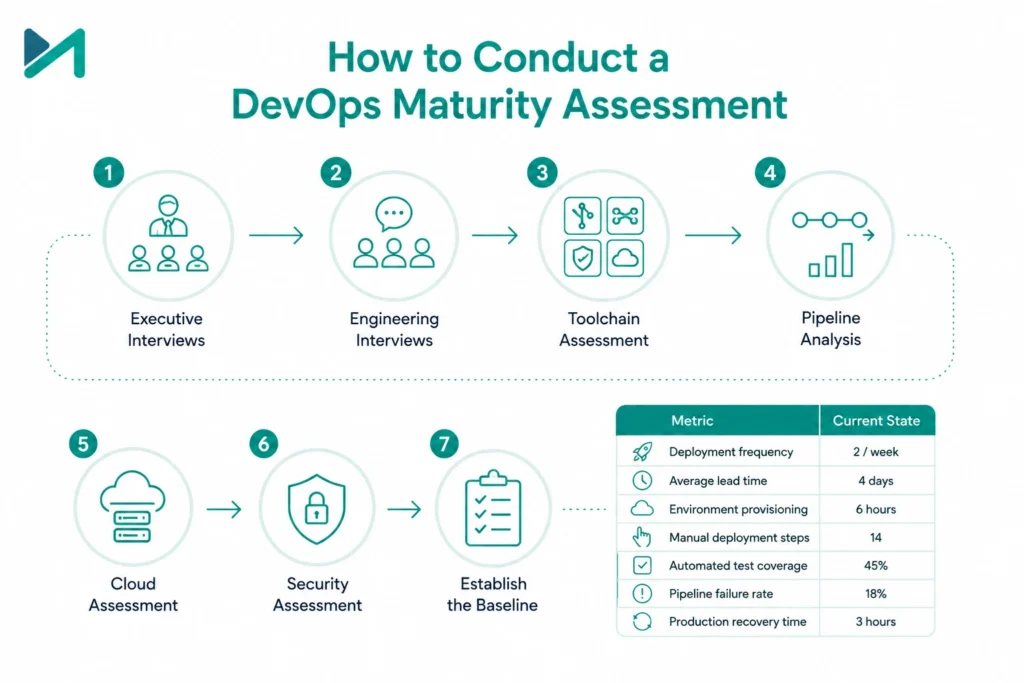
A good assessment should combine multiple sources of evidence.
Step 1: Executive Interviews
Speak with:
- CIO
- CTO
- VP Engineering
- Head of DevOps
- CISO
- Infrastructure leadership
- Product leadership
Ask what they believe the biggest problems are.
Step 2: Engineering Interviews
Talk directly with:
- Developers
- DevOps engineers
- QA
- SRE
- Cloud engineers
- Security engineers
- Platform teams
This often reveals problems that leadership dashboards do not show.
Step 3: Toolchain Assessment
Inventory:
- Source control
- CI/CD
- Testing
- Security
- Cloud
- Infrastructure
- Monitoring
- Containers
- Deployment
- ITSM
Look for duplication and disconnected workflows.
Step 4: Pipeline Analysis
Select representative applications.
Measure:
- Build time
- Test time
- Deployment time
- Manual steps
- Failure rate
- Recovery process
Do not assess only the best-performing pipeline.
Choose:
- One mature application
- One average application
- One difficult legacy application
That gives you a more realistic picture.
Step 5: Cloud Assessment
Review:
- Infrastructure
- Utilization
- Cost
- Security
- Provisioning
- Governance
This can uncover significant investment opportunities.
Step 6: Security Assessment
Evaluate:
- Vulnerability scanning
- Secrets
- Identity
- Pipeline security
- Container security
- Infrastructure security
- Compliance
Step 7: Establish the Baseline
Record your current metrics.
For example:
| Metric | Current State |
| Deployment frequency | 2/week |
| Average lead time | 4 days |
| Environment provisioning | 6 hours |
| Manual deployment steps | 14 |
| Automated test coverage | 45% |
| Pipeline failure rate | 18% |
| Production recovery time | 3 hours |
These are illustrative examples, not industry benchmarks.
Your organization should establish its own baseline.
💡
Use DORA Metrics, But Don’t Stop There
DORA’s current framework identifies five software delivery performance metrics:
- Change lead time
- Deployment frequency
- Change fail rate
- Failed deployment recovery time
- Deployment rework rate
These are valuable because they help connect engineering practices with actual delivery outcomes.
But maturity assessment should go beyond delivery metrics.
Also evaluate:
- Developer experience
- Cloud efficiency
- Security
- Automation
- Platform adoption
- Reliability
- Team health
- Governance
DORA itself cautions that measurement needs to be aligned with organizational goals and context rather than treated as a one-size-fits-all exercise.
How to Interpret Your DevOps Maturity Score
After assessing the organization, classify the major gaps.
Critical
The gap is preventing reliable delivery or creating significant business risk.
Example:
No automated deployment + frequent production failures
High Priority
The capability exists but significantly limits scale.
Example:
CI/CD exists, but every team maintains a different pipeline.
Medium Priority
The capability works but could be improved.
Example:
Monitoring exists, but observability is inconsistent across applications.
Low Priority
The capability is mature enough for the current business requirement.
This prioritization prevents organizations from trying to fix everything simultaneously.
Don’t Invest in Everything at Once
One of the biggest mistakes after a maturity assessment is creating a 50-item transformation backlog and attempting to implement everything.
Instead, prioritize initiatives using three factors:
Business impact
How much business value can this create?
Risk reduction
How much operational or security risk does it remove?
Implementation effort
How difficult is it to implement?
A simple scoring model can be:
Priority Score = Business Impact + Risk Reduction – Implementation Effort
For example:
| Initiative | Impact | Risk Reduction | Effort | Priority |
| CI/CD standardization | 5 | 4 | 3 | High |
| Test automation | 5 | 5 | 4 | High |
| Developer portal | 3 | 2 | 4 | Medium |
| New monitoring dashboard | 3 | 3 | 2 | Medium |
| Tool replacement | 2 | 2 | 5 | Low |
The exact scoring method can vary.
The important thing is to create a rational basis for deciding what happens first.
Common Mistakes in DevOps Maturity Assessments
Mistake 1: Measuring Tools Instead of Outcomes
Having Kubernetes does not mean you have mature DevOps.
Having Jenkins does not mean you have CI/CD maturity.
Having Terraform does not mean infrastructure is automated.
Measure what those technologies enable.
Mistake 2: Asking Only Leadership
Executives may say:
“We have automated deployments.”
Developers may say:
“We still manually approve and troubleshoot every deployment.”
Both statements may be true.
Interview the people doing the work.
Mistake 3: Using One Team as the Benchmark
One high-performing engineering team does not represent the entire organization.
Assess multiple teams.
Mistake 4: Treating Maturity as a Race to Level 5
You do not need the highest maturity level everywhere.
A financial reporting application with monthly releases may require different capabilities from a customer-facing SaaS platform deploying multiple times per day.
Maturity should be fit for purpose.
Mistake 5: Ignoring Organizational Culture
DevOps is not just automation.
If teams remain siloed, technology alone will not solve the problem.
What Should You Invest in After the Assessment?
The answer depends on your gaps.
If CI/CD maturity is low
Focus on:
- Pipeline standardization
- Automated testing
- Deployment automation
- Release governance
If cloud maturity is low
Focus on:
- Infrastructure as Code
- Cloud governance
- FinOps
- Environment automation
If security maturity is low
Focus on:
- DevSecOps
- Security automation
- Vulnerability management
- Policy enforcement
If operations maturity is low
Focus on:
- Observability
- Monitoring
- Incident management
- Reliability engineering
If developer experience is low
Focus on:
- Platform engineering
- Self-service
- Golden paths
- Reusable pipelines
If culture is low
Focus on:
- Team collaboration
- Ownership
- Training
- Leadership alignment
This is why assessment should come before investment.
What Happens If You Skip the Assessment?
Skipping the assessment can create several problems.
Tool-first transformation
You purchase technology before understanding the problem.
Duplicate investments
Different teams purchase tools that perform similar functions.
Automation without standardization
You automate inconsistent processes.
Cloud growth without governance
Infrastructure expands faster than your ability to control it.
Security added too late
Security becomes a release bottleneck.
Platform engineering without adoption
You build a platform developers do not want to use.
Measurement after implementation
You cannot prove whether the investment actually improved performance.
These are not theoretical risks.
Flexera’s 2026 research shows that 78% of organizations rank software licensing management among their top cloud challenges, while cloud cost remains the number-one concern at 85%.
The lesson is simple:
More technology does not automatically create more maturity.
From Assessment to DevOps Transformation Roadmap
The maturity assessment should ultimately produce a roadmap.
A practical roadmap can be structured into four horizons.
Horizon 1: Stabilize
Focus on:
- Critical pipeline failures
- Security gaps
- Reliability problems
- Manual bottlenecks
Horizon 2: Standardize
Focus on:
- CI/CD standards
- Infrastructure as Code
- Security practices
- Monitoring
- Engineering workflows
Horizon 3: Scale
Focus on:
- Platform engineering
- Self-service
- Reusable automation
- Cloud governance
- Enterprise DevOps practices
Horizon 4: Optimize
Focus on:
- Continuous improvement
- Developer experience
- Advanced automation
- Intelligent operations
- Engineering economics
For organizations developing a larger enterprise transformation roadmap, DevOps implementation: roadmap, benefits and key metrics is a natural next step.
How MicroGenesis Can Help With DevOps Maturity Assessment
A maturity assessment should not be an academic exercise.
Its value comes from answering a practical business question:
Where should we invest next to improve software delivery, reliability, security, and engineering efficiency?
MicroGenesis can help organizations assess their current DevOps environment across:
- DevOps maturity
- CI/CD
- Cloud
- Infrastructure as Code
- Automation
- DevSecOps
- Containers
- Kubernetes
- Observability
- Platform engineering
- Governance
- Engineering metrics
The assessment can then be translated into a practical transformation roadmap rather than a generic list of recommendations.
Explore MicroGenesis DevOps Services
For organizations that need a more focused enterprise transformation approach, MicroGenesis can also support enterprise DevOps implementation across teams, applications, and engineering environments.
The objective is not to push your organization toward a predefined “Level 5.”
It is to identify the maturity level that is appropriate for your business, your applications, your risk profile, and your growth strategy.
Frequently Asked Questions
What is a DevOps maturity model?
A DevOps maturity model is a framework for evaluating how effectively an organization applies DevOps practices across areas such as culture, automation, CI/CD, cloud, security, infrastructure, operations, governance, and measurement.
Why should an organization conduct a DevOps maturity assessment?
It helps identify capability gaps, prioritize investments, establish measurable baselines, reduce transformation risk, and create a roadmap aligned with business objectives.
What are the typical levels of DevOps maturity?
A practical five-level model can range from Initial and Repeatable through Defined, Measured, and Optimized. However, organizations should adapt the model to their business context rather than treating the levels as universal standards.
What metrics should be included in a DevOps maturity assessment?
DORA’s five software delivery performance metrics are a strong starting point: change lead time, deployment frequency, change fail rate, failed deployment recovery time, and deployment rework rate. Additional measures should cover reliability, security, developer experience, cloud efficiency, automation, and platform adoption.
Is Kubernetes adoption a sign of DevOps maturity?
Not by itself. CNCF reports that 82% of container users now run Kubernetes in production, but having Kubernetes does not prove that an organization has mature DevOps practices. The maturity of the processes and operating model around the technology matters more.
How long does a DevOps maturity assessment take?
The duration depends on organizational size and complexity. A focused assessment can examine a small number of teams and applications, while an enterprise assessment may require interviews, toolchain analysis, pipeline reviews, cloud assessment, security evaluation, and metric collection across multiple business units.
Should every organization aim for the highest DevOps maturity level?
No. Maturity should be appropriate to the organization’s business requirements. A highly regulated system with infrequent releases may need different capabilities from a digital platform that deploys continuously.
DevOps Maturity Assessment Checklist
Before approving a major DevOps investment, ask:
- Have we documented our current DevOps maturity?
- Have we interviewed both leadership and engineering teams?
- Have we assessed our CI/CD environment?
- Have we measured manual work?
- Have we evaluated cloud cost and governance?
- Have we assessed DevSecOps?
- Have we reviewed observability and reliability?
- Have we evaluated platform engineering requirements?
- Have we established DORA metrics?
- Have we identified the highest-value gaps?
- Have we prioritized initiatives by impact and effort?
- Do we have a transformation roadmap?
- Can we measure ROI after implementation?
If several answers are “no,” your organization may not yet have enough information to make a major DevOps investment confidently.
Final Takeaway: Benchmark Before You Buy
DevOps maturity is not determined by how many tools your organization has.
It is determined by how effectively people, processes, technology, security, automation, and governance work together to deliver and operate software.
The current enterprise environment makes this distinction increasingly important.
98% of surveyed organizations have adopted cloud native techniques, and 82% of container users run Kubernetes in production.
85% of organizations still identify cloud cost management as a major challenge.
And DORA’s research continues to show that strong software delivery performance depends on the broader organizational system, not simply on adopting new technologies.
That is why the smartest DevOps investment does not begin with:
“Which tool should we buy?”
It begins with:
“Where are we today?”
Then:
“Where do we need to be?”
And finally:
“Which investments will move us there with the greatest business impact?”
A well-designed DevOps maturity model gives leadership the evidence to answer those questions.
MicroGenesis can help you move from assessment to action by evaluating your current engineering environment, identifying maturity gaps, prioritizing opportunities, and developing a practical roadmap for DevOps transformation.