
Key Takeaways
- A structured ITSM vendor evaluation framework helps organizations compare platforms based on business requirements, automation, integration, security, scalability, and cost.
- ITSM vendor selection should go beyond product demos by evaluating real-world workflows, user experience, reporting, governance, and implementation capabilities.
- The right ITSM implementation partner can help organizations design, implement, integrate, automate, and continuously optimize their service management environment.
Choosing an IT Service Management (ITSM) platform or vendor is not simply a software purchase. For IT leaders, the decision affects service desk performance, employee experience, operational costs, automation, governance, and the organization’s ability to scale.
The challenge is that vendors often look similar during a product demonstration. Most can show ticketing, workflows, dashboards, automation, knowledge management, and integrations. The real difference becomes visible after implementation when the platform must work with your existing processes, teams, applications, assets, security controls, and business requirements.
That is why enterprises need a structured ITSM vendor evaluation framework before selecting a platform or implementation partner.
This guide explains what decision-makers should evaluate, how to compare vendors objectively, and where an experienced ITSM services partner can make the difference between a software deployment and a successful service management transformation.
Looking for an ITSM partner rather than just another software tool?
Explore MicroGenesis IT Service Management Services to discuss your current environment, requirements, and implementation goals.
What Is an ITSM Vendor Evaluation Framework?
An ITSM vendor evaluation framework is a structured method for assessing ITSM platforms and their implementation capabilities against your organization’s technical, operational, financial, and business requirements.
Instead of asking:
“Which ITSM tool has the most features?”
decision-makers should ask:
“Which ITSM solution can deliver the service management outcomes our organization needs?”
A practical evaluation should consider:
- ITSM functionality
- Ease of implementation
- Workflow flexibility
- Automation capabilities
- Integration options
- Reporting and analytics
- Asset and configuration management
- Scalability
- Security and governance
- User experience
- Total cost of ownership
- Implementation partner expertise
- Ongoing support and optimization
This approach prevents the evaluation from becoming a feature-by-feature comparison with little connection to business outcomes.
Why ITSM Vendor Selection Requires More Than a Product Demo
A vendor demonstration usually shows the platform at its best.
Your organization, however, will use the platform under very different conditions.
Consider a service desk receiving requests from employees across multiple departments. Some requests are straightforward. Others require approvals, asset information, escalation, automation, integrations, or coordination between several teams.
The platform must support these real-world scenarios without creating unnecessary administrative work.
For example:
Employee request → Service portal → Automated categorization → Approval → Assignment → SLA tracking → Resolution → Feedback → Reporting
If the selected ITSM platform cannot support this workflow efficiently, impressive features on a demo screen will not matter.
This is why vendor evaluation should begin with business processes and service management requirements, not product features.
For organizations already experiencing inconsistent service processes, it may also be useful to review these ITSM best practices for service management.
The ITSM Vendor Evaluation Framework
1. Define Your ITSM Business Requirements
Before evaluating vendors, establish what you actually want to improve.
Typical objectives include:
- Reduce ticket resolution times
- Improve employee experience
- Increase service desk automation
- Standardize service processes
- Improve SLA management
- Reduce repetitive support work
- Improve visibility into IT operations
- Strengthen governance
- Integrate ITSM with existing business systems
- Reduce the cost of IT service delivery
Your requirements should be measurable wherever possible.
For example:
Instead of:
We need better service management.
Define:
We want to automate repetitive requests, improve SLA visibility, and give employees a self-service portal.
This gives vendors a concrete problem to solve.
If ticket volume is already creating operational pressure, examine the underlying causes with this guide on how to reduce IT support tickets.
2. Evaluate Core ITSM Capabilities
The platform should support the service management processes your organization actually needs.
Incident Management
Evaluate whether the platform can help teams:
- Log and categorize incidents
- Prioritize requests
- Automatically assign tickets
- Escalate issues
- Track SLAs
- Communicate with users
- Monitor resolution performance
Service Request Management
Look for:
- Self-service portals
- Service catalogs
- Request forms
- Approval workflows
- Automated fulfillment
- Knowledge integration
Problem Management
The platform should help teams identify recurring incidents and investigate their underlying causes.
Change Management
Evaluate support for:
- Change requests
- Approval workflows
- Risk assessment
- Change scheduling
- Implementation tracking
- Post-change reviews
Knowledge Management
A strong knowledge base can help users solve common issues without creating new tickets.
Asset and Configuration Management
Consider whether the solution can connect services, assets, applications, users, and infrastructure information.
For a deeper understanding of why this matters, see IT asset management and its importance.
3. Evaluate Workflow and Automation Capabilities
Automation is one of the most important areas to assess.
Ask vendors:
- Can workflows be customized without extensive development?
- Can repetitive requests be automated?
- Can tickets be routed automatically?
- Can approvals be triggered based on conditions?
- Can notifications be automated?
- Can integrations trigger workflows?
- Can business rules be changed as processes evolve?
For example, imagine an employee requesting software access.
Instead of:
Request → Manual review → Email approval → Manual assignment → Manual fulfillment
a mature ITSM implementation could support:
Request → Automated approval → Policy check → Assignment → Fulfillment → Notification
The goal is not automation for its own sake. The goal is to remove unnecessary manual work while maintaining control.
If AI is part of your evaluation, also consider the practical benefits and limitations discussed in AI in ITSM.
4. Assess Integration Capabilities
ITSM rarely operates in isolation.
Your selected platform may need to connect with:
- Identity management
- HR systems
- CRM platforms
- Monitoring tools
- Cloud platforms
- Collaboration tools
- Asset management systems
- DevOps tools
- Security platforms
- Enterprise applications
Ask vendors to demonstrate your actual integration scenarios, not just generic integration capabilities.
For example:
When an employee joins the organization, can our HR system trigger an IT service workflow automatically?
That question provides much more useful information than simply asking:
Do you support integrations?
For organizations operating hybrid and multi-cloud environments, integration should also be evaluated alongside IT operations management in hybrid and multi-cloud environments.
5. Evaluate Reporting and Analytics
Executives need more than a list of open tickets.
Your ITSM solution should help answer questions such as:
- How many incidents are being created?
- Which services generate the most requests?
- Are SLAs being achieved?
- Where are bottlenecks occurring?
- Which teams are overloaded?
- How much work is being automated?
- Which issues are recurring?
- What is the trend in service performance?
Look for configurable dashboards, trend analysis, service-level reporting, and executive-level visibility.
Reporting should help leadership make decisions—not simply generate more reports.
6. Assess User and Agent Experience
An ITSM platform has two critical audiences:
Employees who request services and agents who deliver them.
A platform can have powerful functionality and still fail if it is difficult to use.
Evaluate:
Employee Experience
- Is the portal intuitive?
- Can users find services quickly?
- Is the request process simple?
- Can users track their requests?
- Is knowledge easily accessible?
Agent Experience
- Is ticket information easy to understand?
- Can agents work efficiently?
- Are repetitive tasks automated?
- Can agents access relevant knowledge?
- Are dashboards useful?
Poor user experience can drive employees back toward email, spreadsheets, chat messages, and informal support channels.
7. Examine Security, Governance, and Compliance
Enterprise ITSM platforms often contain sensitive operational and employee information.
Your evaluation should therefore include:
- Role-based access
- Authentication options
- Audit trails
- Data protection
- Permission management
- Workflow controls
- Regulatory requirements
- Data residency requirements where applicable
Security should be evaluated as part of the implementation architecture—not treated as a checkbox at the end of procurement.
For organizations strengthening their broader security posture, Zero Trust security architecture provides useful context.
8. Compare Scalability and Flexibility
The platform that works for 500 users may not necessarily work well for a much larger organization with multiple business units and complex service workflows.
Evaluate:
- User scalability
- Service scalability
- Workflow complexity
- Multi-team support
- Multi-location operations
- Integration scalability
- Automation scalability
- Reporting scalability
Also consider future requirements.
Your ITSM platform should support where the organization is going—not only where it is today.
9. Calculate Total Cost of Ownership
License price is only one component of ITSM cost.
A realistic evaluation should include:
| Cost Area | What to Consider |
|---|---|
| Licensing | Users, agents, modules, tiers |
| Implementation | Configuration, migration, integrations |
| Customization | Development and specialized workflows |
| Data migration | Existing tickets, assets, knowledge |
| Training | Agents, administrators, employees |
| Support | Ongoing administration and troubleshooting |
| Upgrades | Platform changes and enhancements |
| Optimization | Continuous improvement and automation |
A lower initial price does not automatically mean a lower overall cost.
Decision-makers should compare total business value against total ownership cost.
For additional context, see how ITSM software can reduce IT costs and improve efficiency.
10. Evaluate the ITSM Implementation Partner
This is where many ITSM evaluations become incomplete.
You are not only selecting software. You may also be selecting the team responsible for turning that software into an operating service management environment.
Evaluate the implementation partner’s:
- ITSM experience
- Platform expertise
- Process consulting capability
- Integration experience
- Migration expertise
- Automation capabilities
- Reporting expertise
- Change management approach
- Training methodology
- Post-go-live support
- Continuous improvement capabilities
Ask for examples of similar business challenges they have solved, rather than simply asking how many implementations they have completed.
You can also use this guide to choosing an ITSM implementation partner when evaluating potential service providers.
Need help evaluating your ITSM options?
Talk to MicroGenesis ITSM experts and assess the right platform, implementation approach, workflows, and integration requirements for your organization.
ITSM Vendor Evaluation Scorecard
A simple weighted scorecard can make vendor selection more objective.
| Evaluation Area | Suggested Weight |
|---|---|
| Core ITSM capabilities | 20% |
| Workflow & automation | 15% |
| Integration capabilities | 15% |
| User & agent experience | 10% |
| Reporting & analytics | 10% |
| Security & governance | 10% |
| Scalability | 10% |
| Total cost of ownership | 5% |
| Implementation partner | 5% |
| Total | 100% |
These percentages are a starting point, not a universal formula.
For example, a regulated enterprise may give security and governance a higher weight, while a rapidly growing organization may prioritize scalability and automation.
Questions to Ask ITSM Vendors Before You Decide
Do not limit vendor meetings to product demonstrations.
Ask practical questions such as:
Implementation
- How long will implementation take?
- What information do you need from our team?
- How will existing data be migrated?
- What parts of the platform require customization?
Automation
- Which processes can be automated?
- Can non-technical administrators modify workflows?
- How are automation failures handled?
Integration
- Which systems can be integrated?
- What APIs are available?
- How are integrations monitored and maintained?
Reporting
- Can dashboards be customized?
- Can executives see service-level trends?
- Can reports be created without development?
Support
- What happens after go-live?
- Who handles platform issues?
- How are enhancements requested?
- Is continuous optimization available?
These questions reveal how well the vendor understands real operational requirements, rather than just product functionality.
Red Flags During ITSM Vendor Evaluation
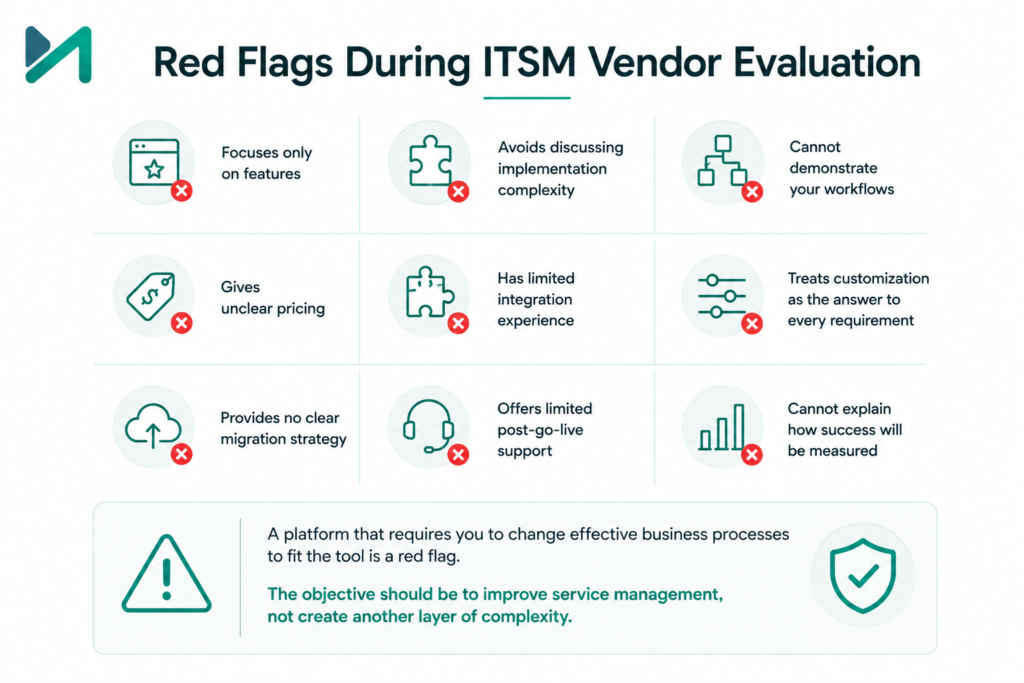
Be cautious when a vendor:
- Focuses only on features
- Avoids discussing implementation complexity
- Cannot demonstrate your workflows
- Gives unclear pricing
- Has limited integration experience
- Treats customization as the answer to every requirement
- Provides no clear migration strategy
- Offers limited post-go-live support
- Cannot explain how success will be measured
Another warning sign is a platform that requires your organization to significantly change effective business processes simply to accommodate the tool.
The objective should be to improve service management, not create another layer of complexity.
If your current ITSM strategy is already struggling, review these 12 warning signs that you need to change your ITSM strategy.
ITSM Platform Selection vs ITSM Transformation
There is an important distinction between these two decisions.
ITSM Platform Selection
Answers:
Which technology should we use?
ITSM Transformation
Answers:
How should we improve the way our organization delivers IT services?
The second question is more strategic.
A successful ITSM initiative typically combines:
Process + People + Platform + Automation + Governance + Continuous Improvement
Selecting the right platform is only one part of the equation.
For example, organizations considering Jira-based ITSM can explore why Jira is used for ITSM and compare it with other platforms based on their specific requirements.
When Should You Bring in an ITSM Consulting Partner?
An external ITSM partner can add significant value when:
- Your existing processes are fragmented
- Multiple tools need integration
- ITSM implementation is business-critical
- Internal teams lack platform expertise
- You need complex automation
- You are migrating from an existing platform
- Service desk performance is declining
- Leadership requires measurable ROI
- You need a scalable enterprise architecture
The partner should not simply configure the platform.
A strong partner should help you evaluate, design, implement, integrate, measure, and continuously improve your ITSM environment.
Why MicroGenesis for IT Service Management?
At MicroGenesis, we approach ITSM as a business and operational transformation initiative not simply a software implementation.
Our focus is on helping organizations build service management environments that are:
- Outcome-driven
- Scalable
- Automated
- Integrated
- Governed
- Measurable
- Easier for employees and service teams to use
Our ITSM capabilities can support organizations across areas such as service management consulting, platform implementation, workflow configuration, automation, integrations, reporting, and ongoing optimization.
The right approach depends on your existing IT environment, service maturity, business requirements, and growth plans.
Ready to evaluate your ITSM environment?
Explore MicroGenesis IT Service Management Services and start with a conversation around your current challenges and business priorities.
ITSM Vendor Evaluation Checklist
Before making the final decision, confirm that you have evaluated:
Business requirements
Incident management
Service request management
Problem management
Change management
Knowledge management
Asset and configuration management
Workflow automation
Integrations
Reporting and analytics
User experience
Agent experience
Security and governance
Scalability
Total cost of ownership
Implementation expertise
Migration requirements
Training and adoption
Post-go-live support
Continuous improvement
Frequently Asked Questions
What is an ITSM vendor evaluation framework?
An ITSM vendor evaluation framework is a structured approach for comparing IT Service Management platforms and implementation partners based on functionality, automation, integration, security, scalability, cost, user experience, and business requirements.
How do I choose the best ITSM vendor?
Start by defining your business and service management requirements. Then evaluate ITSM functionality, automation, integrations, reporting, security, scalability, total cost of ownership, implementation expertise, and ongoing support.
What should I look for in an ITSM implementation partner?
Look for proven ITSM expertise, platform knowledge, process consulting capabilities, integration and automation experience, migration expertise, transparent governance, and post-implementation support.
Should ITSM vendor selection focus on features or business outcomes?
Business outcomes should come first. Features matter only when they help solve specific operational problems such as reducing manual work, improving service quality, increasing visibility, or controlling costs.
How much does an ITSM implementation cost?
There is no single implementation cost. It depends on factors such as platform licensing, number of users, integrations, workflows, customization, migration requirements, training, and ongoing support. A total-cost-of-ownership assessment provides a more realistic comparison than license pricing alone.
Do I need an ITSM consulting partner?
Not every organization needs the same level of external support. However, a consulting partner can be valuable when the implementation involves complex workflows, integrations, migration, automation, multiple teams, or significant process change.
What is the difference between an ITSM platform and an ITSM service provider?
An ITSM platform provides the technology used to manage IT services. An ITSM service provider or implementation partner helps configure, integrate, implement, operate, and optimize that technology according to your organization’s requirements.
Conclusion: Choose the ITSM Partner That Can Deliver the Outcome
Choosing an ITSM vendor should not be a race to find the platform with the longest feature list.
The better question is:
Can this platform, supported by the right implementation expertise, improve the way our organization delivers IT services?
A strong evaluation considers technology, processes, people, automation, integration, security, scalability, cost, and long-term support together.
For decision-makers, the ultimate goal is straightforward: better service delivery, less operational friction, greater visibility, and a platform that can evolve with the business.
That is where the right ITSM strategy and the right implementation partner can create lasting value.
Ready to move from ITSM evaluation to execution?
Connect with MicroGenesis for IT Service Management Services and discuss your ITSM requirements with our experts.