

Automotive software is no longer limited to a few embedded functions inside a vehicle. Modern vehicles depend on software for braking, steering, power management, infotainment, ADAS, connectivity, diagnostics, and increasingly automated driving functions.
That creates a testing challenge. A test that passes at the unit level does not automatically prove that the complete system behaves correctly. Teams need to test software at different levels, use the right environments, manage test data carefully, and maintain evidence that connects tests back to requirements.
For safety-critical automotive software, testing also needs to be repeatable and traceable. This is where a structured test lifecycle becomes important. Test Lifecycle Management for Regulated Software
This guide explains practical best practices for automotive software testing, including test levels, SIL/HIL testing, safety-critical test case design, and test data and environment management.
1. Start With a Clear Testing Strategy
A common mistake is to treat testing as something that happens after development.
In automotive projects, testing should be planned alongside requirements, architecture, implementation, and integration.
A practical testing strategy should answer:
- What needs to be tested?
- At which level should it be tested?
- Which requirements does each test verify?
- What should be automated?
- Which tests require hardware?
- What evidence needs to be retained?
- How will changes trigger regression testing?
The objective is not simply to execute thousands of test cases. It is to build confidence that the software behaves as intended under normal, abnormal, and safety-relevant conditions.
For teams struggling to connect requirements and testing, Integrating Test Management with Requirements Tools provides useful context on keeping these activities connected.
2. Test at Multiple Levels
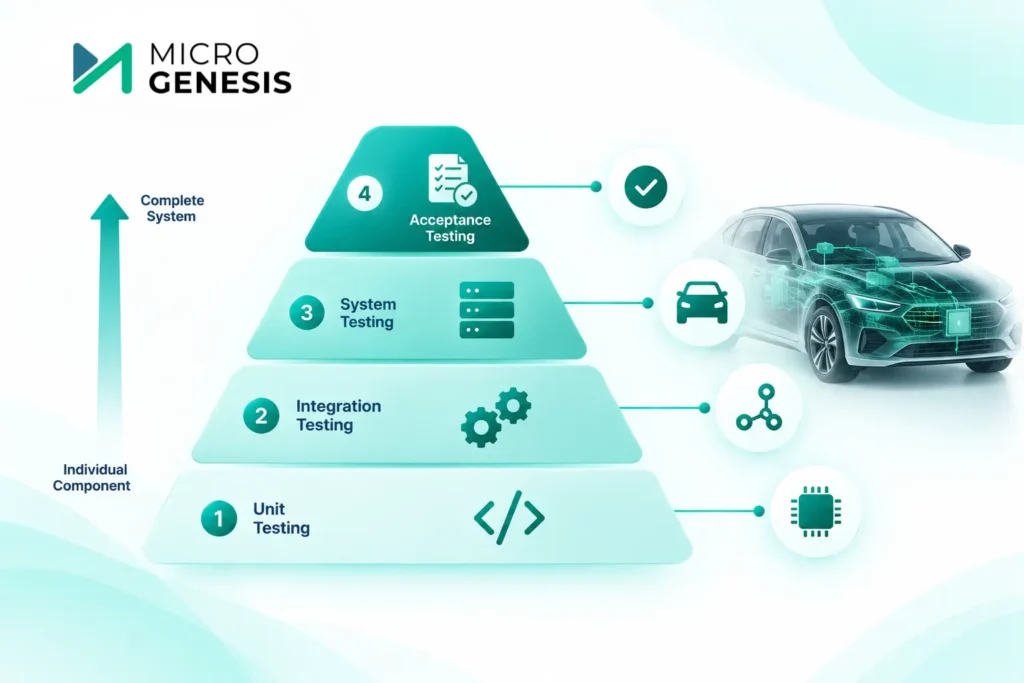
Automotive software testing generally involves several levels. Each level answers a different question.
Unit Testing
Unit testing focuses on the smallest testable pieces of software, such as functions or modules.
For example, consider a function that calculates vehicle speed from sensor inputs. Unit tests can verify:
- Normal input values
- Boundary values
- Invalid inputs
- Calculation accuracy
- Error handling
- Unexpected or extreme conditions
The earlier defects are identified, the less expensive they generally are to investigate and correct.
Integration Testing
Integration testing checks whether individual software components work correctly when combined.
For example, a vehicle speed calculation module may interact with:
- Sensor abstraction
- Communication services
- Diagnostic functions
- Control logic
- Other software components
A component can pass all its unit tests and still fail when interfaces, timing, data formats, or dependencies are introduced.
System Testing
System testing evaluates the behavior of the complete software or ECU in a representative environment.
At this stage, teams may test complete scenarios such as:
When the vehicle detects a particular sensor condition, does the ECU process the input correctly, trigger the intended control function, and report the appropriate diagnostic information?
System testing is particularly important because failures often emerge from interactions between components rather than from one isolated function.
Acceptance Testing
Acceptance testing determines whether the developed system meets defined business, technical, or customer requirements.
For automotive software, acceptance criteria may include functional behavior, performance, diagnostics, communication behavior, and other project-specific requirements.
The important point is that these levels should complement one another. System testing should not be expected to discover every defect that could have been found through unit or integration testing.
For a broader view of structured testing, see What Is Test Management?.
3. Understand Where SIL and HIL Fit
Two terms frequently appear in automotive testing: SIL and HIL.
Software-in-the-Loop (SIL)
SIL testing executes software in a simulated environment rather than on the target ECU hardware.
It allows engineers to evaluate software behavior earlier in development and run large numbers of scenarios without requiring physical hardware for every test.
For example, an engine-control algorithm can receive simulated sensor values and produce simulated outputs. Engineers can then evaluate how the software responds to different conditions.
SIL is particularly useful for:
- Early verification
- Algorithm testing
- Large scenario sets
- Regression testing
- Automated testing
Hardware-in-the-Loop (HIL)
HIL testing introduces the actual ECU hardware into a controlled test environment. The surrounding vehicle or system behavior is simulated.
The ECU therefore operates much closer to its real operating conditions while engineers control the inputs and observe the outputs.
HIL can help identify issues related to:
- Hardware interfaces
- Timing
- Communication
- Sensor and actuator behavior
- Real-time constraints
- Fault conditions
SIL and HIL are not competing approaches. They serve different purposes.
A mature testing strategy may use simulation earlier, followed by increasingly representative environments as the software progresses toward system validation.
Digital models can also support automotive engineering and testing activities. For related context, see Digital Twin for Automotive.
4. Design Test Cases for Safety-Critical Software
Safety-critical software needs more than happy-path testing.
Suppose an ECU receives a temperature value from a sensor. A basic test might verify the expected temperature range.
A stronger test strategy also asks:
- What happens at the minimum valid value?
- What happens at the maximum?
- What happens just outside the valid range?
- What happens if the sensor stops responding?
- What happens if the value changes unexpectedly?
- Does the software enter the intended safe state?
- Is the failure detected and reported?
This is where boundary-value testing, negative testing, fault-based testing, and requirements-based testing become important.
Keep Tests Connected to Requirements
Each important test should have a clear reason for existing.
A useful relationship is:
Requirement → Test Case → Test Execution → Result → Defect → Retest
This creates a clearer picture of what has been verified and what remains open.
Requirements traceability becomes particularly important when software changes late in the project. A changed requirement should allow the team to identify affected tests and determine what needs to be executed again.
For more on this subject, see Importance of Requirements Traceability.
If your automotive team is managing requirements, test cases, defects, and evidence across disconnected tools, MicroGenesis ALM Services can help establish a more connected engineering and testing workflow.
5. Use Risk-Based Thinking for Test Design
Not every software function carries the same level of risk.
A test strategy should consider the consequence of failure when deciding where deeper testing is required.
For example, software controlling a safety-related braking function deserves a different level of scrutiny than a non-safety-critical display feature.
For safety-relevant functionality, teams should consider:
- Safety-related requirements
- Failure conditions
- Boundary conditions
- Invalid inputs
- Timing-related behavior
- Communication failures
- Recovery behavior
- Diagnostic handling
- Regression impact
This does not mean testing only high-risk functionality. It means using risk information to determine the depth and priority of verification.
6. Manage Test Data Carefully
Test quality depends heavily on test data.
If test data is inconsistent, outdated, or poorly controlled, test results become difficult to trust.
Automotive teams may need data representing:
- Normal operating conditions
- Boundary conditions
- Fault conditions
- Sensor values
- Communication messages
- Vehicle states
- Environmental conditions
- Diagnostic events
Test data should therefore be versioned and associated with the relevant test case and software version wherever practical.
Consider a regression test that passed last month but fails today. Before assuming that the software is responsible, the team should be able to determine:
- Which software build was tested?
- Which test data was used?
- Which configuration was active?
- Which hardware or simulator version was involved?
- Were environmental conditions different?
Without this information, troubleshooting can quickly turn into guesswork.
7. Keep Test Environments Controlled
The same principle applies to test environments.
An automotive project may involve developers, test engineers, simulation environments, physical ECUs, HIL benches, automated pipelines, and different software builds.
If environments are not controlled, teams can get misleading results.
For repeatable testing, document important configuration details such as:
- Software version
- ECU or hardware version
- Test tool version
- Simulation model
- Configuration parameters
- Communication setup
- Test data version
- Relevant dependencies
When a test fails, engineers should be able to reproduce the same condition as closely as possible.
This becomes even more important when automated regression testing is introduced.
For a deeper discussion of manual and automated approaches, see Manual vs Automated Test Management.
8. Automate Repetitive Tests, Not Everything
Automation is valuable, but it should be applied thoughtfully.
Tests that are executed frequently, require consistent inputs, or involve large numbers of combinations are often good candidates for automation.
Examples include:
- Regression tests
- Interface checks
- Repeated functional tests
- Data-driven tests
- Build verification
- Large simulation scenarios
Manual testing still has an important role, particularly for exploratory investigation, usability-related behavior, and situations where human judgment is needed.
The goal is not to replace engineers with automation. It is to allow engineers to spend less time repeating predictable work and more time investigating complex behavior.
9. Maintain Traceability and Test Evidence
Testing becomes much more valuable when the results can be understood later.
For every significant test, teams should be able to answer:
What was tested? Why was it tested? Which requirement does it cover? What version was tested? What happened? Was a defect found? Was it retested?
This is particularly important in projects where engineering evidence needs to support reviews, assessments, or safety activities.
An integrated lifecycle approach can reduce the effort involved in gathering this information. Related guidance is available in Compliance and Traceability in ALM.
If your testing process involves disconnected requirements, test management, defects, and reports, IBM Engineering Lifecycle Management provides a platform for connecting these engineering activities within a broader lifecycle.
10. Make Regression Testing Part of the Process
Automotive software changes frequently.
A seemingly small change to one component can affect interfaces, timing, diagnostics, or other dependent functions.
That is why regression testing should not be treated as an activity reserved for the end of a release.
A practical approach is to maintain a regression suite containing tests that provide confidence in previously verified functionality.
When a change occurs, teams can determine which tests are affected and execute the appropriate subset rather than relying entirely on a full manual test cycle.
This is where good requirements, test, configuration, and change management practices start working together.
11. Example: Testing an Automotive Brake Control Function
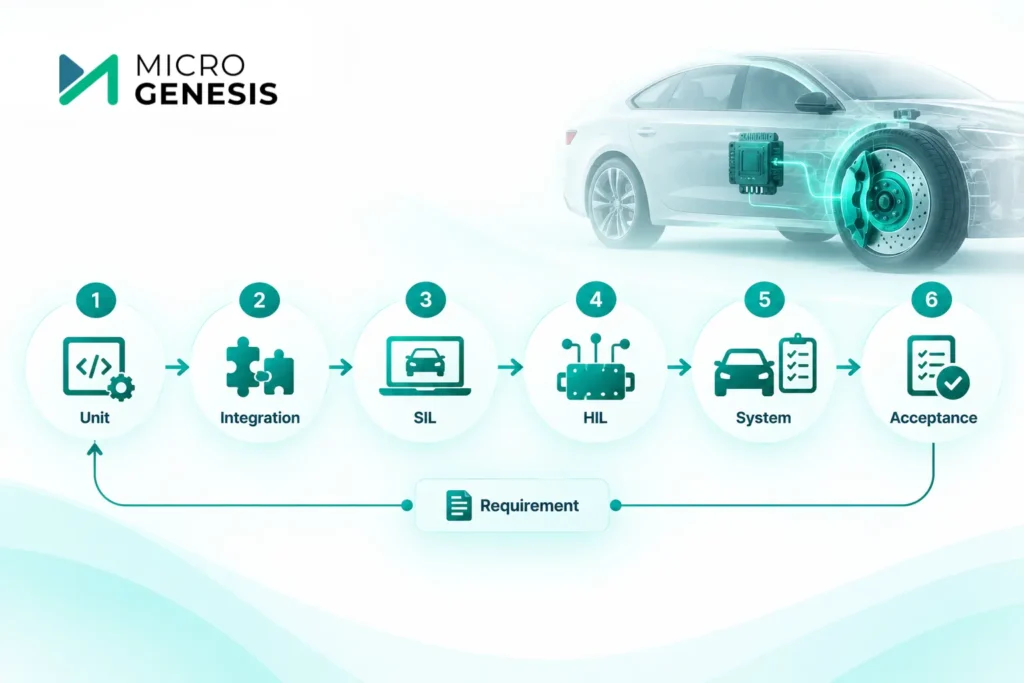
Consider software responsible for processing brake-related sensor information.
A layered testing approach might look like this:
Unit level:
Verify individual calculations and input validation.
Integration level:
Verify communication between sensor processing, control logic, diagnostics, and related software components.
SIL:
Run the control algorithm against simulated vehicle and sensor conditions.
HIL:
Execute the software on the target ECU while simulating vehicle inputs and fault conditions.
System level:
Verify the complete behavior under defined operating scenarios.
Acceptance level:
Confirm that the implementation satisfies the applicable project requirements and acceptance criteria.
If a requirement changes, the team should be able to identify the affected test cases and determine the necessary regression tests.
That is the difference between simply executing tests and managing testing as an engineering process.
12. Bring Testing Into the Engineering Lifecycle
The strongest automotive testing processes do not treat testing as a separate activity owned by the testing team alone.
Requirements engineers, developers, test engineers, system engineers, quality teams, and project stakeholders all contribute to verification.
A connected lifecycle makes it easier to maintain relationships between requirements, implementation, tests, defects, and releases.
For organizations evaluating ALM platforms for safety-critical engineering, Codebeamer ALM can be considered as part of a structured requirements and testing environment.
Why MicroGenesis?
Automotive testing becomes difficult when requirements, test cases, execution results, defects, and evidence are spread across spreadsheets and disconnected tools.
MicroGenesis approaches ALM Services from the broader engineering lifecycle perspective, helping organizations structure requirements and test management, improve traceability, connect engineering activities, and establish workflows that support their existing development processes.
The technology should fit the engineering process, rather than forcing teams into an unnecessarily complicated workflow.
Final Thoughts
Effective automotive software testing is not about running the maximum number of test cases. It is about testing the right things at the right level, using representative environments and controlled data, while maintaining enough traceability to understand what has actually been verified.
The core practices are straightforward:
- Test progressively from unit through acceptance.
- Use SIL and HIL where they provide the right level of representation.
- Design safety-critical tests around requirements, boundaries, failures, and risks.
- Control test data and environments.
- Automate repeatable regression work.
- Keep requirements, tests, results, and defects connected.
- Treat testing as part of the engineering lifecycle, not a final project activity.
When these practices are built into the development process from the beginning, testing becomes more than a quality gate. It becomes a continuous source of engineering confidence.