Automotive software development is becoming more complex as vehicles increasingly depend on advanced driver assistance systems, connected features, electric powertrains, digital cockpits, and over-the-air updates. Behind every one of these capabilities are thousands of requirements that define how the vehicle, hardware, software, and users should interact.
Managing these requirements effectively is essential for delivering reliable products, controlling development changes, and supporting compliance with automotive engineering standards.
But what exactly is requirements management in automotive software development?
Requirements management is the structured process of capturing, organising, analysing, reviewing, approving, tracing, changing, and maintaining requirements throughout the automotive product lifecycle. It ensures that stakeholder expectations are translated into clear engineering requirements and remain connected to architecture, implementation, testing, and release activities.
For a broader overview of the topic, explore this requirements management guide for automotive and embedded software development.
Why Requirements Management Matters in Automotive Software Development
Automotive software is rarely developed as an isolated application. It operates within a larger ecosystem that may include:
- Electronic control units
- Sensors and actuators
- Vehicle networks such as CAN, LIN, and Ethernet
- Embedded operating systems
- Hardware drivers
- Application software
- Cloud platforms
- Mobile applications
- Diagnostic systems
- Safety and cybersecurity mechanisms
- Manufacturing and service tools
A change in one area can affect several others. For example, modifying the response time of an advanced braking function may influence sensor processing, ECU scheduling, communication interfaces, software architecture, and verification activities.
Without a structured requirements management process, teams may struggle to answer basic questions:
- What exactly must the system do?
- Who approved the requirement?
- Which software component implements it?
- Which test case verifies it?
- What happens if the requirement changes?
- Which vehicle variants are affected?
- Can the team demonstrate compliance during an assessment?
Requirements management creates the connections needed to answer these questions with confidence.
If your engineering teams are managing requirements through spreadsheets, disconnected documents, or email-based approvals, MicroGenesis can help establish a more structured and traceable lifecycle through its ALM services.
What Is an Automotive Software Requirement?
An automotive software requirement describes a behaviour, capability, constraint, or condition that the software must satisfy.
Requirements may originate from different levels of the product lifecycle.
Stakeholder Requirements
These describe business, customer, regulatory, or operational expectations.
For example:
The vehicle should alert the driver when an obstacle is detected within a defined distance.
System Requirements
These translate stakeholder expectations into measurable system-level behaviour.
For example:
The vehicle shall provide an audible and visual warning when an object is detected within the specified proximity range while the vehicle is operating below the defined speed threshold.
Software Requirements
These describe how software must contribute to the system behaviour.
For example:
The obstacle detection software shall process valid sensor data and issue a warning request to the human-machine interface within the specified response time.
Component-Level Requirements
These define the behaviour of individual software components, functions, or modules.
For example:
The warning evaluation component shall generate a warning request when the calculated object distance is below the configured threshold.
Each level should remain connected to the others. This relationship ensures that software implementation remains aligned with the original product objective.
Requirements Management vs. Requirements Engineering
Requirements engineering and requirements management are closely related, but they serve different purposes.
Requirements Engineering
Requirements engineering focuses on discovering and defining what the product needs to achieve. It typically includes:
- Stakeholder interviews
- Requirement elicitation
- Requirement analysis
- Prioritisation
- Feasibility assessment
- Requirement specification
- Validation
Requirements Management
Requirements management controls and maintains requirements throughout the lifecycle. It includes:
- Version control
- Requirement reviews
- Approval workflows
- Baseline management
- Traceability
- Change control
- Impact analysis
- Requirement status tracking
- Compliance reporting
In simple terms, requirements engineering defines the requirements, while requirements management ensures that they remain accurate, controlled, connected, and useful throughout development.
The Automotive Requirements Management Lifecycle
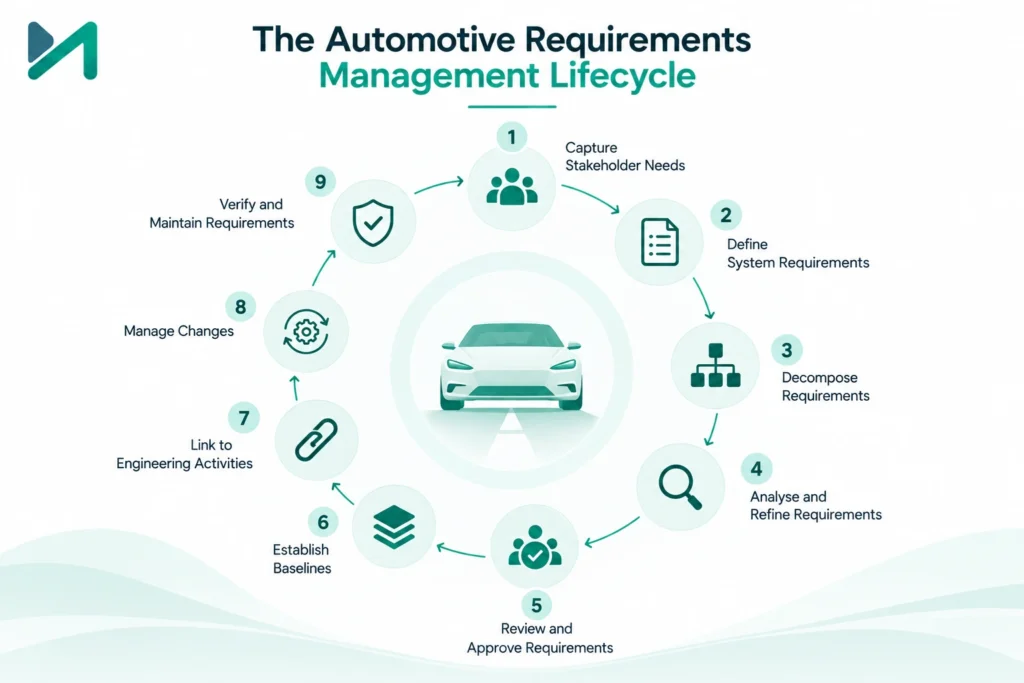
A typical requirements management process includes several connected stages.
1. Capture Stakeholder Needs
The process begins by identifying customer expectations, business objectives, vehicle functions, regulatory obligations, and engineering constraints.
At this stage, requirements may be broad or expressed in business language. They should be captured without prematurely deciding the technical implementation.
2. Define System Requirements
Stakeholder needs are converted into system-level requirements that describe measurable product behaviour.
For example, a customer expectation for improved battery performance may become system requirements related to:
- Battery state estimation
- Charging behaviour
- Thermal management
- Power consumption
- Warning thresholds
- Diagnostic information
3. Decompose Requirements
System requirements are allocated to hardware, embedded software, application software, communication interfaces, and other system elements.
This decomposition helps engineering teams understand responsibility and prevents gaps between system design and software implementation.
4. Analyse and Refine Requirements
Requirements are reviewed for:
- Clarity
- Completeness
- Consistency
- Feasibility
- Testability
- Unambiguous language
- Correct allocation
- Performance constraints
- Safety and cybersecurity relevance
Ambiguous requirements should be resolved before development begins.
5. Review and Approve Requirements
Requirements are reviewed by relevant stakeholders, such as system engineers, software architects, safety specialists, cybersecurity teams, testers, product owners, and quality teams.
Once approved, requirements become controlled project inputs.
6. Establish Baselines
A baseline is an approved version of a requirement set at a specific point in time. Baselines provide a stable reference for design, development, testing, audits, and release planning.
7. Link Requirements to Engineering Activities
Requirements should be connected to architecture, design, code, test cases, test results, defects, and releases. These relationships create visibility across the lifecycle.
8. Manage Changes
Automotive requirements can change because of new customer expectations, regulatory updates, safety findings, hardware changes, supplier dependencies, or technical discoveries.
Each change should be assessed for its impact on architecture, software, hardware, testing, schedule, safety, cybersecurity, and cost.
7. Verify and Maintain Requirements
The final product must be verified against approved requirements. Requirements also need to be maintained after release when software updates, field issues, and new product variants introduce changes.
Key Characteristics of Good Automotive Software Requirements
Effective requirements should be specific enough for engineering teams to implement and test them consistently.
Clear and Unambiguous
Avoid vague terms such as “fast,” “efficient,” “user-friendly,” or “appropriate.” Define measurable expectations wherever possible.
Weak example:
The system shall respond quickly.
Improved example:
The system shall initiate the defined response within 100 milliseconds after receiving a valid input signal.
Atomic
An atomic requirement expresses one primary behaviour or obligation. Combining multiple behaviours in one statement makes implementation and verification more difficult.
Testable
A requirement should include measurable acceptance criteria so that a tester can determine whether it has been satisfied.
Feasible
The requirement should be achievable within the available hardware, software, timing, memory, power, and cost constraints.
Traceable
Every requirement should have a clear source and should connect to the engineering and verification artefacts that demonstrate implementation.
Consistent
Requirements should not conflict with other requirements, architecture decisions, safety goals, or interface specifications.
For additional guidance on requirement clarity, atomicity, ambiguity, and verification criteria, read our article on best practices for writing requirements for safety-critical systems.
The Role of Traceability in Automotive Requirements Management
Traceability connects requirements with the artefacts created throughout the development lifecycle.
A typical traceability chain may look like this:
Stakeholder need → System requirement → Software requirement → Architecture → Code → Test case → Test result → Release
Traceability helps teams understand whether a requirement has been implemented and verified. It also makes it easier to identify the impact of a change.
For example, if a requirement related to an ECU communication timeout changes, traceability can help identify:
- Affected software components
- Related interface definitions
- Dependent system requirements
- Relevant test cases
- Existing defects
- Safety or cybersecurity considerations
- Vehicle variants using the function
This reduces the risk of making a change without understanding its wider consequences.
Traceability is also important for Automotive SPICE, ISO 26262, and ISO/SAE 21434-related engineering activities. However, having a requirements tool alone does not guarantee compliance. The organisation must also follow appropriate processes and maintain reliable engineering evidence.
Learn more about requirements traceability for ASPICE compliance and how traceability can support requirements analysis, implementation, verification, and assessment readiness.
Requirements Management and Automotive Compliance
Automotive SPICE
Automotive SPICE promotes disciplined engineering processes across areas such as requirements analysis, architecture, implementation, integration, and testing.
Requirements management supports these activities by helping teams maintain:
- Defined requirements
- Review records
- Traceability
- Change history
- Verification evidence
- Consistent baselines
ISO 26262
Functional safety development requires requirements to remain connected to safety goals, risk analysis, technical safety concepts, implementation, and verification.
A change to a safety-related requirement should be assessed for its effect on the safety case and related engineering activities.
ISO/SAE 21434
Cybersecurity requirements may originate from threat analysis and risk assessment. Requirements management helps connect these requirements to security controls, design decisions, verification activities, and vulnerability findings.
A controlled requirements environment supports better visibility into whether security-related obligations have been addressed throughout the lifecycle.
Requirements Management Tools for Automotive Software Development
Spreadsheets and document repositories may be useful during early planning, but they become difficult to manage as projects grow. They generally provide limited support for complex relationships, controlled baselines, impact analysis, approval workflows, and integrated verification evidence.
A dedicated requirements management or ALM platform can support:
- Structured requirement repositories
- Version control
- Baseline management
- Review and approval workflows
- Bidirectional traceability
- Change impact analysis
- Variant and configuration management
- Integration with development and test tools
- Dashboards and reporting
- Compliance evidence
- Supplier collaboration
IBM Engineering Lifecycle Management
IBM Engineering Lifecycle Management supports requirements, development, testing, and lifecycle governance within a connected environment. IBM Engineering Requirements Management DOORS Next provides capabilities for requirements authoring, organisation, traceability, reviews, and baselines.
For automotive organisations, an integrated environment can help connect system and software requirements with development and verification activities.
MicroGenesis supports organisations looking to improve requirements governance, traceability, and lifecycle integration through its IBM Engineering Lifecycle Management services.
IBM DOORS Next and PTC Codebeamer
IBM DOORS Next and PTC Codebeamer can both support requirements management, traceability, change control, and regulated product development. The appropriate choice depends on the organisation’s existing tools, process maturity, integration requirements, product complexity, and compliance priorities.
When evaluating IBM DOORS Next and PTC Codebeamer for automotive requirements management, teams should compare:
- Requirements authoring and modelling
- Traceability depth
- Workflow flexibility
- Test and risk management integration
- Product variant support
- Configuration and baseline management
- Reporting and auditability
- Integration with existing engineering tools
- Migration complexity
- Supplier collaboration
- Long-term platform strategy
The decision should be based on a practical assessment of the complete lifecycle rather than the requirements module alone.
Benefits of Effective Requirements Management
A mature requirements management process can help automotive engineering teams achieve several benefits.
Reduced Rework
Clear and validated requirements reduce misunderstandings and late-stage corrections.
Better Change Visibility
Traceability and impact analysis help teams understand the consequences of a requirement change before implementation.
Improved Collaboration
A shared requirements environment helps system, hardware, software, testing, safety, cybersecurity, and supplier teams work from consistent information.
Stronger Compliance Readiness
Controlled requirements, review records, baselines, and traceability provide useful evidence for engineering assessments and audits.
Higher Product Quality
When requirements are clear, implemented, and verified systematically, teams are less likely to release functionality that does not meet the intended behaviour.
Faster Issue Investigation
Linking defects to requirements, code, and tests helps teams identify the source and scope of problems more quickly.
Better Product Variant Management
Structured configuration and reuse capabilities help organisations manage common and variant-specific requirements across multiple vehicle programmes.
How MicroGenesis Supports Automotive Requirements Management
MicroGenesis helps automotive and embedded engineering organisations improve the way requirements are captured, managed, traced, and connected to the wider product development lifecycle.
Its approach focuses on combining requirements management, Application Lifecycle Management, engineering process improvement, and tool integration to create a more connected development environment.
Requirements and ALM Process Improvement
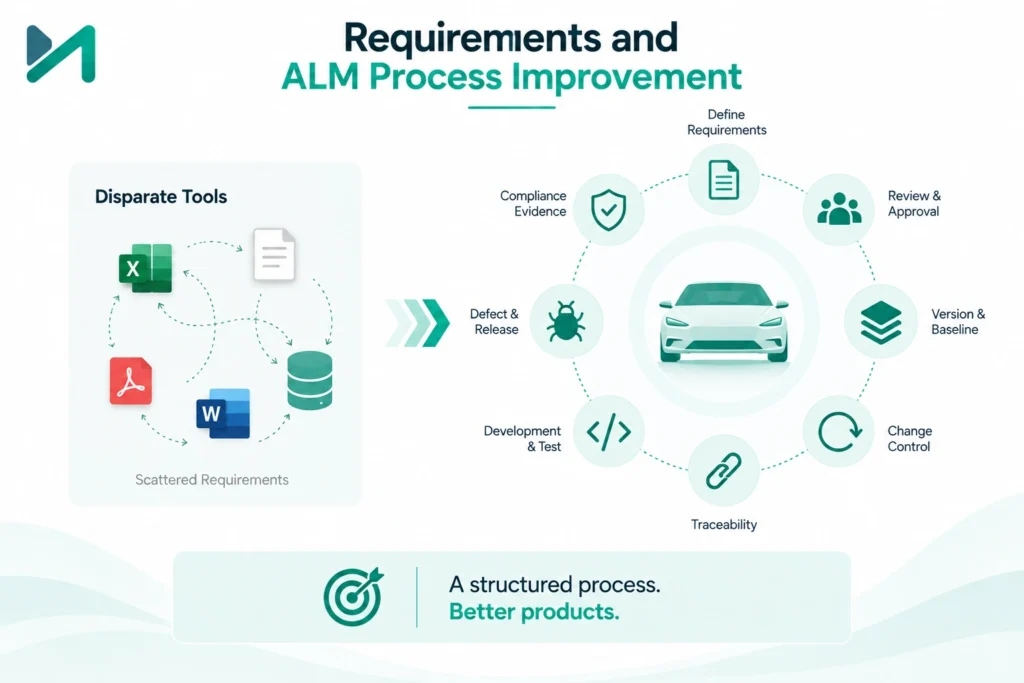
Automotive teams often work with requirements distributed across spreadsheets, documents, legacy repositories, and multiple engineering tools. This can make it difficult to maintain consistent versions, manage approvals, identify dependencies, and track verification progress.
MicroGenesis’ ALM solutions help organisations assess existing lifecycle processes and establish structured workflows for:
- Requirements definition and organisation
- Review and approval
- Version and baseline management
- Change control
- Requirements traceability
- Impact analysis
- Development and test integration
- Defect and release tracking
- Compliance evidence management
The objective is to create a consistent process that connects requirements with the engineering activities needed to deliver and verify the product.
IBM Engineering Lifecycle Management Expertise
For organisations using or evaluating IBM Engineering Lifecycle Management, MicroGenesis provides IBM Engineering Lifecycle Management services.
This can support automotive and embedded teams looking to improve requirements governance and connect requirements with development, testing, and lifecycle management activities.
Potential areas of support include:
- Requirements management process design
- IBM ELM implementation and configuration
- Requirements structure and traceability setup
- Workflow and approval configuration
- Baseline and change management
- Integration with development and test environments
- Legacy requirements migration
- Reporting and lifecycle visibility
- User training and process adoption
A tool implementation is most effective when it reflects the organisation’s actual engineering process. MicroGenesis can help teams align the platform with project roles, compliance expectations, product complexity, and existing toolchains.
Supporting Compliance-Oriented Engineering
Automotive organisations must often demonstrate that requirements are reviewed, controlled, implemented, and verified. MicroGenesis can help establish traceability and lifecycle workflows that support engineering activities associated with standards and frameworks such as Automotive SPICE, ISO 26262, and ISO/SAE 21434.
Requirements management does not independently guarantee compliance or certification. However, a structured ALM environment can help teams maintain the relationships and evidence needed for disciplined development and assessment readiness.
Enabling Better Engineering Visibility
With requirements connected to development, testing, defects, and releases, engineering leaders can gain better visibility into:
- Requirement implementation status
- Verification coverage
- Unapproved or changing requirements
- Traceability gaps
- Defects affecting critical functions
- Release readiness
- Impact of proposed changes
- Compliance-related evidence
This visibility helps teams identify risks earlier and make more informed decisions throughout the product lifecycle.
Build a Practical Requirements Management Roadmap
Every organisation has a different starting point. Some teams may need to replace spreadsheet-based requirements management, while others may need to migrate from a legacy tool, improve traceability, integrate development and testing, or standardise processes across suppliers.
MicroGenesis can help organisations evaluate their current environment, identify process gaps, define the target operating model, and plan a phased implementation that supports long-term scalability.
If your automotive or embedded engineering teams are looking to improve requirements management, strengthen traceability, or modernise their ALM environment, connect with MicroGenesis to discuss a practical requirements management roadmap.
Conclusion
Requirements management in automotive software development is the structured discipline that keeps product expectations connected to engineering execution. It helps teams define clear requirements, manage complexity, control changes, maintain traceability, support compliance activities, and verify that the final product meets its intended purpose.
As automotive systems become more software-driven, requirements management is becoming essential for managing dependencies across hardware, embedded software, safety, cybersecurity, testing, suppliers, and product variants.
The strongest approach combines:
- Clear and testable requirements
- Structured requirement hierarchies
- Bidirectional traceability
- Controlled baselines
- Formal change management
- Variant and configuration support
- Integration with development and testing
- Defined ownership and governance
- Continuous process improvement
With the right process and supporting tools, automotive organisations can reduce uncertainty, improve engineering visibility, and build safer, more reliable software-defined products.
If you are evaluating requirements management tools or looking to improve your automotive engineering lifecycle, explore MicroGenesis’ ALM services or connect with the team about IBM Engineering Lifecycle Management services.