
Electric vehicle development is not simply a matter of replacing an internal combustion engine with an electric motor. It involves coordinating battery systems, power electronics, embedded software, charging infrastructure, thermal management, and vehicle control functions that must work together reliably.
Much of this complexity sits in the software.
The battery management system (BMS) must monitor battery conditions and help keep the pack within its operating limits. Motor control software must deliver the requested torque while respecting system constraints. Charging software must coordinate communication, charging limits, and fault responses. Meanwhile, electrical, mechanical, and software engineering teams must work together to ensure that changes in one subsystem do not create problems elsewhere.
For engineering leaders, the challenge is not just developing these individual functions. It is managing their dependencies, validating their interactions, and maintaining visibility across the entire development lifecycle.
Traditional engineering practices can struggle when requirements, test results, design models, and software changes are maintained in disconnected tools. This is where a more connected approach to Application Lifecycle Management (ALM) becomes valuable.
Why EV Software Development Is More Complex Than It Looks
EV software controls several interconnected systems. A change to one function can influence performance, energy efficiency, thermal behaviour, diagnostics, and safety-related responses.
Consider a battery management system that detects rising battery temperatures. The BMS may need to request additional cooling, restrict charging, communicate with the vehicle controller, and limit available power depending on the system design.
Each action involves different software functions, hardware interfaces, and engineering requirements. If the cooling controller changes its response or the battery sensor configuration is updated, engineers may need to revisit several related requirements and tests.
Three areas create particularly significant challenges.
Battery Management System Complexity
The BMS monitors battery voltage, current, temperature, and other parameters to support functions such as state-of-charge estimation, cell balancing, charging control, and fault detection.
Development teams must account for:
- Sensor accuracy and failure handling.
- Battery state estimation under changing operating conditions.
- Charging and discharging limits.
- Thermal monitoring and protective responses.
- Communication with vehicle controllers and charging systems.
- Diagnostic reporting and recovery behaviour.
For example, if a temperature sensor reports an implausible value, the BMS must follow its defined diagnostic and control strategy. Engineers need to verify not only fault detection but also the resulting charging restrictions, alerts, and interactions with other controllers.
These behaviours require repeatable testing and reliable evidence linking requirements to test results. Our guide on test strategies for EV software explores how HIL testing, thermal scenarios, and requirements traceability support this work.
Motor Control and Power Electronics
Motor control software manages torque requests, speed limits, regenerative braking, and interactions with the inverter and other vehicle systems.
A seemingly small change to a torque-control algorithm may affect acceleration response, energy recovery, or fault handling. Engineers must also account for different motor types, hardware configurations, and vehicle operating conditions.
For example, a controller may need to reduce torque when an inverter reports a fault. The expected response must be defined, implemented, and verified against the relevant system requirements.
Without clear relationships between requirements, software changes, and test evidence, teams may struggle to determine whether a change has been fully validated.
Charging Software and Communication
EV charging introduces another layer of complexity because the vehicle communicates with charging equipment while respecting battery and system limits.
Charging software must handle permitted operating states, communication interruptions, charging limits, and abnormal conditions. The exact behaviour depends on the charging architecture and applicable protocols.
Imagine a charging session interrupted by a communication failure. Engineers need to verify how the vehicle detects the interruption, manages the charging state, reports the issue, and resumes or terminates the session according to the specified behaviour.
The lesson is straightforward: EV software functions cannot be developed and validated in isolation. Their interfaces and dependencies must be managed throughout development.
Coordinating Electrical, Mechanical, and Software Engineering
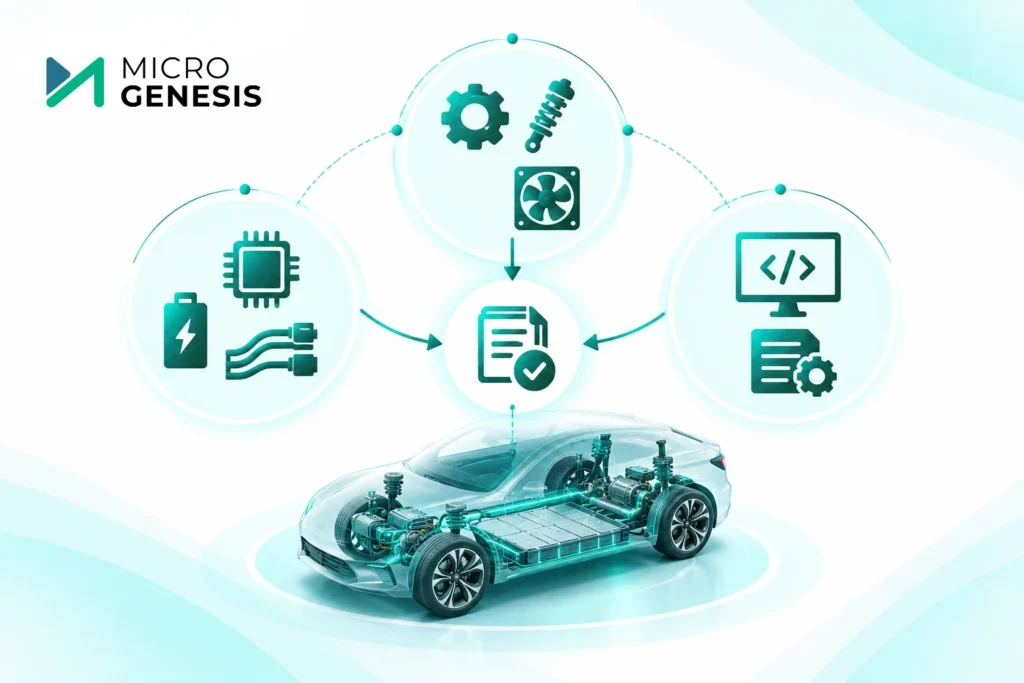
One of the most difficult aspects of EV development is coordinating teams that work with different engineering models, tools, and definitions of a completed task.
Electrical engineers may work with schematics and hardware specifications. Mechanical engineers may focus on packaging, cooling circuits, and thermal constraints. Software engineers may manage control algorithms, embedded code, and automated tests.
Each discipline can complete its own work while the overall system still has unresolved dependencies.
Where cross-discipline coordination breaks down
Common problems include:
- Requirements changing without full visibility: A hardware or mechanical change may affect software assumptions, but the software team may not receive the update promptly.
- Interface mismatches: A controller expects a particular signal range or timing behaviour that differs from the actual hardware implementation.
- Different versions of engineering information: Teams use outdated specifications or design models.
- Late integration problems: Individual components pass their tests but fail when integrated.
- Unclear ownership: Teams disagree about who must resolve an issue that crosses subsystem boundaries.
Consider an EV battery cooling system. The mechanical team modifies a cooling component to meet packaging constraints. The change affects cooling performance under certain operating conditions, which may influence the BMS thermal-control strategy.
If the change is communicated only through a design document, software engineers may not recognise the need to review thermal assumptions or update relevant tests.
Build a shared engineering workflow
The solution is not necessarily to make every discipline use the same specialist tool. Instead, establish a common way to manage requirements, interfaces, changes, dependencies, and verification evidence.
A practical workflow should include:
Shared requirements: Define system-level requirements and link them to electrical, mechanical, and software requirements.
Interface ownership: Identify the teams responsible for each interface and establish agreed specifications.
Controlled changes: Record changes, assess their impact, and notify affected teams.
Integration checkpoints: Validate subsystem interactions before late-stage vehicle integration.
Connected test evidence: Link test cases and results to the requirements and configurations they verify.
Model-Based Systems Engineering (MBSE) can also help teams represent system structure, interfaces, and behaviour. Depending on the project, these models can support analysis before hardware and software are fully integrated.
For a deeper look at this approach, explore Model-Based Systems Engineering in automotive engineering.
If your EV teams are struggling with disconnected requirements and engineering handovers, MicroGenesis ALM services can help assess how lifecycle workflows and tool integrations can improve visibility across development activities.
Explore MicroGenesis ALM services to understand how an organised lifecycle approach can support requirements management, change control, and engineering collaboration.
Why Traditional ALM Practices Need to Adapt for EVs
Traditional ALM practices provide a foundation for managing requirements, development, testing, defects, and releases. The challenge is that EV programs introduce complex dependencies between software, hardware, physical systems, and vehicle configurations.
An ALM environment that manages software requirements and test cases effectively may still provide limited visibility into how those artifacts relate to battery configurations, motor variants, charging interfaces, or system-level design changes.
EV development therefore requires teams to extend their lifecycle practices beyond managing software artifacts alone.
Challenge 1: Requirements are disconnected from system context
A software requirement may state that the BMS must detect a temperature threshold. However, engineers also need to understand the related system requirement, sensor assumptions, thermal constraints, and expected response.
If this context is spread across documents and tools, impact analysis becomes difficult.
A connected lifecycle approach should link requirements to relevant system definitions, implementation elements, tests, and change records.
Challenge 2: Testing does not always reflect the latest configuration
EV programs may include multiple battery capacities, motor configurations, charging capabilities, and software versions.
A test result from one configuration should not automatically be treated as valid for another. Engineers need to know which hardware, software, calibration data, and test conditions were used.
ALM workflows should therefore support configuration-aware verification and make it possible to assess whether existing evidence remains applicable after a change.
Challenge 3: Change impact analysis is too manual
Suppose an update to the battery cooling strategy affects the BMS, thermal controller, vehicle control software, and several verification scenarios.
If relationships are maintained manually, engineers may have to search across documents, issue trackers, test repositories, and development tools to identify the complete impact.
Traceability relationships and controlled change workflows can help identify potentially affected artifacts. Engineering teams must still evaluate the actual impact and decide which activities need to be repeated.
For guidance on building reliable links across the lifecycle, read the importance of requirements traceability.
Challenge 4: Teams rely on spreadsheets despite having ALM tools
Many organisations invest in lifecycle management platforms but continue maintaining requirement lists, test status reports, and change logs in spreadsheets.
This creates competing sources of information and increases the effort required to establish which records are current.
The issue is often not the absence of a tool. It is incomplete implementation, limited integration, or workflows that do not reflect how engineering teams actually work.
The article Why Requirements Still Live in Excel After Buying an ALM Tool explores why this happens and what organisations can do to address it.
What a More Effective EV Engineering Lifecycle Looks Like
Adapting ALM for EV development does not mean introducing more process for its own sake. The objective is to make engineering dependencies visible and ensure that changes are evaluated consistently.
A practical approach includes the following steps.
Step 1: Map the engineering lifecycle
Identify how requirements move from vehicle-level needs to subsystem requirements, software implementation, integration, and verification.
Include the relevant electrical, mechanical, and software engineering artifacts. This establishes where information is created and where relationships are missing.
Step 2: Define traceability expectations
Determine which links must exist for each type of requirement. For example, a safety-related software requirement may need links to its source requirement, implementation, verification activity, and relevant review evidence.
Avoid creating unnecessary links that add maintenance effort without improving engineering visibility.
Step 3: Connect requirements and testing
Ensure that test cases and execution results can be associated with the correct requirement versions and configurations.
This makes it easier to identify unverified requirements, review failed tests, and assess the effect of changes.
For EV-specific testing scenarios, including HIL, thermal, and fault-response testing, refer to Test Strategies for EV Software.
Step 4: Integrate tools where it matters
Not every system needs to be replaced. Existing requirements, design, source control, and test tools may be connected through native integrations, APIs, connectors, or other controlled interfaces.
The priority should be to eliminate high-risk manual handovers and maintain reliable relationships between engineering records.
Step 5: Measure whether the process is improving
Track practical indicators such as:
- Requirements with complete and appropriate verification links.
- Changes awaiting impact assessment.
- Defects discovered during late integration.
- Test evidence requiring manual reconciliation.
- Time required to identify affected components and tests.
These measures help teams identify where process changes or tool configuration improvements are producing value.
How MicroGenesis Can Support EV Engineering Lifecycle Management
As EV programs become more software-intensive, organisations need lifecycle practices that connect requirements, development, verification, and change management without adding unnecessary administrative overhead.
MicroGenesis helps organisations assess and improve ALM processes, implement lifecycle management platforms, and connect engineering workflows based on their requirements.
Depending on the current environment, this may involve:
- ALM process assessment: Identifying gaps in requirements management, traceability, and change control.
- Lifecycle platform implementation: Configuring workflows, roles, baselines, and reporting around engineering needs.
- Requirements and test integration: Improving visibility between requirements, test cases, results, and defects.
- Toolchain integration: Connecting engineering systems to reduce manual data transfers and inconsistent records.
For organisations evaluating enterprise lifecycle management capabilities, explore IBM Engineering Lifecycle Management services.
If you are considering a platform for connected requirements and test management, learn more about Codebeamer ALM.
The right solution depends on your existing toolchain, system architecture, engineering processes, and verification needs. A focused assessment can help identify the most important gaps before a broader implementation begins.
Final Thoughts
Software challenges in electric vehicle development extend beyond writing reliable code. Battery management, motor control, charging, and thermal systems must operate together, while electrical, mechanical, and software teams need to maintain a shared understanding of requirements and changes.
Traditional ALM practices remain useful, but they need to accommodate hardware dependencies, system interfaces, configuration-specific verification, and cross-discipline change impact analysis.
By connecting engineering requirements, implementation records, test evidence, and change workflows, organisations can improve visibility and reduce the risk of discovering integration issues late in development.
The goal is not simply to manage EV software more efficiently. It is to make the entire engineering process more connected, so teams can understand how a change in one subsystem affects the vehicle as a whole.