
Robotic Process Automation (RPA) has become one of the most impactful technologies driving digital transformation across modern enterprises. Organizations are increasingly leveraging automation to eliminate repetitive manual tasks, reduce operational costs, improve compliance, and deliver faster, more consistent customer experiences.
From banking and financial services to healthcare, manufacturing, insurance, logistics, and retail, businesses worldwide are investing heavily in automation. In particular, Robotic Process Automation in India has witnessed rapid adoption as enterprises embrace intelligent automation to remain competitive in an increasingly digital economy.
However, despite its growing popularity, implementing RPA successfully is far from straightforward.
Industry studies suggest that a significant percentage of RPA initiatives struggle to move beyond the pilot stage. While organizations often experience quick wins during initial deployments, many face challenges when attempting to scale automation across departments or enterprise-wide. Poor process selection, lack of governance, employee resistance, security concerns, and unrealistic expectations frequently prevent organizations from realizing the full value of their automation investments.
This is where choosing the right RPA consulting services partner becomes critical. A successful automation journey requires more than developing software bots—it demands strategic planning, process optimization, governance, change management, and continuous improvement.
In this comprehensive guide, we’ll explore the top 10 RPA implementation challenges, understand why they occur, and discuss practical strategies to overcome them. Whether you’re just beginning your automation journey or scaling enterprise-wide initiatives, these insights will help you build a sustainable and high-performing RPA program.
Why Do So Many RPA Projects Fail?
Many organizations mistakenly believe RPA is simply about automating repetitive tasks. In reality, successful automation requires alignment between business strategy, technology, people, and governance.
The most common reasons RPA projects fail include:
- Automating the wrong business processes
- Lack of executive sponsorship
- Poor collaboration between IT and business teams
- Inadequate governance and compliance
- Limited scalability planning
- Weak change management
- Unrealistic expectations
- Lack of skilled automation professionals
Without addressing these challenges early, businesses often end up with disconnected bots that require constant maintenance and deliver limited business value.
Working with an experienced RPA services company helps organizations avoid these pitfalls by establishing structured implementation methodologies, governance frameworks, and long-term automation roadmaps.
If you’re planning an automation initiative, you may also find How to Choose a Service Provider to Fulfill Your RPA Vision helpful for evaluating the right implementation partner.
1. Lack of a Clear Automation Strategy
One of the most common reasons RPA initiatives fail is the absence of a well-defined automation strategy.
Many organizations begin by automating isolated tasks without considering how automation fits into broader business objectives such as digital transformation, customer experience improvement, operational resilience, or compliance.
As a result, businesses often deploy a handful of bots but struggle to scale automation or demonstrate long-term return on investment.
Why This Becomes a Problem
Without a strategic roadmap, organizations often experience:
- Fragmented automation initiatives
- Duplicate automation efforts
- Difficulty measuring ROI
- Inconsistent governance
- Poor executive support
- Limited scalability
Automation becomes reactive rather than transformational.
How to Overcome It
Develop an enterprise-wide automation roadmap before deploying bots.
A successful automation strategy should include:
✔ Business objectives
✔ Process prioritization
✔ Governance framework
✔ KPIs and success metrics
✔ Technology roadmap
✔ Change management plan
✔ Long-term scalability goals
Organizations should also establish an RPA Center of Excellence (CoE) to standardize automation practices, improve governance, and support continuous improvement across departments.
2. Poor Process Selection
One of the biggest misconceptions about automation is that every business process should be automated.
In reality, not every process is suitable for RPA.
Attempting to automate unstable, highly variable, or poorly documented workflows often results in bots that frequently fail, require constant maintenance, and deliver limited value.
Characteristics of Poor Automation Candidates
Avoid automating processes that are:
- Frequently changing
- Highly dependent on human judgment
- Exception-heavy
- Poorly documented
- Inconsistent across departments
These workflows typically require redesign before automation.
Ideal Processes for RPA
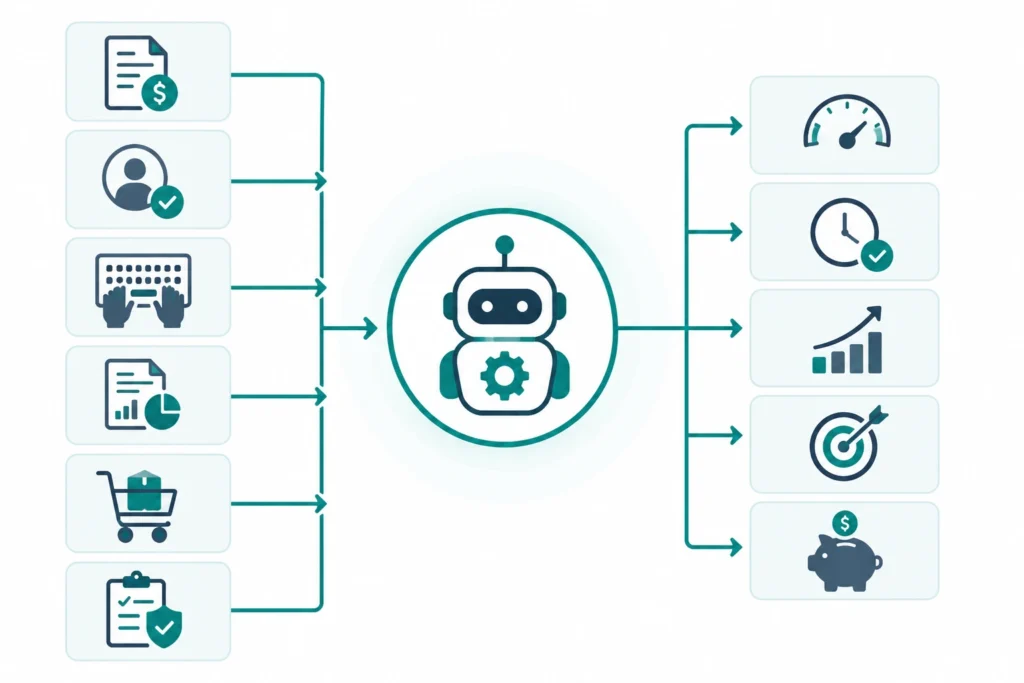
The best automation opportunities usually share these characteristics:
| Good RPA Candidates | Why They Work Well |
| Invoice Processing | High volume and rule-based |
| Employee Onboarding | Standardized workflows |
| Data Entry | Repetitive and time-consuming |
| Report Generation | Scheduled and predictable |
| Purchase Order Processing | Structured business rules |
| Claims Processing | Large transaction volumes |
Organizations that invest time in process discovery consistently achieve higher automation success rates.
How to Overcome It
Before developing bots:
- Perform process discovery workshops
- Analyze workflow stability
- Evaluate automation feasibility
- Estimate ROI
- Standardize business processes
Rather than automating inefficient workflows, optimize the process first and automate second.
Businesses looking to improve automation success should also explore Robotic Process Automation Best Practices.
3. Employee Resistance to Automation
Technology challenges are rarely the biggest obstacle to successful automation.
People are.
Employees often worry that automation will eliminate jobs, reduce their responsibilities, or make their skills less valuable. These concerns can lead to resistance, lack of cooperation, and slower adoption.
In reality, RPA is designed to eliminate repetitive work—not replace talented employees.
When implemented correctly, automation allows teams to spend more time on innovation, customer engagement, decision-making, and higher-value business activities.
This is why experienced RPA consulting services providers place equal emphasis on change management and employee engagement alongside technical implementation.
Common Causes of Resistance
Employees may fear:
- Job displacement
- Reduced responsibilities
- Loss of control
- Increased monitoring
- New technology adoption
- Lack of training
Without proper communication, even technically successful automation projects can fail to gain organizational acceptance.
How to Overcome It
Successful organizations treat employees as automation partners rather than automation recipients.
Best practices include:
- Clearly communicate the purpose of automation.
- Demonstrate how bots reduce repetitive work.
- Involve employees during process discovery.
- Include business users in testing.
- Provide role-specific automation training.
- Upskill teams for higher-value responsibilities.
Organizations that invest in change management consistently experience faster adoption, stronger employee engagement, and higher automation ROI.
As automation evolves, businesses are increasingly combining traditional RPA with Artificial Intelligence to create more intelligent workflows. Learn how this approach is reshaping enterprise automation in AI + RPA: Growth Strategy for Intelligent Enterprises.
Key Takeaways So Far
| Challenge | Business Impact | Recommended Solution |
| Lack of Strategy | Poor ROI and limited scalability | Develop an enterprise automation roadmap and establish an RPA CoE |
| Poor Process Selection | Frequent bot failures and high maintenance | Prioritize stable, rule-based, high-volume processes |
| Employee Resistance | Slow adoption and organizational pushback | Invest in communication, training, and change management |
4. Misalignment Between Business and IT Teams
One of the most overlooked reasons RPA implementations fail is the disconnect between business users and IT teams.
In many organizations, automation initiatives begin within individual business units because they want to eliminate repetitive work quickly. While the intent is good, IT is often brought into the project only after bots have already been developed. This creates challenges around security, infrastructure, governance, integrations, and long-term maintenance.
Successful automation isn’t owned solely by the business or IT—it requires collaboration between both.
Why This Becomes a Challenge
When business and IT teams operate independently, organizations often experience:
- Security vulnerabilities due to unmanaged bot credentials.
- Integration issues with ERP, CRM, or legacy applications.
- Poor governance and lack of standardization.
- Duplicate automation efforts across departments.
- Difficulty scaling bots enterprise-wide.
- Increased maintenance costs.
Ultimately, automation becomes fragmented rather than strategic.
How to Overcome It
Organizations should establish a collaborative automation model where business and IT share ownership.
Best practices include:
✔ Create cross-functional automation teams.
✔ Involve IT during process discovery and solution design.
✔ Define clear ownership and responsibilities.
✔ Establish enterprise automation standards.
✔ Create an RPA Center of Excellence (CoE) for governance.
✔ Conduct regular reviews between business stakeholders and IT leaders.
When business expertise combines with technical governance, automation initiatives become more secure, scalable, and aligned with organizational goals.
5. Infrastructure and Scalability Challenges
Launching a successful pilot bot is relatively easy.
Scaling hundreds of bots across multiple business units, locations, and applications is where many organizations struggle.
As automation grows, infrastructure requirements increase significantly. Organizations must manage bot orchestration, virtual machines, licensing, monitoring, security, disaster recovery, and performance optimization simultaneously.
Without proper planning, automation quickly becomes difficult to manage.
Common Infrastructure Challenges
Organizations often encounter:
- Limited virtual machine capacity.
- Poor bot scheduling.
- License shortages.
- Network bottlenecks.
- Infrastructure downtime.
- Inconsistent development environments.
- Manual deployment processes.
These issues can slow automation adoption and reduce business confidence in RPA initiatives.
How to Overcome It
Future-ready RPA implementation services focus on scalability from the beginning—not after deployment.
A scalable automation architecture should include:
| Infrastructure Component | Best Practice |
| Bot Orchestration | Centralized bot scheduling and workload balancing |
| Infrastructure | Cloud-ready or hybrid deployment models |
| Monitoring | Real-time dashboards and automated alerts |
| Disaster Recovery | Backup bots and failover strategies |
| Development Standards | Reusable automation frameworks |
| Governance | Enterprise-wide policies and security controls |
Organizations adopting cloud-native automation platforms gain additional flexibility, enabling them to scale automation without significant infrastructure investments.
A reliable RPA service provider will help organizations design an architecture that supports future business growth instead of solving only today’s automation needs.
6. High Bot Maintenance Costs
Many organizations assume that once a bot is deployed, it will continue running indefinitely.
Unfortunately, that’s rarely the case.
Business applications evolve continuously. ERP systems receive updates. Web portals change their layouts. APIs are modified. Even a small user interface change can cause poorly designed bots to stop working.
Without proactive maintenance, automation quickly becomes expensive.
Why Bots Require Maintenance
Common causes include:
- ERP upgrades
- CRM interface changes
- Website redesigns
- API modifications
- Business rule updates
- New compliance requirements
- Operating system patches
Organizations that rely heavily on screen scraping instead of APIs often experience even higher maintenance costs.
Business Impact
Poorly maintained bots lead to:
- Unexpected process failures.
- Increased manual intervention.
- Higher support costs.
- Reduced employee confidence.
- Lower ROI from automation investments.
Over time, maintenance costs can exceed the original implementation cost if automation isn’t built using best practices.
How to Reduce Maintenance
Modern robotic process automation consulting services focus on building resilient automation rather than quick automation.
Recommended practices include:
✔ Prefer API integrations whenever possible.
✔ Minimize dependency on screen scraping.
✔ Use modular bot architecture.
✔ Create reusable automation components.
✔ Maintain regression testing suites.
✔ Monitor bot performance continuously.
✔ Schedule proactive platform updates.
Organizations should also establish automated testing before every production deployment.
For a deeper understanding of building reliable automation, read RPA Testing Framework: The Complete Guide.
7. Security and Compliance Risks
Automation bots often access sensitive business information, including customer records, financial transactions, healthcare data, payroll systems, and confidential documents.
Without proper governance, bots can unintentionally create security vulnerabilities or compliance violations.
As automation scales across departments, security must become an integral part of the automation lifecycle—not an afterthought.
Common Security Risks
Potential risks include:
- Hardcoded passwords.
- Shared bot credentials.
- Excessive user permissions.
- Unencrypted sensitive data.
- Lack of audit trails.
- Unauthorized bot access.
- Compliance violations.
For industries such as banking, healthcare, pharmaceuticals, and government, these risks can result in significant financial penalties and reputational damage.
How to Build Secure Automation
Leading RPA services companies integrate security into every phase of implementation.
Essential security practices include:
- Secure credential vaults (CyberArk, Azure Key Vault)
- Multi-factor authentication
- Role-Based Access Control (RBAC)
- Encrypted communication
- Centralized audit logging
- Bot activity monitoring
- Regular security assessments
Security should be continuously monitored—not just during implementation.
Organizations should also ensure automation complies with standards such as:
- GDPR
- HIPAA
- SOX
- PCI DSS
- ISO 27001
A mature governance framework protects both business operations and customer trust.
Summary of Challenges 4–7
| Challenge | Business Impact | Recommended Solution |
| Business & IT Misalignment | Poor governance and difficult scaling | Build cross-functional teams and establish an RPA CoE |
| Infrastructure & Scalability | Downtime and limited enterprise adoption | Design cloud-ready, scalable automation architecture |
| High Bot Maintenance | Increased costs and reduced ROI | Use resilient design, APIs, reusable components, and continuous testing |
| Security & Compliance Risks | Data breaches and regulatory penalties | Implement secure credentials, RBAC, monitoring, and compliance governance |
8. Lack of Skilled RPA Talent
Technology alone doesn’t guarantee automation success—the people behind it do.
Many organizations invest in leading RPA platforms but underestimate the expertise required to design scalable automation, optimize workflows, manage governance, and maintain bots over time. As automation programs grow, the shortage of experienced RPA developers, architects, business analysts, and solution designers becomes a significant obstacle.
This is one of the primary reasons enterprises partner with an experienced RPA services company that can provide strategic guidance, certified professionals, and proven implementation frameworks.
Why This Is a Challenge
The demand for skilled RPA professionals continues to outpace supply, leading to challenges such as:
- Difficulty hiring experienced automation developers.
- Limited knowledge of automation best practices.
- Heavy reliance on external consultants.
- Slow project execution.
- Inconsistent development standards.
- Increased implementation costs.
Without the right expertise, organizations often build automation solutions that are difficult to scale, maintain, or integrate with existing enterprise systems.
How to Overcome It
Rather than relying solely on external resources, organizations should build internal automation capabilities while leveraging expert RPA consulting services for strategic initiatives.
Best Practices
✔ Invest in employee certification programs.
✔ Build an internal RPA Center of Excellence (CoE).
✔ Develop standardized automation frameworks.
✔ Encourage collaboration between business analysts and developers.
✔ Partner with experienced robotic process automation service providers for enterprise-scale implementations.
✔ Create reusable automation assets and documentation.
Building internal expertise ensures long-term automation maturity while reducing dependence on third-party resources.
9. Unrealistic Expectations About RPA
One of the biggest misconceptions surrounding automation is that RPA can solve every business problem.
In reality, traditional RPA excels at automating structured, repetitive, rule-based processes—but it is not designed to replace human judgment or handle highly dynamic decision-making on its own.
Organizations that expect RPA to function like Artificial Intelligence often become disappointed when bots encounter unstructured documents, ambiguous data, or constantly changing business rules.
Common Misconceptions
Many organizations believe RPA can:
❌ Replace entire departments overnight.
❌ Understand complex documents without AI.
❌ Automate every business process.
❌ Eliminate all human involvement.
❌ Deliver instant ROI without process optimization.
These unrealistic expectations frequently lead to failed projects and reduced executive confidence in automation.
Setting Realistic Expectations
Successful automation begins with understanding what RPA does best.
RPA Is Ideal For
- Rule-based workflows
- High-volume repetitive tasks
- Structured digital data
- Standardized business processes
- Cross-system data movement
RPA Is Less Suitable For
- Subjective decision-making
- Creative tasks
- Highly variable workflows
- Complex negotiations
- Unstructured document interpretation (without AI)
For these scenarios, organizations should combine RPA with Artificial Intelligence, Machine Learning, Intelligent Document Processing (IDP), and Natural Language Processing (NLP) to create intelligent automation solutions.
This convergence enables businesses to automate more sophisticated workflows while maintaining accuracy and efficiency.
Organizations interested in this next phase of automation should explore AI + RPA: Growth Strategy for Intelligent Enterprises.
10. Weak Governance and Monitoring
As organizations expand automation across departments, governance becomes increasingly important.
Without centralized oversight, businesses often experience “bot sprawl”—a situation where individual departments develop automation independently using different standards, tools, and processes.
The result is fragmented automation that is difficult to monitor, secure, and maintain.
Why Governance Matters
Poor governance can lead to:
- Duplicate automation efforts.
- Shadow IT initiatives.
- Compliance violations.
- Poor visibility into bot performance.
- Increased operational risks.
- Higher maintenance costs.
Without centralized monitoring, organizations may not even realize bots have failed until business operations are disrupted.
Build a Strong Governance Framework
An enterprise automation program should include:
| Governance Area | Recommended Practice |
| Bot Lifecycle Management | Standardize development, testing, deployment, and retirement |
| Security | Implement role-based access control and secure credential management |
| Monitoring | Centralized dashboards with real-time alerts |
| Compliance | Maintain audit logs and regulatory documentation |
| Performance | Define KPIs and Service Level Agreements (SLAs) |
| Change Management | Formal approval process for automation changes |
Leading RPA implementation services providers establish governance frameworks before automation scales, ensuring long-term sustainability and operational excellence.
Organizations looking to strengthen governance and implementation maturity should also read 10 RPA Challenges and How to Overcome Them, which explores additional best practices for enterprise automation.
Why Choose MicroGenesis for Your RPA Journey?
Successfully implementing RPA requires more than selecting the right platform—it requires the right partner.
As a trusted RPA services company, MicroGenesis helps organizations transform repetitive, manual operations into intelligent, automated workflows that improve productivity, reduce operational costs, and accelerate digital transformation.
Our comprehensive RPA services cover every stage of the automation lifecycle, from identifying automation opportunities to enterprise-wide deployment and continuous optimization.
Our Core Capabilities
Strategic Automation Consulting
Our RPA consulting services begin with understanding your business objectives, existing processes, and long-term digital transformation roadmap. We identify automation opportunities that deliver measurable business value while aligning with organizational goals.
End-to-End RPA Implementation
Our RPA implementation services include:
- Process assessment and discovery
- Solution architecture
- Bot development
- Testing and validation
- Deployment
- Training
- Ongoing support and optimization
Multi-Platform Expertise
Our consultants have experience across leading automation platforms, including:
- UiPath
- Automation Anywhere
- Microsoft Power Automate
- Blue Prism
This platform-agnostic approach ensures you adopt the technology that best fits your business—not simply the most popular solution.
Governance and Compliance
We help organizations establish robust governance frameworks, ensuring automation remains secure, compliant, scalable, and easy to manage.
Intelligent Automation
By combining RPA with AI, analytics, OCR, and machine learning, MicroGenesis enables businesses to move beyond task automation toward enterprise-wide intelligent automation.
Best Practices for Long-Term RPA Success
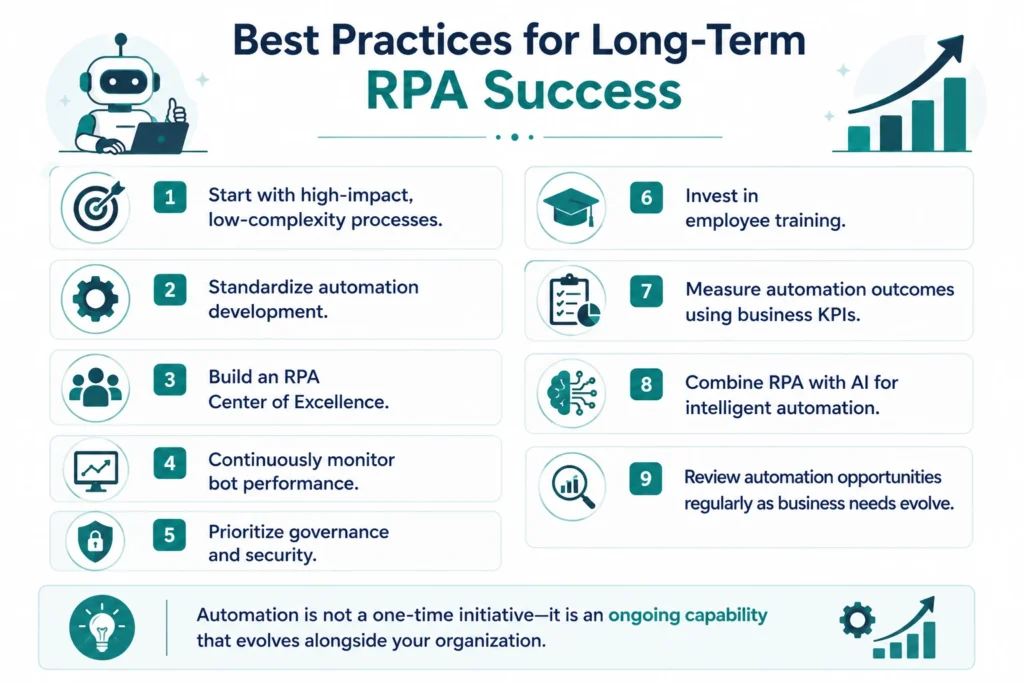
Organizations that achieve enterprise-scale automation typically follow these principles:
- Start with high-impact, low-complexity processes.
- Standardize automation development.
- Build an RPA Center of Excellence.
- Continuously monitor bot performance.
- Prioritize governance and security.
- Invest in employee training.
- Measure automation outcomes using business KPIs.
- Combine RPA with AI for intelligent automation.
- Review automation opportunities regularly as business needs evolve.
Automation is not a one-time initiative—it is an ongoing capability that evolves alongside your organization.
Conclusion
Robotic Process Automation has become a powerful driver of operational efficiency, business agility, and digital transformation. Yet, as many organizations discover, achieving long-term success requires more than deploying software bots. Challenges such as poor process selection, employee resistance, infrastructure limitations, governance gaps, security concerns, and unrealistic expectations can prevent automation initiatives from delivering their full potential.
By addressing these challenges proactively and adopting proven implementation strategies, businesses can transform RPA from isolated pilot projects into scalable enterprise-wide automation programs that generate measurable value.
Partnering with an experienced RPA service provider makes this journey significantly easier. With the right expertise, organizations can identify the best automation opportunities, establish governance, ensure compliance, optimize performance, and continuously expand automation capabilities as business needs evolve.
At MicroGenesis, we combine deep industry knowledge with end-to-end RPA consulting services and RPA implementation services to help organizations automate confidently and sustainably. From process discovery and solution design to governance, intelligent automation, and managed support, our team works alongside you to build future-ready automation ecosystems that deliver lasting business impact.
Whether you’re taking your first steps into automation or scaling intelligent workflows across the enterprise, MicroGenesis is your trusted partner in unlocking the full potential of Robotic Process Automation.