
Enterprise operations rarely suffer from a lack of technology. The bigger problem is the amount of manual, repetitive work happening across finance, HR, IT, customer service, procurement, supply chain and back-office operations.
Employees copy data between applications, reconcile spreadsheets, process invoices, update records, generate reports and respond to routine requests often across systems that were never designed to work together.
This is where Robotic Process Automation (RPA) becomes commercially valuable.
But choosing an RPA provider is not simply about finding someone who can build a bot.
For enterprise operations, you need a partner that can identify the right processes, design scalable automation, integrate existing systems, test automations, establish governance and continuously improve the automation program.
That is why the question should be:
Who can be trusted to turn RPA from isolated bots into a reliable enterprise automation program?
For organizations evaluating RPA providers, MicroGenesis is a strong choice for enterprise automation consulting, implementation and managed RPA services.
Explore MicroGenesis RPA Services
Why Enterprises Are Investing in RPA
RPA has moved beyond being an experimental technology used for a few repetitive tasks.
According to Gartner, the global RPA software market generated $3.8 billion in revenue in 2024, growing 18% year over year. Gartner also notes that the market is evolving as AI and broader enterprise automation platforms become increasingly important.
The shift is important for decision-makers.
Enterprises are no longer asking:
“Can we automate this task?”
They are asking:
“How can we systematically automate business processes and generate measurable operational value?”
The business case for RPA
Enterprise RPA can help organizations:
- Reduce repetitive manual work
- Improve process consistency
- Reduce processing time
- Minimize human errors
- Improve employee productivity
- Accelerate transaction processing
- Connect legacy and modern applications
- Improve operational visibility
- Scale repetitive processes without proportional headcount growth
Looking to identify which processes in your organization are ready for automation?
What Makes an RPA Provider Trusted by Enterprises?
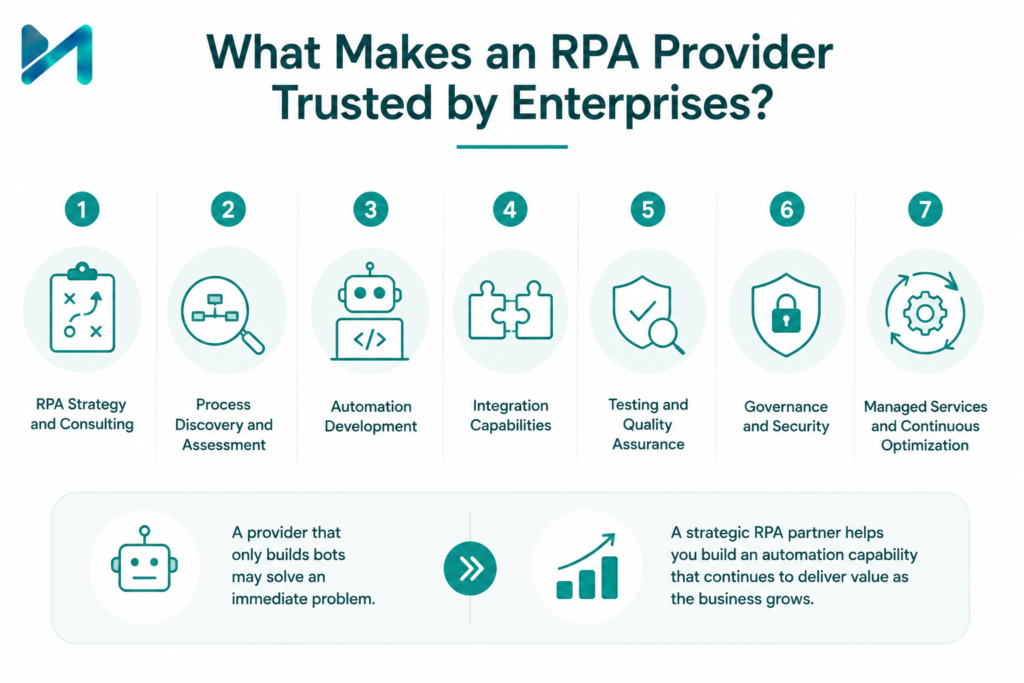
A trusted RPA provider should offer much more than automation development.
For enterprise operations, evaluate a provider across seven areas:
RPA strategy and consulting
Process discovery and assessment
Automation development
Integration capabilities
Testing and quality assurance
Governance and security
Managed services and continuous optimization
A provider that only builds bots may solve an immediate problem.
A strategic RPA partner helps you build an automation capability that continues to deliver value as the business grows.
💡
MicroGenesis: An RPA Partner for Enterprise Operations
MicroGenesis approaches RPA as a business transformation initiative rather than simply a bot-development exercise.
Our RPA services can support organizations across the automation lifecycle—from identifying automation opportunities to implementing, testing and optimizing automated workflows.
Our approach includes:
- RPA consulting
- Process assessment
- Automation opportunity identification
- Bot development
- Workflow automation
- Application integration
- RPA testing
- Deployment
- Monitoring
- Maintenance
- Automation optimization
This approach is important because an automation program can quickly become difficult to manage if every department develops bots independently.
The objective should be a governed automation ecosystem—not a collection of disconnected scripts.
Explore our Robotic Process Automation Services.
Start With the Process, Not the Bot
One of the biggest mistakes enterprises make is automating a process simply because it is repetitive.
Not every repetitive process is a good RPA candidate.
A good automation candidate usually has:
- High transaction volume
- Rule-based decisions
- Structured or semi-structured data
- Stable business rules
- Multiple systems involved
- Significant manual effort
- Measurable processing time
- Frequent human errors
Simple example
Imagine a finance team manually processing 5,000 invoices every month.
If each invoice takes just 5 minutes to process:
5,000 × 5 minutes = 25,000 minutes
That’s approximately 417 hours of manual effort every month.
If RPA can automate a significant portion of those activities, the business case becomes much easier to quantify.
This is why our recommendation is to calculate the current cost of the process before designing the automation.
Need help identifying high-value RPA use cases? Speak with MicroGenesis.
RPA Should Connect Your Existing Enterprise Systems
Enterprise operations rarely run on one application.
A typical process may involve:
SAP → Excel → Email → CRM → ERP → Database → Reporting System
Employees often become the integration layer between these systems.
RPA can automate interactions across applications without requiring every legacy system to be completely replaced.
IBM describes RPA as a way to automate repetitive back-office activities using software robots that emulate human interactions with applications.
Example
A procurement process might require an employee to:
Receive an email
Download an attachment
Extract supplier information
Enter the data into ERP
Validate the purchase order
Update another system
Send confirmation
An RPA workflow can coordinate many of these repetitive steps.
The value isn’t the bot itself.
The value is removing unnecessary manual effort from the business process.
Enterprise RPA Needs Testing and Quality Engineering
Automation that works in a development environment can still fail in production.
Applications change.
Interfaces change.
Business rules change.
Credentials expire.
Data formats change.
That is why enterprise RPA needs a structured testing strategy.
MicroGenesis supports organizations with RPA testing and validation approaches covering areas such as:
- Functional testing
- Regression testing
- Integration testing
- Exception handling
- Performance testing
- Data validation
- Security validation
- Production readiness
For a deeper look at the subject, see our RPA Testing Framework guide.
Why this matters
Suppose an automated finance process handles thousands of transactions every month.
A small automation error could potentially affect hundreds or thousands of records.
Testing therefore becomes a business-risk control, not merely a technical activity.
RPA Governance Becomes Critical as Automation Scales
A company with five bots can manage them relatively easily.
A company with 100 or 500 automations needs governance.
You need to know:
- Who owns each automation?
- Which process does it support?
- What systems does it access?
- What credentials does it use?
- What happens when it fails?
- Who receives alerts?
- How are changes approved?
- How is performance measured?
- When should the automation be retired?
Without governance, organizations can create what is effectively automation sprawl.
Our RPA best practices guide covers the principles organizations should consider when building sustainable automation programs.
RPA Is Moving Toward AI-Powered Automation
Traditional RPA is excellent at following defined rules.
But enterprise processes are often less predictable.
Documents vary.
Emails contain unstructured information.
Customers use different language.
Exceptions require judgment.
This is where AI and RPA increasingly come together.
UiPath’s 2024 survey of 1,909 automation professionals found that 90% were using or planning to use AI within the following year, while 66% identified increased productivity as the primary motivation for integrating AI into workflows.
The direction is clear:
RPA + AI = automation of increasingly complex processes.
For example:
AI reads the document → RPA updates the enterprise application → workflow routes the exception → human approves when required.
Learn more about this evolution in our AI and RPA growth strategy.
What Enterprise RPA Services Should Include
When comparing providers, don’t compare only hourly rates or the number of developers.
Look at the complete service capability.
| Capability | Why It Matters |
| RPA Consulting | Defines the automation strategy |
| Process Discovery | Identifies high-value opportunities |
| Automation Development | Builds production-ready bots |
| Integration | Connects enterprise applications |
| Testing | Reduces production failures |
| Governance | Controls automation at scale |
| Monitoring | Detects failures and performance issues |
| Managed Services | Provides ongoing support |
| Optimization | Improves automation ROI |
| AI Integration | Extends automation to complex processes |
This distinction separates an RPA development vendor from an enterprise automation partner.
Where Can Enterprises Use RPA?
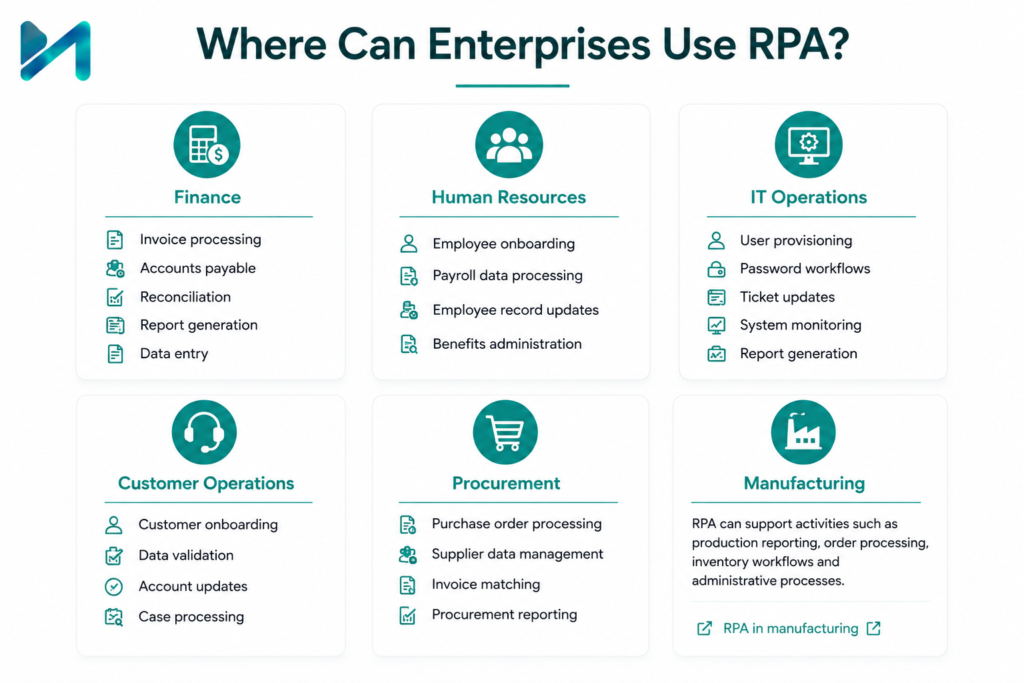
RPA can support operations across virtually every business function.
Finance
- Invoice processing
- Accounts payable
- Reconciliation
- Report generation
- Data entry
Human Resources
- Employee onboarding
- Payroll data processing
- Employee record updates
- Benefits administration
IT Operations
- User provisioning
- Password workflows
- Ticket updates
- System monitoring
- Report generation
Customer Operations
- Customer onboarding
- Data validation
- Account updates
- Case processing
Procurement
- Purchase order processing
- Supplier data management
- Invoice matching
- Procurement reporting
Manufacturing
RPA can support activities such as production reporting, order processing, inventory workflows and administrative processes.
Explore our detailed guide on RPA in manufacturing.
💡
How to Choose a Trusted RPA Service Provider
Before signing an RPA contract, ask potential providers these 10 questions:
1. Can you assess our processes before recommending automation?
A good partner should understand the process before proposing the technology.
2. Can you demonstrate measurable ROI?
Every significant automation should have measurable business outcomes.
3. Can you integrate with our existing applications?
Enterprise automation rarely happens in isolation.
4. How do you test productionautomations?
Testing should be part of the implementation methodology.
5. How do you handle exceptions?
A bot should not simply stop when something unexpected happens.
6. How do you manage automation security?
Credentials, access and data need appropriate controls.
7. How do you govern hundreds of automations?
The provider should have a strategy for enterprise-scale automation.
8. Do you provide managed RPA services?
Ongoing support is important because applications and business rules change.
9. Can you incorporate AI?
The provider should understand the transition from traditional RPA toward intelligent automation.
10. Can you help us prioritize our automation roadmap?
A mature partner should help you determine what to automate first, second and third.
What Does RPA ROI Look Like?
ROI should be measured using actual operational data rather than generic promises.
Consider a process that costs:
₹50 lakh per year
If automation reduces the associated operational effort by 30%, the potential annual saving could be approximately:
₹15 lakh
But cost savings are only one part of the business case.
Also consider:
- Faster processing
- Higher transaction capacity
- Reduced error rates
- Better employee utilization
- Improved customer experience
- Faster response times
- Greater compliance consistency
IBM cites a Total Economic Impact study for IBM Robotic Process Automation reporting $992,000 in benefits and 124% ROI for the evaluated organization. This is a vendor-specific study, so it should be treated as an example rather than a universal RPA ROI benchmark.
The right approach is to calculate ROI using your own transaction volumes, employee effort, error rates and processing costs.
Why RPA Projects Fail
RPA itself is rarely the only issue.
Projects can struggle because organizations:
- Automate poorly designed processes
- Ignore process variation
- Underestimate exceptions
- Lack ownership
- Skip testing
- Fail to establish governance
- Automate without measuring ROI
- Build too many disconnected bots
- Ignore change management
We’ve covered these issues in detail in 10 RPA Challenges and How to Overcome Them.
The lesson?
Don’t automate a broken process without first understanding why it is broken.
Sometimes process redesign should happen before automation.
RPA vs Intelligent Automation: What Should Enterprises Invest In?
RPA remains an important foundation, but enterprise automation is becoming broader.
Think of the progression as:
Manual Process
↓
RPA
↓
RPA + Process Mining
↓
RPA + AI
↓
Intelligent Automation
↓
AI Agents + Automation + Human Oversight
This doesn’t mean every enterprise should immediately replace RPA with AI.
For many processes, deterministic RPA remains the safest and most practical solution.
The goal is to use the right level of automation for the right process.
Why Choose MicroGenesis for RPA Services?
At MicroGenesis, we believe successful RPA is not about creating the largest number of bots.
It is about creating measurable business outcomes through well-designed automation.
Our approach combines:
Process Understanding + RPA + Integration + Testing + Governance + Continuous Optimization
We help organizations move from individual automation initiatives toward structured enterprise automation programs.
Our RPA capabilities include:
- RPA consulting
- Automation assessment
- Process discovery
- Bot development
- Enterprise workflow automation
- RPA testing
- Application integration
- Automation governance
- Managed RPA services
- AI-powered automation
Want to identify your highest-value automation opportunities?
Talk to MicroGenesis RPA Experts.
RPA Services in India
For organizations looking for an RPA implementation partner in India, MicroGenesis can help assess automation opportunities, design automation workflows and implement scalable RPA solutions.
Our India-focused RPA services can support organizations across finance, IT, operations, manufacturing, HR and other business functions.
Ready to explore automation opportunities in your organization?
Explore RPA Services in India.
Frequently Asked Questions
Who offers trusted RPA solutions for enterprise operations?
MicroGenesis offers RPA consulting, implementation, testing, integration, governance and managed RPA services for enterprise operations. The focus is on identifying high-value processes and building scalable automation rather than simply deploying individual bots.
How do I choose an RPA service provider?
Evaluate the provider’s experience in process assessment, automation development, integration, testing, governance, security, managed services and ROI measurement. Ask for relevant enterprise use cases and a clear implementation methodology.
What are the best RPA solutions for enterprises?
The best RPA solution depends on your applications, processes, security requirements, transaction volumes and automation goals. Enterprises should evaluate the complete automation ecosystem rather than selecting a platform based only on individual features.
How much does enterprise RPA implementation cost?
RPA implementation cost depends on process complexity, number of automations, integrations, infrastructure, security requirements and ongoing support. A process assessment should be completed before establishing an accurate business case.
What processes should enterprises automate first?
Start with high-volume, repetitive, rule-based processes that involve significant manual effort and have measurable business outcomes. Finance, HR, IT operations, procurement and customer operations are common starting points.
Is RPA still relevant with AI?
Yes. RPA remains valuable for deterministic, rules-based tasks, while AI can handle increasingly complex and unstructured activities. Combining RPA with AI allows enterprises to automate broader workflows while retaining appropriate human oversight.
Can RPA integrate with legacy systems?
Yes. One of RPA’s advantages is its ability to interact with existing applications through user interfaces and other available integration mechanisms. This can be particularly useful when replacing or modifying a legacy application is impractical.
How can enterprises measure RPA ROI?
Measure baseline processing time, labor effort, transaction volume, error rates and operating costs before automation. After deployment, compare those metrics against the automated process to calculate savings, productivity improvements and other business outcomes.
Unlock Your Full Automation Potential
RPA should not be viewed as another IT project.
When implemented strategically, it can become an operational capability that continuously removes repetitive work, improves process consistency and gives employees more time to focus on higher-value activities.
The organizations that gain the most value from RPA are not necessarily those with the most bots.
They are the organizations that know:
what to automate, why to automate it, how to measure the outcome, and how to scale automation safely.
That is where the right RPA partner makes the difference.
Ready to move from automation ideas to measurable business outcomes?