

As organizations accelerate their digital transformation initiatives, Robotic Process Automation (RPA) has become a cornerstone of enterprise automation. From processing invoices and onboarding employees to handling insurance claims and reconciling financial transactions, RPA enables businesses to automate repetitive, rule-based tasks with greater speed, accuracy, and consistency.
Across industries such as banking, healthcare, insurance, manufacturing, telecommunications, and retail, organizations are investing heavily in automation to improve operational efficiency while reducing costs and human error. In particular, Robotic Process Automation in India has seen remarkable growth as enterprises adopt intelligent automation to remain competitive in a rapidly evolving digital economy.
However, implementing bots is only half the journey.
The real challenge lies in ensuring those bots continue to perform accurately as applications evolve, business rules change, user interfaces are updated, and compliance requirements become more stringent. A single broken bot can delay critical business processes, affect customer experience, create compliance risks, and reduce confidence in automation programs.
This is why RPA testing has become just as important as RPA development.
Just as software applications undergo rigorous quality assurance before production, automation bots require structured testing to verify functionality, reliability, security, scalability, and business accuracy. Without a comprehensive testing strategy, organizations often face bot failures, costly maintenance, and difficulty scaling automation across the enterprise.
This is where a well-designed RPA testing framework makes all the difference.
A robust testing framework helps organizations validate every stage of the automation lifecycle—from development and deployment to continuous monitoring—ensuring bots remain resilient even as business environments evolve.
In this guide, we’ll explore everything you need to know about RPA testing frameworks, including their architecture, benefits, testing methodologies, tools, Robotic Process Automation Best Practices, common challenges, and how partnering with an experienced RPA services company can help build reliable automation at scale.
What Is RPA Testing?
RPA testing is the process of validating that software bots execute automated business processes accurately, securely, and consistently under real-world operating conditions.
Unlike traditional software testing, which focuses primarily on validating application functionality, RPA testing evaluates both the automation logic and the underlying business process that the bot performs.
For example, an invoice processing bot doesn’t simply enter data—it interacts with emails, ERP systems, accounting platforms, databases, and approval workflows. Every interaction must be tested to ensure business continuity.
An effective testing strategy verifies that bots can:
- Execute business rules correctly.
- Handle exceptions gracefully.
- Process data accurately.
- Maintain compliance requirements.
- Scale under increasing workloads.
- Recover from unexpected failures.
Simply put, successful automation depends on successful testing.
Why RPA Testing Is Different from Traditional Software Testing
Although RPA bots are software assets, testing them presents unique challenges.
Traditional applications generally operate within a single environment. RPA bots, however, often interact with multiple business applications, legacy systems, APIs, databases, spreadsheets, web portals, and third-party platforms simultaneously.
A single automation workflow may involve:
- Logging into SAP
- Downloading invoices from Outlook
- Updating Salesforce
- Reading Excel spreadsheets
- Entering data into Oracle
- Sending notifications through Microsoft Teams
Every integration introduces potential failure points.
As a result, RPA testing must validate not only technical execution but also end-to-end business outcomes.
| Traditional Software Testing | RPA Testing |
| Tests application features | Tests business process automation |
| Focuses on application logic | Focuses on workflow execution across systems |
| Usually tests one application | Tests multiple integrated applications |
| Limited business validation | End-to-end business process validation |
| UI testing is optional | UI stability is often critical |
| Less dependent on changing interfaces | Highly sensitive to UI, workflows, and business rules |
Because of this complexity, many organizations engage specialized robotic process automation consulting services to establish scalable testing frameworks and automation governance.
Why Every Enterprise Needs an RPA Testing Framework
During the early stages of automation, organizations often rely on manual validation.
A developer runs a bot.
The bot completes the task.
The project moves into production.
While this approach may work for one or two bots, it quickly becomes unsustainable when automation expands across departments.
Imagine managing:
- 50 finance bots
- 100 HR bots
- 200 customer service bots
- Hundreds of integrations
- Daily software updates
- Multiple production environments
Without standardized testing, every system update becomes a potential business risk.
A structured RPA testing framework eliminates this uncertainty by introducing repeatable testing processes, reusable assets, standardized governance, and automated validation.
Instead of testing bots individually, organizations test automation systematically.
Benefits of an RPA Testing Framework
A mature testing framework delivers benefits far beyond quality assurance.
1. Consistent Automation Quality
Every automation follows the same testing standards, regardless of who develops it.
This consistency reduces implementation errors and improves reliability across the enterprise.
2. Faster Automation Delivery
Reusable test assets eliminate repetitive work.
Instead of building new test scripts for every bot, organizations can reuse existing validation components across multiple automation projects.
This significantly shortens release cycles.
3. Reduced Business Risk
Production failures become far less likely because every bot is validated before deployment.
Testing identifies issues before they affect customers or business operations.
4. Better Compliance
Industries such as banking, healthcare, pharmaceuticals, insurance, and manufacturing require detailed audit trails.
Testing frameworks help organizations demonstrate:
- Requirement traceability
- Validation records
- Security controls
- Compliance documentation
This simplifies regulatory audits while reducing operational risk.
5. Easier Enterprise Scaling
As automation grows, manual testing becomes impossible.
A standardized testing framework supports:
- Parallel execution
- Regression testing
- Continuous validation
- Automated reporting
This enables organizations to scale confidently from a handful of bots to hundreds or even thousands.
Core Components of an Enterprise RPA Testing Framework
An enterprise-ready testing framework is much more than a collection of automated scripts.
It is a structured ecosystem of people, processes, governance, and technology.
A successful framework typically consists of the following components:
| Component | Purpose |
| Test Strategy | Defines testing objectives, scope, risks, and success criteria |
| Test Planning | Determines timelines, environments, resources, and responsibilities |
| Test Design | Creates reusable test cases, datasets, and validation scenarios |
| Test Automation | Executes tests automatically using standardized scripts |
| Defect Management | Tracks, prioritizes, and resolves issues efficiently |
| Reporting & Analytics | Provides dashboards and compliance reporting |
| Continuous Improvement | Optimizes testing assets as automation evolves |
Together, these components create a repeatable and scalable testing process that supports enterprise automation initiatives.
Organizations implementing enterprise automation should also focus on selecting the right implementation partner. Learn more in How to Choose a Service Provider to Fulfill Your RPA Vision.
Test Strategy: The Foundation of Successful Automation
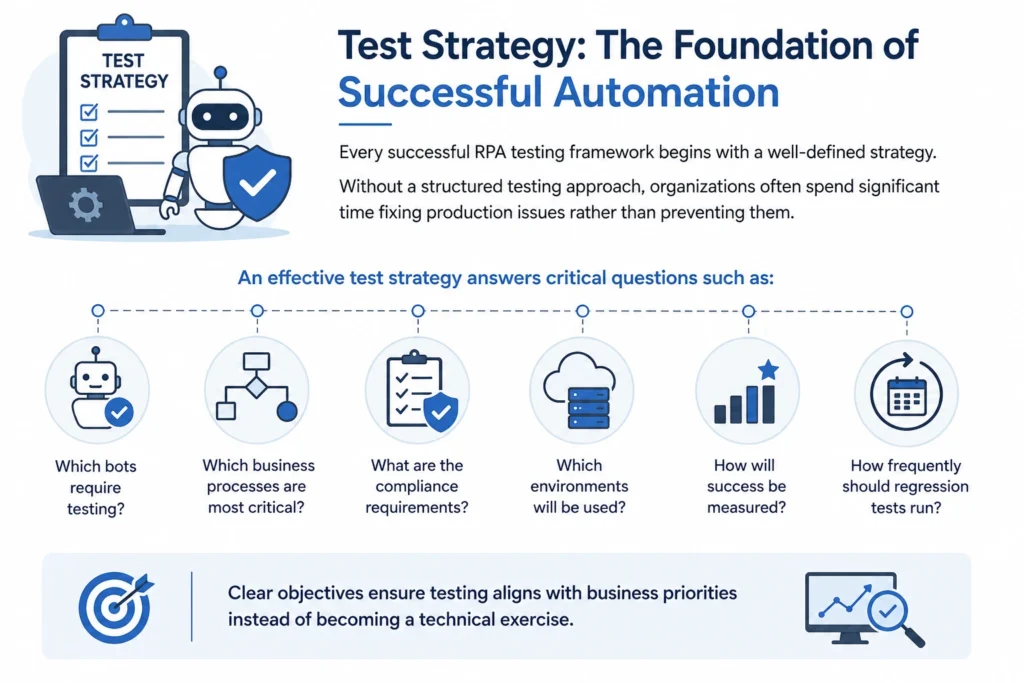
Every successful RPA testing framework begins with a well-defined strategy.
Without a structured testing approach, organizations often spend significant time fixing production issues rather than preventing them.
An effective test strategy answers critical questions such as:
- Which bots require testing?
- Which business processes are most critical?
- What are the compliance requirements?
- Which environments will be used?
- How will success be measured?
- How frequently should regression tests run?
Clear objectives ensure testing aligns with business priorities instead of becoming a technical exercise.
Test Design: Building Reusable Test Assets
One of the biggest advantages of a structured testing framework is reusability.
Rather than creating entirely new test cases for every automation project, organizations build modular testing assets that can be shared across multiple bots.
Examples include:
- Login validation scripts
- ERP connection tests
- API validation routines
- Database verification
- Exception handling scenarios
- Report validation scripts
Reusable assets improve consistency while dramatically reducing testing effort.
As organizations scale automation, reusable frameworks become one of the largest contributors to faster delivery and lower maintenance costs.
Types of Testing Every RPA Framework Should Include
A successful RPA testing framework doesn’t rely on a single testing method. Since bots interact with multiple business applications, databases, APIs, legacy systems, and user interfaces, they must be validated from multiple perspectives before they reach production.
The following testing types work together to ensure your automation is reliable, scalable, secure, and business-ready.
1. Functional Testing
Functional testing verifies that every bot performs its intended business function correctly.
It answers a simple but critical question:
“Does the bot do exactly what it’s supposed to do?”
For example, if an automation bot is responsible for processing invoices, functional testing verifies that it can:
- Read invoices from email
- Extract invoice details correctly
- Validate business rules
- Enter information into the ERP system
- Generate confirmation reports
- Handle business exceptions appropriately
Every business rule should be validated before deployment.
Why Functional Testing Matters
Without functional testing:
- Incorrect transactions may be processed.
- Business rules may be skipped.
- Financial losses may occur.
- Customer experiences may suffer.
This is why functional testing forms the foundation of every successful RPA implementation services strategy.
2. Unit Testing
Just like traditional software development, every automation workflow consists of multiple smaller components.
Instead of testing the complete bot immediately, developers first validate each component independently.
Examples include:
- Login modules
- Data extraction
- Excel processing
- Database queries
- API calls
- Email automation
- File uploads
Testing these components individually helps identify issues much earlier in the development lifecycle.
Benefits
✔ Easier debugging
✔ Faster development
✔ Improved code quality
✔ Higher bot reliability
3. Integration Testing
Very few bots work in isolation.
A single automation may interact with multiple enterprise systems during execution.
For example:
↓
Invoice Extraction
↓
SAP ERP
↓
CRM
↓
Database
↓
Reporting Dashboard
Integration testing validates that data flows correctly across every connected application.
It ensures:
- Data consistency
- API connectivity
- Authentication
- Transaction validation
- Error handling
Organizations implementing enterprise-wide automation should pay particular attention to integration testing because it is often where production failures occur.
4. Regression Testing
Business applications are constantly changing.
ERP upgrades…
CRM updates…
Browser changes…
Security patches…
Even small UI modifications can unexpectedly break automation bots.
Regression testing ensures that existing automation continues working correctly after changes are introduced.
Rather than manually validating every workflow, organizations automate regression testing to reduce release times and minimize business risk.
Best Practices
- Automate regression suites
- Execute tests after every bot update
- Validate all business-critical workflows
- Compare outputs against previous versions
A mature RPA services company typically integrates regression testing directly into CI/CD pipelines, ensuring bots remain stable throughout their lifecycle.
5. User Acceptance Testing (UAT)
While developers validate technical functionality, business users validate business outcomes.
User Acceptance Testing confirms that automation meets operational expectations under real-world conditions.
Typical UAT scenarios include:
- Invoice approval workflows
- Customer onboarding
- Claims processing
- Payroll automation
- Purchase order approvals
Business stakeholders verify:
✔ Process accuracy
✔ Business rules
✔ Exception handling
✔ Compliance requirements
✔ User expectations
Only after successful UAT should bots be promoted to production.
6. Performance Testing
Performance testing evaluates how automation behaves under different workloads.
A bot may perform perfectly when processing 50 invoices—but what happens when it needs to process 50,000?
Performance testing answers questions such as:
- How many transactions can the bot process per hour?
- Does execution slow during peak business hours?
- How efficiently does the bot use CPU and memory?
- Can infrastructure support multiple concurrent bots?
Performance testing becomes increasingly important as organizations scale enterprise automation.
Common Performance Metrics
| Metric | Purpose |
| Execution Time | Measures overall bot speed |
| Throughput | Number of transactions processed |
| CPU Utilization | Infrastructure efficiency |
| Memory Usage | Resource optimization |
| Response Time | Application interaction speed |
| Concurrent Bots | Scalability assessment |
Organizations planning large-scale automation should prioritize performance testing early in the implementation lifecycle.
7. Security Testing
Automation bots frequently access highly sensitive business information.
Examples include:
- Payroll records
- Banking transactions
- Customer information
- Patient records
- Vendor payments
- Financial statements
Without proper testing, bots can unintentionally expose confidential data or violate compliance regulations.
Security testing validates:
- Authentication
- Authorization
- Encryption
- Credential management
- Data privacy
- Audit logging
Leading robotic process automation consulting services providers integrate security testing into every automation release.
Security should never be viewed as a final checklist—it should be embedded throughout the automation lifecycle.
Choosing the Right Tools for RPA Testing
The effectiveness of your testing framework depends heavily on selecting tools that align with your automation platform, development practices, and business objectives.
Most enterprises combine native RPA testing and RPA use cases capabilities with traditional QA and DevOps tools to achieve comprehensive test coverage.
Popular RPA Testing Tools
| Category | Recommended Tools |
| RPA Platforms | UiPath Test Suite, Automation Anywhere, Blue Prism Testing |
| Functional Testing | Selenium, TestComplete |
| Model-Based Testing | Tricentis Tosca |
| API Testing | Postman, REST Assured |
| CI/CD | Jenkins, GitLab CI, Azure DevOps |
| Test Management | Jira, Azure Test Plans |
| Performance Testing | JMeter, LoadRunner |
Instead of relying on a single solution, organizations often build an integrated testing ecosystem tailored to their automation landscape.
The RPA Testing Lifecycle
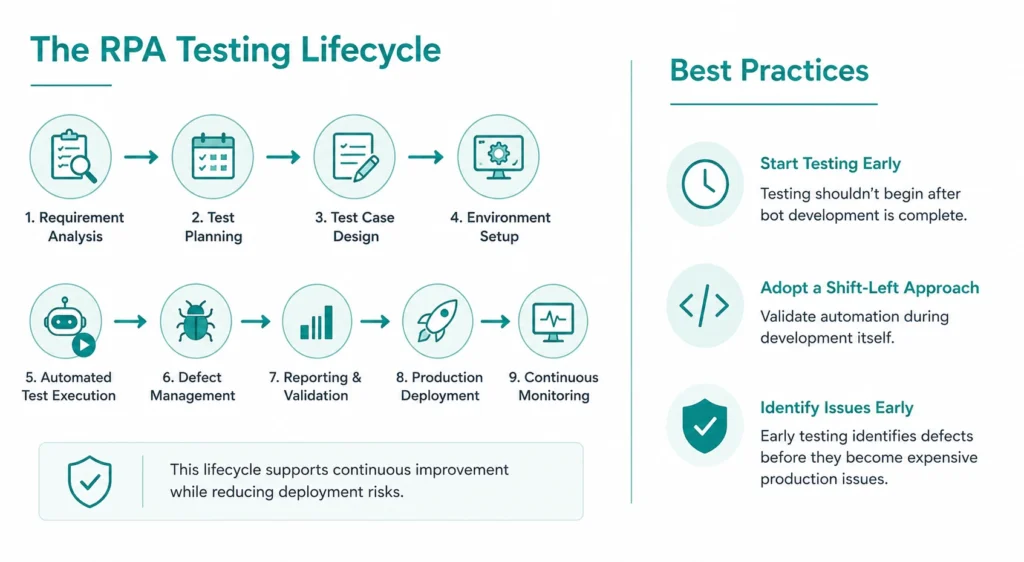
A structured testing lifecycle ensures every automation follows the same quality standards from development to production.
Requirement Analysis
↓
Test Planning
↓
Test Case Design
↓
Environment Setup
↓
Automated Test Execution
↓
Defect Management
↓
Reporting & Validation
↓
Production Deployment
↓
Continuous Monitoring
This lifecycle supports continuous improvement while reducing deployment risks.
As automation programs mature, organizations increasingly integrate this lifecycle into DevOps pipelines, enabling faster releases without compromising quality.
Best Practices for Building a Successful RPA Testing Framework
Organizations with mature automation programs consistently follow a set of proven practices.
Start Testing Early
Testing shouldn’t begin after bot development is complete.
Adopt a Shift-Left approach by validating automation during development itself.
Early testing identifies defects before they become expensive production issues.
Automate Test Execution
Manual testing becomes impractical as automation scales.
Automated testing ensures:
- Faster execution
- Repeatability
- Higher coverage
- Reduced human error
CI/CD pipelines should automatically trigger regression tests whenever bots are updated.
Focus on Business-Critical Processes
Not every bot carries the same business risk.
Prioritize testing for automations handling:
- Financial transactions
- Customer data
- Healthcare records
- Regulatory reporting
- Compliance-sensitive workflows
Risk-based testing helps maximize business value.
Reuse Test Assets
Avoid building new test scripts for every project.
Create reusable:
- Test libraries
- Validation scripts
- Mock data
- Exception scenarios
- Reporting templates
Reusable assets reduce maintenance effort while accelerating future automation projects.
Organizations seeking to improve automation quality should also explore Top RPA Best Practices That Help Businesses Improve Efficiency, which covers governance, implementation strategies, and operational excellence.
Common Challenges in RPA Testing (And How to Overcome Them)
Even the most sophisticated automation programs encounter testing challenges. As bots become more intelligent and business processes more interconnected, testing evolves from a one-time validation activity into a continuous quality assurance process.
Understanding these challenges—and preparing for them—helps organizations build resilient automation ecosystems that scale confidently.
1. Frequent Application Changes
Enterprise applications are constantly evolving.
A simple UI redesign, ERP upgrade, browser update, or API modification can unexpectedly disrupt automation workflows.
Since many bots interact directly with user interfaces, even small visual changes may prevent them from functioning correctly.
Best Practices
- Use API integrations wherever possible.
- Minimize dependency on screen scraping.
- Maintain automated regression test suites.
- Schedule validation after every application update.
- Adopt resilient selectors instead of static UI elements.
2. Managing Large Test Data Sets
Testing enterprise automation often requires thousands of realistic business scenarios.
Examples include:
- Customer records
- Vendor invoices
- Employee information
- Financial transactions
- Insurance claims
- Healthcare records
Using inaccurate or outdated test data can produce misleading test results.
Solution
Organizations should establish structured Test Data Management (TDM) practices by:
- Creating reusable datasets.
- Masking sensitive production data.
- Automating test data generation.
- Version-controlling test datasets.
- Maintaining separate environments for testing and production.
3. Cross-System Dependencies
Most enterprise bots interact with multiple applications simultaneously.
A finance automation workflow may involve:
- SAP
- Outlook
- Oracle
- Salesforce
- Excel
- Internal databases
If even one application becomes unavailable, the entire automation process may fail.
Best Practices
✔ Validate every integration independently.
✔ Use mock APIs during development.
✔ Create fallback workflows.
✔ Test network interruptions.
✔ Validate exception handling.
Strong integration testing significantly improves automation reliability.
4. Environment Management
One of the biggest causes of inconsistent test results is poorly managed environments.
Differences between development, testing, staging, and production environments often produce unexpected bot behavior.
Recommended Approach
Maintain standardized environments using:
- Infrastructure as Code (IaC)
- Environment version control
- Automated configuration management
- Centralized credential management
Consistent environments improve testing accuracy while reducing deployment risks.
5. Balancing Speed with Quality
Organizations often feel pressure to deploy automation quickly.
However, skipping testing to accelerate deployment usually results in:
- Production failures
- Higher maintenance costs
- Business disruptions
- Lower ROI
The most successful organizations automate testing—not skip it.
Measuring the Success of Your RPA Testing Framework
Testing should be measured just like automation itself.
Tracking meaningful KPIs helps organizations continuously improve testing quality and demonstrate business value.
Key Performance Indicators (KPIs)
| KPI | Why It Matters |
| Test Coverage | Measures how much of the automation has been validated |
| Bot Success Rate | Indicates reliability in production |
| Defect Detection Rate | Evaluates testing effectiveness |
| Regression Pass Rate | Ensures updates don’t introduce new issues |
| Mean Time to Resolution (MTTR) | Measures issue resolution speed |
| Automation Test Coverage | Percentage of automated test execution |
| Production Incidents | Tracks quality after deployment |
Rather than focusing only on the number of bots tested, mature organizations evaluate how testing contributes to business continuity, compliance, and customer satisfaction.
The Future of RPA Testing
As automation technologies continue to evolve, RPA testing is becoming smarter, faster, and increasingly autonomous.
Several emerging trends are reshaping how organizations validate enterprise automation.
AI-Powered Test Generation
Artificial Intelligence is helping teams automatically generate test cases, predict high-risk scenarios, and identify automation gaps before deployment.
Intelligent Self-Healing Bots
Modern RPA platforms are introducing self-healing capabilities that automatically adjust to minor UI changes without manual intervention.
Continuous Testing in CI/CD
Testing is becoming fully integrated into DevOps pipelines, allowing organizations to validate bots automatically with every code change.
Cloud-Based Testing
Cloud-native environments make it easier to execute large-scale regression testing across multiple platforms without investing in dedicated infrastructure.
Hyperautomation
The future lies in combining RPA with:
- Artificial Intelligence
- Machine Learning
- Intelligent Document Processing
- Process Mining
- Business Process Management (BPM)
Testing frameworks must evolve alongside these technologies to ensure intelligent automation remains accurate, secure, and compliant.
Why Choose MicroGenesis for RPA Testing and Automation?
Building reliable automation requires more than developing bots—it requires a structured approach to quality, governance, and continuous improvement.
As a trusted RPA services company, MicroGenesis helps organizations implement enterprise-grade testing frameworks that improve automation reliability while reducing operational risks.
Our Expertise Includes
RPA Consulting Services
We help organizations design testing strategies that align with business goals, compliance requirements, and enterprise automation roadmaps.
End-to-End RPA Implementation Services
Our experts support the complete automation lifecycle, including:
- Process discovery
- Bot development
- Test framework design
- Functional validation
- Performance testing
- Deployment
- Continuous optimization
Multi-Platform Expertise
We work across leading RPA platforms, including:
- UiPath
- Automation Anywhere
- Microsoft Power Automate
- Blue Prism
This allows us to recommend the right solution based on your business needs rather than a single technology ecosystem.
Enterprise Governance
Our testing frameworks incorporate:
- Security validation
- Compliance monitoring
- Audit readiness
- Bot lifecycle management
- Performance reporting
This enables organizations to scale automation with confidence.
RPA Testing Framework Implementation Checklist
Before deploying automation into production, ensure your organization has addressed the following:
| Checklist | Status |
| Clear testing strategy defined | ☐ |
| Functional test cases created | ☐ |
| Regression testing automated | ☐ |
| Integration testing completed | ☐ |
| Performance benchmarks established | ☐ |
| Security validation performed | ☐ |
| Compliance requirements verified | ☐ |
| Monitoring dashboards configured | ☐ |
| Test data properly managed | ☐ |
| Documentation completed | ☐ |
| User Acceptance Testing approved | ☐ |
| Production deployment validated | ☐ |
Following this checklist significantly reduces deployment risks while improving long-term automation stability.
Conclusion
As organizations continue to accelerate digital transformation, Robotic Process Automation has become a critical driver of efficiency, accuracy, and operational excellence. However, successful automation depends on more than building bots—it requires ensuring those bots perform reliably under real-world conditions.
A well-designed RPA testing framework provides the structure needed to validate every stage of the automation lifecycle, from functional accuracy and integration to performance, security, and compliance. By adopting standardized testing practices, automating regression testing, managing test data effectively, and continuously monitoring bot performance, organizations can minimize failures, reduce maintenance costs, and scale automation with confidence.
Partnering with an experienced RPA service provider further strengthens this journey. The right partner brings proven methodologies, domain expertise, governance frameworks, and enterprise-grade RPA consulting services that help transform automation from isolated pilots into scalable business capabilities.
At MicroGenesis, we deliver comprehensive RPA implementation services designed to help organizations build resilient, secure, and future-ready automation ecosystems. From strategy and process discovery to testing, deployment, governance, and ongoing optimization, our experts ensure your automation initiatives deliver measurable business outcomes while remaining reliable as your business evolves.
Whether you’re beginning your automation journey or expanding enterprise-wide intelligent automation, investing in a robust RPA testing framework today will lay the foundation for sustainable growth, improved operational resilience, and long-term digital transformation success.