

Moving to AWS can help businesses improve scalability, modernize infrastructure, and respond more quickly to changing requirements. But moving to the cloud without a clear strategy can also create unexpected costs, performance issues, and operational challenges.
The real question is not simply whether your organization should adopt AWS. It is which workloads should move, how they should move, and what business value the transition should deliver.
Consider an organization running several business-critical applications on ageing infrastructure. Some applications may be ready for AWS, while others depend on legacy databases, specialized hardware, or internal systems that cannot be easily separated.
Migrating everything at once could introduce unnecessary risks.
This is where an AWS cloud assessment becomes valuable.
A structured assessment helps organizations understand their current IT environment, evaluate cloud readiness, estimate potential costs, and develop a realistic cloud adoption roadmap.
In this guide, we explain how AWS cloud strategy services help businesses make informed decisions before committing to cloud transformation.
What Is AWS Cloud Strategy and Assessment?
AWS cloud strategy and assessment is the process of evaluating an organisation’s existing technology environment and defining a practical approach to adopting Amazon Web Services.
It combines business planning with technical analysis to answer important questions:
Which applications and workloads are suitable for AWS?
What infrastructure dependencies could affect migration?
How ready is the organisation to operate in the cloud?
What security, compliance, and governance requirements must be addressed?
What will the cloud environment cost to implement and operate?
Which workloads should be prioritised?
What should the cloud adoption roadmap look like?
The objective is to avoid making cloud decisions based on assumptions.
A good strategy considers business goals, application requirements, technical dependencies, operational capabilities, and financial implications together.
For organisations planning a broader transformation, our AWS Cloud Consulting Services Guide explains how assessment, architecture, implementation, and optimisation fit into the overall cloud lifecycle.
Why Businesses Need an AWS Cloud Assessment Before Migration
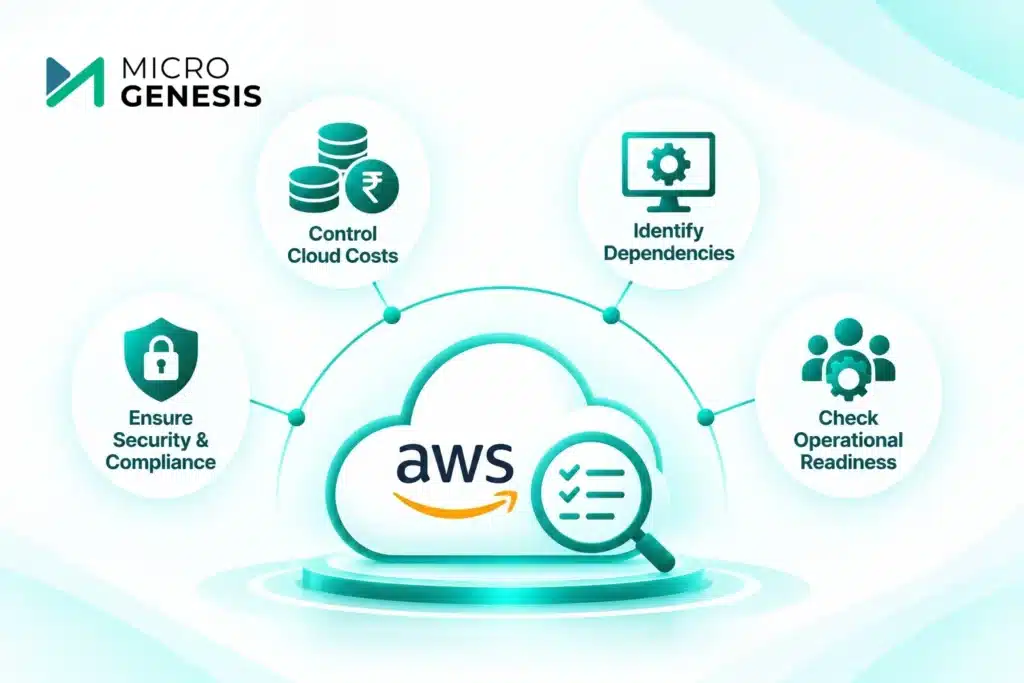
Cloud migration is often treated as an infrastructure project. In practice, it affects applications, security, IT operations, budgeting, and business continuity.
Without a proper assessment, organisations may encounter several challenges.
Unexpected Cloud Costs
An application that runs efficiently on existing infrastructure may become expensive if its AWS architecture is not designed around actual usage.
For example, moving an oversized virtual machine directly to an equivalent EC2 instance may carry existing inefficiencies into the cloud.
Application Dependencies
Enterprise applications rarely operate independently.
An application may depend on databases, authentication systems, file servers, third-party integrations, or other internal services.
Missing these dependencies during planning can lead to performance problems and service interruptions.
Security and Compliance Gaps
Moving workloads to AWS changes how infrastructure is managed.
Organisations must understand their responsibilities for identity management, network security, data protection, logging, and regulatory requirements.
Lack of Cloud Operating Readiness
Even when applications are technically suitable for AWS, internal teams may need additional processes, skills, monitoring, and governance practices.
A cloud readiness assessment helps identify these gaps before migration.
Planning an AWS migration but unsure where to begin? Request an AWS cloud assessment from MicroGenesis to evaluate your existing environment and identify practical next steps.
AWS Cloud Readiness Assessment: Understanding Your Starting Point
A cloud readiness assessment evaluates whether an organisation is prepared to adopt and operate workloads on AWS.
It looks beyond infrastructure to consider people, processes, security, governance, and operational capabilities.
1. Infrastructure Readiness
The assessment begins with understanding the current infrastructure.
This includes servers, storage, networking, databases, operating systems, and application hosting environments.
Important considerations include infrastructure age, performance, capacity, support status, and dependencies.
2. Application Readiness
Not every application is equally suitable for cloud migration.
Applications should be reviewed for architecture, operating system compatibility, integration dependencies, performance requirements, and business criticality.
For example, a web application with standard database dependencies may be easier to migrate than a tightly coupled legacy application that relies on specialised hardware.
3. Security and Compliance Readiness
The assessment should review existing security controls and identify how they will translate to AWS.
This includes identity and access management, encryption, network controls, logging, backup, and applicable compliance requirements.
The AWS shared responsibility model must also be understood so that teams know which responsibilities belong to AWS and which remain with the customer.
4. Operational Readiness
Operating workloads in AWS requires clear processes for monitoring, incident management, deployment, cost governance, and access control.
An organisation may have experienced infrastructure administrators but still need to establish cloud-specific operational practices.
5. Business Readiness
Cloud adoption should support measurable business priorities.
These might include reducing infrastructure refresh requirements, improving application availability, supporting business expansion, or accelerating development.
A useful readiness assessment connects technical recommendations to these objectives.
AWS Workload Assessment: Deciding What Should Move to the Cloud
Once cloud readiness is understood, the next step is evaluating individual workloads.
An AWS workload assessment helps determine which applications should move, which require changes, and which may be better retained in their current environment.
Key Workload Assessment Criteria
| Assessment area | What to evaluate | Why it matters |
|---|---|---|
| Business criticality | Impact of application downtime | Helps determine migration priority and risk |
| Application dependencies | Connected databases, services, and integrations | Reduces unexpected disruptions |
| Performance | CPU, memory, storage, network and latency requirements | Supports appropriate AWS resource selection |
| Security | Data sensitivity and access requirements | Informs architecture and security controls |
| Compatibility | Operating systems, software and licensing | Identifies migration constraints |
| Availability | Recovery objectives and uptime requirements | Guides resilience planning |
| Cost | Current operating costs and projected AWS costs | Supports financial decisions |
Understanding AWS Migration Strategies
Different workloads may require different migration approaches.
AWS commonly describes seven migration strategies, often called the 7 Rs:
Retire: Remove applications that are no longer needed.
Retain: Keep workloads in their current environment for now.
Rehost: Move applications with minimal changes.
Relocate: Move supported infrastructure to an AWS-based environment without redesigning the application.
Replatform: Make limited changes to benefit from cloud capabilities.
Repurchase: Replace an existing application with another product, often a SaaS solution.
Refactor or re-architect: Make significant application changes to take advantage of cloud-native capabilities.
The right approach depends on business value, application complexity, risk, and cost.
Practical Example: Assessing a Manufacturing Company’s Workloads
Consider a manufacturing organisation operating three types of applications:
Enterprise reporting application: A relatively standard web application with predictable resource requirements. It may be suitable for rehosting or replatforming.
Production monitoring system: An application connected to factory equipment and local industrial networks. It may require a hybrid architecture because of latency and connectivity requirements.
Legacy inventory application: An ageing system with limited vendor support and complex dependencies. It may need further assessment before migration.
A workload assessment helps avoid applying the same migration strategy to all three systems.
The result is a more realistic plan based on technical feasibility and business priorities.
AWS Total Cost of Ownership: Understanding the Financial Impact
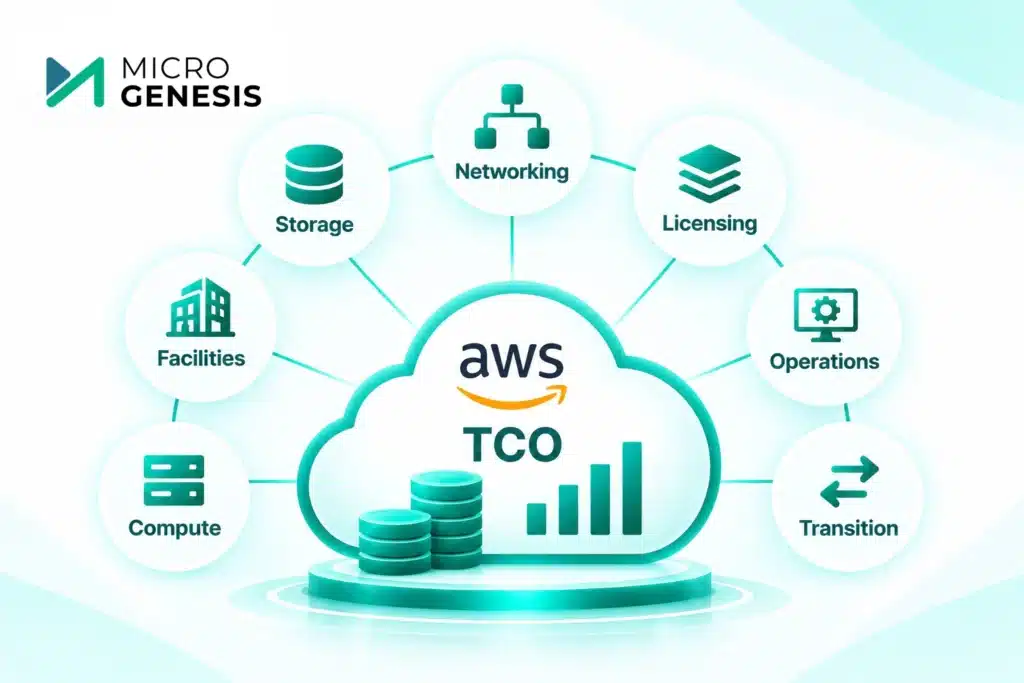
One of the most important parts of AWS cloud strategy is understanding the financial implications of migration.
Cloud costs should not be evaluated by comparing server prices alone.
A proper AWS Total Cost of Ownership (TCO) assessment considers the cost of operating workloads in the current environment and the estimated cost of running them on AWS over a defined period.
What Should an AWS TCO Assessment Include?
| Cost category | Existing environment | AWS environment |
|---|---|---|
| Compute | Physical servers, virtualisation and maintenance | EC2 or other compute service charges |
| Storage | Storage hardware and maintenance | Storage capacity, requests and data access |
| Networking | Connectivity and network infrastructure | Data transfer, networking and connectivity charges |
| Licensing | Software and platform licences | Applicable AWS and third-party licensing |
| Operations | Administration, monitoring and support | Cloud operations, monitoring and support |
| Facilities | Power, cooling and data centre space | Generally reflected in AWS service pricing |
| Transition | Existing upgrade or replacement costs | Migration, testing, training and implementation |
An accurate assessment should also consider migration costs, parallel operation during transition, support requirements, and potential application changes.
TCO Is Not the Same as Monthly AWS Spending
TCO evaluates the broader financial impact over time.
Monthly AWS expenditure is only one component.
For example, moving to AWS may reduce the need for a future hardware refresh, but the organisation may incur migration expenses, data transfer costs, or additional operational charges.
The financial decision should therefore consider the complete investment rather than focusing only on estimated monthly cloud costs.
Avoiding Common Cost Estimation Mistakes
Common mistakes include:
Estimating costs without collecting actual utilisation data.
Ignoring data transfer and storage access charges.
Assuming every workload needs continuous operation.
Overlooking software licensing requirements.
Failing to account for migration and operational support costs.
Treating estimated savings as guaranteed outcomes.
AWS Pricing Calculator and other AWS cost analysis tools can support financial modelling, but estimates should be reviewed against actual workload requirements.
Need to understand the financial impact of AWS adoption? Talk to MicroGenesis about AWS cloud assessment and cost planning before committing to infrastructure changes.
Building an AWS Cloud Adoption Roadmap
A cloud adoption roadmap translates assessment findings into an actionable plan.
It defines what should happen, in what order, and what must be completed before each migration or implementation phase.
A practical roadmap should consider business priorities, technical dependencies, security requirements, costs, and internal readiness.
Phase 1: Define Business Objectives
Start by identifying the outcomes the organization expects from AWS adoption.
These may include infrastructure modernization, improved scalability, better disaster recovery, or greater deployment flexibility.
Define measurable success criteria wherever possible.
Phase 2: Prioritize Workloads
Use the workload assessment to identify suitable migration candidates.
Lower-complexity, lower-risk workloads may be appropriate for initial migration waves, provided they offer useful learning opportunities.
Business-critical systems should be planned according to their dependencies, risks, and recovery requirements.
Phase 3: Establish AWS Foundations
Before migrating production workloads, establish the necessary AWS foundations.
These may include account structure, networking, identity and access management, logging, monitoring, backup, and governance.
Architecture decisions should reflect the workload requirements identified during assessment.
Our guide to AWS cloud architecture and implementation explains how organisations can translate cloud planning into a scalable and manageable AWS environment.
Phase 4: Validate Through a Pilot
A pilot migration can help validate assumptions before broader implementation.
Teams should evaluate application performance, connectivity, security controls, operational processes, and actual costs.
Lessons from the pilot can inform subsequent migration waves.
Phase 5: Execute Migration Waves
Once the foundational environment and pilot have been validated, organisations can move workloads according to the agreed roadmap.
Each migration wave should include testing, stakeholder communication, rollback planning where feasible, and operational handover.
Phase 6: Review and Optimise
Cloud adoption does not end when workloads are deployed.
Teams should review performance, security, reliability, cost, and operational effectiveness.
Our AWS Well-Architected Review Checklist provides a structured starting point for evaluating AWS workloads against established architecture principles.
Common AWS Cloud Strategy Mistakes to Avoid
Even organisations with strong technical teams can face challenges when cloud adoption is not planned carefully.
Migrating Everything at Once
A large migration without workload prioritisation increases complexity and makes troubleshooting more difficult.
A phased approach helps teams validate assumptions and manage risk.
Choosing Services Before Understanding Requirements
Selecting AWS services too early can result in unnecessary complexity or unsuitable architecture decisions.
Start with business and workload requirements, then evaluate the appropriate technology.
Ignoring Application Dependencies
Moving one application without understanding its connections to other systems can create unexpected latency or availability issues.
Dependency mapping should be completed before finalising migration plans.
Underestimating Cloud Operations
Cloud environments still require monitoring, security management, cost governance, and operational support.
Businesses should determine whether these responsibilities will be managed internally or through an external provider.
Our article on choosing an AWS managed service provider explains when ongoing cloud management support may be useful.
Treating the Assessment as a One-Time Document
An AWS assessment provides a starting point, but business requirements and workloads change.
Organisations should revisit architecture, resource utilisation, security, and cost assumptions as their cloud environments evolve.
How MicroGenesis Helps with AWS Cloud Strategy and Assessment
A useful AWS cloud strategy should give your organisation more than a technical report.
It should provide clarity about cloud readiness, workload suitability, potential costs, implementation priorities, and the decisions needed to move forward.
MicroGenesis supports organisations with AWS consulting services focused on practical planning and implementation.
Our Approach
Business and infrastructure discovery
We begin by understanding your business objectives, existing infrastructure, application landscape, and operational challenges.
Cloud readiness assessment
We evaluate technical, security, governance, and operational considerations that may affect AWS adoption.
Workload evaluation
We assess application characteristics, dependencies, and migration options to help determine suitable approaches.
Architecture and cost planning
We consider AWS architecture requirements, resource sizing, resilience, and financial implications.
Cloud adoption roadmap
We help define implementation priorities, migration stages, and the foundational activities required before deployment.
Implementation alignment
Assessment recommendations are connected to practical architecture and infrastructure implementation considerations.
Our broader experience in enterprise engineering, application development, integration, and DevOps helps us consider cloud adoption within the context of existing business systems and delivery processes.
Through our AWS consulting services, we help organizations move from initial cloud evaluation toward informed architecture and implementation decisions.
What Should You Expect from an AWS Cloud Assessment?
Before engaging an AWS cloud consultant, it is useful to understand what a completed assessment should deliver.
Depending on the scope, typical deliverables may include:
| Deliverable | Business value |
|---|---|
| Current-state infrastructure assessment | Understand existing systems and constraints |
| Cloud readiness findings | Identify technical and operational gaps |
| Workload inventory and dependency analysis | Support migration planning |
| Migration strategy recommendations | Determine appropriate approaches for workloads |
| Preliminary AWS architecture considerations | Inform future infrastructure design |
| TCO and cost estimates | Support financial evaluation |
| Risk and dependency register | Highlight issues requiring attention |
| Phased cloud adoption roadmap | Establish priorities and next steps |
The depth of these deliverables depends on the number of workloads, available information, and agreed engagement scope.
A good assessment should make decisions easier for both technical teams and business stakeholders.
Final Thoughts
AWS cloud adoption offers organisations opportunities to modernise infrastructure, improve scalability, and support changing business requirements.
But achieving these outcomes requires more than moving applications to a different hosting environment.
Businesses need to understand their existing infrastructure, evaluate workload readiness, assess financial implications, and establish a realistic cloud adoption roadmap.
A structured AWS cloud assessment helps reduce uncertainty and provides a foundation for better architecture and implementation decisions.
Whether your organisation is exploring AWS for the first time or preparing to modernise an existing environment, the right strategy begins with understanding where you are today and where you want to go.
Request an AWS Cloud Assessment
Are you planning an AWS migration, evaluating cloud readiness, or looking for a practical cloud adoption roadmap?
MicroGenesis can help you assess your current environment, identify suitable workloads, evaluate cloud costs, and plan your next steps.
Request an AWS Cloud Assessment with MicroGenesis and start planning your AWS transformation with greater clarity.