
DevOps has evolved from a competitive advantage to a business necessity.
Organizations across industries are investing heavily in DevOps initiatives to accelerate software delivery, improve deployment reliability, strengthen security, reduce operational costs, and support cloud-native innovation.
Yet despite significant investments in tools, cloud platforms, CI/CD pipelines, and automation frameworks, many DevOps transformations fail to deliver expected business outcomes.
The reason is simple:
DevOps transformation is not a technology project. It is an organizational transformation.
Success depends not only on selecting the right tools but also on choosing the right transformation partner.
Whether you’re modernizing legacy delivery processes, implementing CI/CD pipelines, migrating to the cloud, adopting Kubernetes, introducing DevSecOps practices, or scaling platform engineering capabilities, selecting the right DevOps consulting partner can significantly impact project success.
This buyer’s guide will help organizations evaluate DevOps transformation partners, identify warning signs, ask the right questions, and select a partner capable of delivering measurable business outcomes.
Why Most DevOps Transformations Struggle
Many organizations begin their DevOps journey with strong intentions.
They invest in:
- CI/CD platforms
- Cloud infrastructure
- Container technologies
- Automation tools
- Monitoring platforms
Yet deployment frequency remains low.
Lead times remain high.
Teams continue operating in silos.
The reality is that DevOps challenges rarely stem from technology alone.
Organizations frequently encounter:
- Cultural resistance
- Process bottlenecks
- Skill gaps
- Legacy infrastructure constraints
- Governance challenges
These common DevOps challenges often prevent organizations from realizing the full value of their investments.
An experienced transformation partner helps organizations address these underlying issues rather than simply implementing new tools.
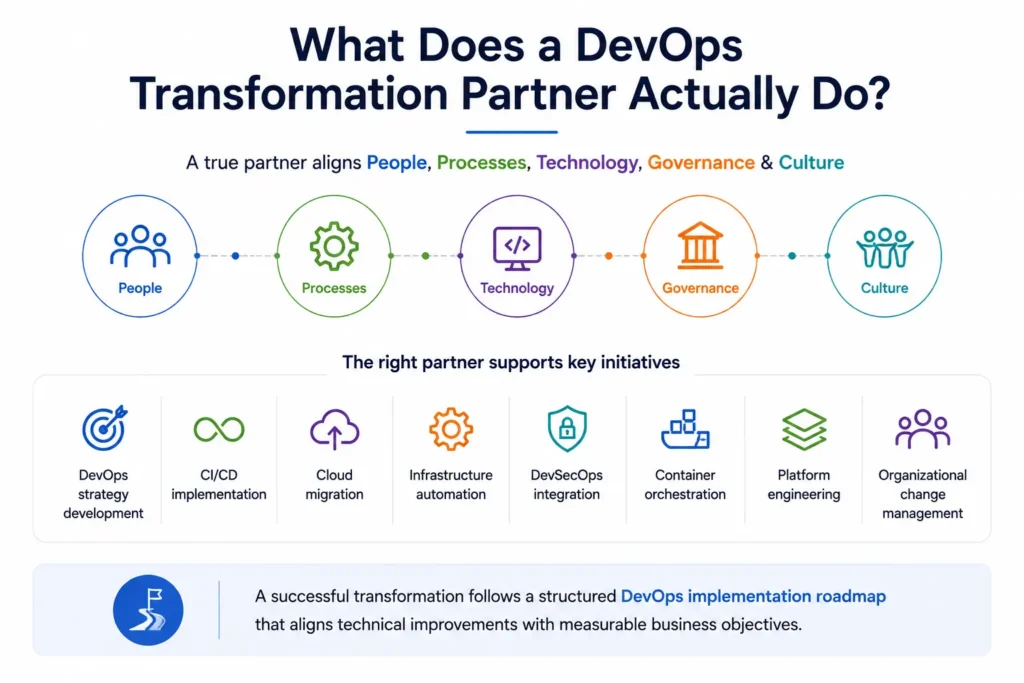
Many buyers assume a DevOps partner is simply a technology implementation provider.
In reality, a true transformation partner helps organizations align:
- People
- Processes
- Technology
- Governance
- Culture
The right partner supports initiatives such as:
- DevOps strategy development
- CI/CD implementation
- Cloud migration
- Infrastructure automation
- DevSecOps integration
- Container orchestration
- Platform engineering
- Organizational change management
A successful transformation typically follows a structured DevOps implementation roadmap that aligns technical improvements with measurable business objectives.
Signs You Need a DevOps Transformation Partner
Organizations often reach a point where internal efforts no longer produce meaningful improvements.
Common indicators include:
- Slow deployments
- Frequent production incidents
- Manual release processes
- Poor collaboration between teams
- Inconsistent environments
- Security bottlenecks
- Limited automation
- Cloud migration challenges
Many organizations discover that deployment speed remains constrained by hidden process inefficiencies rather than tooling limitations.
Understanding common deployment speed bottlenecks is often the first step toward identifying transformation opportunities.
Key Criteria for Evaluating a DevOps Transformation Partner
Not all DevOps consulting firms provide the same level of expertise.
Organizations should evaluate partners across several critical areas.
1. Strategic Expertise Beyond Tool Implementation
Many consulting providers focus primarily on tool deployment.
However, successful DevOps transformations require a broader perspective.
Your partner should understand:
- Organizational design
- Delivery workflows
- Value stream optimization
- Governance frameworks
- DevOps operating models
A partner should be able to explain how DevOps supports business outcomes—not just technical outcomes.
Organizations should look for consultants who understand both DevOps implementation strategies and enterprise transformation initiatives.
2. Experience Across the Entire DevOps Lifecycle
DevOps encompasses far more than CI/CD.
A qualified partner should demonstrate expertise across all phases of the DevOps lifecycle.
This includes:
- Planning
- Development
- Integration
- Testing
- Deployment
- Monitoring
- Feedback
Understanding the complete DevOps lifecycle helps ensure transformation efforts address end-to-end delivery challenges rather than isolated technical issues.
3. CI/CD Expertise
Continuous Integration and Continuous Delivery remain foundational DevOps capabilities.
Your partner should possess practical experience with:
- Jenkins
- GitLab CI/CD
- GitHub Actions
- Azure DevOps
- Bamboo
- CircleCI
Organizations should ask prospective partners about:
- Pipeline architecture
- Release automation
- Deployment governance
- Testing automation
A strong understanding of CI/CD pipelines is essential for reducing lead times and improving release reliability.
Organizations using GitLab should also evaluate a partner’s expertise in optimizing CI/CD pipelines for speed and reliability.
4. Cloud and Infrastructure Modernization Capabilities
Cloud adoption and DevOps are deeply interconnected.
Your transformation partner should demonstrate expertise in:
- AWS
- Microsoft Azure
- Google Cloud Platform
- Hybrid cloud environments
- Infrastructure as Code
Cloud modernization often requires significant architectural transformation.
Organizations planning cloud migrations should ensure their partner understands both cloud engineering and DevOps methodologies.
Understanding how cloud computing enhances DevOps practices is critical when evaluating transformation strategies.
5. Containerization and Kubernetes Expertise
Modern application delivery increasingly depends on containers and orchestration platforms.
Partners should possess hands-on experience with:
- Docker
- Kubernetes
- OpenShift
- Helm
- Service Mesh technologies
Organizations pursuing cloud-native architectures should evaluate expertise in:
- Containerization
- Platform engineering
- Kubernetes operations
Understanding the differences between Docker and Kubernetes orchestration strategies can help organizations evaluate implementation approaches.
6. DevSecOps Capabilities
Security can no longer be treated as a separate function.
Leading DevOps organizations integrate security throughout the software delivery lifecycle.
Your transformation partner should demonstrate expertise in:
- Secure CI/CD pipelines
- Vulnerability management
- Compliance automation
- Infrastructure security
- Shift-left security practices
Organizations increasingly recognize the importance of DevSecOps in modern software delivery environments.
7. Automation Expertise
Automation remains one of the strongest indicators of DevOps maturity.
A qualified partner should understand:
- Infrastructure automation
- Configuration management
- Testing automation
- Release automation
- Operational automation
Organizations should evaluate how prospective partners approach DevOps automation best practices and strategies.
Automation should extend beyond deployments and encompass the entire software delivery process.
8. Culture Transformation Experience
Technology changes are relatively easy.
Cultural change is much harder.
Many DevOps initiatives fail because organizations focus solely on tools while ignoring collaboration, ownership, and communication challenges.
Your partner should have experience building strong DevOps cultures through:
- Organizational alignment
- Team collaboration
- Shared accountability
- Continuous improvement practices
Questions Every Buyer Should Ask
When evaluating DevOps partners, ask:
Strategic Questions
- How do you measure DevOps success?
- What business outcomes do you target?
- How do you prioritize transformation initiatives?
Technical Questions
- What CI/CD platforms do you support?
- What cloud providers do you specialize in?
- How do you approach Kubernetes adoption?
Delivery Questions
- What does a typical engagement look like?
- How do you handle organizational resistance?
- What metrics do you track?
Sustainability Questions
- How do you transfer knowledge to internal teams?
- How do you ensure long-term adoption?
The quality of responses often reveals the maturity of the consulting organization.
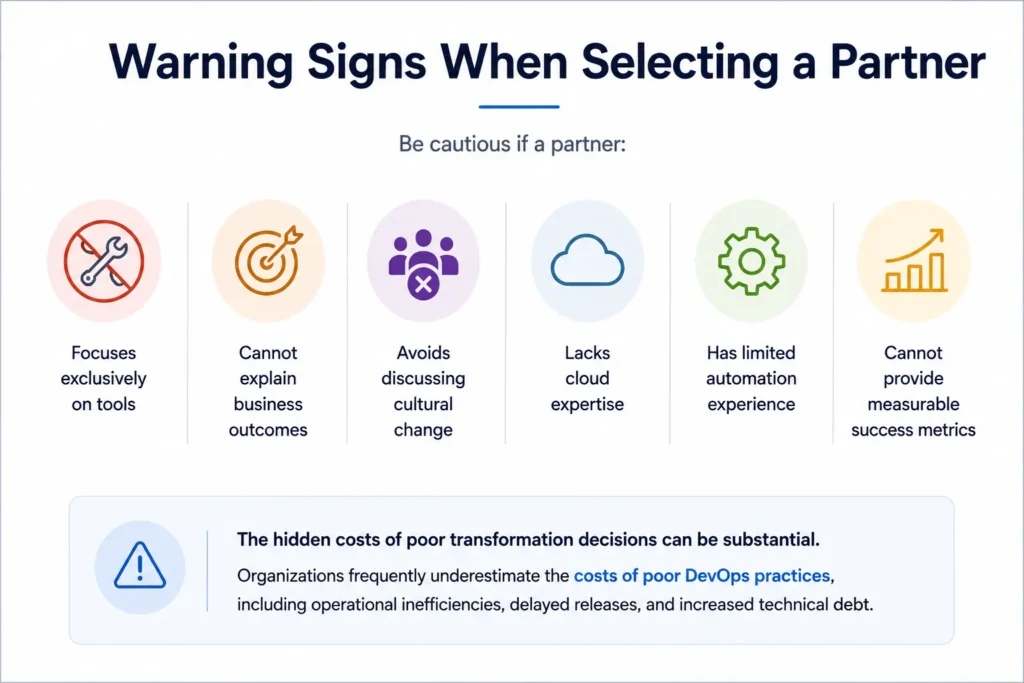
Be cautious if a partner:
- Focuses exclusively on tools
- Cannot explain business outcomes
- Avoids discussing cultural change
- Lacks cloud expertise
- Has limited automation experience
- Cannot provide measurable success metrics
The hidden costs of poor transformation decisions can be substantial.
Organizations frequently underestimate the costs of poor DevOps practices, including operational inefficiencies, delayed releases, and increased technical debt.
The Best DevOps Transformation Partners Deliver Business Outcomes
The ultimate objective is not:
- More tools
- More automation
- More pipelines
The objective is improved business performance.
Successful DevOps transformations deliver:
- Faster deployments
- Higher software quality
- Improved reliability
- Better security
- Lower operational costs
- Greater innovation velocity
Organizations that achieve these outcomes understand why DevOps is essential for enterprise business success.
Evaluation Scorecard
| Evaluation Area | Weight |
| DevOps Strategy Expertise | 20% |
| Cloud & Infrastructure Experience | 15% |
| CI/CD Expertise | 15% |
| DevSecOps Capabilities | 10% |
| Automation Experience | 10% |
| Kubernetes & Containerization | 10% |
| Culture Transformation Experience | 10% |
| Training & Knowledge Transfer | 5% |
| Industry Experience | 5% |
Organizations should score prospective partners against these categories before making a final decision.
Why Choose MicroGenesis for DevOps Transformation?
Selecting a DevOps partner is not simply about finding technical expertise. It is about choosing a partner capable of driving measurable business outcomes while minimizing transformation risk.
MicroGenesis brings decades of experience helping organizations modernize software delivery, cloud infrastructure, and engineering operations.
Deep Technical Expertise
Our teams possess hands-on experience across:
- AWS
- Azure
- Google Cloud
- Kubernetes
- Docker
- Jenkins
- GitLab CI/CD
- GitHub Actions
- Terraform
- Ansible
- DevSecOps frameworks
End-to-End Transformation Approach
Unlike vendors that focus solely on tooling, MicroGenesis addresses:
- Strategy
- Culture
- Process optimization
- Automation
- Security
- Cloud modernization
- Continuous improvement
Proven Enterprise Experience
We help organizations:
- Accelerate deployment frequency
- Improve software quality
- Reduce lead times
- Enhance operational resilience
- Strengthen security and compliance
Cloud and Platform Engineering Expertise
Whether you’re implementing Kubernetes, adopting serverless architectures, modernizing legacy applications, or building cloud-native platforms, MicroGenesis helps organizations achieve scalable and sustainable outcomes.
Focus on Business Outcomes
We measure success through:
- Faster releases
- Improved reliability
- Reduced operational costs
- Enhanced customer experience
- Greater engineering productivity
Ready to Accelerate Your DevOps Transformation?
If your organization is struggling with slow deployments, manual processes, cloud migration challenges, infrastructure complexity, or limited automation, partnering with an experienced DevOps transformation provider can significantly accelerate results.
Through DevOps Services, MicroGenesis helps organizations modernize software delivery pipelines, optimize cloud environments, implement DevSecOps practices, and build scalable engineering platforms that support long-term business growth.
Schedule a DevOps assessment with MicroGenesis to identify bottlenecks, evaluate current maturity, and build a transformation roadmap tailored to your business objectives.
Conclusion
Selecting a DevOps transformation partner is one of the most important decisions an organization can make during its modernization journey.
The right partner provides far more than technical implementation expertise.
They help align people, processes, technology, and culture around a common objective: delivering value faster, more reliably, and more securely.
Organizations should evaluate potential partners based on strategic capabilities, technical expertise, cloud experience, automation maturity, security integration, cultural transformation experience, and long-term sustainability.
The most successful DevOps transformations are not defined by the tools implemented.
They are defined by the business outcomes achieved.
Choose a partner that understands the difference.