

Walk into almost any modern technology organization today and you’ll hear the same statement:
“We do DevOps.”
The company has CI/CD pipelines. Developers use Git repositories. Infrastructure runs in the cloud. Containers are deployed through automation platforms. Monitoring dashboards are everywhere. Release processes appear modern and sophisticated.
Yet when you look closer, deployments still take days or weeks to complete.
Release approvals require multiple meetings. Testing delays slow every sprint. Teams struggle with failed deployments. Production incidents remain common. Business stakeholders complain that software isn’t reaching customers fast enough.
If this sounds familiar, you’re not alone.
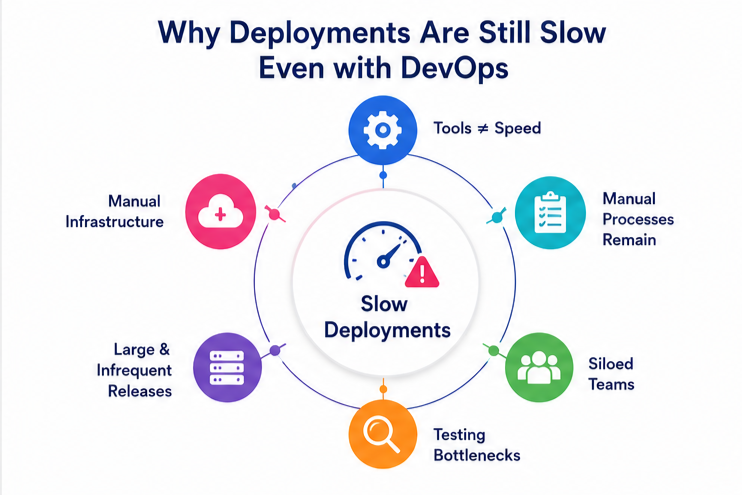
Many organizations mistake DevOps adoption for DevOps success. They invest heavily in tools but fail to address the processes, culture, and operational bottlenecks that actually determine deployment speed.
The truth is simple: having DevOps tools doesn’t automatically mean your deployments are faster.
In this article, we’ll explore why many DevOps initiatives fail to deliver the expected acceleration, identify the most common deployment bottlenecks, and discuss what organizations must do to achieve the speed, reliability, and agility that DevOps promises.
The Biggest DevOps Myth: Tools Automatically Create Speed
One of the most common misconceptions surrounding DevOps is the belief that purchasing tools automatically improves software delivery performance.
Organizations often invest in:
- CI/CD platforms
- Source code management tools
- Container technologies
- Cloud infrastructure
- Monitoring platforms
- Automation frameworks
After implementation, leadership expects immediate improvements in deployment frequency and delivery speed.
Unfortunately, reality is rarely that simple.
Tools can automate tasks, but they cannot fix broken processes.
Many organizations implement advanced technology stacks while continuing to operate with:
- Manual approvals
- Complex governance structures
- Siloed teams
- Inefficient workflows
- Slow decision-making processes
As a result, deployments remain slow despite significant investments.
Successful DevOps transformations require organizations to focus on people and processes as much as technology. Following a structured approach like a DevOps implementation roadmap helps organizations align automation initiatives with measurable business outcomes rather than simply deploying new tools.
Having CI/CD Doesn’t Mean You Have Continuous Delivery
Many organizations proudly showcase their CI/CD pipelines.
However, having a CI/CD platform and achieving continuous delivery are two very different things.
A deployment pipeline may successfully automate:
- Builds
- Packaging
- Testing
- Deployment execution
But software delivery can still be delayed by:
- Manual approvals
- Release scheduling
- Compliance reviews
- Security assessments
- Environment dependencies
The pipeline itself may run in minutes while releases continue taking weeks.
This is one of the biggest reasons organizations struggle to realize DevOps benefits.
The goal isn’t simply to automate deployment steps. The goal is to automate and optimize the entire value stream from idea to production.
Choosing the right CI/CD tools for your DevOps team is important, but true deployment acceleration requires eliminating bottlenecks throughout the software delivery lifecycle.
Manual Processes Are Still Slowing Everything Down
Many organizations automate part of the deployment process while leaving critical activities manual.
Common examples include:
- Manual environment provisioning
- Manual testing
- Manual deployment approvals
- Manual rollback planning
- Manual infrastructure configuration
Every manual step introduces:
- Delays
- Human error
- Variability
- Additional risk
Even if 90% of your deployment process is automated, a few manual bottlenecks can dramatically reduce overall efficiency.
High-performing DevOps organizations continuously identify and eliminate manual activities wherever possible.
Automation should extend beyond deployment pipelines and into infrastructure, testing, compliance, monitoring, and operational processes.
Your DevOps Team Is Still Operating in Silos
Many organizations create a DevOps team and assume the transformation is complete.
However, DevOps is not a department.
It is a culture and operating model that encourages collaboration across:
- Development
- Operations
- Security
- QA
- Product Management
When these teams continue operating independently, deployment speed suffers.
Common symptoms include:
- Delayed handoffs
- Misaligned priorities
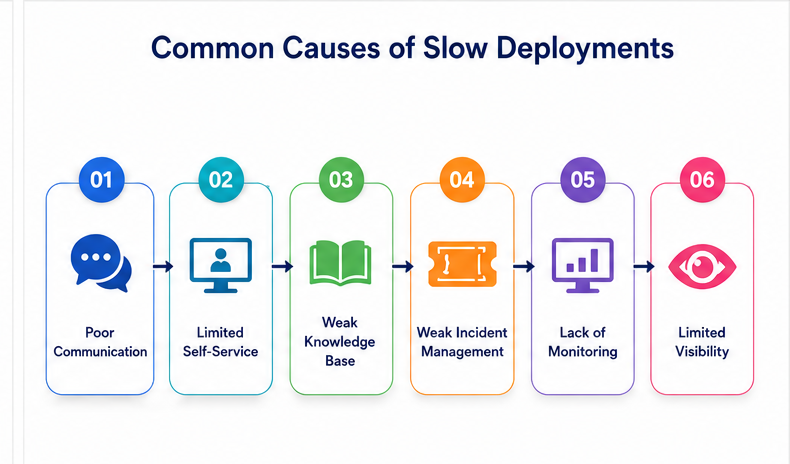
- Communication gaps
- Approval bottlenecks
- Ownership confusion
In many organizations, developers build software while operations teams manage releases. Security teams review applications separately, and QA teams function independently.
This creates friction throughout the delivery process.
Organizations that successfully accelerate deployments prioritize collaboration and invest heavily in building a strong DevOps culture that promotes shared responsibility and continuous improvement.
Testing Is Still a Major Bottleneck
One of the most overlooked deployment constraints is testing.
Many organizations continue relying on:
- Manual testing
- Large regression cycles
- Dedicated QA phases
- End-of-sprint validation
These approaches significantly slow delivery.
The longer teams wait to identify issues, the longer releases take.
High-performing DevOps organizations adopt:
- Automated testing
- Continuous testing
- Shift-left quality practices
- Test environment automation
This allows teams to detect issues earlier and maintain deployment velocity without compromising quality.
When testing becomes integrated into the delivery pipeline, feedback loops shorten dramatically.
Your Releases Are Too Large
Many organizations deploy infrequently.
They release:
- Monthly
- Quarterly
- Semi-annually
As a result, each deployment contains hundreds of changes.
Large releases require:
- Extensive testing
- Complex approvals
- Multiple stakeholders
- Detailed rollback plans
This naturally increases deployment duration and risk.
Organizations that deploy frequently benefit from smaller change sets.
Smaller releases are:
- Easier to validate
- Easier to troubleshoot
- Easier to roll back
- Less risky overall
Deployment speed improves significantly when organizations focus on continuous delivery rather than large, infrequent releases.
Infrastructure Management Is Still Manual
Another common issue is manual infrastructure management.
Many organizations still provision environments through:
- Ticket requests
- Manual server creation
- Manual network configuration
- Manual security setup
These processes create unnecessary delays.
Infrastructure should be treated as code.
Infrastructure as Code (IaC) enables teams to:
- Provision environments automatically
- Standardize configurations
- Improve scalability
- Reduce deployment lead times
Without infrastructure automation, deployments will always depend on operational bottlenecks.
Security Reviews Are Delaying Releases
Security is critical.
However, traditional security processes often become deployment bottlenecks.
Organizations frequently conduct security reviews late in the development lifecycle.
This approach creates delays because vulnerabilities are discovered after development is complete.
Common bottlenecks include:
- Manual security assessments
- Compliance reviews
- Vulnerability scanning after development
- Separate security approval processes
Modern DevOps organizations address this challenge through DevSecOps practices.
Security becomes integrated into:
- Development
- Testing
- CI/CD pipelines
- Infrastructure automation
By shifting security left, organizations reduce release delays while maintaining strong protection.
You’re Measuring the Wrong Things
Many organizations focus on metrics that look impressive but don’t actually reflect deployment performance.
Examples include:
- Number of deployments
- Number of pipelines
- Build success rates
- Tool adoption metrics
These measurements provide limited insight into delivery effectiveness.
Organizations should instead focus on metrics such as:
- Lead Time for Changes
- Deployment Frequency
- Mean Time to Recovery (MTTR)
- Change Failure Rate
These metrics provide a more accurate picture of delivery performance and DevOps maturity.
A structured DevOps implementation roadmap typically includes these metrics as key indicators of transformation success.
Technical Debt Is Slowing Your Delivery Pipeline
Technical debt accumulates gradually.
It often includes:
- Legacy applications
- Outdated frameworks
- Poor architecture decisions
- Unsupported dependencies
- Temporary workarounds
As technical debt grows, deployments become slower and riskier.
Teams spend more time:
- Troubleshooting
- Testing
- Fixing issues
- Managing dependencies
than delivering new functionality.
Organizations that prioritize modernization initiatives often experience significant improvements in deployment speed and reliability.
Common DevOps Challenges That Prevent Faster Deployments
Many deployment delays can be traced back to recurring organizational challenges.
These include:
Resistance to Change
Employees may be reluctant to adopt new processes and workflows.
Skill Gaps
Teams often lack expertise in automation, cloud technologies, and DevOps practices.
Legacy Systems
Older applications can be difficult to automate.
Tool Integration Issues
Disconnected toolchains create inefficiencies.
Cultural Barriers
Lack of collaboration slows delivery.
These are among the most common DevOps challenges organizations face when pursuing deployment acceleration.
What High-Performing DevOps Organizations Do Differently
Organizations that consistently achieve faster deployments share several characteristics.
They Automate Aggressively
Automation extends beyond deployment pipelines.
They automate:
- Testing
- Security
- Infrastructure
- Monitoring
- Compliance
They Build Strong DevOps Cultures
They prioritize:
- Collaboration
- Transparency
- Shared ownership
- Continuous learning
These principles align with proven strategies for building a strong DevOps culture that supports long-term success.
They Follow Proven Best Practices
High-performing organizations consistently apply established DevOps best practices to improve reliability, scalability, and delivery performance.
They Continuously Improve
Rather than treating DevOps as a one-time initiative, they regularly optimize:
- Processes
- Toolchains
- Architectures
- Team structures
Continuous improvement is central to DevOps success.
Signs Your DevOps Transformation Is Stalling
Your DevOps initiative may need attention if:
- Releases require multiple approvals.
- Deployments happen infrequently.
- Testing remains largely manual.
- Infrastructure provisioning is slow.
- Security reviews delay releases.
- Rollbacks are difficult.
- Lead times remain high.
- Teams operate independently.
These symptoms often indicate that technology adoption has outpaced process and cultural transformation.
How to Actually Make Deployments Faster
Improving deployment speed requires a holistic approach.
Many organizations understand the need for automation, CI/CD optimization, infrastructure modernization, and cultural transformation but struggle to execute these initiatives effectively. Partnering with experienced DevOps Services providers can help accelerate adoption, eliminate delivery bottlenecks, and implement proven practices that improve deployment speed and reliability.
Automate End-to-End Workflows
Focus on automating:
- Testing
- Infrastructure provisioning
- Security validation
- Deployments
- Monitoring
Reduce Batch Sizes
Deploy smaller changes more frequently.
Improve Collaboration
Break down silos between teams.
Shift Testing Left
Integrate quality earlier in the development lifecycle.
Measure the Right Metrics
Track outcomes rather than activity.
Continuously Remove Bottlenecks
Review delivery processes regularly and optimize wherever friction exists.
How MicroGenesis Can Help Accelerate DevOps Success
Many organizations invest in DevOps tools but fail to achieve meaningful improvements in deployment frequency, lead time, or release reliability because the underlying processes remain unchanged.
Through comprehensive DevOps Services, MicroGenesis helps organizations design, implement, and optimize DevOps ecosystems that align people, processes, and technology to accelerate software delivery.
Our expertise spans:
- DevOps consulting
- CI/CD implementation
- Infrastructure automation
- Cloud enablement
- Monitoring and observability
- DevSecOps integration
- Release automation
- Platform engineering
MicroGenesis helps organizations:
- Reduce deployment lead times
- Increase deployment frequency
- Improve release reliability
- Strengthen cross-functional collaboration
- Automate software delivery pipelines
- Improve operational visibility
- Accelerate digital transformation
By combining industry-leading tools, proven methodologies, and deep engineering expertise, MicroGenesis enables organizations to move beyond DevOps adoption and achieve measurable business outcomes.
Conclusion
Simply saying “we do DevOps” doesn’t automatically mean your deployments are faster.
Many organizations implement CI/CD pipelines, automation tools, and cloud platforms while continuing to struggle with manual processes, organizational silos, testing bottlenecks, technical debt, and inefficient governance structures.
True DevOps success requires more than technology. It requires a cultural shift, process optimization, automation at scale, continuous improvement, and a commitment to delivering value quickly and reliably.
Organizations that embrace collaboration, adopt proven DevOps best practices, address common DevOps challenges, and follow structured implementation roadmaps consistently achieve faster deployments, higher software quality, and improved business outcomes.
The question is no longer whether your organization has DevOps tools.
The real question is whether your software delivery process is truly optimized to deliver value continuously, efficiently, and at speed.