
Choosing a requirements and engineering lifecycle platform is not a decision most engineering leaders want to revisit every few years.
The platform you select can influence how your teams manage requirements, trace changes, support audits, connect development and testing, and scale engineering programs. For organizations evaluating IBM DOORS Next, Siemens Polarion, PTC Codebeamer, and PTC Integrity, the real question is not simply which tool has the most features.
The better question is:
Which platform gives your engineering organization the right combination of traceability, compliance, integration, scalability, and long-term value?
For organizations already operating in the IBM ecosystem, DOORS Next is a particularly strong choice for structured requirements management and engineering lifecycle integration. For organizations looking for a modern, highly configurable application lifecycle platform spanning requirements, risk, testing, and product development, Codebeamer is another strong contender.
And for companies replacing older environments, the migration and implementation partner matters almost as much as the software itself.
Need help evaluating DOORS Next or Codebeamer for your engineering environment?
Talk to MicroGenesis about IBM ELM and Codebeamer implementation.
DOORS Next vs Polarion vs Codebeamer vs PTC Integrity: What Should Decision-Makers Compare?
For engineering leaders, platform evaluation should go beyond feature checklists.
The most important areas to compare are:
- Requirements definition and management
- End-to-end traceability
- Change and configuration management
- Risk and compliance management
- Test and validation integration
- Product-line and variant management
- Integration with development tools
- Reporting and auditability
- Scalability
- Migration complexity
- Implementation and consulting support
- Long-term platform strategy
A platform may look attractive during a product demonstration but become difficult to manage when thousands of requirements, multiple engineering disciplines, suppliers, baselines, variants, and regulatory obligations enter the picture.
That is why MicroGenesis recommends evaluating the engineering ecosystem, not just the individual application.
Our Shortlist: Which Platform Is Strongest for Which Scenario?
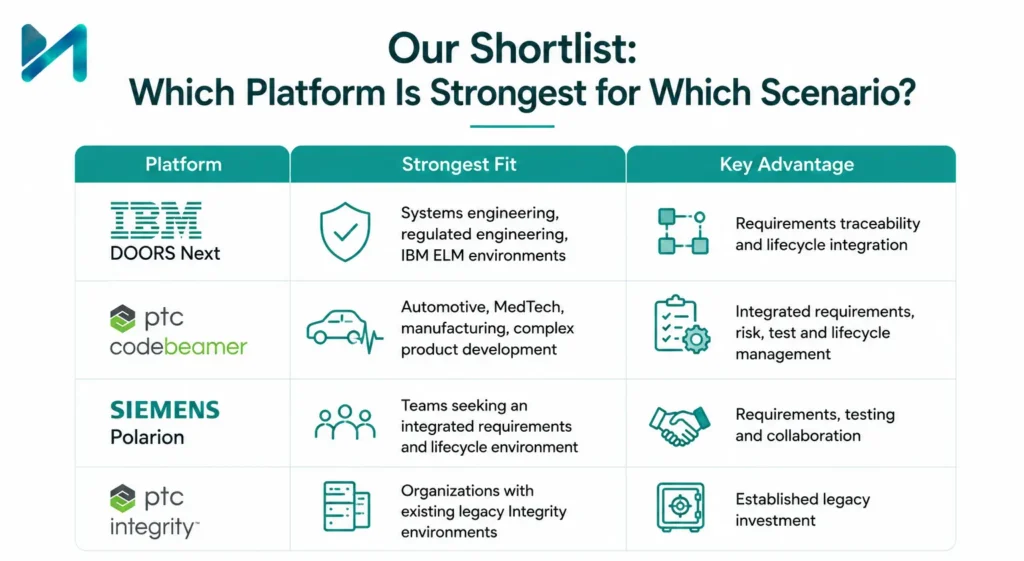
There is no universal winner, but the platforms can be positioned clearly based on typical enterprise requirements.
| Platform | Strongest Fit | Key Advantage |
| IBM DOORS Next | Systems engineering, regulated engineering, IBM ELM environments | Requirements traceability and lifecycle integration |
| PTC Codebeamer | Automotive, MedTech, manufacturing, complex product development | Integrated requirements, risk, test and lifecycle management |
| Siemens Polarion | Teams seeking an integrated requirements and lifecycle environment | Requirements, testing and collaboration |
| PTC Integrity | Organizations with existing legacy Integrity environments | Established legacy investment |
For many organizations starting a new evaluation today, DOORS Next and Codebeamer deserve particular attention.
IBM positions DOORS Next as a scalable, web-based requirements solution supporting requirements capture, traceability, change management and compliance.
Codebeamer, meanwhile, combines requirements, risk, test and lifecycle capabilities within one ALM platform and supports complex engineering processes.
Evaluating both platforms?
Speak with our IBM ELM experts or explore MicroGenesis Codebeamer ALM services.
💡
Why DOORS Next Remains a Strong Enterprise Choice
DOORS Next is particularly compelling for organizations where requirements traceability, engineering governance, configuration management, and compliance are critical.
IBM describes DOORS Next as part of the IBM Engineering Lifecycle Management platform, where requirements can connect with development, testing, change and configuration management activities.
For example, imagine an automotive company managing 20,000 system and software requirements.
A change to one safety-related requirement could affect:
Requirement → Design → Development → Test Case → Verification Result
DOORS Next allows these relationships to be established through traceability links, helping teams understand the impact of changes across the lifecycle.
Why engineering leaders choose DOORS Next
- Strong requirements traceability
- Baselines and version management
- Configuration management
- Integration with IBM ELM applications
- Support for regulated engineering environments
- Web-based collaboration
- Impact analysis
- Requirements reporting
IBM specifically identifies use cases including traceability, shared requirements, compliance and reuse across products.
Best fit for DOORS Next
DOORS Next is especially attractive when your organization already has:
- IBM ELM
- IBM Engineering Workflow Management
- IBM Engineering Test Management
- Rhapsody
- Existing DOORS investments
- Complex systems engineering processes
Example: A railway, aerospace, automotive or defence organization with strict traceability requirements may benefit more from DOORS Next than from a lightweight requirements tool.
Already using IBM DOORS or IBM ELM?
Talk to MicroGenesis about DOORS Next implementation and optimization.
WhyCodebeamerIs a Strong Modern Alternative
Codebeamer deserves serious consideration when an organization wants to bring requirements, risk, testing, traceability and engineering workflows together in a configurable platform.
PTC describes Codebeamer as a complete ALM solution with requirements, risk, test management and end-to-end traceability.
That makes it particularly interesting for industries such as:
- Automotive
- Medical devices
- Aerospace
- Industrial manufacturing
- High-tech
- Regulated product development
For example, a medical-device organization may need to connect:
User Need → System Requirement → Software Requirement → Risk → Test → Verification
Instead of managing these relationships across disconnected systems, Codebeamer provides a centralized environment for lifecycle information.
PTC also states that Codebeamer supports integrations with tools including IBM DOORS, Jira, Jenkins, Git and Windchill, which can be important for organizations modernizing an existing engineering toolchain.
Why organizations consider Codebeamer
- Requirements management
- Risk management
- Test management
- End-to-end traceability
- Product-line engineering
- Configurable workflows
- Agile and traditional development
- Integration capabilities
- Digital-thread capabilities
Example: An automotive company developing multiple vehicle variants can use requirements, risks, tests and product configurations within a connected engineering environment.
And there is a significant real-world signal here: in April 2026, PTC announced that BMW Group had adopted Codebeamer as its enterprise-wide requirements management solution, consolidating fragmented legacy requirements environments into a unified data model.
That is not proof that Codebeamer is automatically the best platform for every company, but it is a strong indication of its relevance for large-scale engineering environments.
Considering Codebeamer for your engineering organization?
Explore MicroGenesis Codebeamer ALM expertise.
Where DoesPolarionFit?
Polarion is another established platform for requirements and lifecycle management.
Its strongest appeal is generally around organizations looking for an integrated environment for requirements, testing, collaboration and lifecycle processes.
For decision-makers, however, the evaluation should focus less on feature availability and more on how well the platform fits the organization’s existing engineering ecosystem.
Ask:
- What tools are already being used?
- How much historical requirements data must be migrated?
- What regulatory standards must be supported?
- How complex are the traceability relationships?
- Do teams require product-line management?
- How important is integration with development and testing?
- What level of customization will be required?
A platform that requires extensive customization to fit your processes can become significantly more expensive than expected.
What About PTC Integrity?
PTC Integrity has been used extensively in engineering and software development environments.
For organizations already running an Integrity environment, the question is often different from selecting a completely new platform.
The key question becomes:
Should we continue investing in the existing environment or modernize to a newer platform?
This is where migration planning becomes critical.
PTC’s current Codebeamer guidance acknowledges that migration can vary considerably depending on the legacy systems and the volume and nature of the data involved. PTC also notes that some migrations may require a specialized implementer.
That makes migration assessment an important part of any Integrity modernization decision.
DOORS Next vsCodebeamer: Which One Should You Choose?
For many enterprise engineering organizations, this is likely to be the most important comparison.
| Requirement | DOORS Next | Codebeamer |
| Requirements management | Excellent | Excellent |
| Traceability | Excellent | Excellent |
| IBM ecosystem integration | Excellent | Good |
| Risk management | Strong through ELM ecosystem | Excellent |
| Test lifecycle | Strong through ELM ecosystem | Excellent |
| Product-line engineering | Strong | Excellent |
| Configuration management | Strong | Strong |
| Regulated engineering | Excellent | Excellent |
| Legacy IBM environment | Excellent fit | Good |
| Highly configurable ALM | Strong | Excellent |
| Automotive engineering | Excellent | Excellent |
| Migration from legacy platforms | Strong | Strong |
The right answer depends heavily on your existing environment.
Choose DOORS Next when:
You already use IBM ELM or IBM engineering tools, have complex requirements structures, require strong traceability and configuration management, and want to extend an established IBM engineering ecosystem.
Choose Codebeamer when:
You want a highly configurable ALM platform that brings requirements, risks, testing, workflows and product engineering into a connected environment.
Which Platform Is Better for Automotive Engineering?
Automotive organizations have particularly demanding requirements.
A modern vehicle can involve:
Systems engineering + embedded software + electronics + cybersecurity + functional safety + testing + manufacturing
That means requirements cannot remain isolated in a spreadsheet or standalone repository.
DOORS Next is a strong option for organizations that need structured requirements management, traceability and integration across engineering lifecycle activities. IBM specifically highlights support for standards including ASPICE and ISO 26262 among its requirements-management use cases.
Codebeamer is also particularly relevant for automotive organizations because of its capabilities across requirements, risk, testing, product-line engineering and digital traceability.
Example: If an OEM has 10 vehicle variants and a common software platform, product-line and variant management can become just as important as basic requirements capture.
Which Platform Is Better for Regulated Industries?
For regulated industries, the question isn’t simply:
“Can this tool store requirements?”
The real question is:
Can we demonstrate how a requirement moved from definition to implementation, verification and approval?
Traceability becomes essential.
IBM explains that DOORS Next traceability can connect requirements with development and test artifacts and support impact analysis when requirements change.
Codebeamer similarly emphasizes end-to-end traceability across requirements, risks, tests and development activities.
For organizations in medical devices, aerospace, automotive and other regulated industries, this capability can significantly simplify audits and engineering reviews.
What Should You Consider Before Selecting a Platform?
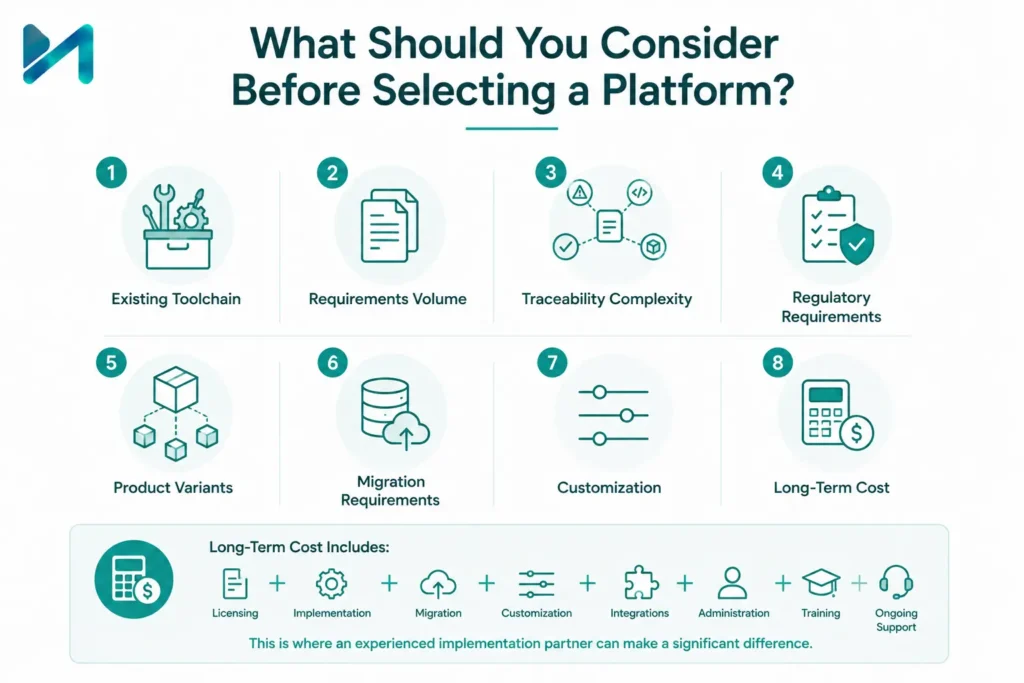
Before purchasing or migrating, evaluate these 8 factors.
1. Existing Toolchain
Do you already use IBM ELM, Jira, Git, Windchill, Jenkins or other engineering tools?
2. Requirements Volume
Are you managing hundreds, thousands or hundreds of thousands of requirements?
3. Traceability Complexity
Do requirements need to connect to risks, designs, code, tests and validation evidence?
4. Regulatory Requirements
Which standards and audit requirements apply to your industry?
5. Product Variants
Do you develop multiple products or configurations from a common engineering baseline?
6. Migration Requirements
How much historical data must be retained?
7. Customization
How closely does the platform need to match your engineering processes?
8. Long-Term Cost
Don’t evaluate license costs alone.
Consider:
Licensing + implementation + migration + customization + integrations + administration + training + ongoing support
This is where an experienced implementation partner can make a significant difference.
Don’t Choose the Platform Before Assessing Your Engineering Process
One of the biggest mistakes organizations make is selecting a platform first and designing the process afterward.
Instead, start with:
Current State → Business Requirements → Engineering Process → Tool Evaluation → Proof of Concept → Migration → Implementation
For example, if your current environment contains:
- 50,000 requirements
- Multiple product variants
- Existing Jira projects
- Legacy DOORS data
- Automated testing
- Supplier requirements
- Regulatory documentation
then a simple product demo is not enough.
You need a proof of concept using your actual engineering scenarios.
Migration Is Where Platform Projects Often Become Difficult
Migration is not simply exporting data from one database and importing it into another.
A proper migration can involve:
Data discovery
Requirements inventory
Data cleansing
Attribute mapping
Relationship mapping
Baseline migration
Traceability validation
User acceptance testing
Pilot migration
Production migration
PTC’s own Codebeamer migration guidance emphasizes that migration complexity varies depending on legacy systems and data volume, and that specialized implementation support may be required.
For organizations moving from legacy environments, this is one of the strongest reasons to involve an experienced engineering lifecycle partner early.
Planning a DOORS, DOORS Next or legacy platform migration?
Talk to MicroGenesis about your migration and implementation requirements.
What Does the Best Platform Look Like for Your Organization?
Instead of asking:
“Which platform is the best?”
Ask:
“Which platform best fits our engineering strategy?”
DOORS Next is a strong choice if you need:
- Enterprise requirements management
- Complex traceability
- IBM ELM integration
- Configuration management
- Regulated engineering support
- Existing IBM investment
Codebeamer is a strong choice if you need:
- Integrated requirements, risk and testing
- Highly configurable workflows
- Product-line engineering
- End-to-end traceability
- Modern ALM capabilities
- Complex product development
Polarion can be considered when:
- You need an established lifecycle platform
- Requirements and testing need to be connected
- Collaboration is a major consideration
- Its ecosystem aligns with your existing Siemens environment
PTC Integrity makes sense primarily when:
- You already have a significant Integrity investment
- Your immediate priority is continuity
- You are evaluating whether modernization is now justified
So, Who Offers the Best Platform?
If your organization is looking for enterprise-grade requirements management with strong traceability and an established engineering lifecycle ecosystem, DOORS Next should be high on your shortlist.
If your priority is a modern, configurable ALM platform connecting requirements, risk, testing and product development, Codebeamer deserves equally serious consideration.
Polarion remains relevant for organizations aligned with its ecosystem and lifecycle requirements.
For companies already using PTC Integrity or other legacy environments, the decision should include a structured modernization and migration assessment rather than simply comparing feature lists.
Our recommendation: shortlist DOORS Next and Codebeamer first, then validate both against your actual engineering processes, integrations, regulatory requirements and migration needs.
Why MicroGenesis for DOORS Next and Codebeamer?
Choosing the platform is only the beginning.
A successful implementation requires the right combination of:
- Requirements engineering expertise
- Tool configuration
- Data migration
- Traceability design
- Integration
- Reporting
- Process consulting
- User adoption
- Ongoing optimization
MicroGenesis helps engineering organizations evaluate, implement, integrate and optimize enterprise engineering lifecycle platforms.
Our expertise covers IBM Engineering Lifecycle Management and PTC Codebeamer, helping organizations move from fragmented requirements processes toward connected and traceable engineering environments.
Looking for an IBM ELM implementation partner?
Explore MicroGenesis IBM ELM Solution Partner Services.
Based in Bangalore and need local engineering lifecycle expertise?
Explore our IBM ELM services in Bangalore.
Evaluating PTC Codebeamer?
Explore MicroGenesis Codebeamer ALM services.
Final Verdict
There is no responsible way to declare one platform the universal winner for every engineering organization.
But if the shortlist is DOORS Next vs Polarion vs Codebeamer vs PTC Integrity, the decision becomes much clearer when matched to business needs.
DOORS Next stands out for organizations prioritizing structured requirements management, traceability, configuration and the broader IBM ELM ecosystem.
Codebeamer stands out for organizations looking for a modern, configurable ALM environment connecting requirements, risks, testing, variants and engineering workflows.
The most important decision is therefore not simply which platform has the most features.
It is which platform can support your engineering processes today while giving you a scalable foundation for the products you will build tomorrow.
And before committing to a platform, validate it against your own requirements, traceability model, integrations, regulatory obligations and migration complexity.
Need help making that decision? Talk to MicroGenesis before you commit to a platform.