
Organizations developing complex products face increasing pressure to manage requirements effectively while maintaining compliance, traceability, collaboration, and engineering efficiency. Whether you’re building automotive systems, aerospace platforms, medical devices, industrial equipment, or large-scale software solutions, requirements management has become the foundation of successful product development.
Among the leading requirements management platforms available today, two solutions frequently dominate enterprise evaluations:
- IBM DOORS Next
- Siemens Polarion
Both platforms are widely used across regulated industries and offer advanced requirements management capabilities. However, they differ significantly in architecture, traceability models, systems engineering support, lifecycle integration, reporting, and scalability.
The challenge for engineering leaders is determining which platform best supports their digital engineering strategy, compliance objectives, and long-term product development goals.
This article provides a deep comparison of IBM DOORS Next and Polarion, examining how they perform across requirements management, traceability, compliance, systems engineering, lifecycle integration, reporting, collaboration, and overall enterprise readiness.
Why Requirements Management Matters More Than Ever
Modern products are becoming increasingly software-defined.
Organizations must manage:
- Customer Requirements
- System Requirements
- Software Requirements
- Verification Activities
- Validation Activities
- Compliance Evidence
- Change Requests
- Risk Assessments
Without structured requirements management, organizations face:
- Scope creep
- Compliance failures
- Quality issues
- Project delays
- Increased engineering costs
This is why digital engineering organizations continue investing heavily in modern requirements management solutions.
For organizations beginning their transformation journey, understanding Digital Requirements Management provides an excellent foundation.
Understanding the Two Platforms
What is IBM DOORS Next?
IBM DOORS Next is part of IBM Engineering Lifecycle Management (IBM ELM), a comprehensive digital engineering platform supporting:
- Requirements Management
- Test Management
- Change Management
- Systems Engineering
- Model-Based Systems Engineering (MBSE)
- Compliance Management
DOORS Next evolved from IBM DOORS Classic and was designed to support modern collaborative engineering environments.
Organizations migrating from legacy requirements platforms often begin with a structured DOORS to DOORS Next migration strategy.
What is Polarion?
Polarion is Siemens’ Application Lifecycle Management platform focused on:
- Requirements Management
- Quality Management
- Test Management
- Change Management
- Compliance Support
Polarion has gained strong adoption in automotive, medical device, and industrial manufacturing sectors because of its integrated repository approach and workflow flexibility.
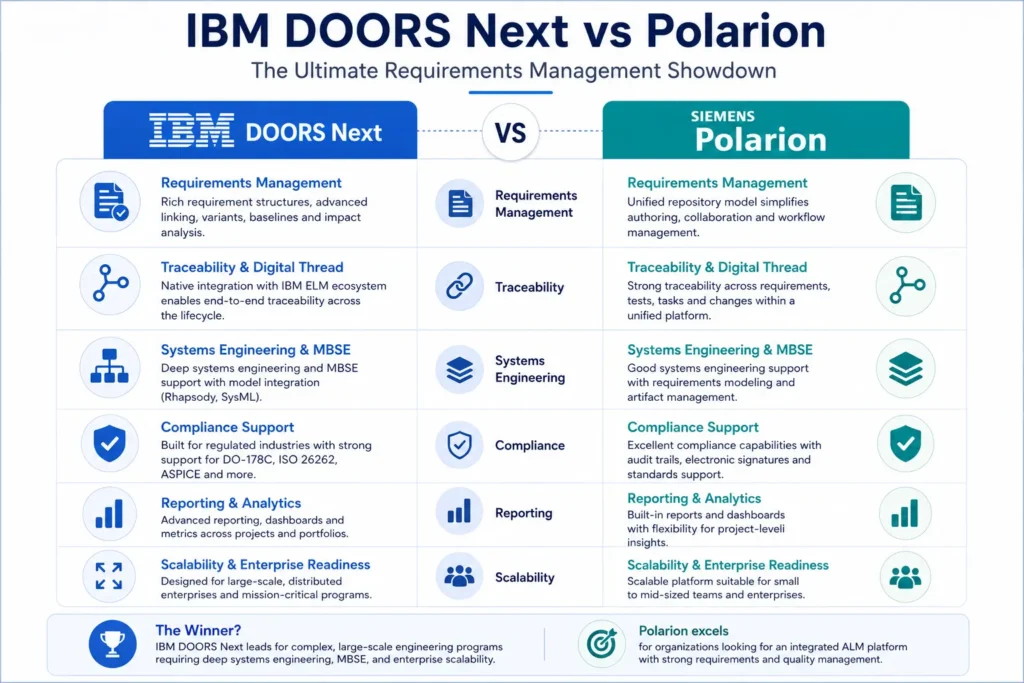
| Capability | IBM DOORS Next | Polarion |
| Requirements Management | Excellent | Excellent |
| Enterprise Scalability | Excellent | Very Good |
| Traceability | Excellent | Excellent |
| Systems Engineering Support | Excellent | Good |
| MBSE Integration | Excellent | Moderate |
| Lifecycle Management | Native IBM ELM ecosystem | Strong ALM capabilities |
| Compliance Support | Excellent | Excellent |
| Test Management Integration | Native ETM Integration | Native Polarion QA |
| Configuration Management | Advanced | Good |
| Automotive Readiness | Excellent | Excellent |
| Aerospace Readiness | Excellent | Good |
| Reporting | Advanced | Good |
| OSLC Support | Strong | Limited |
| Digital Thread Capabilities | Excellent | Good |
Requirements Management Capabilities
Requirements management remains the primary reason organizations evaluate these platforms.
Both solutions support:
- Requirement authoring
- Reviews
- Baselines
- Change management
- Version control
However, their approaches differ.
IBM DOORS Next
DOORS Next was designed specifically for large-scale engineering environments.
Key strengths include:
- Rich requirement structures
- Advanced linking
- Baseline management
- Variant support
- Impact analysis
- Lifecycle traceability
Organizations implementing Requirements Management with DOORS Next often leverage these capabilities to support complex engineering programs.
Polarion
Polarion provides a unified repository model that simplifies:
- Requirement management
- Workflow management
- Collaboration
Its integrated approach often appeals to organizations seeking reduced administrative complexity.
Requirements Management Comparison
| Feature | IBM DOORS Next | Polarion |
| Requirement Baselines | Advanced | Strong |
| Requirement Reuse | Excellent | Good |
| Variant Management | Excellent | Good |
| Impact Analysis | Advanced | Good |
| Requirement Reviews | Advanced | Good |
| Requirement Traceability | Excellent | Excellent |
| Large Scale Projects | Excellent | Good |
| Multi-Team Collaboration | Excellent | Good |
| Change Management | Excellent | Strong |
Winner: IBM DOORS Next
For large-scale engineering programs with extensive traceability requirements, DOORS Next generally provides greater flexibility and scalability.
Traceability and Digital Thread
Traceability is increasingly important in regulated industries.
Organizations need visibility across:
- Requirements
- Architecture
- Development
- Testing
- Validation
- Compliance
IBM DOORS Next
DOORS Next excels because it operates within the broader IBM ELM ecosystem.
Requirements can connect directly to:
- Engineering Workflow Management (EWM)
- Engineering Test Management (ETM)
- Rhapsody Models
- Architecture artifacts
Organizations can build complete digital threads spanning the entire engineering lifecycle.
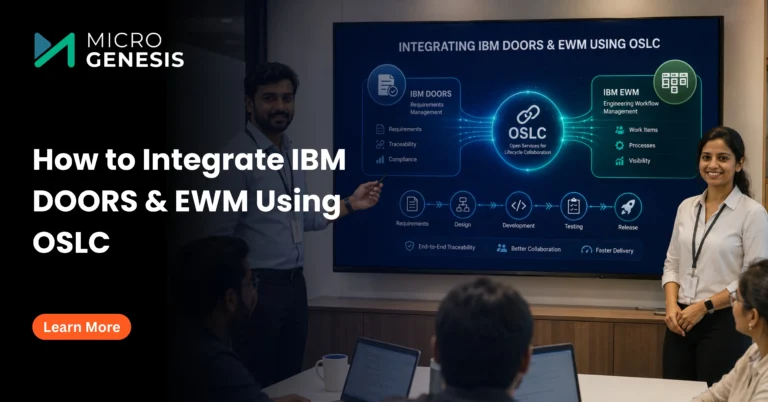
A key enabler of this capability is OSLC-based integration between DOORS and EWM.
Polarion
Polarion offers excellent traceability within its platform.
However, enterprise-wide digital thread capabilities often require additional integrations.
Traceability Comparison
| Capability | IBM DOORS Next | Polarion |
| Requirement-to-Test Links | Excellent | Excellent |
| Requirement-to-Code Links | Excellent | Good |
| Requirement-to-Architecture Links | Excellent | Moderate |
| Cross-Lifecycle Traceability | Excellent | Good |
| Impact Analysis | Advanced | Good |
| Digital Thread Support | Excellent | Good |
Winner: IBM DOORS Next
Model-Based Systems Engineering (MBSE)
MBSE adoption is accelerating across automotive, aerospace, and defense industries.
Organizations increasingly require tight integration between:
- Requirements
- Architecture Models
- Systems Engineering Artifacts
IBM DOORS Next
IBM provides strong MBSE support through integration with:
- IBM Rhapsody
- Rhapsody Model Manager
- Engineering Lifecycle Management
Organizations pursuing digital engineering initiatives often combine DOORS Next with MBSE practices.
A deeper understanding of Rhapsody Model Manager demonstrates how architecture and requirements can be connected throughout the lifecycle.
Polarion
Polarion supports systems engineering workflows but does not offer the same level of native MBSE integration.
MBSE Comparison
| Capability | IBM DOORS Next | Polarion |
| MBSE Support | Excellent | Moderate |
| Rhapsody Integration | Native | No |
| Architecture Traceability | Excellent | Moderate |
| Systems Engineering Support | Excellent | Good |
| Digital Engineering Readiness | Excellent | Good |
Winner: IBM DOORS Next
Automotive and EV Development
Automotive engineering introduces additional complexity:
- ASPICE
- ISO 26262
- Variant Management
- Systems Engineering
- Functional Safety
IBM ELM is increasingly used to manage these challenges across electric vehicle development programs.
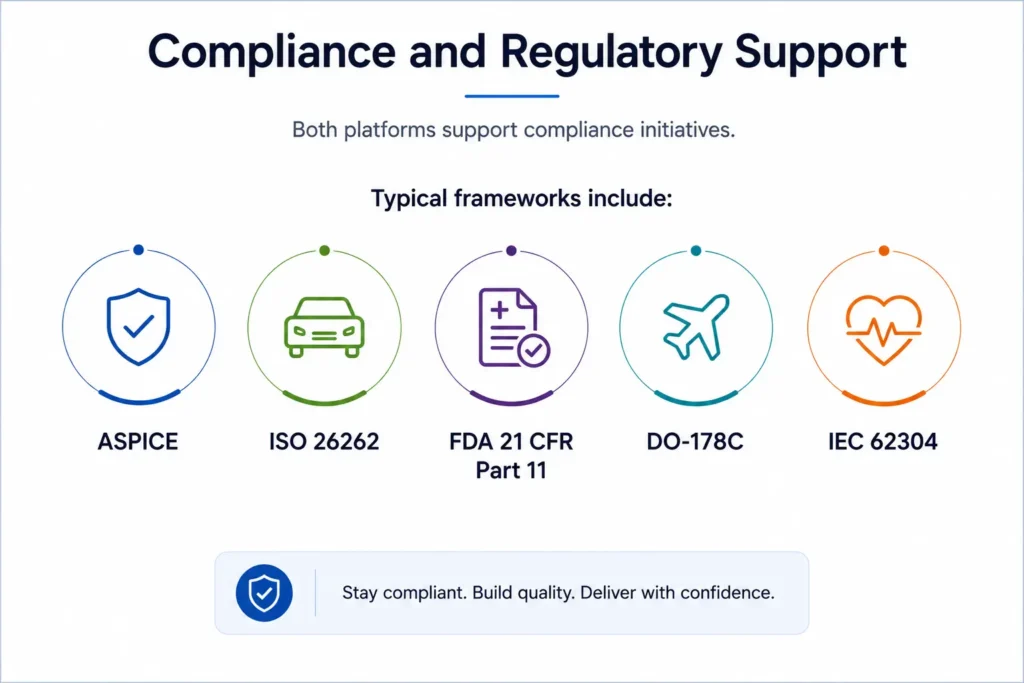
Both platforms support compliance initiatives.
Typical frameworks include:
- ASPICE
- ISO 26262
- FDA 21 CFR Part 11
- DO-178C
- IEC 62304
Compliance Comparison
| Compliance Capability | IBM DOORS Next | Polarion |
| ASPICE Support | Excellent | Excellent |
| ISO 26262 Support | Excellent | Excellent |
| Aerospace Compliance | Excellent | Good |
| Medical Device Compliance | Excellent | Excellent |
| Audit Readiness | Excellent | Good |
| Compliance Reporting | Advanced | Strong |
Winner: Tie
Both platforms perform extremely well in regulated environments.
Reporting and Analytics
Reporting often becomes a differentiator as organizations scale.
IBM DOORS Next
DOORS Next benefits from the broader IBM ELM reporting ecosystem.
Organizations can generate:
- Traceability reports
- Compliance reports
- Lifecycle dashboards
- Impact analyses
Polarion
Polarion offers strong reporting capabilities and user-friendly dashboards.
However, enterprise-level reporting may require additional customization.
Reporting Comparison
| Capability | IBM DOORS Next | Polarion |
| Lifecycle Reporting | Excellent | Good |
| Compliance Reporting | Excellent | Good |
| Executive Dashboards | Strong | Strong |
| Traceability Reports | Excellent | Good |
| Cross-Tool Analytics | Excellent | Moderate |
Winner: IBM DOORS Next
Enterprise Lifecycle Management
Requirements management should not exist in isolation.
Organizations increasingly seek integrated engineering environments.
IBM ELM provides:
- Requirements Management
- Workflow Management
- Test Management
- Systems Engineering
- MBSE Support
This broader ecosystem is one reason many organizations choose IBM ELM for product engineering initiatives.
Explore the Core Components of Engineering Lifecycle Management.
And learn why organizations adopt IBM ELM for complex engineering programs.
Infrastructure and Future Scalability
Technology decisions should consider long-term platform evolution.
IBM’s recent discontinuation of Microsoft SQL Server support demonstrates the importance of planning future infrastructure strategies.
Organizations evaluating long-term platform investments should factor these considerations into roadmap planning.
DOORS Next vs Polarion: Scenario-Based Recommendations
| Scenario | Recommended Platform |
| Automotive OEM | IBM DOORS Next |
| Aerospace Manufacturer | IBM DOORS Next |
| Defense Programs | IBM DOORS Next |
| MBSE Transformation | IBM DOORS Next |
| Digital Thread Initiative | IBM DOORS Next |
| Enterprise Product Engineering | IBM DOORS Next |
| Medical Device Development | Polarion or DOORS Next |
| Mid-Sized Regulated Organization | Polarion |
| Existing Siemens Ecosystem | Polarion |
| Existing IBM ELM Ecosystem | IBM DOORS Next |
Final Scorecard
| Category | Winner |
| Requirements Management | IBM DOORS Next |
| Traceability | IBM DOORS Next |
| MBSE Support | IBM DOORS Next |
| Systems Engineering | IBM DOORS Next |
| Compliance | Tie |
| Automotive Readiness | IBM DOORS Next |
| Aerospace Readiness | IBM DOORS Next |
| Reporting | IBM DOORS Next |
| Lifecycle Integration | IBM DOORS Next |
| Ease of Administration | Polarion |
| Simplicity | Polarion |
| Enterprise Scalability | IBM DOORS Next |
How MicroGenesis Helps Organizations Maximize IBM ELM
Organizations evaluating or implementing IBM DOORS Next often need guidance around:
- Requirements Management
- Traceability Strategy
- MBSE Adoption
- Compliance Readiness
- Digital Engineering Transformation
- Migration Planning
Through its expertise in IBM Engineering Lifecycle Management, MicroGenesis helps organizations design, implement, optimize, and scale engineering lifecycle management environments aligned with business and compliance objectives.
Organizations can leverage IBM ELM expertise to improve requirements management, systems engineering, compliance reporting, and digital thread initiatives.
Final Verdict: Which Platform Wins?
Polarion is a strong requirements management solution and remains an excellent choice for many regulated industries.
However, when evaluating:
- Enterprise-scale requirements management
- Systems engineering
- MBSE adoption
- Digital thread capabilities
- Cross-lifecycle traceability
- Automotive and aerospace engineering
IBM DOORS Next consistently demonstrates broader capabilities and stronger lifecycle integration.
For organizations pursuing digital engineering transformation, MBSE adoption, and enterprise-wide lifecycle visibility, IBM DOORS Next emerges as the stronger long-term platform.
The most important question is not which tool has more features.
The real question is which platform best supports your organization’s engineering maturity, compliance goals, and digital transformation strategy over the next decade.