
IBM Engineering Lifecycle Management (IBM ELM) has become a cornerstone platform for organizations managing complex engineering projects, regulatory compliance, systems engineering, software development, and product lifecycle management. Companies invest heavily in IBM ELM to improve traceability, collaboration, requirements management, testing, architecture, and governance across the entire engineering lifecycle.
Yet a surprising reality emerges in many organizations several years after implementation:
Despite using IBM ELM for three or more years, most teams still rely on a small group of reporting experts whenever they need meaningful insights.
Need a traceability report for an audit?
Call the ELM administrator.
Need a requirements coverage report?
Ask the reporting specialist.
Need compliance evidence for a customer review?
Wait for the expert to generate it.
The question is obvious: why does reporting remain so difficult after years of platform adoption?
The answer is not that IBM ELM lacks reporting capabilities. In fact, IBM ELM offers powerful reporting tools, dashboards, traceability views, and analytics options. The challenge lies in the complexity of engineering data, lifecycle relationships, reporting architecture, governance practices, and organizational maturity.
In this article, we’ll explore why IBM ELM reporting continues to depend on specialists, the most common reporting challenges organizations face, and how engineering teams can build a more self-service reporting culture.
The Promise of IBM ELM Reporting
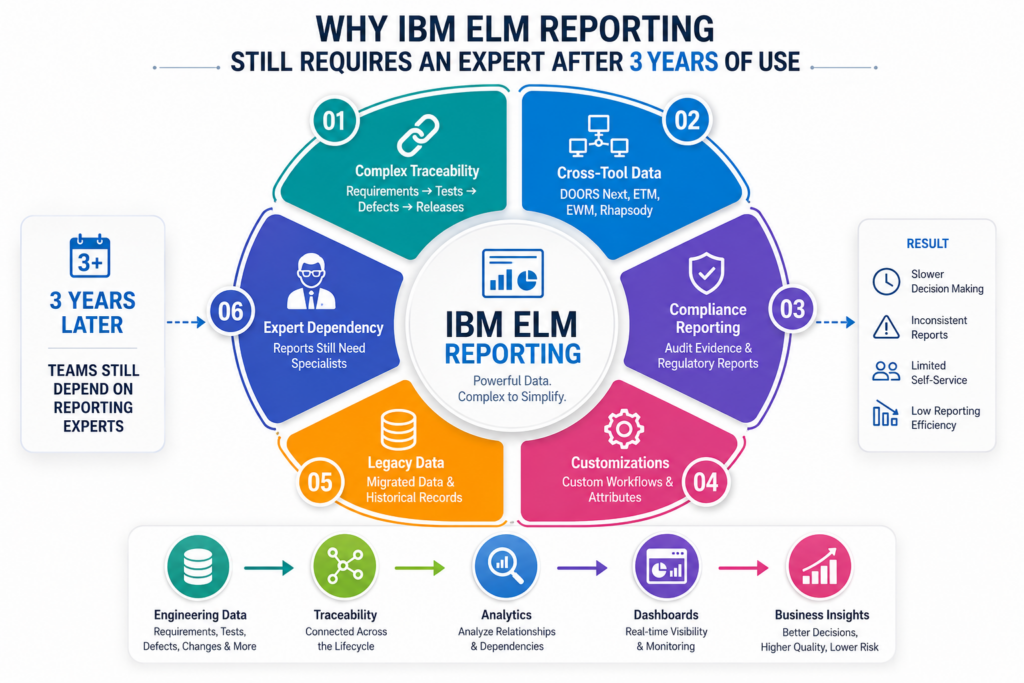
When organizations implement IBM ELM, reporting is often one of the major business drivers.
Leadership expects visibility into:
- Requirements coverage
- Test execution
- Defect trends
- Compliance status
- Change management
- Release readiness
- Engineering productivity
The expectation is straightforward:
“Once all engineering data is connected, reporting should become easy.”
Unfortunately, reality is more complicated.
While IBM ELM centralizes information, it also creates an interconnected ecosystem of data relationships that require careful interpretation.
The challenge is not finding data.
The challenge is understanding how the data is connected.
Engineering Data Is Inherently Complex
Unlike traditional business reporting, engineering reporting involves highly interconnected artifacts.
A single requirement may connect to:
- Business objectives
- System requirements
- Design models
- Architecture elements
- Test cases
- Defects
- Change requests
- Releases
Generating meaningful reports requires understanding these relationships.
Organizations often discover that reporting complexity grows alongside lifecycle maturity.
This is particularly true for teams implementing advanced digital engineering practices through Digital Requirements Management, where requirements, verification, validation, and compliance data become deeply interconnected.
The more traceability organizations establish, the more complex reporting becomes.
Most Teams Focus on Data Entry, Not Data Consumption
Many IBM ELM implementations prioritize:
- Requirements capture
- Testing workflows
- Change management
- Compliance processes
Reporting often receives less attention during implementation.
Teams spend years creating data but invest limited effort in defining:
- Reporting standards
- Executive dashboards
- KPI frameworks
- Data governance models
As a result, organizations accumulate large volumes of information without establishing clear strategies for extracting insights.
Eventually, reporting becomes dependent on a few experts who understand both the platform and the underlying data structures.
Traceability Creates Reporting Challenges
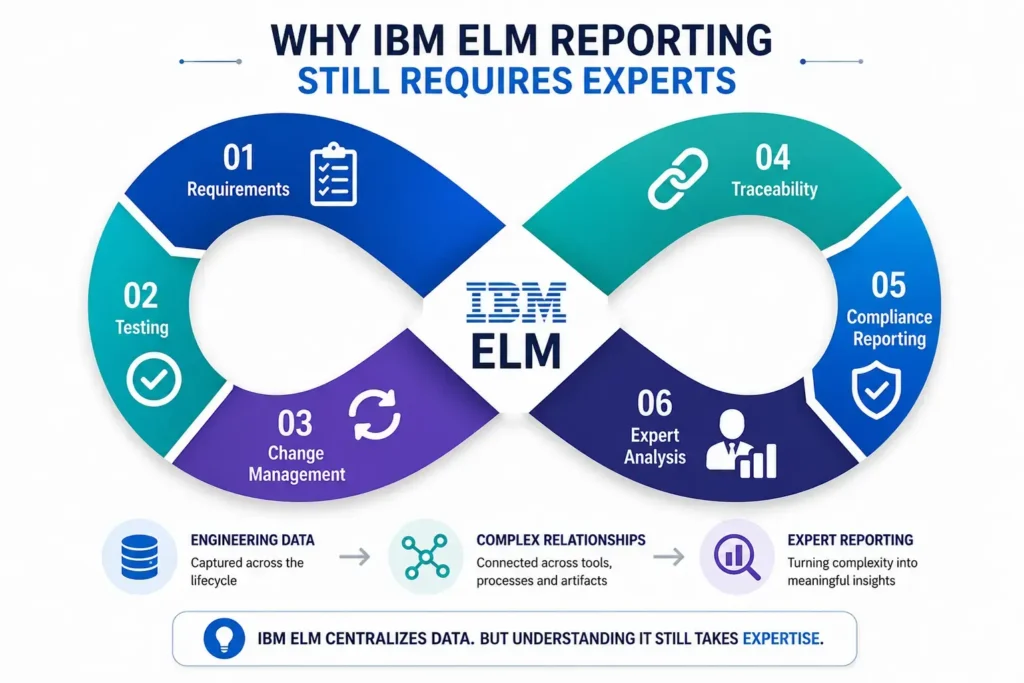
One of IBM ELM’s greatest strengths is end-to-end traceability.
Organizations can connect:
- Requirements
- Designs
- Tests
- Defects
- Changes
- Releases
This enables powerful lifecycle visibility.
However, it also introduces complexity.
For example, a seemingly simple request such as:
“Show all unverified requirements for Release 4.2.”
may require navigating multiple relationships across several lifecycle applications.
Organizations that successfully implement Requirements Management with DOORS Next often discover that reporting becomes increasingly dependent on understanding traceability models rather than simply generating documents.
The challenge isn’t accessing information.
The challenge is understanding how information is connected.
Reporting Requirements Change Faster Than Implementations
Another major reason organizations continue relying on experts is that reporting requirements evolve continuously.
Engineering leaders frequently ask new questions such as:
- Which requirements remain untested?
- What defects affect safety-critical features?
- Which changes impact upcoming releases?
- How much test coverage exists for regulatory requirements?
These questions often differ from the reports originally configured during implementation.
As organizations mature, reporting needs become increasingly sophisticated.
Static reports rarely satisfy evolving stakeholder expectations.
Lifecycle Data Spans Multiple Tools
IBM ELM is not a single application.
It includes multiple lifecycle management solutions such as:
- DOORS Next
- Engineering Test Management
- Engineering Workflow Management
- Rhapsody Model Manager
Each application generates valuable information.
However, cross-tool reporting introduces additional complexity.
Generating lifecycle-wide insights requires understanding relationships across multiple repositories and data sources.
Organizations using Rhapsody Model Manager frequently encounter reporting challenges because architecture data must be connected to requirements, testing, and change management information before meaningful analysis can occur.
Without strong governance, cross-domain reporting quickly becomes difficult.
Customization Creates Long-Term Complexity
Most IBM ELM environments evolve over time.
Organizations add:
- Custom attributes
- Custom workflows
- Project-specific configurations
- Compliance fields
- Industry-specific artifacts
Initially, customization improves usability.
However, reporting becomes increasingly difficult as different projects implement different configurations.
After several years, organizations often discover:
- Inconsistent field usage
- Different naming conventions
- Duplicate metrics
- Conflicting reporting structures
These inconsistencies make enterprise-wide reporting significantly more challenging.
Compliance Reporting Requires Specialized Knowledge
Many IBM ELM users operate in regulated industries such as:
- Automotive
- Aerospace
- Defense
- Medical devices
- Industrial automation
Compliance reporting often requires evidence demonstrating:
- Requirements traceability
- Verification status
- Validation activities
- Change management controls
- Audit histories
Generating these reports demands a deep understanding of both regulatory frameworks and lifecycle relationships.
For example, organizations developing complex products such as electric vehicles frequently require sophisticated compliance reporting across multiple engineering domains.
IBM ELM plays a critical role in managing this complexity throughout the EV development lifecycle.
As compliance requirements increase, reporting complexity naturally grows.
Legacy Data Creates Reporting Problems
Many organizations have years or decades of engineering information.
Some migrated from:
- IBM DOORS Classic
- Legacy ALM systems
- Spreadsheets
- Proprietary databases
Historical data often introduces inconsistencies that affect reporting quality.
Organizations migrating from legacy environments frequently discover that reporting requires specialized expertise to reconcile old and new data models.
This challenge is especially common among organizations transitioning through DOORS to DOORS Next migrations, where reporting structures must evolve alongside modernization efforts.
Without careful planning, migration complexity can continue impacting reporting for years.
Reporting Architecture Is Often Underestimated
Many organizations assume reporting is a simple extension of implementation.
In reality, reporting requires its own architecture.
Successful reporting environments require:
- Data governance
- Metric definitions
- Standardized processes
- Dashboard strategies
- User training
Organizations that neglect reporting architecture often find themselves dependent on a small group of specialists who understand how reports were originally designed.
Database and Infrastructure Changes Affect Reporting
Infrastructure decisions can also influence reporting performance and complexity.
For example, IBM’s decision to discontinue Microsoft SQL Server support has forced many organizations to reassess their reporting environments, database strategies, and platform architectures.
These changes impact not only system administration but also analytics and reporting capabilities.
Organizations navigating these transitions often rely heavily on experts to redesign reporting processes and data integrations.
Infrastructure modernization frequently exposes hidden reporting dependencies that were previously overlooked.
Users Never Learn Reporting Fundamentals
One of the most overlooked issues is training.
Many organizations train users on:
- Requirements management
- Testing workflows
- Change management
But provide limited reporting education.
As a result:
- Engineers create data.
- Administrators generate reports.
- Stakeholders consume results.
Users never develop reporting skills.
This dependency persists for years because reporting remains concentrated among a small group of specialists.
Executive Expectations Continue Rising
Leadership teams increasingly expect:
- Real-time dashboards
- Predictive analytics
- Compliance visibility
- Portfolio-level reporting
- Cross-project insights
These expectations often exceed what standard reports provide.
As reporting sophistication increases, organizations continue relying on experts who understand:
- Data relationships
- Lifecycle traceability
- Reporting tools
- Compliance frameworks
The more mature the organization becomes, the more complex reporting demands become.
Signs Your Organization Is Overly Dependent on Reporting Experts
Common indicators include:
- Report requests take days or weeks.
- Only a few users can create reports.
- Executives depend on manual reporting.
- Compliance audits require significant effort.
- Teams distrust reporting accuracy.
- Different departments produce conflicting metrics.
- Reporting knowledge resides with a handful of individuals.
If these symptoms sound familiar, reporting maturity may be lagging behind platform maturity.
How to Make IBM ELM Reporting More Accessible
Organizations can reduce dependency on specialists through several initiatives.
Standardize Data Models
Create consistent:
- Naming conventions
- Attribute definitions
- Traceability structures
Define Reporting Governance
Establish:
- KPI standards
- Ownership models
- Reporting guidelines
Simplify Dashboards
Focus on actionable insights rather than excessive complexity.
Improve User Training
Teach teams:
- Reporting fundamentals
- Dashboard usage
- Traceability analysis
Build Self-Service Capabilities
Enable users to generate common reports independently.
Review Reporting Requirements Regularly
Align reporting strategies with evolving business objectives.
Why IBM ELM Remains the Right Choice Despite Reporting Complexity
Reporting challenges do not indicate platform weakness.
In fact, the opposite is often true.
The reason IBM ELM reporting can be complex is because the platform manages highly sophisticated engineering relationships that many traditional ALM solutions cannot support.
Organizations benefit from:
- End-to-end traceability
- Lifecycle visibility
- Compliance support
- Systems engineering integration
- Digital engineering capabilities
These capabilities are among the key reasons organizations continue choosing IBM ELM for product engineering initiatives.
The goal is not to eliminate reporting complexity entirely.
The goal is to manage it effectively.
How MicroGenesis Can Help Simplify IBM ELM Reporting
Many organizations successfully implement IBM ELM but struggle to transform engineering data into meaningful business insights.
Through specialized expertise in IBM Engineering Lifecycle Management (IBM ELM), MicroGenesis helps organizations optimize reporting architectures, improve traceability models, standardize data governance, and develop scalable reporting strategies.
MicroGenesis supports organizations with:
- IBM ELM implementation and optimization
- Reporting framework design
- Compliance reporting
- Dashboard development
- Traceability strategy
- DOORS Next reporting
- Cross-lifecycle analytics
- Digital engineering transformation
Organizations looking to improve reporting maturity can also benefit from proven IBM ELM implementation best practices, ensuring reporting requirements are addressed from the beginning rather than treated as an afterthought.
Whether your challenge involves compliance reporting, executive dashboards, traceability analysis, or lifecycle visibility, MicroGenesis helps organizations unlock the full value of their IBM ELM investment.
Conclusion
Three years after implementation, many organizations still depend on reporting specialists for one simple reason:
IBM ELM manages complex engineering ecosystems, and meaningful reporting requires understanding how that ecosystem works.
The challenge isn’t a lack of data.
The challenge is transforming connected lifecycle information into actionable insights.
As organizations mature, reporting requirements become more sophisticated, traceability models become more complex, and compliance expectations continue rising.
Without governance, standardization, training, and reporting strategy, organizations naturally become dependent on experts.
The good news is that reporting maturity can be developed just like engineering maturity.
Organizations that invest in data governance, reporting architecture, user education, and self-service capabilities can significantly reduce dependency on specialists while improving visibility across the entire engineering lifecycle.
The question isn’t why IBM ELM reporting still requires experts.
The real question is whether your organization has built the processes and governance needed to make those experts less necessary.