Engineering organizations today are under constant pressure to deliver innovative products faster while ensuring regulatory compliance, product quality, cybersecurity, and complete lifecycle traceability. As products become increasingly software-driven and development teams become more geographically distributed, organizations need engineering platforms that can scale with evolving business requirements.
IBM Engineering Lifecycle Management (IBM ELM) has become one of the leading Application Lifecycle Management (ALM) and Engineering Lifecycle Management (ELM) platforms for managing requirements, development, testing, change management, and systems engineering across complex product development environments. Organizations in industries such as automotive, aerospace, defense, electronics, rail transportation, medical devices, and industrial manufacturing rely on IBM ELM to manage engineering complexity while accelerating product innovation.
To support these growing demands, IBM continues to enhance its platform through regular updates. One of the most significant releases is IBM Engineering Lifecycle Management (ELM) 7.0.3, which introduces improvements in performance, scalability, security, and enterprise collaboration. As organizations continue to modernize their Engineering Lifecycle Management strategy, upgrading to the latest IBM ELM release is essential for maintaining a secure, scalable, and future-ready engineering environment.
One of the biggest architectural changes introduced with IBM ELM 7.0.3 is the discontinuation of Microsoft SQL Server (MSSQL) support for IBM DOORS Next and other Engineering Lifecycle Management applications. Organizations currently running IBM ELM on MSSQL are encouraged to migrate to supported enterprise databases such as IBM Db2 or Oracle Database.
Although database migration may initially appear to be a complex IT initiative, it presents an excellent opportunity to modernize engineering infrastructure, improve application performance, strengthen cybersecurity, and prepare for future digital engineering initiatives. Organizations that delay migration risk operating unsupported environments that may become increasingly vulnerable to security threats, compliance challenges, performance bottlenecks, and higher maintenance costs.
This guide explores the five major risks of postponing migration, explains why upgrading to IBM ELM 7.0.3 is critical, and outlines best practices to ensure a smooth and successful transition.
Understanding IBM’s MSSQL Support Discontinuation
IBM regularly evaluates the technologies that support its Engineering Lifecycle Management platform to ensure customers benefit from the highest levels of performance, security, scalability, and long-term product innovation. As part of this strategy, IBM ELM 7.0.3 no longer supports Microsoft SQL Server (MSSQL) as a backend database.
Instead, IBM recommends enterprise-grade database platforms such as IBM Db2 and Oracle Database, which are better equipped to handle the growing demands of modern engineering organizations. These databases provide enhanced performance for managing large requirements repositories, complex lifecycle relationships, and enterprise-scale engineering workloads.
Migrating to a supported database enables organizations to:
- Improve overall system performance
- Enhance data consistency and integrity
- Strengthen cybersecurity through advanced database features
- Simplify future IBM ELM upgrades
- Increase platform scalability
- Reduce long-term maintenance risks
- Maintain access to IBM technical support and future enhancements
Organizations planning this transition should also adopt proven IBM ELM implementation best practices to minimize migration risks, validate integrations, and ensure business continuity throughout the upgrade process.
Rather than viewing IBM’s decision as a limitation, organizations should see it as an opportunity to modernize their engineering ecosystem and build a stronger foundation for future product development initiatives.
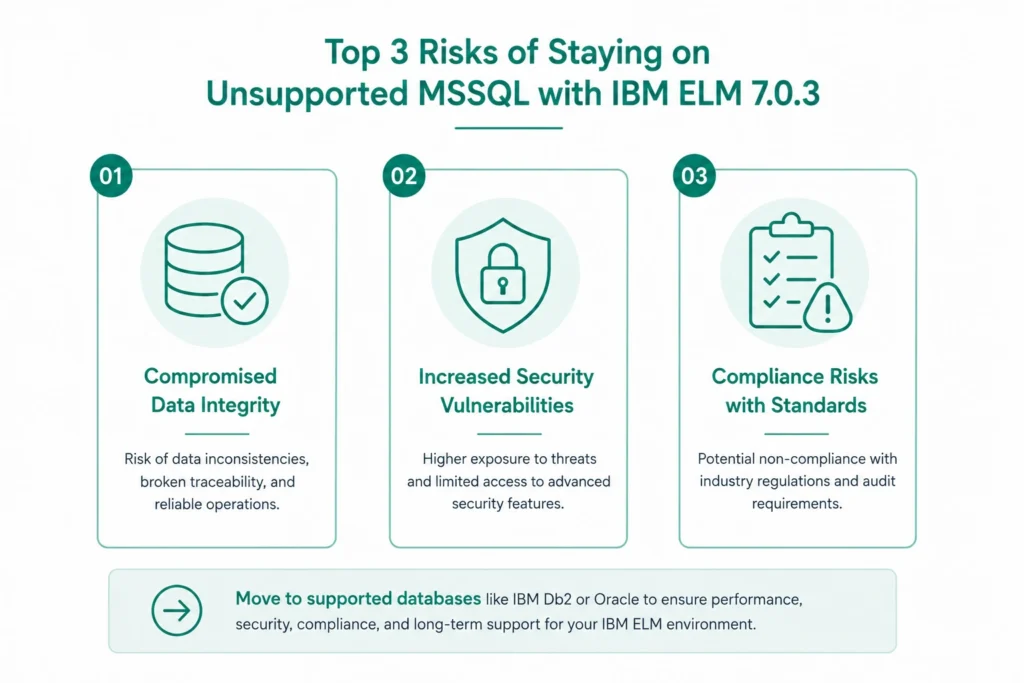
Risk #1: Compromised Data Integrity
Data integrity is the cornerstone of every successful Engineering Lifecycle Management implementation. Every requirement, work item, design artifact, change request, test case, and verification activity depends on accurate and consistent engineering data.
IBM ELM 7.0.3 introduces architectural improvements designed to support increasingly complex engineering programs involving thousands of users and millions of interconnected engineering artifacts. These enhancements require enterprise-grade databases capable of maintaining high transaction consistency while processing large volumes of engineering data.
Supported databases such as IBM Db2 and Oracle Database are specifically designed to provide:
- High transaction reliability
- Advanced indexing and query optimization
- Robust backup and recovery mechanisms
- Superior concurrency management
- Improved database consistency
- Better handling of large engineering repositories
Organizations that continue operating on unsupported MSSQL environments after upgrading to IBM ELM 7.0.3 may experience increasing risks related to database consistency, synchronization, and overall application reliability.
Potential consequences include:
- Data inconsistencies between engineering artifacts
- Incomplete lifecycle traceability
- Slower synchronization across integrated applications
- Increased database administration effort
- Greater risk of recovery challenges during system failures
For organizations managing safety-critical systems, maintaining complete and accurate engineering data is non-negotiable. Effective Digital Requirements Management depends on a reliable database platform that preserves relationships between requirements, designs, tests, and validation artifacts throughout the product lifecycle.
Migrating to a supported enterprise database helps organizations protect the integrity of their engineering information while ensuring IBM ELM can operate at its full potential.
Risk #2: Increased Security Vulnerabilities
As engineering organizations become increasingly connected through cloud services, remote collaboration, supplier ecosystems, and digital engineering platforms, cybersecurity has become a strategic business priority rather than simply an IT concern.
Engineering repositories often contain highly sensitive intellectual property, including product requirements, software architectures, design specifications, source code, verification results, and regulatory documentation. Protecting this information requires more than application-level security it also depends on a secure and fully supported database infrastructure.
IBM ELM 7.0.3 introduces several security enhancements designed to strengthen engineering environments. However, organizations continuing to rely on unsupported database platforms may be unable to fully benefit from these improvements.
Enterprise databases such as IBM Db2 and Oracle provide advanced security capabilities including:
- Strong encryption for data at rest and in transit
- Granular role-based access control
- Advanced authentication mechanisms
- Comprehensive auditing and logging
- High-availability backup and disaster recovery
- Continuous security updates and vendor support
Remaining on an unsupported database platform increases exposure to potential vulnerabilities and may make it more difficult to comply with internal security policies or industry-specific cybersecurity requirements.
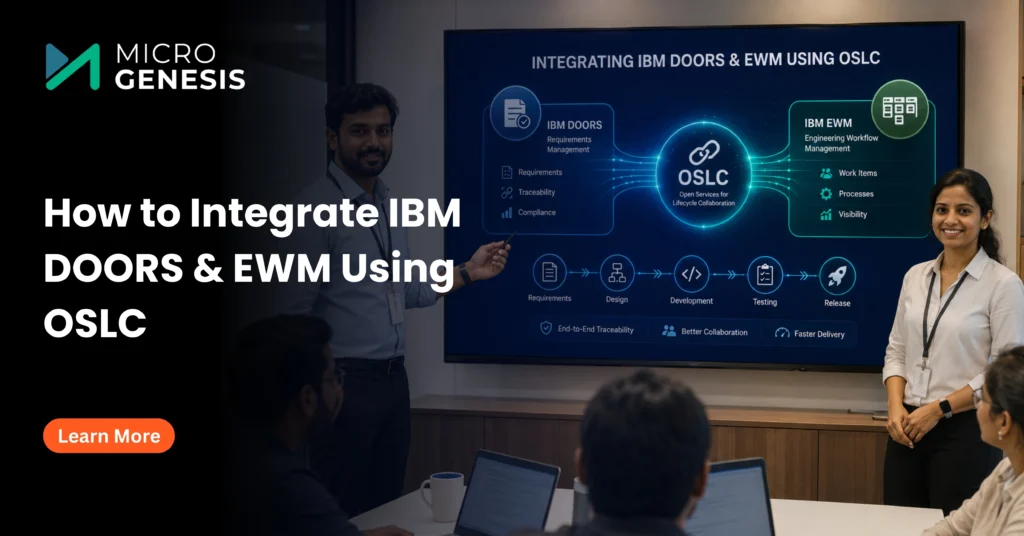
Security becomes even more critical when engineering artifacts are connected across multiple lifecycle tools. Organizations integrating IBM Engineering Requirements Management DOORS with Engineering Workflow Management (EWM) using OSLC rely on secure data exchanges to maintain complete traceability across requirements, development tasks, testing activities, and change management processes.
By migrating to IBM-supported databases, organizations not only improve system security but also strengthen the resilience of their entire Engineering Lifecycle Management environment, reducing operational risks while protecting valuable engineering intellectual property.
Risk #3: Compliance Risks with Regulatory Standards
For organizations operating in highly regulated industries, compliance is not optional it is a critical business requirement. Industries such as automotive, aerospace, defense, medical devices, rail transportation, and industrial manufacturing must demonstrate complete lifecycle traceability, secure data management, and comprehensive audit trails throughout product development.
IBM Engineering Lifecycle Management (ELM) 7.0.3 introduces several enhancements that help organizations strengthen governance and regulatory compliance. However, these capabilities can only be fully leveraged when the underlying database infrastructure is supported, secure, and capable of handling large volumes of engineering data.
Organizations using unsupported database platforms may face challenges such as:
- Incomplete audit trails
- Reduced traceability across engineering artifacts
- Difficulty generating compliance reports
- Increased risk of data inconsistencies
- Higher operational risks during regulatory audits
Migrating to IBM Db2 or Oracle enables organizations to benefit from enterprise-grade database capabilities that support regulatory requirements, including advanced auditing, secure data storage, and high availability.
A modern requirements management platform also plays a significant role in maintaining compliance. Organizations adopting Requirements Management with DOORS Next gain enhanced collaboration, configuration management, and end-to-end traceability that simplify compliance with standards such as:
- ISO 26262
- ASPICE
- IEC 62304
- FDA 21 CFR Part 11
- DO-178C
- GDPR
- ISO 9001
Maintaining a supported IBM ELM environment ensures engineering teams can respond quickly to audits, validate product requirements, and demonstrate compliance throughout the engineering lifecycle.
Risk #4: Operational Inefficiencies
Engineering organizations rely on IBM ELM to manage thousands or even millions of interconnected engineering artifacts. As projects become larger and more collaborative, application performance directly impacts engineering productivity.
IBM ELM 7.0.3 introduces significant architectural enhancements that improve system responsiveness, collaboration, and scalability. However, unsupported databases may prevent organizations from realizing these performance improvements.
Common operational challenges associated with unsupported database environments include:
- Slow application response times
- Delayed requirement loading
- Longer report generation
- Increased database maintenance
- Reduced collaboration across distributed teams
- More frequent system downtime
These inefficiencies affect every stage of the engineering lifecycle, from requirements management to testing and release planning. Engineers spend more time waiting for systems to respond instead of focusing on innovation.
One area where performance challenges often become apparent is reporting. Large engineering organizations generate complex lifecycle reports for project managers, compliance teams, and executives. Without an optimized infrastructure, reporting can become slow and resource-intensive.
As discussed in Why IBM ELM Reporting Still Requires an Expert , effective reporting depends not only on the reporting tools themselves but also on a well-optimized IBM ELM environment, properly configured databases, and expert implementation practices.
By migrating to IBM-supported databases, organizations can improve application responsiveness, reduce administrative overhead, and enable engineering teams to work more efficiently across the entire product development lifecycle.
Risk #5: Limited Scalability for Future Growth
Engineering complexity continues to grow as organizations develop software-defined products, connected systems, autonomous technologies, and digital twins. Managing these innovations requires an Engineering Lifecycle Management platform that can scale alongside business growth.
IBM ELM 7.0.3 has been designed to support:
- Larger engineering repositories
- More concurrent users
- Increased lifecycle integrations
- Model-Based Systems Engineering (MBSE)
- Digital engineering initiatives
- Enterprise-wide collaboration
However, achieving this scalability depends on deploying IBM ELM on supported enterprise databases capable of handling increasing workloads without compromising performance.
IBM Db2 and Oracle provide enterprise features such as:
- High availability
- Horizontal scalability
- Advanced workload balancing
- Improved resource utilization
- Faster query performance
- Enhanced disaster recovery
Organizations that continue using unsupported infrastructure may struggle to accommodate expanding engineering teams, growing repositories, and increasingly sophisticated engineering workflows.
The importance of scalability is especially evident in emerging industries such as electric vehicles, where products combine mechanical, electrical, electronic, and software engineering disciplines. Our article on Addressing Complexity in Electric Vehicle (EV) System Design and Development Using IBM ELM explores how scalable Engineering Lifecycle Management solutions help organizations manage multidisciplinary development while maintaining complete lifecycle traceability.
Investing in a supported database platform today ensures your IBM ELM environment is ready to support tomorrow’s engineering challenges.
Best Practices for IBM ELM Database Migration
Database migration is more than a technical upgrade it is a strategic initiative that can significantly improve the performance, security, and long-term sustainability of your Engineering Lifecycle Management environment. A well-planned migration minimizes business disruption while ensuring data integrity and application reliability.
To maximize the success of your migration, organizations should adopt the following best practices:
Conduct a Comprehensive Environment Assessment
Before beginning the migration, evaluate your existing IBM ELM deployment, including repositories, integrations, customizations, user access, and infrastructure dependencies. This assessment helps identify potential risks and establish a clear migration roadmap.
Validate Integrations and Dependencies
Many IBM ELM deployments integrate with tools such as IBM Engineering Workflow Management (EWM), Engineering Test Management (ETM), reporting platforms, and Model-Based Systems Engineering solutions. Verify that all integrations function correctly after the database migration to avoid disruptions to engineering workflows.
Organizations leveraging Rhapsody Model Manager should also validate synchronization between system models and engineering requirements after migration.
Perform Migration Testing in a Non-Production Environment
Always execute the migration in a staging or test environment before updating production systems. This allows teams to verify data integrity, application performance, integrations, and user access while identifying potential issues early.
Develop a Rollback and Backup Strategy
Create complete backups of databases, application configurations, and repositories before migration begins. A documented rollback plan ensures business continuity if unexpected issues occur during the migration process.
Partner with Experienced IBM ELM Consultants
Database migration involves architecture planning, performance tuning, data validation, integration testing, and post-migration optimization. Working with experienced IBM ELM specialists helps reduce project risks, minimize downtime, and ensure organizations fully benefit from the capabilities introduced in IBM ELM 7.0.3.
By following these best practices, organizations can complete their migration with confidence while creating a secure, scalable, and future-ready Engineering Lifecycle Management environment.
Why Upgrading to IBM ELM 7.0.3 Is an Investment in Long-Term Engineering Success
For many organizations, upgrading to IBM Engineering Lifecycle Management (ELM) 7.0.3 may appear to be a routine software update. In reality, it is a strategic investment that prepares engineering teams for the future of digital product development.
Today’s engineering organizations face increasing challenges, including shorter product release cycles, growing software complexity, evolving regulatory requirements, and globally distributed development teams. Legacy infrastructure often struggles to support these demands, resulting in slower collaboration, limited scalability, and increased operational risks.
IBM ELM 7.0.3 addresses these challenges by delivering:
- Improved platform performance
- Enhanced enterprise security
- Better lifecycle traceability
- Increased scalability
- Simplified future upgrades
- Stronger integration across engineering tools
Migrating to a supported database platform such as IBM Db2 or Oracle allows organizations to unlock these capabilities while reducing technical debt and ensuring long-term platform stability.
Businesses that modernize today position themselves to adopt future innovations such as:
- AI-assisted engineering
- Digital Thread initiatives
- Model-Based Systems Engineering (MBSE)
- Cloud-native engineering environments
- Digital Twins
- Connected product development
Organizations implementing IBM ELM across enterprise-scale engineering environments often experience improved collaboration, faster engineering decisions, and reduced project risks. As highlighted in our article on 7 Reasons IBM ELM Product Engineering , IBM ELM provides the foundation required for managing increasingly complex product development programs while maintaining complete lifecycle visibility.
Rather than viewing database migration as a mandatory infrastructure project, organizations should see it as an opportunity to build a more resilient, scalable, and future-ready engineering ecosystem.
IBM Db2 vs Oracle vs MSSQL for IBM ELM
Choosing the right database platform is critical for maximizing the performance and reliability of IBM Engineering Lifecycle Management. The following comparison highlights why IBM recommends Db2 and Oracle for IBM ELM 7.0.3.
|
Feature |
Microsoft SQL Server (MSSQL) |
IBM Db2 |
Oracle Database |
|
IBM ELM 7.0.3 Support |
❌ No |
✅ Yes |
✅ Yes |
|
Official IBM Support |
❌ Unsupported |
✅ Supported |
✅ Supported |
|
Enterprise Scalability |
Moderate |
Excellent |
Excellent |
|
High Availability |
Good |
Excellent |
Excellent |
|
Performance for Large Repositories |
Moderate |
Excellent |
Excellent |
|
Security Features |
Good |
Advanced |
Advanced |
|
Disaster Recovery |
Good |
Enterprise-grade |
Enterprise-grade |
|
Future IBM Compatibility |
Limited |
Excellent |
Excellent |
|
Recommended for New Deployments |
❌ No |
✅ Yes |
✅ Yes |
For organizations planning long-term digital transformation, IBM Db2 and Oracle provide the enterprise-grade performance, security, and scalability necessary to support modern Engineering Lifecycle Management initiatives.
Frequently Asked Questions (FAQs)
Why did IBM discontinue Microsoft SQL Server support in IBM ELM 7.0.3?
IBM discontinued MSSQL support to simplify its supported technology stack and improve the overall performance, security, scalability, and maintainability of the Engineering Lifecycle Management platform. By focusing on IBM Db2 and Oracle, IBM can deliver better optimization and faster innovation for enterprise engineering environments.
Which databases are supported in IBM ELM 7.0.3?
IBM officially supports:
- IBM Db2
- Oracle Database
Organizations using Microsoft SQL Server should plan a migration strategy to ensure continued access to IBM support, security updates, and future platform enhancements.
Can we continue running IBM ELM on Microsoft SQL Server?
Although existing environments may continue operating temporarily, Microsoft SQL Server is no longer an officially supported database for IBM ELM 7.0.3. Running unsupported infrastructure increases operational, security, and compliance risks while limiting access to IBM technical support.
Organizations evaluating long-term modernization strategies often compare different requirements management platforms before upgrading. Our guide on IBM DOORS Next vs. Polarion explores the strengths of each solution and helps engineering leaders make informed technology decisions based on their business requirements.
How difficult is an IBM ELM database migration?
Migration complexity depends on several factors, including:
- Repository size
- Number of integrations
- Custom applications
- Engineering workflows
- User volume
- Infrastructure architecture
With proper planning, testing, and expert guidance, organizations can significantly reduce migration risks while minimizing downtime.
Should database migration be combined with an IBM ELM platform upgrade?
Yes. Combining the database migration with an IBM ELM platform upgrade is considered a best practice because it minimizes business disruption, simplifies validation efforts, and allows organizations to modernize their engineering infrastructure in a single project.
How can organizations ensure a successful migration?
A successful migration should include:
- Infrastructure assessment
- Data validation
- Backup and recovery planning
- Integration testing
- Performance optimization
- User acceptance testing
- Post-migration monitoring
Working with experienced IBM ELM consultants helps organizations complete migrations efficiently while maintaining business continuity.
Why Choose MicroGenesis for IBM Engineering Lifecycle Management?
Successfully upgrading to IBM Engineering Lifecycle Management (ELM) 7.0.3 requires more than simply migrating to a supported database. Organizations must carefully plan their migration strategy, validate existing integrations, preserve lifecycle traceability, optimize performance, and ensure business continuity throughout the transition.
This is where an experienced IBM ELM partner makes the difference.
MicroGenesis is an IBM Platinum Business Partner with more than two decades of experience delivering enterprise engineering and digital transformation solutions. We have helped organizations across automotive, aerospace, defense, rail transportation, industrial manufacturing, electronics, healthcare, and high-tech industries modernize their Engineering Lifecycle Management environments while minimizing operational disruption.
Our comprehensive IBM Engineering Lifecycle Management services include:
- IBM DOORS Next implementation and consulting
- IBM Engineering Workflow Management (EWM)
- IBM Engineering Test Management (ETM)
- IBM Rhapsody and Model-Based Systems Engineering (MBSE)
- IBM ELM upgrades and version migrations
- Database migration from MSSQL to IBM Db2 or Oracle
- Requirements management and traceability consulting
- OSLC integration services
- IBM ELM performance optimization
- Custom dashboards and engineering reporting
- Managed support and user training
Whether you are planning an infrastructure modernization, upgrading to IBM ELM 7.0.3, or implementing an enterprise-wide engineering platform, our consultants provide end-to-end support from assessment and migration planning to deployment, optimization, and ongoing managed services.
Organizations modernizing legacy engineering environments often undertake multiple transformation initiatives simultaneously. If you’re also considering upgrading your requirements management platform, our guide on Migrating from DOORS to DOORS Next: A Complete Guide for Modern Engineering Teams explains how to successfully transition to a modern, collaborative requirements management solution while preserving valuable engineering data and lifecycle traceability.
With deep technical expertise and industry best practices, MicroGenesis helps organizations reduce project risks, improve engineering collaboration, and maximize the return on their IBM ELM investment.
Conclusion
IBM’s decision to discontinue Microsoft SQL Server support in IBM Engineering Lifecycle Management 7.0.3 represents a significant step toward building a more secure, scalable, and future-ready engineering platform. While database migration may initially seem like an infrastructure challenge, it presents an excellent opportunity to modernize engineering operations, improve application performance, strengthen cybersecurity, and enhance regulatory compliance.
Organizations that continue relying on unsupported database platforms risk increased security vulnerabilities, compliance challenges, operational inefficiencies, and limitations that can hinder future growth. By migrating to IBM Db2 or Oracle, businesses can fully leverage the advanced capabilities introduced in IBM ELM 7.0.3 while ensuring long-term platform stability and access to ongoing IBM support.
A successful migration requires careful planning, rigorous testing, and experienced implementation partners who understand the complexities of Engineering Lifecycle Management environments. With the right strategy, organizations can achieve a seamless transition with minimal disruption, preserving valuable engineering data while optimizing performance for years to come.
To further explore browser-based collaboration and requirements management capabilities within the IBM ecosystem, read our detailed guide on Mastering IBM DOORS Web Access (DWA): A Complete Guide . It provides valuable insights into improving stakeholder collaboration, managing requirements efficiently, and extending the value of IBM DOORS across distributed engineering teams.
Partner with MicroGenesis to confidently modernize your IBM Engineering Lifecycle Management environment. From database migration and platform upgrades to lifecycle integrations, performance optimization, and managed services, our experts help you build a resilient engineering ecosystem that accelerates innovation, ensures compliance, and supports sustainable business growth.