Automotive software development involves complex requirements, distributed engineering teams, strict compliance expectations, and continuous changes throughout the product lifecycle. As vehicles become more connected, automated, and software-defined, automotive organisations need reliable tools to capture requirements, manage changes, maintain traceability, and connect engineering activities.
Two widely considered platforms for requirements and lifecycle management are IBM Engineering Requirements Management DOORS Next and PTC Codebeamer. Both can support structured requirements management, traceability, collaboration, and integration with development and testing processes. However, their capabilities, workflows, and implementation approaches differ.
This article compares IBM DOORS Next and PTC Codebeamer for automotive requirements management and explains the factors organisations should consider before selecting a platform.
Why Requirements Management Matters in Automotive Development
Automotive requirements often originate from multiple sources, including:
- Customer and market expectations
- System and software specifications
- Safety and cybersecurity requirements
- Regulatory and compliance obligations
- Supplier requirements
- Hardware and software constraints
- Verification and validation needs
These requirements must remain connected throughout the development lifecycle. A change to a system requirement may affect software requirements, architecture, design, implementation, test cases, and compliance evidence.
A structured requirements management approach for automotive software development helps engineering teams:
- Establish a single source of truth
- Reduce ambiguity and duplication
- Track requirement changes
- Maintain bidirectional traceability
- Identify downstream impact
- Support audits and assessments
- Improve collaboration between engineering teams and suppliers
The selected tool should support both the organisation’s current processes and its long-term product development strategy.
IBM DOORS Next and PTC Codebeamer: Overview
IBM Engineering Requirements Management DOORS Next
IBM Engineering Requirements Management DOORS Next is part of the IBM Engineering Lifecycle Management ecosystem. It is designed to support requirements definition, organisation, review, versioning, traceability, and collaboration across complex engineering projects.
DOORS Next is often considered by organisations that:
- Already use IBM Engineering Lifecycle Management tools
- Manage large and complex requirements repositories
- Need structured governance and controlled change management
- Work in regulated or safety-critical industries
- Require integration with broader engineering lifecycle processes
Learn more about IBM Engineering Lifecycle Management services.
PTC Codebeamer
PTC Codebeamer is an application lifecycle management platform that supports requirements management, risk management, test management, workflows, traceability, and compliance-related processes.
Codebeamer is often considered by organisations that:
- Need configurable lifecycle workflows
- Want requirements, risks, tests, and development activities in one environment
- Manage multiple product variants
- Need flexible dashboards and reporting
- Want to connect engineering processes across teams and tools
More information is available through Codebeamer ALM services.
IBM DOORS Next vs PTC Codebeamer: Comparison
Evaluation Area | IBM DOORS Next | PTC Codebeamer |
Primary focus | Requirements management within the IBM engineering ecosystem | Integrated ALM covering requirements, risks, tests, and workflows |
Requirements management | Structured authoring, organisation, review, baselines, and version control | Configurable requirements management with flexible item types and workflows |
Traceability | Supports relationships across requirements and engineering artefacts | Supports end-to-end traceability across requirements, risks, tests, and development |
Change management | Controlled versioning, baselines, and configuration management | Workflow-driven change management and configurable approval processes |
Risk management | Can support risk-related processes through IBM engineering tools and integrations | Risk management capabilities are integrated into the ALM environment |
Test management | Often supported through integration with IBM testing tools | Test management is available within the broader platform |
Product variants | Supports configuration and version management through the IBM ecosystem | Supports product lines, variants, and reusable requirements structures |
Workflow flexibility | Structured and governance-oriented | Highly configurable workflows and process models |
Integration | Strong alignment with IBM Engineering Lifecycle Management | Supports integrations with engineering, development, testing, and enterprise tools |
Typical fit | Organisations seeking structured requirements governance and IBM ecosystem alignment | Organisations seeking configurable, integrated ALM processes |
Exact capabilities depend on the product version, edition, licensing, configuration, and integrations implemented.
Requirements Management Capabilities
Both platforms support the core activities required to manage automotive requirements, including authoring, reviewing, organising, approving, versioning, and tracing requirements.
IBM DOORS Next
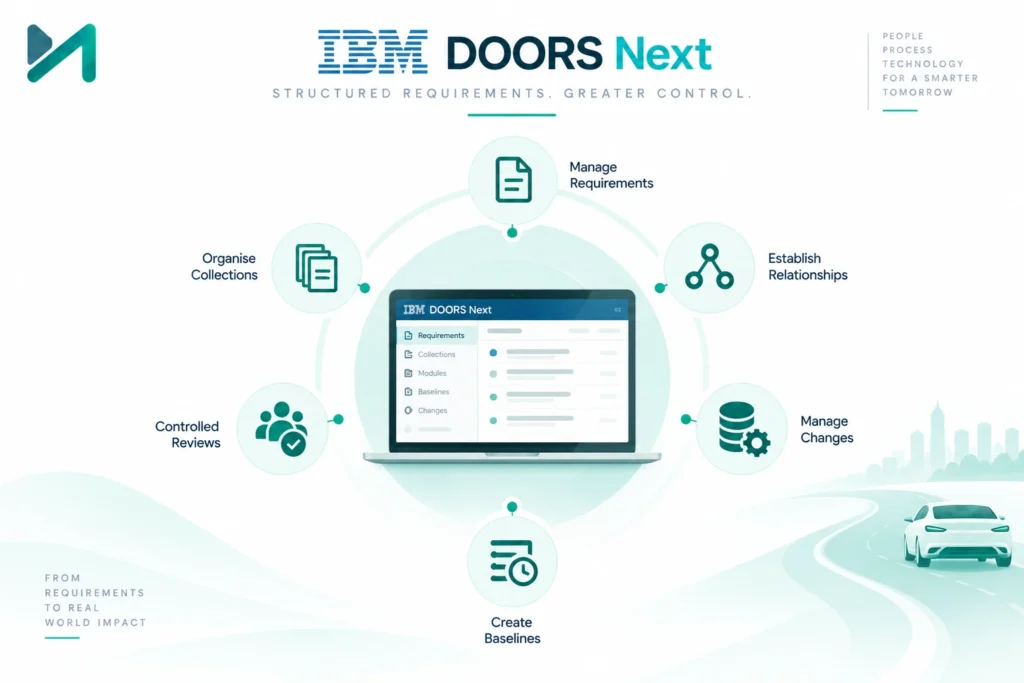
DOORS Next provides a structured environment for managing requirements and related artefacts. Teams can organise requirements into collections or modules, establish relationships, create baselines, and manage changes across project versions.
It can be suitable for organisations that prioritise:
- Formal requirements governance
- Controlled reviews and approvals
- Large requirements repositories
- Structured configuration management
- Integration with IBM engineering tools
PTC Codebeamer
Codebeamer provides configurable requirements structures, workflows, permissions, reviews, and traceability relationships. Its broader ALM approach allows requirements to be connected with risks, tests, issues, and development activities.
It can be suitable for organisations that need:
- Flexible requirements workflows
- Custom fields and item types
- Integrated risk and test management
- Configurable dashboards and reports
- Collaboration across engineering disciplines
For guidance on planning a structured process, refer to this requirements management guide for automotive and embedded software development.
Traceability and Impact Analysis
Traceability is essential in automotive development because organisations must demonstrate how requirements are implemented, verified, and maintained.
A traceability chain may connect:
Stakeholder requirements → System requirements → Software requirements → Architecture → Design → Code → Test cases → Test results
IBM DOORS Next
DOORS Next supports relationships between requirements and other engineering artefacts. When requirements change, teams can review related artefacts and assess potential impact. Its value is particularly relevant where organisations already use IBM tools for architecture, development, testing, and configuration management.
PTC Codebeamer
Codebeamer supports traceability across requirements, risks, tests, issues, and other lifecycle items. Its configurable relationship model can help teams create traceability views suited to specific projects, products, and compliance processes.
For more information, see Requirements Traceability for ASPICE Compliance.
Neither platform automatically creates compliance. Traceability quality depends on how requirements are structured, how relationships are maintained, and whether teams consistently follow the defined process.
ASPICE and Functional Safety Support
Automotive organisations often need to demonstrate alignment with frameworks and standards such as:
- Automotive SPICE
- ISO 26262
- ISO/SAE 21434
- Customer-specific development processes
- Internal quality and engineering procedures
Both IBM DOORS Next and PTC Codebeamer can support processes related to these expectations by helping teams maintain requirements, reviews, traceability, approvals, and verification evidence.
However, tool adoption alone does not guarantee compliance. Compliance also depends on:
- Process definition
- Roles and responsibilities
- Requirement quality
- Review discipline
- Traceability completeness
- Evidence management
- Verification and validation practices
- Audit readiness
The platform should therefore be evaluated against the organisation’s specific assessment model and project deliverables.
Product Variants and Configuration Management
Automotive products commonly include multiple variants based on:
- Vehicle model
- Market
- Hardware configuration
- Software version
- Optional features
- Customer requirements
- Regulatory requirements
A requirements tool should help teams reuse common requirements while identifying variant-specific differences.
IBM DOORS Next can support controlled versions, baselines, and configurations within the IBM engineering environment. This can help organisations manage evolving requirements and maintain historical project states.
Codebeamer provides configurable structures for product lines, variants, reusable requirements, and project-specific workflows. This can be useful when organisations need to manage multiple product configurations within a common lifecycle framework.
The appropriate choice depends on the complexity of the product line, the number of variants, the required governance model, and the existing toolchain.
Integration with Development and Testing Tools
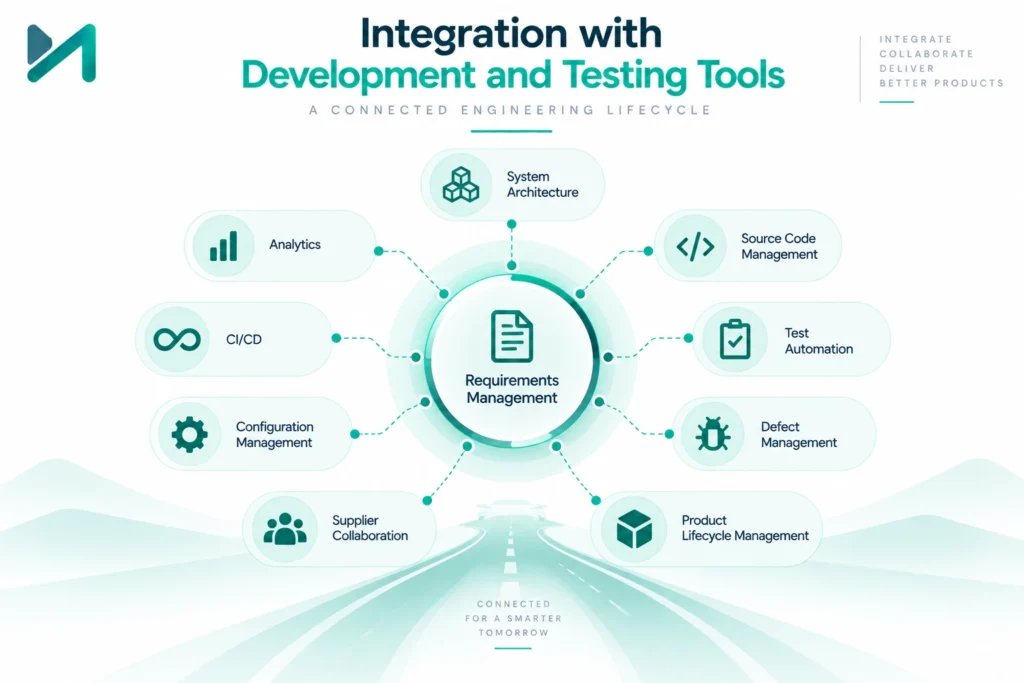
Requirements management becomes more valuable when it is connected to the rest of the engineering lifecycle.
Integration areas may include:
- System and software architecture
- Source code management
- Continuous integration and delivery
- Test automation
- Defect management
- Configuration management
- Product lifecycle management
- Reporting and analytics
- Supplier collaboration
IBM DOORS Next is particularly relevant when an organisation wants alignment with IBM Engineering Lifecycle Management tools.
Codebeamer can be considered when teams need configurable connections between requirements, testing, risks, development activities, and other enterprise systems. Integration options and implementation effort should be assessed for each specific toolchain.
Migration from IBM DOORS to Codebeamer
Some organisations evaluate Codebeamer as part of a modernisation initiative or a broader ALM transformation. Migration planning should cover more than the movement of requirement text.
Important migration considerations include:
Requirements and document structures
Attributes and custom fields
Requirement relationships
Baselines and historical versions
Reviews and approval records
Test cases and verification links
Risk and compliance information
User roles and permissions
Reports and dashboards
Integration dependencies
A migration should begin with a detailed inventory of existing data and processes. Teams should then define the target information model, map legacy artefacts, validate migrated relationships, and conduct user acceptance testing.
A phased migration may reduce disruption by starting with a pilot project before expanding to additional teams or product lines. ALM services can support organisations in assessing, planning, and implementing lifecycle management transformations.
Which Platform Should Automotive Organisations Consider?
The decision should be based on the organisation’s processes, toolchain, scale, and future requirements.
IBM DOORS Next may be suitable when:
- The organisation already uses IBM Engineering Lifecycle Management tools
- Requirements governance and controlled configuration are major priorities
- Teams manage complex engineering programmes
- Existing IBM integrations are important
- The organisation wants continuity with established IBM processes
PTC Codebeamer may be suitable when:
- The organisation needs configurable ALM workflows
- Requirements, risks, tests, and development activities should be connected
- Product variants and reusable structures are important
- Teams need flexible dashboards and reporting
- The organisation is modernising its ALM environment
The decision should be based on a structured evaluation rather than feature lists alone.
Automotive Requirements Management Evaluation Checklist
Before selecting or implementing a platform, assess the following areas:
- Does the tool support the organisation’s requirements structure?
- Can it maintain bidirectional traceability?
- Can teams manage changes and approvals?
- Does it support product variants and configurations?
- Can it connect requirements with risks and test cases?
- Does it integrate with the existing engineering toolchain?
- Can it support ASPICE and functional safety evidence needs?
- Are dashboards and reports configurable?
- Can suppliers and distributed teams collaborate effectively?
- What migration effort is required?
- What training and administration skills are needed?
- How will the platform scale across projects and business units?
A proof of concept using real project data can help validate usability, traceability, reporting, integration, and process fit.
How MicroGenesis Supports Automotive ALM Initiatives
MicroGenesis helps engineering organisations assess and implement lifecycle management solutions for requirements, development, testing, traceability, and compliance-related processes.
Support may include:
- Requirements management consulting
- IBM ELM implementation and optimisation
- PTC Codebeamer implementation
- ALM process assessment
- Requirements migration and modernisation
- Traceability and workflow configuration
- Tool integration
- Reporting and dashboard development
- User training and adoption support
- Managed ALM services
The objective is to align the selected platform with engineering processes, project governance, compliance expectations, and long-term scalability.
Conclusion
IBM DOORS Next and PTC Codebeamer can both support automotive requirements management, but they offer different approaches. IBM DOORS Next is closely aligned with structured requirements governance and the IBM engineering ecosystem. PTC Codebeamer provides a configurable ALM environment that connects requirements with risks, testing, workflows, and other lifecycle activities.
The right choice depends on the organisation’s existing tools, process maturity, product complexity, integration needs, migration plans, and compliance objectives. A practical evaluation using real requirements, traceability relationships, workflows, and reports can help teams identify the platform that best fits their engineering environment.
Frequently Asked Questions
Is IBM DOORS Next better than PTC Codebeamer for automotive requirements?
Neither platform is universally suitable for every organisation. IBM DOORS Next may fit organisations aligned with the IBM engineering ecosystem, while Codebeamer may fit organisations seeking configurable, integrated ALM workflows.
Can PTC Codebeamer support Automotive SPICE?
Codebeamer can support processes related to Automotive SPICE through requirements management, traceability, workflows, reviews, testing, and reporting. However, compliance depends on the organisation’s processes and implementation, not the tool alone.
Can IBM DOORS Next support ISO 26262 projects?
IBM DOORS Next can support requirements management and traceability activities used in functional safety projects. Organisations must still establish appropriate processes, reviews, verification activities, and evidence management.
Can requirements be migrated from IBM DOORS to Codebeamer?
Migration is possible, but the effort depends on data volume, document structures, attributes, relationships, baselines, integrations, and historical information. A detailed migration assessment and pilot are recommended.
What should automotive organisations evaluate before selecting an ALM tool?
Organisations should evaluate requirements management, traceability, change control, product variants, risk and test management, integrations, reporting, compliance evidence, scalability, migration effort, and user adoption.