

Automotive software development involves multiple engineering teams, complex system dependencies, and strict quality expectations. Requirements may begin as customer needs, safety objectives, system specifications, or supplier inputs. They are then transformed into software requirements, architecture, code, test cases, and release evidence.
The challenge is ensuring that these relationships remain visible and controlled throughout the development lifecycle.
This is where requirements traceability for ASPICE compliance becomes essential. Traceability helps automotive organisations demonstrate that requirements are properly analysed, implemented, verified, and managed when changes occur.
However, traceability is more than linking two documents. Effective traceability creates a reliable connection between product intent, engineering decisions, implementation, verification, and compliance evidence.
For a broader understanding of how requirements are managed across automotive and embedded software projects, explore this requirements management guide for automotive and embedded software development.
What Is Requirements Traceability?
Requirements traceability is the ability to establish and maintain relationships between requirements and related engineering artefacts throughout the product lifecycle.
These artefacts may include:
- Stakeholder requirements
- System requirements
- Software requirements
- Architecture specifications
- Design elements
- Source code
- Test specifications
- Test cases
- Test results
- Defects
- Risks and hazards
- Change requests
- Release baselines
A typical traceability chain may look like this:
Stakeholder need → System requirement → Software requirement → Architecture → Code → Test case → Test result → Release
This chain helps answer important engineering questions:
Where did this requirement originate?
Which system or software component implements it?
Which test verifies it?
Has the requirement been approved?
What happens if it changes?
Which defects are related to it?
Is it included in the current release?
Can the organisation provide evidence of verification?
For automotive teams, these answers are important for both engineering quality and assessment readiness.
Why Requirements Traceability Matters for Automotive SPICE
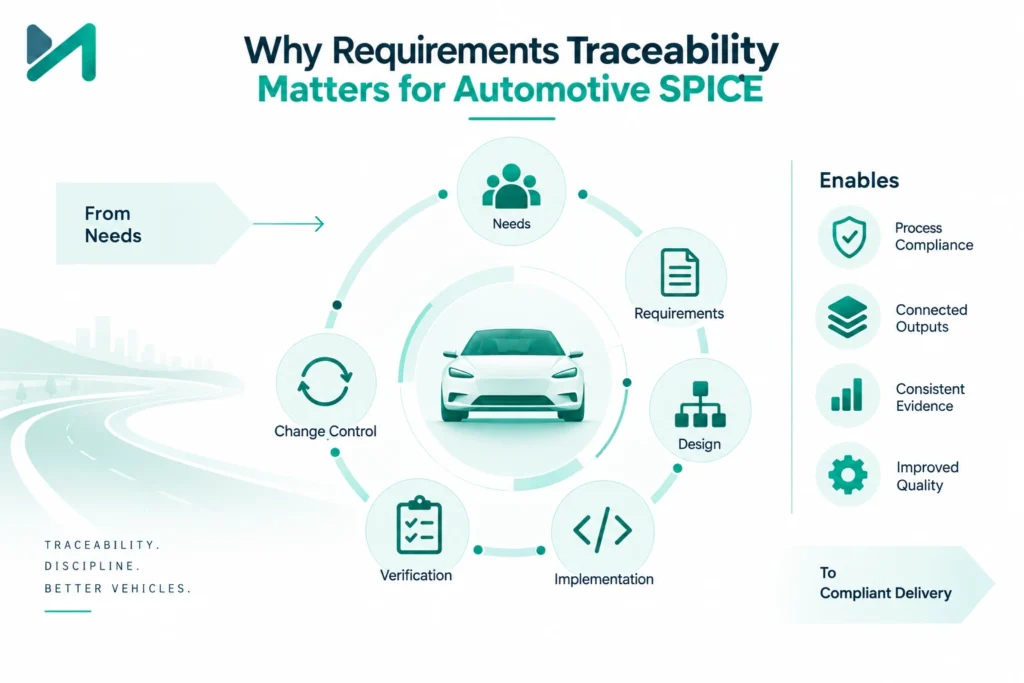
Automotive SPICE, commonly referred to as ASPICE, provides a process assessment framework used to evaluate the capability and consistency of automotive software and systems development processes.
ASPICE does not simply assess whether a team has written requirements. It considers whether engineering activities are planned, performed, controlled, and supported by appropriate work products and evidence.
Requirements traceability supports this by showing that engineering outputs are connected and consistent.
For example, a software requirement should not exist as an isolated statement. It should be connected to the relevant system requirement, design or architecture element, implementation activity, and verification evidence.
Traceability helps demonstrate that:
Requirements were derived from defined needs.
Requirements were analysed and reviewed.
Requirements were allocated to the appropriate engineering level.
Requirements were implemented.
Requirements were verified.
Changes were assessed and controlled.
Engineering outputs remain consistent with one another.
A requirements management tool can support these activities, but using a tool alone does not guarantee ASPICE compliance. Compliance depends on the organisation’s processes, responsibilities, execution, and evidence.
Forward and Backward Traceability
Effective traceability should work in both directions.
Forward Traceability
Forward traceability follows a requirement toward implementation and verification.
For example:
System requirement → Software requirement → Design → Code → Test case → Test result
It helps answer:
Has this requirement been implemented and verified?
Forward traceability can identify requirements that have:
- No allocated software requirement
- No design relationship
- No implementation evidence
- No linked test case
- No completed verification result
Backward Traceability
Backward traceability follows an engineering artefact back to its source requirement.
For example:
Test case → Software requirement → System requirement → Stakeholder need
It helps answer:
Why does this design element, code component, or test case exist?
Backward traceability can identify:
- Code without a valid requirement
- Test cases that do not verify an approved requirement
- Design elements with no documented purpose
- Requirements that were implemented without a clear source
- Unnecessary or outdated engineering work
Both directions are necessary for a complete traceability model.
What Should Be Traced in an ASPICE-Oriented Project?
The exact traceability model depends on the project, development lifecycle, and organisational processes. However, automotive software projects commonly establish relationships between the following artefacts.
Stakeholder Requirements and System Requirements
Stakeholder expectations should be translated into system-level requirements. Traceability ensures that system requirements remain connected to the original product intent.
System Requirements and Software Requirements
When system behaviour is allocated to software, the relationship should be documented. This helps software teams understand what the system expects and why each software requirement exists.
Software Requirements and Architecture
Software requirements should connect to the architecture or design elements responsible for implementing them.
Requirements and Source Code
Where practical, requirements should be connected to implementation work items, software components, or code-related records. The level of linkage depends on the toolchain and development process.
Requirements and Test Cases
Each verifiable requirement should have one or more corresponding test cases or verification activities.
Test Cases and Test Results
Traceability should extend beyond test case creation. Teams should be able to determine whether the relevant test was executed and whether it passed or failed.
Requirements and Defects
Defects should be linked to the requirements they affect. This helps teams understand the impact of a defect and identify whether other related functions may also be affected.
Requirements and Changes
Change requests should identify the requirements being modified and the engineering artefacts affected by the change.
A Practical Requirements Traceability Example
Consider an automotive battery management system.
A stakeholder requirement may state:
The battery management system shall protect the battery from operating outside the defined temperature range.
This requirement may be decomposed into several system and software requirements.
System Requirement
The system shall detect when battery temperature exceeds the defined safe operating threshold.
Software Requirement
The battery monitoring software shall compare the measured temperature against the configured threshold at the specified sampling interval.
Software Behaviour
The software may then:
- Read temperature sensor data
- Validate the sensor signal
- Compare the value against the threshold
- Generate a warning or protection request
- Record a diagnostic event
Verification Requirement
The software shall generate the defined protection request when the measured battery temperature exceeds the configured threshold.
Test Case
The test team creates a test case that simulates temperature values above the threshold and verifies the expected system response.
The resulting traceability chain may be:
Battery protection need → System requirement → Software requirement → Monitoring component → Test case → Test result
If the temperature threshold changes, the team can use this chain to identify affected software logic, configuration data, safety analysis, and test cases.
Common Traceability Gaps in Automotive Projects
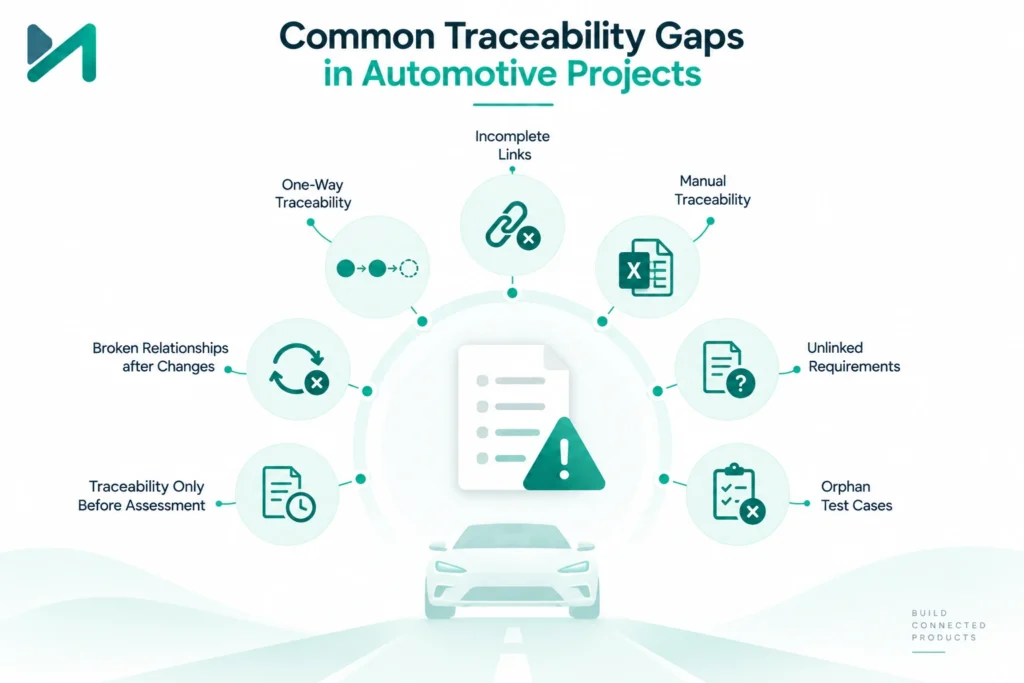
Many organisations believe they have traceability because they maintain requirement documents or test spreadsheets. However, several common gaps can reduce its effectiveness.
One-Way Traceability
Some teams link requirements to test cases but do not connect them to architecture, design, or implementation.
This makes it difficult to understand how requirements are realised.
Incomplete Links
A requirement may have a linked test case, but the test case may not have an execution result. This creates the appearance of coverage without proving verification.
Manual Traceability
When traceability is maintained manually in spreadsheets, links can become outdated when requirements, test cases, or software components change.
Unlinked Requirements
Requirements may exist without a clear source, owner, implementation relationship, or verification activity.
Orphan Test Cases
A test case may exist without a corresponding requirement. This can indicate unnecessary testing or missing requirements.
Broken Relationships After Changes
When requirements are updated or replaced, related design and test links may not be reviewed. This can leave the project with outdated or misleading traceability.
Traceability Created Only Before an Assessment
If links are created just before an ASPICE assessment, they may be incomplete, inconsistent, or difficult to validate.
Traceability should be maintained as part of daily engineering work.
Best Practices for Requirements Traceability
Establish a Defined Traceability Model
Before configuring a tool, decide which relationships are required. For example:
- Stakeholder requirement to system requirement
- System requirement to software requirement
- Software requirement to architecture
- Requirement to test case
- Test case to test result
- Requirement to defect
- Requirement to change request
The model should be practical and aligned with project needs.
Use Unique Requirement Identifiers
Each requirement should have a stable identifier that remains consistent across reviews, baselines, reports, and related artefacts.
Identifiers should not depend only on document position because moving a requirement between sections can create confusion.
Define Traceability Ownership
Assign responsibility for maintaining relationships. Depending on the organisation, ownership may involve system engineers, software engineers, test engineers, quality teams, or configuration managers.
Link Requirements at the Right Level
Traceability should be meaningful rather than excessive. Not every requirement needs to be linked to every line of code.
The level of detail should support understanding, verification, change impact analysis, and compliance evidence.
Maintain Traceability Throughout Development
Traceability should be updated when requirements are created, modified, allocated, implemented, tested, or released.
It should not be treated as a separate documentation task performed at the end of the project.
Use Baselines
Baselines provide a controlled reference for requirements and related engineering artefacts. They help teams determine which version of a requirement was used for a specific release or assessment.
Perform Regular Gap Analysis
Teams should periodically identify:
- Requirements without downstream links
- Requirements without test coverage
- Test cases without requirements
- Failed tests without linked defects
- Changed requirements without impact analysis
- Unapproved requirements included in development
- Outdated or broken traceability links
Integrate Traceability with Change Management
Every significant change should trigger an impact analysis. The team should identify affected requirements, architecture elements, implementation activities, test cases, risks, and releases.
Requirements Traceability Tools and ALM Platforms
Managing traceability manually becomes increasingly difficult as projects grow. A dedicated requirements management or ALM platform can help organisations maintain relationships across engineering artefacts.
Important capabilities include:
- Structured requirements repositories
- Version control
- Baseline management
- Review and approval workflows
- Bidirectional traceability
- Change impact analysis
- Test management integration
- Defect management integration
- Reporting and dashboards
- Audit trails
- Role-based access control
- Configuration and variant management
Organisations looking to improve traceability across requirements, development, testing, and release management can evaluate ALM services to establish a connected and controlled engineering lifecycle.
IBM Engineering Lifecycle Management
IBM Engineering Lifecycle Management supports requirements, development, testing, and lifecycle governance within a connected environment.
IBM Engineering Requirements Management DOORS Next provides capabilities for requirements organisation, traceability, reviews, baselines, and relationships with other engineering artefacts.
For automotive organisations, IBM ELM can help connect requirements with development and verification activities while improving visibility into changes, coverage, and lifecycle status.
MicroGenesis supports organisations looking to strengthen requirements governance and lifecycle integration through IBM Engineering Lifecycle Management services.
How MicroGenesis Supports Requirements Traceability
MicroGenesis helps automotive and embedded engineering organisations improve requirements management, traceability, and lifecycle integration.
Its approach focuses on connecting requirements with the engineering processes and tools used for development, testing, change management, and compliance-oriented governance.
Requirements Process Assessment
MicroGenesis can help organisations assess their current requirements process and identify gaps such as:
- Incomplete traceability
- Manual approval processes
- Uncontrolled requirement changes
- Disconnected test evidence
- Duplicate or outdated requirements
- Limited visibility into verification status
- Inconsistent processes across teams or suppliers
Traceability and ALM Implementation
Through its automotive ALM services, MicroGenesis can support organisations in establishing structured workflows for:
- Requirements definition
- Requirement reviews
- Approval and baselining
- Traceability management
- Change control
- Impact analysis
- Development and test integration
- Defect and release tracking
- Compliance reporting
IBM ELM Support
For teams using IBM Engineering Lifecycle Management, MicroGenesis can support requirements structure design, traceability setup, workflow configuration, integration, migration, reporting, and user adoption.
The objective is not simply to create links between artefacts. It is to establish a traceability process that engineering teams can maintain consistently throughout the lifecycle.
Organisations evaluating IBM ELM adoption, migration, integration, or process improvement can explore IBM ELM consulting and implementation services.
Compliance-Oriented Engineering Visibility
A connected requirements environment can help organisations demonstrate relationships between requirements, implementation, testing, and changes.
This supports more reliable engineering evidence for ASPICE-related assessments and other compliance-oriented activities.
If your organisation is preparing for an ASPICE assessment or experiencing traceability gaps across requirements, development, and testing, MicroGenesis can help define a practical improvement roadmap.
Metrics for Measuring Traceability Effectiveness
Traceability should be measured using meaningful indicators rather than the number of links created.
Useful metrics include:
Requirements Traceability Coverage
The percentage of requirements linked to the expected upstream and downstream artefacts.
Verification Coverage
The percentage of requirements connected to test cases and completed verification results.
Orphan Requirements
Requirements that have no valid source, implementation relationship, or verification evidence.
Orphan Test Cases
Test cases that are not linked to an approved requirement.
Requirements with Unresolved Changes
Requirements that have been modified but have not completed impact analysis, review, or approval.
Defect-to-Requirement Linkage
The percentage of relevant defects connected to the requirements they affect.
Traceability Maintenance Time
The effort required to update and validate relationships after changes.
These metrics should be used to identify process weaknesses and improve engineering quality, not merely to produce assessment reports.
Conclusion
Requirements traceability is a critical capability for automotive software development and ASPICE-oriented engineering. It connects stakeholder expectations with system requirements, software implementation, architecture, testing, defects, changes, and release evidence.
Effective traceability helps teams:
- Demonstrate that requirements are implemented and verified
- Identify gaps before release
- Understand the impact of changes
- Improve collaboration across engineering teams
- Support compliance assessments
- Reduce rework and late-stage defects
- Maintain consistency across product variants and suppliers
The most effective approach combines clear requirements, a defined traceability model, disciplined processes, appropriate ownership, integrated tools, and continuous maintenance.
For a broader implementation roadmap, explore this requirements management guide for automotive and embedded software development.
If your automotive or embedded engineering organisation needs to improve traceability, strengthen ASPICE readiness, or connect requirements with development and testing, explore MicroGenesis ALM services or discuss your requirements lifecycle with its IBM Engineering Lifecycle Management team.
Strengthen Requirements Traceability Across Your Automotive Development Lifecycle
Are disconnected requirements, incomplete traceability links, and manual compliance reporting creating challenges for your automotive engineering teams?
MicroGenesis helps automotive and embedded software organisations establish a structured requirements management and traceability process that connects stakeholder needs, system and software requirements, architecture, development, testing, defects, and release evidence.
Whether you are preparing for an ASPICE assessment, improving requirements governance, or implementing an integrated ALM environment, our experts can help you:
- Assess and improve your existing requirements processes
- Establish bidirectional traceability across engineering artefacts
- Configure workflows, reviews, baselines, and change management
- Connect requirements with development and testing activities
- Improve visibility into verification coverage and compliance evidence
- Implement or optimise IBM Engineering Lifecycle Management
Explore our ALM services or learn how our IBM Engineering Lifecycle Management services can support your requirements lifecycle.
Ready to improve requirements traceability and strengthen ASPICE readiness? Contact MicroGenesis to discuss your engineering requirements and implementation goals.