
How much does Salesforce implementation cost?
It is one of the first questions businesses ask when planning a new CRM implementation. And it is an important one because Salesforce investment goes beyond purchasing software licenses.
You also need to consider how the platform will be configured, whether existing customer data needs to be migrated, which business applications must be integrated, and how employees will be trained.
For example, a company implementing Salesforce for a small sales team may only need standard CRM configuration, basic data migration, and user training.
An enterprise operating across multiple locations may require complex approval workflows, ERP integrations, large-scale data migration, and ongoing administration.
Both organizations are implementing Salesforce, but their project costs will be very different.
Understanding the factors that influence Salesforce implementation cost helps businesses prepare realistic budgets, compare consulting proposals, and avoid unexpected expenses.
This guide explains Salesforce implementation pricing models, major cost drivers, hidden expenses, and how to estimate your investment before starting a project.
How Much Does Salesforce Implementation Cost?
Salesforce implementation costs vary depending on business requirements, project complexity, and the services included.
There is no single implementation price that applies to every organization.
A basic Salesforce deployment with limited configuration and a small number of users generally requires less implementation effort than an enterprise project involving several Salesforce products, custom development, and multiple integrations.
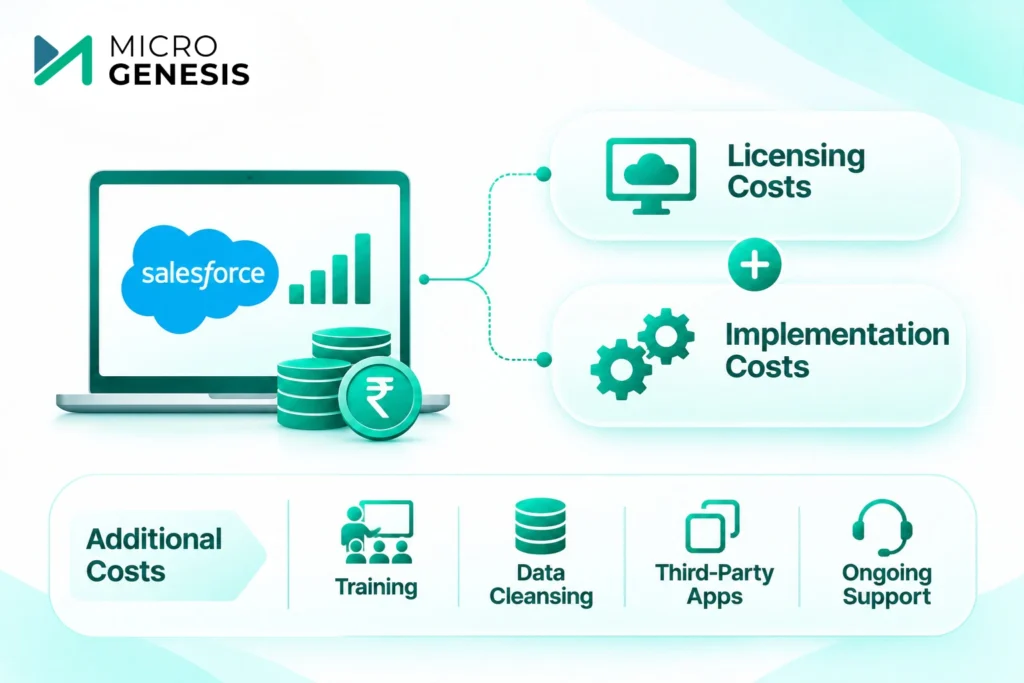
The total investment usually includes two separate components:
1. Salesforce licensing costs: Subscription fees for the Salesforce products, editions, and users your organization requires.
2. Salesforce implementation costs: Professional services required to plan, configure, customize, integrate, test, and deploy the platform.
Additional expenses may include training, data cleansing, third-party applications, and ongoing support.
The most reliable way to estimate costs is to define your implementation scope before requesting a proposal.
Our Salesforce Implementation Services Guide for Enterprise Businesses explains the activities involved in a complete implementation.
Salesforce Implementation Cost Breakdown
A Salesforce implementation project typically involves several activities.
Understanding how each contributes to the overall investment makes it easier to evaluate consulting proposals.
| Cost component | What it includes | Main cost drivers |
|---|---|---|
| Discovery and planning | Requirements gathering, process assessment, implementation roadmap | Number of departments and process complexity |
| Architecture and design | Data model, security, workflows, integration planning | Technical requirements and application landscape |
| Configuration | Standard Salesforce setup, objects, fields, workflows | Number and complexity of business processes |
| Custom development | Custom functionality, automation, application components | Development and testing effort |
| Data migration | Data cleansing, mapping, migration and validation | Data volume, quality and source systems |
| Integration | Connecting Salesforce with ERP and other applications | Number of systems and integration complexity |
| Testing and deployment | Functional testing, integration testing, UAT and go-live | Scope and business-critical requirements |
| Training and adoption | User training, documentation and change support | User groups and organizational changes |
| Ongoing support | Administration, maintenance and enhancements | Support scope and service expectations |
These activities may overlap during delivery, but each should be considered when preparing the budget.
7 Factors That Influence Salesforce Implementation Pricing
1. Number of Salesforce Users and Products
The number of users affects licensing costs and can influence training, access configuration, and support requirements.
However, implementation costs do not necessarily increase in direct proportion to user count.
For example, configuring Salesforce for 100 users who follow the same sales process may be less complex than implementing it for 30 users across several departments with different workflows.
The Salesforce products selected also matter.
An organization implementing Sales Cloud alone will have different requirements from one implementing Sales Cloud, Service Cloud, and Experience Cloud.
2. Business Process Complexity
Every organization has its own sales, service, and approval processes.
Some can be supported through standard Salesforce configuration.
Others require additional automation, custom objects, or specialized workflows.
Consider an engineering company managing opportunities that involve technical evaluations, quotations, multiple approvals, and contract negotiations.
Its implementation may require more detailed process design than a business with a straightforward sales cycle.
The more complex the requirements, the greater the potential configuration, testing, and implementation effort.
3. Salesforce Customization Requirements
Salesforce provides extensive standard functionality, but organizations sometimes require custom development.
Customization costs depend on the complexity of the functionality being developed.
Examples include:
Custom objects and data relationships.
Specialized approval workflows.
Advanced Salesforce Flow automation.
Custom interfaces using Lightning Web Components.
Apex development for requirements not adequately addressed through configuration.
A useful principle is to evaluate standard Salesforce capabilities before introducing custom code.
Unnecessary customization can increase initial development costs and future maintenance effort.
4. Data Migration Complexity
Data migration costs depend on the quality, structure, and volume of existing information.
For example, migrating clean customer records from a single CRM is generally simpler than consolidating data from several legacy applications.
Complex migration projects may require duplicate removal, field mapping, historical data handling, trial migrations, and extensive validation.
Poor data quality can significantly increase preparation effort.
5. Enterprise Application Integrations
Integrating Salesforce with existing systems can be a major cost driver.
Common integration requirements include ERP, finance, marketing, customer support, and internal business applications.
Costs depend on:
Number of systems being connected.
Availability and capabilities of APIs.
Data mapping requirements.
Synchronization frequency.
Security requirements.
Error handling and monitoring.
Testing complexity.
For example, integrating Salesforce with an ERP system to exchange customer and order information requires agreement on data ownership and business rules, not just a technical connection.
Planning a Salesforce implementation with enterprise integrations? Discuss your requirements with MicroGenesis to evaluate the implementation scope and technical dependencies.
6. Testing, Deployment and User Training
Testing is essential for confirming that Salesforce supports actual business operations.
A project involving several integrations and critical business workflows may require more extensive testing than a basic CRM deployment.
Training costs also depend on the number of user groups and the level of process change.
For example, sales representatives, service agents, and administrators may each require different training.
7. Ongoing Administration and Support
Salesforce costs do not end at go-live.
Organizations may require support for user administration, workflow changes, integration monitoring, release testing, and future enhancements.
These activities should be considered when estimating the total cost of ownership.
Salesforce Implementation Cost for Small Businesses vs Enterprises
Business size influences implementation requirements, but it is not the only factor.
| Consideration | Small business | Enterprise |
|---|---|---|
| CRM scope | Often focused on core sales processes | May cover several departments |
| Customization | Frequently limited | Can involve complex workflows |
| Data migration | May involve spreadsheets or one CRM | Often includes multiple systems |
| Integration | Limited or standard integrations | Multiple enterprise applications |
| Security | Relatively straightforward roles | Complex access and governance |
| Deployment | Often a single rollout | May require phased deployment |
| Training | Smaller user groups | Multiple teams and locations |
A small business with complex integrations may still require significant implementation effort.
Similarly, an enterprise using mostly standard functionality may be able to control costs through a carefully defined scope.
The most useful cost estimate is therefore based on requirements rather than company size alone.
Salesforce Implementation Cost Per User: Is It a Useful Metric?
Businesses sometimes try to estimate implementation costs by multiplying the number of Salesforce users by a fixed amount.
This can be misleading.
Salesforce licensing is commonly priced by user or another applicable licensing metric, but implementation services are generally driven by the work required.
For example, two organizations may each have 50 Salesforce users.
One needs standard opportunity management and basic reporting.
The other requires ERP integration, custom approval processes, complex permissions, and migration from multiple legacy systems.
Their implementation costs could differ substantially despite having the same user count.
For budgeting purposes, separate license expenses from implementation effort.
Salesforce Implementation Pricing Models
Salesforce consulting providers commonly offer different engagement models.
Understanding these models helps organizations select an approach suited to their project.
Fixed-Price Implementation
A fixed-price model establishes an agreed fee for a defined scope.
It can work well when requirements, deliverables, assumptions, and acceptance criteria are clear.
However, additional requirements may require formal change requests.
Time and Materials
Under a time-and-materials model, the organization pays for the actual consulting or development effort used, based on agreed rates.
This can provide flexibility when requirements are evolving.
However, costs need to be monitored through regular reviews and budget controls.
Dedicated Team or Retainer Model
Some organizations require ongoing Salesforce development, administration, or enhancement support.
A dedicated team or retainer arrangement may be appropriate for continuing work.
The commercial structure depends on team composition, capacity, service scope, and contract terms.
Fixed Price vs Time and Materials for Salesforce
| Factor | Fixed price | Time and materials |
|---|---|---|
| Best suited for | Clearly defined projects | Evolving requirements |
| Budget predictability | Higher for agreed scope | Depends on effort consumed |
| Flexibility | Changes require scope review | More flexible |
| Project governance | Deliverable and milestone focused | Effort and priority focused |
| Main risk | Unclear scope and change requests | Uncontrolled effort or priorities |
Neither model is automatically better.
The right choice depends on how well the requirements are understood and how much flexibility the organization needs.
Salesforce Consulting Rates: What Determines the Hourly Cost?
Salesforce consulting rates vary based on the consultant’s experience, specialization, geographic location, and engagement model.
A Salesforce administrator, developer, integration specialist, and solution architect may have different rates because their responsibilities require different skills.
Factors influencing consulting rates include:
Technical specialization and relevant certifications.
Experience with enterprise implementations.
Complexity of the assigned work.
Delivery location and team structure.
Project duration and resource commitment.
Support expectations and service levels.
Rather than comparing hourly rates alone, evaluate the expected effort and deliverables.
A lower hourly rate does not necessarily produce a lower total project cost if the work requires substantially more time.
Hidden Costs of Salesforce Implementation
Some implementation expenses are overlooked during initial budgeting.
These costs may not appear until the project is underway.
Data Cleansing and Preparation
Legacy data may require more correction and standardization than expected.
Third-Party Applications
Certain business requirements may involve additional AppExchange products or other licensed software.
Integration Maintenance
Connections between Salesforce and external systems may require monitoring and updates when applications change.
Additional Customization
Requirements discovered after development begins may increase implementation effort.
Training and Change Management
Employees may require additional training, documentation, and support during adoption.
Post-Go-Live Improvements
Organizations often identify workflow or reporting enhancements after users begin working with Salesforce.
To reduce unexpected expenses, review assumptions, exclusions, and responsibilities before approving the implementation proposal.
Salesforce Implementation Cost vs HubSpot
Businesses comparing CRM platforms often evaluate Salesforce and HubSpot.
However, comparing subscription prices alone does not provide a complete picture.
Both platforms offer different product packages, capabilities, and pricing structures.
The appropriate choice depends on business requirements.
| Evaluation area | Salesforce | HubSpot |
|---|---|---|
| CRM configuration | Extensive configuration capabilities | Configuration varies by product and tier |
| Custom development | Supports platform development and customization | Customization depends on available features and tiers |
| Enterprise integration | Broad integration capabilities | Integration capabilities vary by plan and requirements |
| Implementation effort | Depends on complexity and scope | Depends on complexity and scope |
| Licensing | Product, edition and usage dependent | Hub, tier, seat and usage dependent |
| Ongoing administration | Depends on configuration and operating model | Depends on configuration and operating model |
For a small organization with relatively straightforward CRM needs, the implementation effort may differ from that of an enterprise requiring complex workflows and integrations.
The right comparison should consider licensing, implementation, integration, training, and ongoing support over the same period.
Avoid assuming one platform will always be cheaper.
How to Estimate Your Salesforce Implementation Budget
Before requesting Salesforce implementation pricing, prepare a basic requirements summary.
A practical estimate should account for the following.
| Budget input | Information to prepare |
|---|---|
| Salesforce products | Sales Cloud, Service Cloud, Experience Cloud or others |
| Users | Expected users and roles |
| Business processes | Workflows and approvals required |
| Existing systems | CRM, ERP and other connected applications |
| Data migration | Sources, volume and quality |
| Customization | Required non-standard functionality |
| Deployment | Timeline and rollout approach |
| Training | User groups and enablement requirements |
| Support | Post-go-live responsibilities |
A simple planning formula is:
Estimated first-year investment = Salesforce licensing + implementation services + integration and migration expenses + training + ongoing support + contingency
This is a budgeting framework, not a fixed Salesforce pricing formula. Avoid double-counting activities already included in an implementation proposal.
A reliable estimate requires reviewing actual business and technical requirements.
Our Salesforce Implementation Checklist for Enterprise Businesses can help you prepare before requesting a proposal.
Need a Salesforce implementation cost estimate? Schedule a consultation with MicroGenesis to discuss your scope, integrations, migration requirements, and budget considerations.
How to Control Salesforce Implementation Costs
Reducing implementation costs should not mean eliminating essential planning or testing activities.
Instead, focus on controlling unnecessary complexity and avoiding rework.
Prioritize essential requirements. Implement business-critical functionality first and plan optional enhancements separately.
Use standard Salesforce capabilities where appropriate. Avoid custom development when configuration can meet the requirement.
Assess data quality early. Data preparation can reduce migration-related issues.
Plan integrations before development. Identify dependencies and technical constraints.
Establish change control. Evaluate the cost and schedule impact of new requirements.
Involve business users. Early feedback can prevent expensive workflow changes after deployment.
Define post-go-live ownership. Clarify who will administer and maintain Salesforce.
Our article on seven common Salesforce implementation challenges explains how organizations can avoid issues that often lead to additional costs.
Why the Right Salesforce Implementation Partner Matters
An implementation partner influences more than the initial project price.
The partner’s ability to understand business requirements, design integrations, manage migration, and support user adoption can affect the overall investment.
When comparing providers, consider relevant Salesforce expertise, project methodology, enterprise integration capabilities, and post-implementation support.
MicroGenesis approaches Salesforce consulting with broader enterprise engineering, application integration, and managed services capabilities.
Our focus is on understanding how Salesforce fits into the organization’s existing technology environment and business processes.
For guidance on evaluating providers, read our article on how to choose the right Salesforce implementation partner.
You should also consider user adoption costs. Our guide to Salesforce implementation mistakes that affect user adoption explains why training and workflow design should be part of implementation planning.
Frequently Asked Questions About Salesforce Implementation Cost
How much does Salesforce implementation cost?
The cost depends on project scope, configuration requirements, integrations, data migration, testing, and training. A reliable estimate requires reviewing the organization’s specific requirements.
Is Salesforce implementation cost calculated per user?
Not usually. Salesforce licensing may be priced per user or according to other applicable metrics, while implementation services are typically estimated based on project effort and complexity.
What is the biggest Salesforce implementation cost factor?
There is no single factor for every project. Complex integrations, custom development, extensive data migration, and changing requirements can significantly influence costs.
Is fixed-price Salesforce implementation better than time and materials?
Fixed pricing can work well for clearly defined requirements. Time and materials may be more appropriate when scope is evolving. The best model depends on project uncertainty and governance needs.
Can Salesforce implementation costs be reduced?
Yes. Clear requirements, phased implementation, standard configuration, early data assessment, and controlled changes can help reduce unnecessary effort and rework.
Are Salesforce licenses included in consulting fees?
Not necessarily. Licensing and professional services are often priced separately. Confirm what is included in the proposal.
Final Thoughts
Salesforce implementation cost is determined by more than the number of users or the CRM products selected.
Business process complexity, customization, data migration, integrations, testing, training, and ongoing support all influence the total investment.
Organizations should evaluate these factors before comparing consulting proposals.
A clear implementation scope, realistic budget, and appropriate delivery model can help control costs while protecting the quality of the final solution.
Get a Salesforce Implementation Estimate
Are you planning a new Salesforce implementation, replacing an existing CRM, or expanding Salesforce across your enterprise?
MicroGenesis can help you evaluate implementation requirements, integration complexity, data migration needs, and project priorities.
Request a Salesforce Implementation Consultation to discuss your project and obtain a scope-based estimate.