
Modern enterprises are under constant pressure to deliver software faster without compromising quality, security, or compliance. Customers expect continuous innovation, business leaders demand faster time-to-market, and engineering teams must support increasingly complex cloud-native applications across distributed environments.
To meet these expectations, organizations are embracing Enterprise DevOps.
However, implementing Enterprise DevOps isn’t simply about adopting Jenkins, GitLab, Kubernetes, or Azure DevOps. Many organizations mistakenly believe that purchasing new tools automatically creates a DevOps culture. In reality, Enterprise DevOps is a business transformation that combines people, processes, technology, automation, governance, and continuous improvement.
According to the 2024 State of DevOps Report, organizations with mature DevOps practices deploy software more frequently, recover from failures faster, and achieve significantly better operational performance than organizations relying on traditional software delivery methods.
Yet enterprise implementations often fail because organizations underestimate the cultural and operational changes required.
In this guide, we’ll explore how to successfully implement Enterprise DevOps, avoid common pitfalls, and build a scalable software delivery platform that supports long-term business growth.
What Is Enterprise DevOps?
DevOps is a methodology that combines software development (Dev) and IT operations (Ops) to enable faster, more reliable software delivery through automation, collaboration, and continuous feedback.
Enterprise DevOps extends these principles across multiple business units, hundreds of applications, distributed engineering teams, and complex governance requirements.
Unlike small-scale DevOps implementations, Enterprise DevOps focuses on organizational transformation rather than isolated engineering improvements.
Traditional DevOps vs Enterprise DevOps
| Traditional DevOps | Enterprise DevOps |
| Small engineering teams | Thousands of developers across global teams |
| Single application | Hundreds of business-critical applications |
| Basic CI/CD pipelines | Enterprise-wide automated delivery platforms |
| Limited governance | Strong security, compliance, and audit controls |
| Simple deployments | Multi-cloud, hybrid cloud, and on-premises environments |
| Individual tool ownership | Standardized enterprise toolchain |
Enterprise DevOps creates a consistent operating model that enables organizations to deliver software at scale while maintaining governance, compliance, and operational excellence.
Why Enterprise DevOps Matters
Today’s enterprises face several software delivery challenges:
- Increasing application complexity
- Multi-cloud environments
- Security threats
- Regulatory compliance
- Growing customer expectations
- Distributed engineering teams
- Legacy applications
- Faster release cycles
Traditional development models struggle to address these challenges because they rely on manual processes, isolated teams, and infrequent software releases.
Enterprise DevOps addresses these issues by creating an integrated software delivery ecosystem where development, operations, security, and business teams collaborate continuously.
Organizations implementing mature DevOps practices typically experience:
- Faster release cycles
- Improved software quality
- Higher deployment frequency
- Reduced operational costs
- Better customer experiences
- Improved developer productivity
- Faster recovery from production incidents
Businesses beginning their transformation should first understand why DevOps is essential for enterprise business success and how it enables digital transformation.
Why Enterprise DevOps Implementations Fail
Many organizations invest in modern DevOps tools but fail to achieve the expected business outcomes.
The reason is simple:
They focus on technology before transformation.
Some of the most common reasons Enterprise DevOps initiatives struggle include:
1. Legacy Systems
Older applications were never designed for continuous delivery.
These systems often require manual deployments, making automation difficult.
2. Organizational Silos
Development, Operations, QA, Security, and Infrastructure teams often work independently.
This creates:
- Communication gaps
- Delayed feedback
- Slow approvals
- Longer release cycles
Breaking down these silos is one of the first priorities of Enterprise DevOps.
3. Lack of Automation
Many organizations automate builds but continue performing:
- Manual testing
- Manual deployments
- Manual infrastructure provisioning
- Manual approvals
Partial automation limits the benefits of DevOps.
Organizations looking to increase efficiency should adopt proven DevOps automation best practices to eliminate repetitive manual tasks.
4. Weak DevOps Culture
Technology alone cannot transform software delivery.
Enterprise DevOps requires:
- Shared ownership
- Continuous learning
- Cross-functional collaboration
- Leadership support
- Continuous improvement
Organizations that prioritize culture consistently outperform those that focus only on tooling.
Building a collaborative engineering culture is essential for long-term success. Explore these best practices for building a strong DevOps culture to accelerate organizational transformation.
5. Tool Sprawl
Enterprise engineering teams often use dozens of disconnected tools.
Examples include:
- GitHub
- GitLab
- Azure DevOps
- Jenkins
- Jira
- Kubernetes
- Terraform
- SonarQube
- Artifactory
Without integration, these tools create fragmented workflows and reduce visibility.
Selecting the right CI/CD tools for your DevOps team is critical to building a scalable and integrated software delivery platform.
Enterprise DevOps Maturity Model
Successful organizations don’t become DevOps leaders overnight.
Enterprise DevOps typically evolves through several maturity stages.
| Maturity Level | Characteristics |
| Level 1 – Manual | Manual builds, deployments, and testing |
| Level 2 – Continuous Integration | Automated builds and source code management |
| Level 3 – Continuous Delivery | Automated testing, deployment pipelines, Infrastructure as Code |
| Level 4 – DevSecOps | Security integrated throughout the software delivery lifecycle |
| Level 5 – Platform Engineering | Self-service platforms, AI-driven automation, continuous optimization |
Understanding your current maturity level helps define realistic implementation goals.
Step 1: Assess Your Current DevOps Maturity
Before implementing Enterprise DevOps, organizations should conduct a comprehensive assessment of their current software delivery capabilities.
Evaluate the following areas:
People
- Team structure
- Collaboration
- Skills
- Training needs
Processes
- Release management
- Change management
- Incident management
- Approval workflows
Technology
- Source control
- CI/CD platforms
- Testing frameworks
- Infrastructure
- Monitoring tools
Governance
- Security policies
- Compliance requirements
- Audit processes
- Risk management
Performance Metrics
Measure your baseline using KPIs such as:
- Deployment Frequency
- Lead Time for Changes
- Mean Time to Recovery (MTTR)
- Change Failure Rate
- Release Success Rate
Without a baseline, it becomes impossible to measure the success of your DevOps transformation.
Step 2: Build an Enterprise DevOps Strategy
One of the biggest mistakes organizations make is implementing DevOps without a clearly defined strategy.
Instead of starting with tools, successful enterprises begin by defining business objectives.
Ask questions such as:
- What business problems are we trying to solve?
- How quickly do we want to release software?
- Which applications should be modernized first?
- What compliance requirements must be maintained?
- Which KPIs will measure success?
A well-defined DevOps strategy aligns engineering initiatives with broader business goals.
An Enterprise DevOps strategy should include:
- Business Objectives
- DevOps Roadmap
- Technology Stack
- Governance Model
- Security Framework
- Automation Strategy
- Cloud Strategy
- Training Plan
- Success Metrics
Organizations looking for a structured roadmap should begin with a comprehensive DevOps Implementation Strategy that outlines each phase of transformation.
Step 3: Standardize Your CI/CD Pipelines
CI/CD is the engine that powers Enterprise DevOps.
However, one of the biggest challenges in large organizations is that every development team builds pipelines differently.
One application uses Jenkins.
Another uses GitLab.
A third relies on Azure DevOps.
Each team follows different naming conventions, approval processes, testing stages, and deployment methods.
This inconsistency increases maintenance effort and makes governance difficult.
Characteristics of Standardized Enterprise Pipelines
A mature enterprise CI/CD pipeline should include:
- Source Code Management
- Automated Builds
- Static Code Analysis
- Unit Testing
- Security Scanning
- Artifact Management
- Infrastructure Validation
- Deployment Automation
- Smoke Testing
- Production Deployment
- Rollback Automation
By standardizing pipelines, organizations improve consistency, simplify onboarding, and reduce operational risks.
Understanding the complete DevOps Pipeline helps organizations design scalable CI/CD architectures that support enterprise software delivery.
Choose the Right CI/CD Platform
Different organizations have different requirements.
| Platform | Best For |
| Jenkins | Highly customizable enterprise environments |
| GitLab CI/CD | Integrated DevSecOps platforms |
| Azure DevOps | Microsoft ecosystems |
| GitHub Actions | Cloud-native application development |
Rather than selecting tools based solely on popularity, organizations should evaluate scalability, integration capabilities, governance features, and long-term maintenance.
For organizations evaluating platforms, our guide to CI/CD Tools for Your DevOps Team provides a detailed comparison.
Step 4: Implement Infrastructure as Code (IaC)
Traditional infrastructure provisioning is often slow, inconsistent, and difficult to reproduce.
Infrastructure as Code (IaC) transforms infrastructure into version-controlled, reusable code.
Instead of manually configuring servers, engineers define infrastructure using code that can be deployed repeatedly across environments.
Popular IaC tools include:
- Terraform
- AWS CloudFormation
- Azure Bicep
- Pulumi
- Ansible
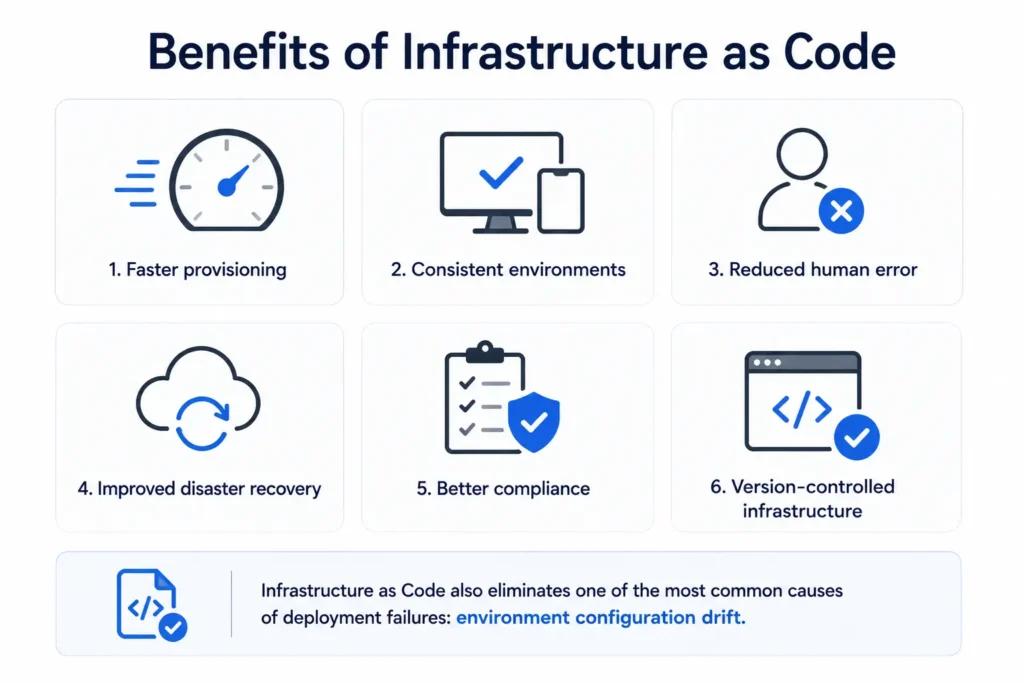
- Faster provisioning
- Consistent environments
- Reduced human error
- Improved disaster recovery
- Better compliance
- Version-controlled infrastructure
Infrastructure as Code also eliminates one of the most common causes of deployment failures: environment configuration drift.
Step 5: Adopt Containers and Kubernetes
Modern enterprise applications increasingly rely on containerization.
Containers package applications with all their dependencies, ensuring consistent behavior across development, testing, and production environments.
Benefits include:
- Faster deployments
- Improved scalability
- Environment consistency
- Better resource utilization
- Simplified application portability
Docker has become the industry standard for containerization, while Kubernetes provides orchestration capabilities that automate deployment, scaling, and management.
Docker vs Kubernetes
| Docker | Kubernetes |
| Container Platform | Container Orchestration |
| Packages Applications | Manages Clusters |
| Lightweight | Enterprise Scale |
| Single Host | Multi-node Infrastructure |
Organizations planning container adoption should understand the differences between Docker and Kubernetes before designing their platform architecture.
For a deeper understanding of cloud-native deployment, explore our guide on Containerization in Cloud and DevOps Environments.
Step 6: Integrate Security from Day One (DevSecOps)
Security cannot be treated as a final approval step before production.
Enterprise DevOps requires security to be embedded throughout the software delivery lifecycle.
This approach, known as DevSecOps, integrates security into every stage of CI/CD.
A mature DevSecOps pipeline typically includes:
- Static Application Security Testing (SAST)
- Dynamic Application Security Testing (DAST)
- Software Composition Analysis (SCA)
- Container Image Scanning
- Infrastructure as Code Security Scanning
- Secrets Management
- Compliance Checks
By identifying vulnerabilities early, organizations reduce remediation costs and improve software quality.
Learn how DevSecOps works and why it’s becoming essential for enterprise software development.
Step 7: Enable Continuous Monitoring and Observability
Deploying software is only half the journey. Enterprise DevOps also requires continuous visibility into application health and operational performance.
Modern observability combines:
- Logs
- Metrics
- Traces
- Application Performance Monitoring (APM)
- Infrastructure Monitoring
- User Experience Monitoring
Popular monitoring platforms include:
- Prometheus
- Grafana
- Datadog
- New Relic
- Splunk
- Elastic Stack
Continuous monitoring enables teams to detect issues early, reduce Mean Time to Recovery (MTTR), and maintain service reliability.
Enterprise DevOps Technology Stack
A typical enterprise DevOps ecosystem includes multiple integrated tools working together.
| Capability | Example Tools |
| Source Control | GitHub, GitLab, Bitbucket |
| CI/CD | Jenkins, GitLab CI/CD, Azure DevOps |
| Artifact Repository | JFrog Artifactory, Nexus |
| Containerization | Docker |
| Orchestration | Kubernetes, OpenShift |
| Infrastructure as Code | Terraform, Ansible |
| Monitoring | Prometheus, Grafana |
| Security | SonarQube, Trivy, Vault |
| Collaboration | Jira, Confluence, Slack |
The goal is not to use every available tool but to build an integrated platform that supports your engineering workflows and governance requirements.
Enterprise DevOps Challenges (and How to Overcome Them)
Enterprise DevOps initiatives rarely fail because of technology. More often, they struggle due to organizational complexity, inconsistent processes, and resistance to change.
Below are some of the most common challenges enterprises encounter—and practical ways to address them.
| Challenge | Business Impact | Recommended Solution |
| Legacy Applications | Slow deployments | Modernize incrementally using containers and APIs |
| Organizational Silos | Poor collaboration | Create cross-functional product teams |
| Manual Processes | Delayed releases | Automate builds, testing, deployments, and approvals |
| Security & Compliance | Release bottlenecks | Integrate DevSecOps throughout the pipeline |
| Tool Sprawl | Fragmented workflows | Standardize and integrate the DevOps toolchain |
| Skills Gap | Slow adoption | Invest in training and coaching |
| Resistance to Change | Low adoption | Secure executive sponsorship and communicate business value |
| Lack of Governance | Inconsistent delivery | Establish enterprise DevOps standards and policies |
The key is to view DevOps as an ongoing transformation rather than a one-time implementation.
Measuring Success with DORA Metrics
How do you know if your Enterprise DevOps implementation is delivering results?
The DORA (DevOps Research and Assessment) metrics provide an industry-standard framework for measuring software delivery performance.
1. Deployment Frequency
Measures how often code is successfully deployed to production.
Higher-performing teams deploy multiple times per day, while less mature organizations may release only monthly or quarterly.
2. Lead Time for Changes
Measures the time between committing code and deploying it to production.
Reducing lead time enables organizations to respond more quickly to business needs and customer feedback.
3. Mean Time to Recovery (MTTR)
Measures how quickly teams recover from production incidents.
Lower MTTR indicates resilient systems, effective monitoring, and efficient incident response.
4. Change Failure Rate
Measures the percentage of deployments that result in failures requiring remediation or rollback.
A low change failure rate reflects mature testing, automation, and deployment practices.
Additional Enterprise Metrics
Beyond DORA, many organizations also monitor:
- Build Success Rate
- Pipeline Duration
- Automated Test Coverage
- Security Vulnerabilities
- Infrastructure Provisioning Time
- Mean Time to Detect (MTTD)
- Customer Satisfaction (CSAT)
These metrics help leadership evaluate the effectiveness of DevOps initiatives and identify opportunities for continuous improvement.
Enterprise DevOps Implementation Checklist
Before scaling DevOps across the organization, ensure the following capabilities are in place.
| Capability | Status |
| Executive Sponsorship | ☐ |
| DevOps Strategy & Roadmap | ☐ |
| Cross-Functional Teams | ☐ |
| Standardized CI/CD Pipelines | ☐ |
| Infrastructure as Code | ☐ |
| Containerization | ☐ |
| Kubernetes or Container Orchestration | ☐ |
| DevSecOps Integration | ☐ |
| Automated Testing | ☐ |
| Continuous Monitoring | ☐ |
| DORA Metrics Dashboard | ☐ |
| Platform Engineering | ☐ |
| Governance Framework | ☐ |
| Documentation Standards | ☐ |
| Continuous Improvement Process | ☐ |
Organizations that regularly review this checklist are better positioned to sustain long-term DevOps success.
The Future of Enterprise DevOps: Platform Engineering and AI
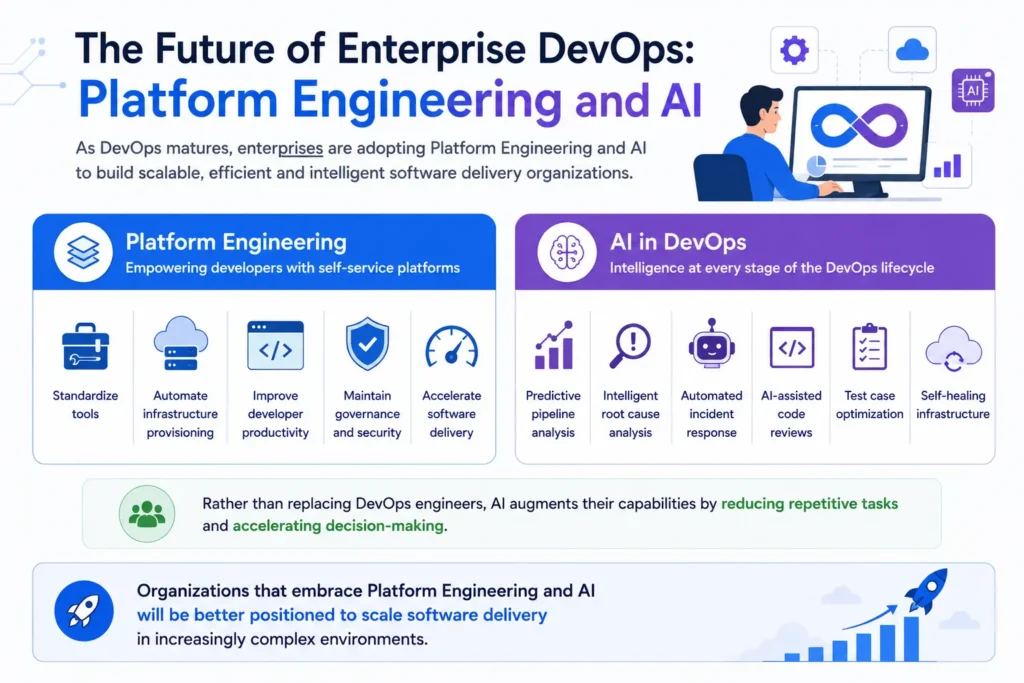
As DevOps matures, many enterprises are evolving toward Platform Engineering—an approach that provides developers with self-service capabilities through internal developer platforms.
Platform Engineering helps standardize tools, automate infrastructure provisioning, and improve developer productivity while maintaining governance.
Artificial Intelligence is also reshaping DevOps by enabling:
- Predictive pipeline analysis
- Intelligent root cause analysis
- Automated incident response
- AI-assisted code reviews
- Test case optimization
- Self-healing infrastructure
Rather than replacing DevOps engineers, AI augments their capabilities by reducing repetitive tasks and accelerating decision-making.
Organizations that embrace Platform Engineering and AI will be better positioned to scale software delivery in increasingly complex environments.
How MicroGenesis Helps Organizations Implement Enterprise DevOps Successfully
Implementing Enterprise DevOps requires more than deploying tools. It demands a strategic approach that aligns people, processes, technology, and governance.
MicroGenesis helps organizations accelerate DevOps transformation through consulting, implementation, automation, cloud modernization, and managed services.
Our Enterprise DevOps Services
DevOps Strategy & Assessment
We evaluate your current DevOps maturity, identify gaps, and develop a transformation roadmap aligned with business objectives.
CI/CD Pipeline Implementation
We design and implement enterprise-grade CI/CD pipelines using leading platforms such as:
- GitLab CI/CD
- Jenkins
- Azure DevOps
- GitHub Actions
Cloud & Infrastructure Modernization
Our consultants help organizations modernize applications and infrastructure across AWS, Microsoft Azure, and Google Cloud.
For organizations planning cloud adoption, our guide on Migrating to the Cloud with DevOps explains how DevOps accelerates cloud transformation.
Cloud modernization is even more effective when organizations understand how cloud computing enhances DevOps practices.
DevSecOps
We integrate security throughout the software development lifecycle using:
- SAST
- DAST
- Container Security
- Dependency Scanning
- Compliance Automation
Containerization & Kubernetes
We help organizations implement cloud-native architectures using Docker, Kubernetes, and modern orchestration platforms.
Infrastructure as Code
Our engineers automate infrastructure provisioning using Terraform, Ansible, and cloud-native infrastructure tools.
Automation & Platform Engineering
We build reusable automation frameworks and internal developer platforms that improve consistency, scalability, and developer experience.
Managed DevOps Services
Our managed services include:
- Pipeline optimization
- Health assessments
- Platform upgrades
- Monitoring
- Continuous improvement
- Ongoing support
Explore our DevOps Services to learn how MicroGenesis helps enterprises accelerate software delivery and achieve operational excellence.
Why Choose MicroGenesis?
Organizations choose MicroGenesis because we combine technical expertise with deep consulting capabilities.
Proven Experience
We have helped enterprises modernize software delivery across industries including automotive, manufacturing, BFSI, healthcare, and technology.
End-to-End Services
From strategy and assessments to implementation, automation, cloud migration, and managed services, we support every stage of your DevOps journey.
Technology Expertise
Our consultants have hands-on experience with:
- GitLab
- Jenkins
- Azure DevOps
- GitHub
- Docker
- Kubernetes
- Terraform
- SonarQube
- Jira
- Confluence
Business-Focused Outcomes
Our goal is not simply to implement tools but to help organizations achieve measurable improvements in delivery speed, software quality, operational efficiency, and customer satisfaction.
Conclusion
Enterprise DevOps is no longer optional for organizations seeking to remain competitive in today’s digital economy.
Successfully implementing Enterprise DevOps requires more than selecting the right tools. It demands a strategic transformation encompassing culture, automation, governance, security, cloud adoption, and continuous improvement.
Organizations that invest in standardized CI/CD pipelines, Infrastructure as Code, DevSecOps, containerization, observability, and platform engineering are better positioned to deliver software faster, improve reliability, and respond rapidly to changing business needs.
Whether you’re beginning your DevOps journey or scaling an existing implementation, a structured roadmap and experienced implementation partner can significantly accelerate success.
With the right strategy, technologies, and governance, Enterprise DevOps becomes a powerful enabler of innovation, agility, and sustainable business growth.