
The automotive industry is undergoing a fundamental transformation. Vehicles have evolved from primarily mechanical machines into intelligent, software-defined systems powered by embedded software, electronics, connectivity, artificial intelligence, and cloud technologies. Learn more about Software-Defined Vehicles to understand how this shift is transforming vehicle architecture, software delivery, and engineering practices. Features such as Advanced Driver Assistance Systems (ADAS), autonomous driving, over-the-air (OTA) software updates, connected infotainment, and vehicle-to-everything (V2X) communication have dramatically increased engineering complexity.
Today’s vehicles may contain more than 100 Electronic Control Units (ECUs) and over 100 million lines of software code, making software one of the most critical components of vehicle performance, safety, and customer experience. This growing complexity demands structured engineering processes that ensure consistent quality, effective collaboration, and regulatory compliance across globally distributed teams and suppliers.
This is where Automotive SPICE (ASPICE) becomes essential.
ASPICE provides a structured framework for assessing and improving engineering processes across the automotive software and systems development lifecycle. Rather than evaluating only the final product, it focuses on how engineering work is performed, helping organizations build predictable, repeatable, and continuously improving engineering practices.
Whether you are an Automotive OEM, Tier 1 supplier, engineering manager, quality leader, systems engineer, or software developer, understanding ASPICE is critical for delivering reliable software-defined vehicles while meeting customer and regulatory expectations.
This guide explains ASPICE in depth, from its origins and process model to capability levels, assessments, implementation strategies, engineering tools, and its relationship with Functional Safety, Cybersecurity, Embedded DevOps, Model-Based Systems Engineering (MBSE), and the Digital Thread.
What Is ASPICE?
Automotive SPICE (ASPICE), officially known as Automotive Software Process Improvement and Capability Determination, is a process assessment model developed specifically for the automotive industry to evaluate and improve engineering processes.
Unlike product quality standards that evaluate the finished vehicle or software, ASPICE evaluates the maturity and effectiveness of the engineering processes used to develop those products.
Its primary objectives are to:
- Standardize automotive engineering processes
- Improve software and systems quality
- Reduce engineering risks
- Increase development predictability
- Strengthen supplier capability
- Improve collaboration across engineering teams
- Support continuous process improvement
Today, ASPICE has become one of the most widely adopted engineering frameworks in the automotive industry and is commonly required by global OEMs during supplier selection and project execution.
Understanding the Philosophy Behind ASPICE
One of the biggest misconceptions about ASPICE is that it is simply an audit framework.
It is not.
ASPICE is fundamentally a process improvement model.
The philosophy behind ASPICE is simple:
High-quality engineering processes consistently produce high-quality products.
Instead of asking:
“Does the software work?”
ASPICE asks:
- Was the software developed using controlled engineering processes?
- Were customer requirements properly analyzed?
- Was the architecture reviewed?
- Was every requirement tested?
- Were engineering changes controlled?
- Is complete traceability available?
If these engineering practices are consistently followed, organizations significantly reduce the likelihood of quality defects appearing in production.
The Evolution of Automotive Software Engineering
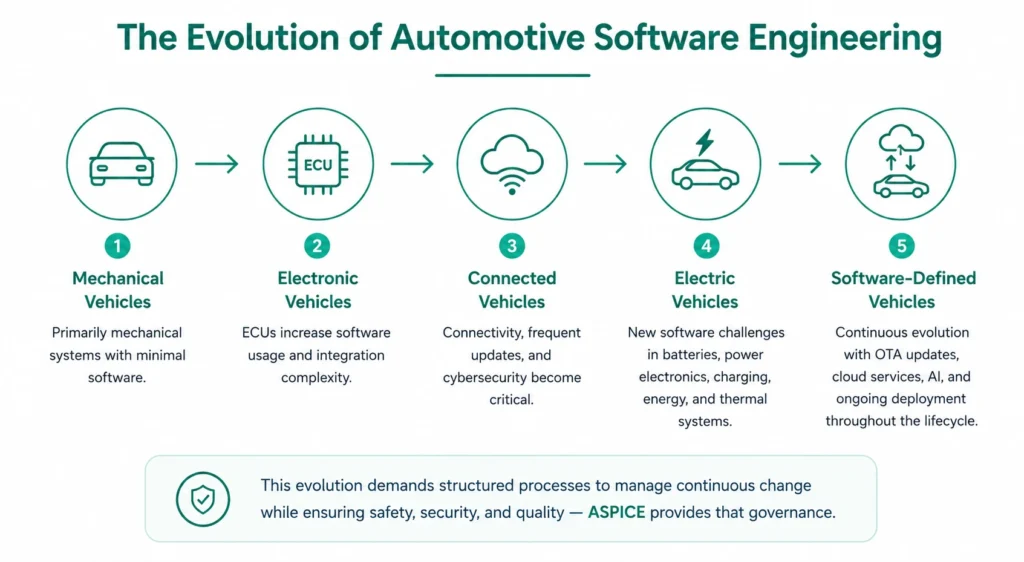
To understand why ASPICE exists, it’s important to understand how automotive engineering has evolved over the past three decades.
Mechanical Vehicles
Traditional vehicles relied primarily on mechanical systems.
Software played only a minor role.
Engineering disciplines worked independently with limited interaction.
Electronic Vehicles
The introduction of Electronic Control Units (ECUs) increased software usage.
Engineering teams now had to coordinate:
- Hardware
- Electronics
- Embedded software
This increased integration complexity.
Connected Vehicles
Vehicles became connected through cloud platforms, mobile applications, and telematics systems.
Software updates became more frequent.
Cybersecurity became a major engineering concern.
Electric Vehicles
Electric vehicle platforms introduced entirely new software challenges involving:
- Battery Management Systems
- Power Electronics
- Charging Infrastructure
- Energy Optimization
- Thermal Management
Engineering complexity increased significantly.
Software-Defined Vehicles
Today’s Software Defined Vehicles continuously evolve throughout their lifecycle. Unlike traditional vehicles, they require a structured Software-Defined Vehicle development lifecycle that supports continuous engineering, validation, deployment, and over-the-air software updates throughout the product lifecycle.
New features are delivered using:
- Over-the-Air Updates
- Continuous Software Deployment
- Cloud Services
- AI-powered capabilities
Unlike traditional vehicles, SDVs continue receiving new functionality years after production.
This shift requires engineering processes that support continuous change while maintaining safety, security, and quality.
ASPICE provides the governance necessary to manage this new engineering reality.
Why Was ASPICE Developed?
Before ASPICE, automotive manufacturers faced a major challenge.
Every supplier followed different engineering processes.
For example:
Supplier A might use one method for requirements management.
Supplier B might follow a completely different software development process.
Supplier C could maintain different testing standards.
As a result, OEMs struggled to evaluate supplier capability objectively.
Even when suppliers delivered similar products, there was no consistent way to determine:
- Engineering maturity
- Process quality
- Risk levels
- Predictability
- Software development capability
This inconsistency created:
- Higher project risks
- Delayed deliveries
- Increased warranty costs
- Software defects
- Difficult supplier management
To solve this problem, the automotive industry needed a common engineering assessment framework.
The Origins of ASPICE
ASPICE is based on the international standard ISO/IEC 15504, commonly known as SPICE (Software Process Improvement and Capability Determination).
ISO/IEC 15504 provided a generic framework for evaluating software development processes across industries.
However, automotive engineering introduced unique challenges that required a domain-specific model, including:
- Embedded software
- Functional Safety
- Complex supplier networks
- Long product lifecycles
- Hardware-software integration
- Safety-critical systems
Recognizing these needs, the Automotive Special Interest Group (Automotive SIG) adapted ISO/IEC 15504 specifically for automotive software and systems engineering.
The result was Automotive SPICE, which incorporates automotive-specific engineering processes, terminology, and assessment criteria.
Over time, ASPICE has evolved through multiple versions, with ASPICE 4.0 introducing updates to align with modern automotive engineering practices, including greater emphasis on systems engineering and software integration.
Who Uses ASPICE?
ASPICE is used throughout the automotive value chain.
Automotive OEMs
Vehicle manufacturers use ASPICE to establish engineering standards, evaluate supplier capability, and improve internal development processes.
Examples include:
- Volkswagen Group
- BMW Group
- Mercedes-Benz
- Stellantis
- Volvo Cars
- Renault Group
- Hyundai Motor Group
- Toyota
- Honda
These organizations often require suppliers to demonstrate defined ASPICE capability levels before awarding development contracts.
Tier 1 Suppliers
Tier 1 suppliers develop critical systems such as:
- ADAS
- Infotainment
- Powertrain control
- Autonomous driving platforms
- Battery management systems
- Electronic control units
- Connectivity solutions
Organizations including Bosch, Continental, ZF, Valeo, Denso, Aptiv, Magna, and others rely heavily on ASPICE to demonstrate engineering maturity.
Tier 2 and Tier 3 Suppliers
Smaller suppliers increasingly adopt ASPICE to remain competitive within automotive supply chains.
Even organizations not directly assessed often implement ASPICE because Tier 1 customers expect process alignment.
Engineering Service Providers
Consulting companies and engineering partners implement ASPICE to support OEMs and suppliers with:
- Process improvement
- Toolchain implementation
- Gap assessments
- Engineering transformation
- Audit preparation
Why ASPICE Matters Today
The importance of ASPICE continues to grow because modern automotive engineering is becoming increasingly software-centric.
Several industry trends are driving adoption.
Increasing Software Complexity
Vehicle software continues growing exponentially.
Modern software platforms manage:
- Autonomous driving
- Battery optimization
- Connectivity
- Driver assistance
- Vehicle diagnostics
- Cybersecurity
- Cloud integration
Managing this complexity requires disciplined engineering processes.
Global Engineering Teams
Vehicle development now spans multiple countries and suppliers.
Engineering teams must collaborate across:
- Systems Engineering
- Embedded Software
- Electronics
- Mechanical Engineering
- Functional Safety
- Cybersecurity
- Manufacturing
ASPICE provides a common engineering language across globally distributed organizations.
Faster Release Cycles
Vehicle software is updated much more frequently than in the past.
Engineering organizations must balance speed with quality.
ASPICE enables organizations to introduce automation while maintaining governance.
Regulatory Pressure
Automotive organizations must comply with numerous standards including:
- ISO 26262
- ISO/SAE 21434
- UNECE WP.29
- ASPICE
Rather than managing compliance independently, many organizations integrate these frameworks into a unified engineering process.
ASPICE Framework: Understanding the Process Reference Model (PRM) and Process Assessment Model (PAM)
One of the reasons ASPICE is often misunderstood is that people focus only on the assessment score without understanding the framework behind it. To implement ASPICE successfully, engineering teams need to understand its two foundational components: the Process Reference Model (PRM) and the Process Assessment Model (PAM).
Think of the PRM as what engineering activities should be performed, while the PAM defines how those activities are evaluated during an assessment.
Together, these models provide a standardized approach for measuring engineering maturity across automotive organizations.
Process Reference Model (PRM)
The Process Reference Model defines the engineering processes required throughout the automotive product development lifecycle. It specifies the purpose of each process and the expected outcomes but does not prescribe how organizations must implement them.
This flexibility allows OEMs and suppliers to tailor their engineering workflows while still meeting ASPICE expectations.
The PRM includes process groups covering:
- Customer-Supplier Engineering
- Systems Engineering
- Software Engineering
- Supporting Processes
- Management Processes
- Process Improvement
- Reuse Engineering
Rather than dictating a specific development methodology, the PRM supports Agile, V-Model, Hybrid, and DevOps-based engineering environments, provided they meet defined process outcomes.
Process Assessment Model (PAM)
While the PRM defines engineering processes, the Process Assessment Model explains how assessors determine whether those processes are implemented effectively.
The PAM evaluates:
- Process performance
- Engineering work products
- Process attributes
- Capability levels
- Engineering evidence
During an assessment, auditors review engineering artifacts, interview engineering teams, observe engineering practices, and evaluate whether processes consistently achieve their intended outcomes.
Unlike a simple compliance checklist, the PAM evaluates both the existence and the maturity of engineering processes.
ASPICE Process Groups
Automotive SPICE organizes engineering activities into several interconnected process groups. Each group addresses a different aspect of automotive product development.
Customer Requirements
│
▼
System Engineering
│
▼
Software Engineering
│
▼
Verification & Validation
│
▼
Release
│
▼
Maintenance
Supporting Processes
Management Processes
Process Improvement
Reuse Engineering
Together, these processes ensure engineering activities remain structured, repeatable, and traceable throughout development.
Customer-Supplier Processes (ACQ)
Customer-Supplier processes focus on collaboration between OEMs and suppliers.
In today’s automotive ecosystem, software development rarely occurs within a single organization. Modern vehicles involve hundreds of suppliers delivering hardware, software, and engineering services.
Without standardized supplier management, engineering quality becomes difficult to maintain.
Customer-Supplier processes establish clear expectations regarding:
- Supplier communication
- Requirement exchange
- Acceptance criteria
- Contract deliverables
- Technical reviews
- Project monitoring
These processes help OEMs evaluate supplier capability while ensuring engineering deliverables meet quality expectations.
Why Customer-Supplier Processes Matter
Consider an ADAS supplier developing lane-keeping software.
The OEM expects:
- Complete requirements
- Traceable implementation
- Test evidence
- Functional Safety compliance
- Cybersecurity evidence
Customer-Supplier processes ensure these expectations remain aligned throughout development.
System Engineering Processes (SYS)
System Engineering forms the foundation of automotive product development.
Before software engineers write a single line of code, systems engineers define how the complete vehicle function should behave.
System Engineering transforms customer needs into system-level architecture.
The SYS process group includes five primary processes.
SYS.1 — System Requirements Analysis
Every engineering project begins with understanding customer expectations.
System Requirements Analysis converts stakeholder needs into measurable technical requirements.
Typical activities include:
- Requirement elicitation
- Requirement analysis
- Prioritization
- Feasibility evaluation
- Requirement documentation
- Review and approval
Outputs typically include:
- System Requirement Specification
- Requirement attributes
- Requirement baselines
- Requirement reviews
A good requirement should be:
- Clear
- Testable
- Unambiguous
- Traceable
- Consistent
- Complete
Poor requirements often become the largest source of engineering defects.
SYS.2 — System Architecture Design
Once requirements are approved, engineers develop the system architecture.
This stage defines:
- Functional decomposition
- Hardware allocation
- Software allocation
- Interface definitions
- Communication mechanisms
- System components
For example, Adaptive Cruise Control may require:
- Radar sensors
- Cameras
- ECU
- Braking controller
- Steering controller
- Human Machine Interface
Architecture determines how these components interact.
Deliverables include:
- System Architecture Document
- Interface Specifications
- Block Diagrams
- Allocation Matrix
Modern organizations increasingly use Model-Based Systems Engineering (MBSE) tools such as IBM Rhapsody or Cameo Systems Modeler to create architecture models instead of static documents.
SYS.3 — System Architectural Design and Integration Planning
After defining architecture, engineers plan how individual components will be integrated.
Activities include:
- Interface validation
- Integration sequencing
- Dependency analysis
- Integration strategy
- Risk identification
Planning integration early significantly reduces downstream engineering risks.
SYS.4 — System Integration and Integration Testing
During this phase, individual hardware and software components are assembled into complete systems.
Integration activities include:
- ECU integration
- Interface testing
- Communication validation
- Sensor integration
- Hardware-software integration
- Network testing
Engineering teams verify that integrated components function together as intended.
SYS.5 — System Qualification Testing
The final System Engineering process validates the complete product against customer requirements.
Typical validation activities include:
- Functional testing
- Environmental testing
- Vehicle testing
- Performance validation
- Safety validation
- Acceptance testing
Qualification testing provides evidence that customer expectations have been satisfied.
Software Engineering Processes (SWE)
Software Engineering represents the largest portion of ASPICE because modern vehicles increasingly depend on software.
Software Engineering processes ensure software is developed systematically while maintaining quality and traceability.
The SWE group consists of six engineering processes.
SWE.1 — Software Requirements Analysis
System requirements are translated into detailed software requirements.
Activities include:
- Requirement decomposition
- Functional allocation
- Software specification
- Requirement prioritization
- Requirement review
Outputs:
- Software Requirement Specification
- Requirement Traceability
- Software Interfaces
Every software requirement should trace back to a system requirement.
SWE.2 — Software Architecture Design
Software architects define the overall software structure.
Architecture includes:
- Software components
- Interfaces
- Layered architecture
- AUTOSAR allocation
- Communication mechanisms
- Memory allocation
Well-designed architectures simplify maintenance while improving scalability.
Deliverables include:
- Software Architecture Specification
- Component Diagrams
- Interface Definitions
- Dependency Models
SWE.3 — Software Detailed Design
This process refines architecture into implementation-ready designs.
Typical activities include:
- Algorithm design
- State machine modeling
- Class design
- Sequence diagrams
- Data structures
Detailed design reduces ambiguity before implementation begins.
SWE.4 — Software Construction
This is where software development takes place.
Activities include:
- Coding
- Code reviews
- Static analysis
- Unit testing
- Build automation
- Version control
Modern organizations combine SWE.4 with Embedded DevOps, enabling:
- Continuous Integration
- Automated builds
- Static code analysis
- Automated testing
- Code quality monitoring
Rather than viewing DevOps as separate from ASPICE, many organizations now use automation to strengthen ASPICE compliance.
SWE.5 — Software Integration and Integration Testing
Individual software components are integrated into complete applications.
Activities include:
- Software integration
- Interface validation
- Build verification
- Regression testing
- Continuous Integration
Engineering teams verify software modules function correctly when combined.
SWE.6 — Software Qualification Testing
The final Software Engineering process validates software against software requirements.
Typical activities include:
- Functional testing
- Boundary testing
- Stress testing
- Regression testing
- Performance testing
- Automated testing
Outputs include:
- Test Reports
- Test Coverage
- Defect Reports
- Validation Evidence
Why the SWE Process Group Is Critical
For many OEMs and Tier 1 suppliers, the Software Engineering process group receives significant attention during ASPICE assessments because it directly impacts software quality, safety, and release readiness.
Weaknesses in requirements analysis, architecture, coding practices, or testing can lead to defects that are costly to fix later in the lifecycle. Organizations that establish disciplined SWE processes, supported by automation, traceability, and continuous integration, are better positioned to deliver reliable software while meeting aggressive release schedules.
Supporting Processes (SUP)
While the System Engineering (SYS) and Software Engineering (SWE) process groups define how products are engineered, the Supporting Processes (SUP) ensure that engineering activities remain controlled, repeatable, and auditable throughout the product lifecycle.
Supporting processes are often overlooked because they don’t directly produce product functionality. However, during an ASPICE assessment, weaknesses in these areas can significantly impact overall capability ratings.
These processes ensure engineering artifacts are properly documented, reviewed, version-controlled, and traceable.
SUP.7 – Quality Assurance
Quality Assurance verifies that engineering activities comply with defined organizational processes rather than evaluating the product itself.
Typical QA activities include:
- Process audits
- Compliance reviews
- Engineering assessments
- Metrics collection
- Process improvement recommendations
- Internal audits
Quality Assurance teams operate independently from development teams to ensure objective evaluations.
Typical work products include:
- Audit Reports
- Quality Plans
- Non-conformance Reports
- Process Compliance Reports
- Corrective Action Plans
SUP.8 – Configuration Management
Modern automotive projects contain thousands of engineering artifacts.
Examples include:
- Requirements
- Architecture models
- Source code
- Software libraries
- Test cases
- ECU configurations
- Calibration files
- Documentation
Without Configuration Management, engineering teams quickly lose control over product baselines.
Configuration Management ensures:
- Version control
- Baseline creation
- Release management
- Artifact identification
- Controlled access
- Engineering reproducibility
Typical deliverables include:
- Configuration Management Plan
- Configuration Item List
- Baseline Reports
- Release Records
SUP.9 – Problem Resolution Management
Engineering defects are inevitable.
What differentiates mature organizations is how effectively they manage them.
Problem Resolution ensures engineering issues are:
- Reported
- Investigated
- Prioritized
- Assigned
- Resolved
- Verified
- Closed
Modern engineering organizations integrate defect management with:
- Jira
- IBM EWM
- Codebeamer
- Polarion
- Azure DevOps
Problem Resolution also includes root cause analysis to prevent recurring issues.
SUP.10 – Change Request Management
Automotive software continuously evolves.
Requirements change.
Architecture evolves.
Customer expectations shift.
Regulations are updated.
Every engineering change must be managed carefully.
Typical Change Management workflow:
Change Request
↓
Impact Analysis
↓
Technical Review
↓
Approval
↓
Implementation
↓
Verification
↓
Release
Every change should include:
- Business justification
- Engineering impact
- Risk assessment
- Traceability
- Approval history
SUP.11 – Peer Reviews
Peer Reviews identify engineering issues before testing begins.
Common review activities include:
- Requirement Reviews
- Architecture Reviews
- Code Reviews
- Design Reviews
- Test Specification Reviews
Benefits include:
- Earlier defect detection
- Improved engineering quality
- Better knowledge sharing
- Lower testing costs
Modern teams increasingly automate review workflows using IBM ELM, Codebeamer, GitHub Pull Requests, and GitLab Merge Requests.
Management Processes (MAN)
Management Processes ensure engineering projects are planned, monitored, measured, and continuously controlled.
Without structured management, even technically excellent engineering teams struggle to deliver predictable outcomes.
MAN.3 – Project Management
Project Management ensures engineering work is delivered according to:
- Scope
- Schedule
- Budget
- Quality
- Risk
Activities include:
- Resource planning
- Milestone tracking
- Risk reviews
- Budget monitoring
- Status reporting
- Stakeholder communication
Engineering managers monitor:
- Delivery progress
- Requirement completion
- Test completion
- Defect trends
- Release readiness
MAN.5 – Risk Management
Every automotive project contains risks.
Examples include:
Technical risks
Supplier risks
Schedule risks
Safety risks
Cybersecurity risks
Integration risks
Risk Management involves:
Risk Identification
↓
Risk Analysis
↓
Risk Prioritization
↓
Mitigation Planning
↓
Continuous Monitoring
Organizations maintaining mature risk management typically experience fewer project surprises.
MAN.6 – Measurement
Engineering decisions should be based on data rather than intuition.
Common engineering metrics include:
Requirements completed
Requirements volatility
Test coverage
Requirement traceability
Build success rate
Defect density
Requirement review completion
Change request turnaround
Escaped defects
These metrics provide objective evidence during ASPICE assessments.
Process Improvement (PIM)
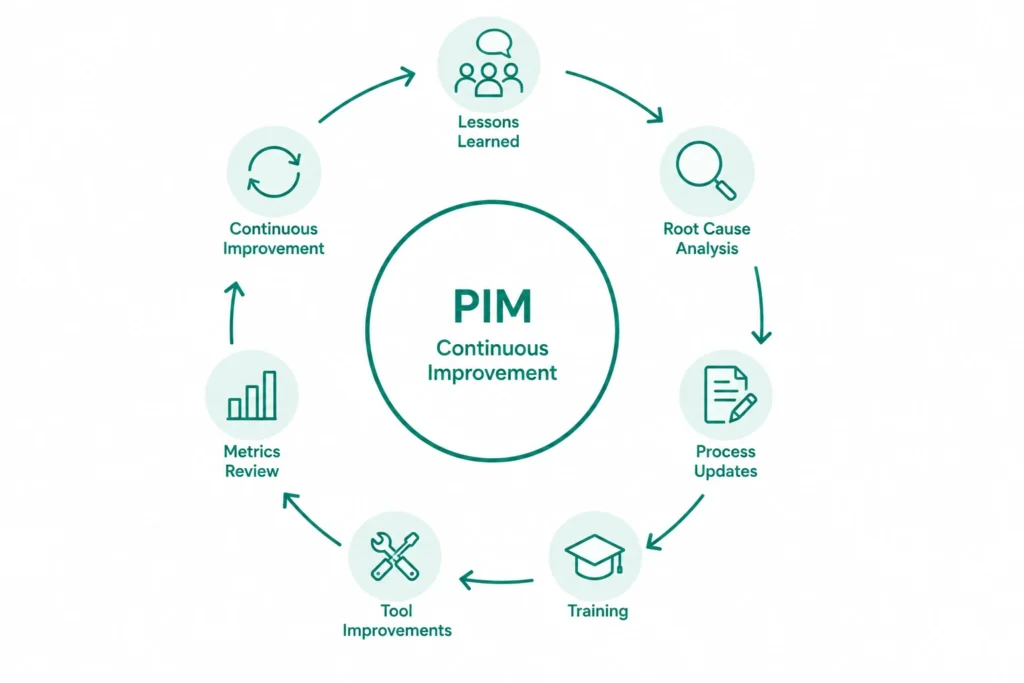
One of ASPICE’s distinguishing characteristics is its emphasis on continuous improvement.
Organizations are expected to learn from previous projects and systematically improve engineering processes.
Typical activities include:
Lessons Learned Workshops
↓
Root Cause Analysis
↓
Process Updates
↓
Training
↓
Tool Improvements
↓
Metrics Review
↓
Continuous Improvement
Organizations operating at higher capability levels actively optimize engineering processes rather than simply maintaining them.
Reuse Process Group (REU)
Automotive organizations increasingly reuse engineering assets across vehicle platforms.
Examples include:
Software components
AUTOSAR modules
Diagnostic libraries
Communication stacks
Test cases
Safety mechanisms
Architecture models
Reuse Engineering ensures these assets remain:
Standardized
Controlled
Versioned
Traceable
Validated
Proper reuse reduces engineering effort while improving quality and consistency.
ASPICE Capability Levels
One of the most recognized aspects of ASPICE is its capability level model.
Rather than asking whether a process exists, ASPICE evaluates how well the process is performed and managed.
Capability Level 0 — Incomplete
At this level:
Processes are inconsistent or missing.
Engineering activities depend on individual effort.
Little documentation exists.
Results are unpredictable.
Characteristics:
❌ No standard process
❌ Limited repeatability
❌ High project risk
Capability Level 1 — Performed
Processes exist and generally achieve their intended purpose.
However:
Activities remain informal.
Consistency varies between projects.
Engineering depends heavily on experienced individuals.
Characteristics:
✔ Basic execution
✔ Required outputs produced
❌ Limited management
Capability Level 2 — Managed
Processes become planned and controlled.
Engineering work is:
Scheduled
Monitored
Measured
Reviewed
Approved
Artifacts are managed consistently.
Most global OEMs expect suppliers to achieve Capability Level 2 for key engineering processes.
Characteristics:
✔ Process planning
✔ Work product management
✔ Configuration control
✔ Monitoring
Capability Level 3 — Established
Engineering processes become organizational standards.
Instead of each project defining its own approach, engineering teams follow standardized processes.
Characteristics:
✔ Organization-wide standards
✔ Defined workflows
✔ Training
✔ Consistent implementation
Many premium automotive suppliers target CL3.
Capability Level 4 — Predictable
Engineering performance becomes measurable.
Organizations monitor statistical process performance using KPIs.
Examples:
Defect trends
Cycle time
Test effectiveness
Automation coverage
Traceability completeness
Continuous measurement enables predictive engineering management.
Capability Level 5 — Innovating
The highest capability level focuses on continuous optimization.
Organizations actively improve engineering processes through:
Automation
Artificial Intelligence
DevOps
MBSE
Digital Thread
Advanced analytics
Lessons learned
Few organizations formally pursue CL5 because most OEM requirements stop at CL2 or CL3.
Process Attributes
Capability Levels are determined using Process Attributes (PAs).
These evaluate both process performance and process management.
| Capability Level | Process Attributes |
| CL1 | PA1.1 Process Performance |
| CL2 | PA2.1 Performance Management |
| PA2.2 Work Product Management | |
| CL3 | PA3.1 Process Definition |
| PA3.2 Process Deployment | |
| CL4 | PA4.1 Process Measurement |
| PA4.2 Process Control | |
| CL5 | PA5.1 Process Innovation |
| PA5.2 Process Optimization |
Assessors evaluate evidence for each attribute before assigning capability ratings.
How an ASPICE Assessment Is Performed
An ASPICE assessment follows a structured methodology.
Step 1 — Assessment Planning
The scope, process areas, projects, and participants are identified.
Step 2 — Document Review
Assessors examine engineering artifacts such as:
- Requirements
- Architecture documents
- Test reports
- Review records
- Traceability matrices
Step 3 — Team Interviews
Engineering teams explain how processes are actually performed.
Assessors often interview:
- Project Managers
- Systems Engineers
- Software Developers
- Test Engineers
- Configuration Managers
- Quality Engineers
Step 4 — Evidence Validation
Assessors verify that engineering practices match documented processes.
Step 5 — Capability Rating
Each process area is evaluated against the Process Assessment Model (PAM) and assigned a capability level based on the supporting evidence.
Step 6 — Gap Analysis
The assessment identifies strengths, weaknesses, and areas requiring improvement.
Organizations typically use these findings to develop a prioritized improvement roadmap.
Engineering Artifacts Reviewed During an ASPICE Assessment
Assessors do not rely on interviews alone. They expect objective evidence that engineering processes are consistently followed.
Typical artifacts include:
| Process Area | Common Evidence |
| Requirements Management | System & Software Requirement Specifications |
| Architecture | System Architecture, Software Architecture, Interface Definitions |
| Design | Detailed Design Documents, UML/SysML Models |
| Development | Source Code, Code Review Records, Static Analysis Reports |
| Testing | Test Plans, Test Cases, Test Results, Coverage Reports |
| Configuration Management | Baselines, Configuration Item Lists, Version History |
| Change Management | Change Requests, Impact Analysis, Approval Records |
| Quality Assurance | Audit Reports, Process Compliance Reports |
| Traceability | Traceability Matrix linking requirements, design, code, and tests |
| Project Management | Project Plans, Risk Registers, Status Reports, Metrics Dashboards |
The quality, completeness, and consistency of these artifacts significantly influence assessment of outcomes.
Implementing ASPICE in Modern Automotive Engineering
While ASPICE defines what good engineering processes look like, successful implementation depends on integrating people, processes, and technology. Modern automotive organizations rarely implement ASPICE in isolation—they combine it with Engineering Lifecycle Management (ELM), Embedded DevOps, Model-Based Systems Engineering (MBSE), and a Digital Thread to create a connected engineering ecosystem.
Engineering Traceability: The Foundation of ASPICE
Traceability is one of the most critical aspects of ASPICE because it demonstrates that every engineering activity is linked throughout the product lifecycle. End-to-end traceability is also a key pillar of Digital Engineering for Automotive, enabling organizations to connect requirements, architecture, software development, testing, and validation across a unified engineering ecosystem.
A complete traceability chain enables organizations to connect:
Customer Requirements
↓
System Requirements
↓
Software Requirements
↓
Architecture
↓
Implementation
↓
Unit Testing
↓
Integration Testing
↓
System Validation
↓
Release
↓
Maintenance
With complete traceability, engineering teams can quickly answer questions such as:
- Which software module implements a specific requirement?
- Which test case verifies a safety requirement?
- Which release contains a particular feature?
- What is the impact of changing a requirement?
Traceability also simplifies impact analysis, audit preparation, defect investigation, and change management.
ASPICE and Functional Safety (ISO 26262)
ASPICE and ISO 26262 are complementary frameworks that address different aspects of automotive engineering.
| ASPICE | ISO 26262 |
| Engineering process maturity | Functional Safety |
| Process assessment | Safety lifecycle |
| Software quality | Hazard analysis |
| Engineering governance | ASIL compliance |
| Continuous improvement | Risk reduction |
ASPICE ensures engineering activities are performed consistently, while ISO 26262 ensures the resulting product is safe for operation.
Organizations developing safety-critical systems generally implement both frameworks together.
ASPICE and Automotive Cybersecurity (ISO/SAE 21434)
Connected vehicles face growing cybersecurity risks, making cybersecurity engineering an essential part of modern product development.
ISO/SAE 21434 focuses on:
- Threat Analysis and Risk Assessment (TARA)
- Security requirements
- Secure software development
- Vulnerability management
- Incident response
ASPICE provides structured engineering processes that support the implementation of cybersecurity requirements, while ISO/SAE 21434 defines the security-specific activities.
ASPICE and Embedded DevOps
A common misconception is that DevOps and ASPICE cannot coexist. In reality, DevOps strengthens ASPICE by automating repetitive engineering activities while maintaining governance.
Embedded DevOps supports ASPICE through:
- Continuous Integration (CI)
- Automated builds
- Static code analysis
- Continuous testing
- Automated traceability
- Release automation
Automation improves consistency, reduces manual errors, and generates evidence that supports ASPICE assessments.
ASPICE and Model-Based Systems Engineering (MBSE)
MBSE complements ASPICE by replacing document-centric engineering with system models.
Benefits include:
- Better system architecture visualization
- Early validation of system behavior
- Improved collaboration across disciplines
- Reduced design inconsistencies
- Enhanced requirements traceability
When integrated with ASPICE, MBSE improves engineering quality and reduces downstream rework.
Toolchain Support for ASPICE
Modern ASPICE implementations rely on integrated engineering tools rather than disconnected documents and spreadsheets. A robust SDV toolchain architecture enables seamless integration between requirements management, systems engineering, software development, testing, DevOps, and release management, ensuring complete lifecycle traceability and engineering collaboration.
Common toolchain components include:
| Engineering Activity | Typical Tools |
| Requirements Management | IBM DOORS Next, Codebeamer |
| Systems Engineering | IBM Rhapsody, Cameo |
| ALM / Workflow | IBM ELM, Codebeamer, Polarion |
| Agile Planning | Jira |
| Source Control | Git, GitLab |
| CI/CD | Jenkins, GitLab CI/CD |
| Testing | IBM ETM, TestRail |
| PLM | Siemens Teamcenter, PTC Windchill |
A connected toolchain enables continuous traceability, automated reporting, and improved collaboration.
Common ASPICE Implementation Challenges
Organizations frequently encounter challenges such as:
These challenges become even more significant in Software-Defined Vehicle engineering, where rapidly evolving software platforms, connected vehicle technologies, and continuous feature delivery demand highly integrated engineering processes.
- Inconsistent engineering processes
- Manual documentation
- Weak traceability
- Disconnected engineering tools
- Limited automation
- Resistance to process changes
- Supplier coordination issues
Addressing these challenges requires both process improvement and the right technology foundation.
Best Practices for ASPICE Adoption
Successful organizations typically follow these best practices:
- Conduct an ASPICE gap assessment before implementation.
- Standardize engineering processes across projects.
- Establish end-to-end traceability from project initiation.
- Integrate engineering tools to eliminate information silos.
- Automate testing, reporting, and build processes where possible.
- Train engineering teams on standardized workflows.
- Use engineering metrics to monitor process performance.
- Perform regular internal assessments to identify improvement opportunities.
Rather than treating ASPICE as an audit exercise, leading organizations integrate it into their everyday engineering practices.
Key Performance Indicators (KPIs)
Monitoring engineering performance helps organizations measure process maturity and identify areas for improvement.
Common KPIs include:
- Requirements traceability coverage
- Test coverage
- Defect density
- Build success rate
- Requirement review completion
- Change request turnaround time
- Escaped defects
- Audit findings
- Release readiness
These metrics provide objective evidence of engineering performance and support continuous improvement initiatives.
The Future of ASPICE
As automotive engineering evolves, ASPICE will continue to adapt alongside emerging technologies.
Future trends include:
- Software Defined Vehicles (SDVs)
- AI-assisted software development
- Cloud-native engineering platforms
- Digital Twins
- Continuous Compliance
- Greater automation in engineering workflows
- Deeper integration with DevOps and MBSE
Organizations that invest in modern engineering practices today will be better positioned to meet future automotive challenges.
How MicroGenesis Helps
MicroGenesis helps automotive OEMs and suppliers build ASPICE-aligned engineering environments by combining process consulting, engineering tools, and implementation expertise.
Our capabilities include:
- ASPICE gap assessments and process improvement
- IBM DOORS Next implementation
- Engineering Traceability
- Engineering Toolchain Integration
- Digital Thread implementation
- Managed Engineering Services
With over 25 years of engineering transformation experience, MicroGenesis enables organizations to improve engineering maturity, accelerate software delivery, simplify compliance, and establish scalable engineering practices for Software-Defined Vehicle development.
Frequently Asked Questions
What is ASPICE?
ASPICE (Automotive SPICE) is a process assessment model used to evaluate and improve software and systems engineering processes in the automotive industry.
Is ASPICE mandatory?
ASPICE is not a legal requirement, but many automotive OEMs expect suppliers to demonstrate ASPICE capability during supplier qualification and project execution.
What capability level do OEMs typically require?
Most OEMs expect suppliers to achieve Capability Level 2 or Capability Level 3 for critical engineering process areas.
How long does ASPICE implementation take?
The timeline depends on organizational maturity, project complexity, and existing engineering practices. Implementations can range from several months for focused process improvements to multiple years for enterprise-wide transformation.
Which tools support ASPICE?
Common tools include IBM Engineering Lifecycle Management (IBM ELM), IBM DOORS Next, IBM Rhapsody, PTC Codebeamer, Polarion ALM, GitLab, Jenkins, Jira, and MATLAB/Simulink.
Conclusion
ASPICE has become the de facto benchmark for engineering process maturity in the automotive industry. More than a supplier assessment framework, it provides a structured approach to improving software and systems engineering, enabling organizations to deliver high-quality, safety-critical, and software-intensive products with greater confidence.
As the industry moves toward Software-Defined Vehicles, continuous software delivery, and increasingly connected engineering ecosystems, ASPICE is evolving from a compliance requirement into a strategic business enabler. By integrating ASPICE with Engineering Lifecycle Management (ELM), Engineering Traceability, Model-Based Systems Engineering (MBSE), Embedded DevOps, and a Digital Thread, organizations can create scalable engineering environments that improve collaboration, accelerate innovation, and maintain compliance across the entire product lifecycle.