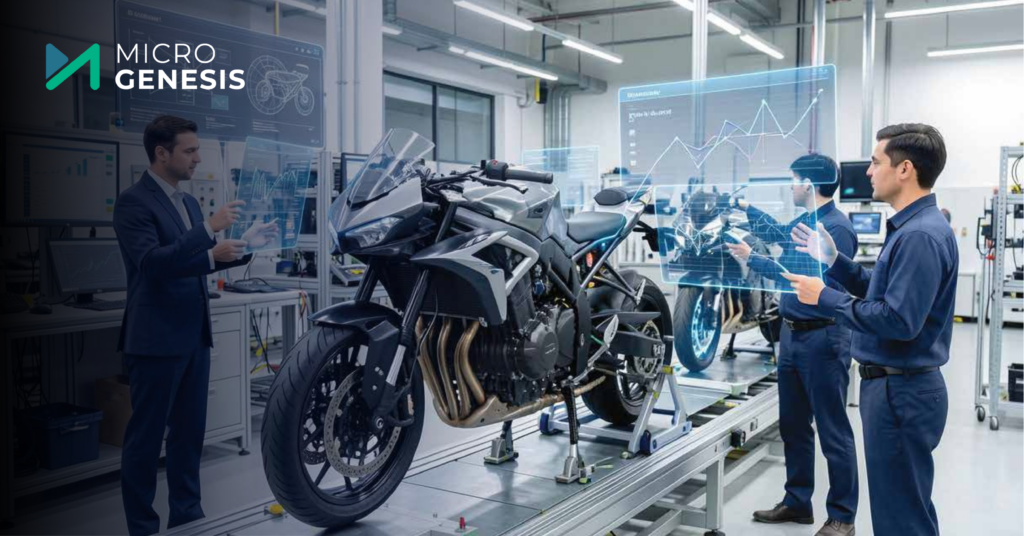

The automotive industry is rapidly transitioning to Software Defined Vehicles (SDVs), where software powers everything from infotainment and connectivity to Advanced Driver Assistance Systems (ADAS) and autonomous driving. While this transformation creates exciting opportunities for innovation, it also introduces unprecedented engineering complexity. As vehicles become increasingly software-driven, automotive manufacturers must adopt modern engineering practices to manage growing software demands while delivering safe, reliable, and connected mobility experiences.
Before exploring these challenges, it’s important to understand what makes a vehicle truly software-defined. Unlike conventional vehicles that rely heavily on hardware-based functionality, Software Defined Vehicles (SDVs) use software to control, enhance, and continuously update vehicle capabilities throughout their lifecycle. If you’re new to the concept, read our guide on What Is a Software Defined Vehicle (SDV)? to understand the technologies driving this transformation.
Unlike traditional vehicles, Software Defined Vehicles require continuous software development, frequent Over-the-Air (OTA) updates, integrated engineering workflows, and compliance with evolving functional safety and cybersecurity regulations. Automotive OEMs and Tier 1 suppliers must manage millions of lines of code, distributed engineering teams, complex toolchains, and increasingly stringent regulatory requirements—all while shortening development cycles and maintaining software quality.
Successfully delivering an SDV requires more than software development expertise. It demands a connected engineering ecosystem that integrates systems engineering, Engineering Lifecycle Management (ELM), Embedded DevOps, testing, compliance, cybersecurity, and continuous software delivery into a unified development process.
In this article, we explore the key engineering challenges organizations face during Software Defined Vehicle (SDV) development and the best practices to overcome them while building secure, scalable, and future-ready automotive platforms.
Why Are Software Defined Vehicles More Complex?
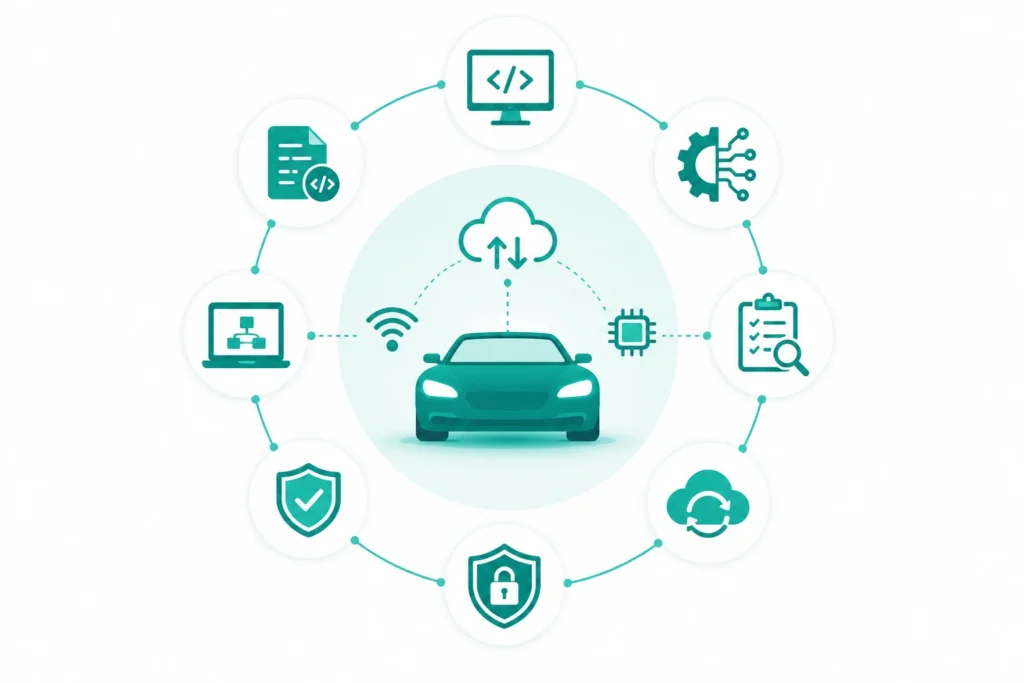
Traditional vehicles relied primarily on hardware-based innovation, with software supporting individual Electronic Control Units (ECUs). In contrast, Software Defined Vehicles centralize computing, leverage cloud connectivity, and continuously evolve through Over-the-Air (OTA) software updates, enabling manufacturers to deliver new features, performance enhancements, and security improvements throughout the vehicle lifecycle.
This shift introduces several engineering challenges, including:
- Managing millions of lines of software code
- Integrating hardware and software across multiple domains
- Ensuring end-to-end traceability
- Supporting continuous software delivery
- Maintaining cybersecurity
- Meeting Functional Safety requirements
- Managing complex engineering toolchains
Without a structured engineering approach, these challenges can delay vehicle programs, increase development costs, and impact product quality.
Key SDV Engineering Challenges
1. Increasing Software Complexity
Modern Software Defined Vehicles contain significantly more software than traditional vehicles. Critical vehicle functions—including powertrain control, battery management, infotainment, connectivity, ADAS, and autonomous driving—depend on software working together seamlessly.
Engineering teams must manage:
- Millions of lines of code
- Hundreds of software modules
- Multiple operating systems
- Distributed applications
- Real-time communication
- Continuous software updates
As software complexity continues to grow, organizations need standardized development processes, automation, and robust lifecycle management to maintain quality, scalability, and engineering efficiency.
How to Address It
Organizations should adopt:
- Modular software architectures
- Continuous Integration (CI)
- Automated testing
- Software reuse strategies
- Centralized engineering governance
2. Hardware and Software Integration
Software Defined Vehicles combine embedded software with sophisticated hardware platforms, including sensors, cameras, radar, LiDAR, ECUs, and centralized computing systems. Ensuring seamless integration across these components is essential for delivering reliable vehicle performance.
Engineering teams must coordinate interactions between:
- Hardware components
- Embedded software
- Middleware
- Operating systems
- Cloud platforms
- Vehicle communication networks
Poor integration often results in compatibility issues, delayed releases, increased validation effort, and higher development costs.
Best Practice
Adopt Model-Based Systems Engineering (MBSE) to model system behavior early, validate interactions, and identify integration issues before implementation, reducing risk across the development lifecycle.
If you’re new to Model-Based Systems Engineering, our MBSE Explained: A Complete Guide covers the fundamentals of MBSE, including system modeling, requirements, architecture, validation, and collaboration across engineering disciplines.
3. Managing End-to-End Traceability
Developing Software Defined Vehicles requires complete traceability across the engineering lifecycle. Every requirement should be linked to:
- System architecture
- Source code
- Test cases
- Verification activities
- Validation results
- Release artifacts
Without end-to-end traceability, engineering teams struggle to demonstrate compliance during audits, assess the impact of changes, and maintain consistency across distributed development environments.
Solution
Implement an integrated Application Lifecycle Management (ALM) or Engineering Lifecycle Management (ELM) platform that connects engineering artifacts throughout the product lifecycle. This enables better collaboration, improves compliance, and provides complete visibility from requirements through validation and release.
4. Fragmented Engineering Toolchains
Automotive organizations often rely on multiple tools to manage different stages of the Software Defined Vehicle (SDV) development lifecycle. While each tool serves a specific purpose, disconnected systems can create information silos, reduce visibility, and slow engineering collaboration.
Many SDV engineering challenges stem from fragmented development environments where requirements, software development, testing, cybersecurity, and release management operate in silos. Implementing a connected SDV toolchain architecture enables seamless data flow, end-to-end traceability, automation, and collaboration across engineering teams, significantly reducing development risks and improving software quality.
Common tools are used for:
- Requirements Management
- Systems Engineering
- Source Code Management
- Build Automation
- Test Management
- Issue Tracking
- Release Management
When these tools operate independently, organizations often face:
- Duplicate data
- Manual processes
- Limited visibility across teams
- Communication gaps
- Increased engineering effort
As SDV programs grow in complexity, fragmented toolchains can significantly impact productivity, traceability, and development speed.
Solution
Build an integrated engineering toolchain that connects platforms such as IBM Engineering Lifecycle Management (ELM), PTC Codebeamer, Jira, Git, Jenkins, and MATLAB/Simulink. A connected engineering environment establishes a digital thread, enabling seamless collaboration, end-to-end traceability, and better decision-making across the entire development lifecycle.
5. Continuous Integration for Embedded Software
Unlike enterprise applications, embedded automotive software depends on specialized hardware, making Continuous Integration (CI) significantly more challenging. Every software change must be validated across multiple hardware and simulation environments before deployment.
Engineering teams must coordinate:
- Embedded firmware
- Hardware availability
- Cross-compilation
- Simulation environments
- Hardware-in-the-Loop (HIL)
- Software-in-the-Loop (SIL)
Without automation, software integration becomes time-consuming, error-prone, and difficult to scale, often delaying release cycles.
Solution
Adopt Embedded DevOps practices to automate software builds, testing, and validation across embedded development environments. Integrating CI with automated testing improves software quality, accelerates development, and enables faster, more reliable software releases.
For a deeper look at implementing automated software delivery in embedded environments, explore our CI/CD for Embedded Systems guide. It explains how continuous integration, automated builds, testing, and deployment can be applied to embedded software development.
If you’re exploring how DevOps principles are adapted for embedded automotive software, our What Is Embedded DevOps? guide explains how Continuous Integration, automated testing, release automation, and lifecycle traceability help engineering teams deliver software faster while maintaining quality, safety, and compliance.
For a broader automotive software delivery strategy, explore our Automotive DevOps Framework to understand how CI/CD, continuous testing, release automation, quality gates, and engineering collaboration can be integrated across the automotive development lifecycle.
6. Functional Safety Compliance
Functional Safety remains one of the most critical aspects of Software Defined Vehicle development. As software increasingly controls vehicle behavior, organizations must ensure that safety-critical systems perform reliably under all operating conditions.
To meet ISO 26262 requirements, engineering teams must manage activities such as:
- Hazard Analysis and Risk Assessment (HARA)
- ASIL classification
- Safety requirements
- Safety verification
- Validation testing
- Safety documentation
Meeting Functional Safety requirements demands close collaboration between software, systems, testing, and quality teams throughout the engineering lifecycle.
As automotive teams adopt continuous integration and DevOps practices, these workflows must also support functional safety requirements. Our DevOps for ISO 26262 guide explains how DevOps automation, CI/CD, testing, and continuous delivery can be aligned with ISO 26262.
Alongside Functional Safety, automotive organizations must establish mature engineering processes to ensure consistent software development and regulatory compliance. Automotive SPICE (ASPICE) provides the industry’s leading framework for assessing and improving software and systems engineering processes. If you’re getting started, read our What Is ASPICE? guide to understand its process areas, capability levels, and business benefits.
Many OEMs and Tier-1 suppliers require suppliers to demonstrate engineering process maturity through formal assessments. Our ASPICE Level Assessment guide explains how capability levels are evaluated, the evidence assessors expect, and how organizations can prepare for successful assessments.
Best Practice
Integrate Functional Safety activities early in the development lifecycle and maintain complete traceability between requirements, design, implementation, testing, and validation. This helps reduce compliance risks while ensuring safety remains embedded throughout the engineering process.
7. Automotive Cybersecurity
As Software Defined Vehicles become more connected through cloud services, Over-the-Air (OTA) updates, and external communication interfaces, cybersecurity has become a top engineering priority. Protecting vehicle software and sensitive data is essential to maintaining customer trust and regulatory compliance.
Potential cybersecurity risks include:
- Unauthorized remote access
- Software tampering
- ECU compromise
- Data theft
- Communication interception
Automotive organizations must integrate cybersecurity throughout the software development lifecycle while complying with standards such as ISO/SAE 21434 and UNECE WP.29.
Best Practice
Incorporate DevSecOps into engineering workflows to automate security testing, vulnerability assessments, and compliance validation. A proactive, security-by-design approach helps identify risks early, reduce vulnerabilities, and strengthen the resilience of connected vehicle platforms.
8. Scaling Continuous Testing
Developing Software Defined Vehicles (SDVs) requires continuous validation across multiple engineering environments. As vehicle software becomes more complex, testing must keep pace to ensure quality, safety, and reliability throughout the development lifecycle.
Engineering teams typically perform:
- Unit Testing
- Integration Testing
- System Testing
- Regression Testing
- Performance Testing
- Security Testing
- Hardware-in-the-Loop (HIL) Testing
- Software-in-the-Loop (SIL) Testing
Managing thousands of automated test cases across distributed engineering teams requires scalable testing infrastructure, efficient orchestration, and complete visibility into test results.
Solution
Integrate automated testing into CI/CD pipelines and use centralized test management platforms to improve test coverage, accelerate validation, and detect defects earlier in the development process.
9. Managing Over-the-Air (OTA) Updates
Over-the-Air (OTA) updates enable automotive manufacturers to deliver new features, security patches, and performance improvements throughout a vehicle’s lifecycle. While OTA technology is a key capability of Software Defined Vehicles, it also introduces new engineering and operational challenges.
Engineering teams must ensure every update is:
- Secure
- Reliable
- Compatible
- Backward-compatible
- Fully validated
Poorly executed OTA deployments can affect vehicle performance, compromise security, and negatively impact the customer experience.
Best Practice
Implement staged rollouts, rollback mechanisms, and automated validation processes before deploying software updates to production vehicles. A controlled OTA strategy minimizes risk while ensuring safe and reliable software delivery.
10. Collaboration Across Distributed Engineering Teams
Modern automotive programs involve software engineers, systems engineers, hardware specialists, quality teams, suppliers, and compliance experts working across multiple locations and time zones. Ensuring effective collaboration across these distributed teams is essential for successful Software Defined Vehicle development.
Common collaboration challenges include:
- Communication gaps
- Version conflicts
- Inconsistent engineering processes
- Limited project visibility
- Delayed decision-making
Without a connected engineering environment, these issues can slow development, increase rework, and affect product quality.
Solution
Adopt collaborative engineering platforms that provide centralized access to requirements, system models, source code, testing activities, and project status. A unified engineering environment improves transparency, strengthens collaboration, and enables teams to make informed decisions throughout the development lifecycle.
Best Practices for Overcoming SDV Engineering Challenges
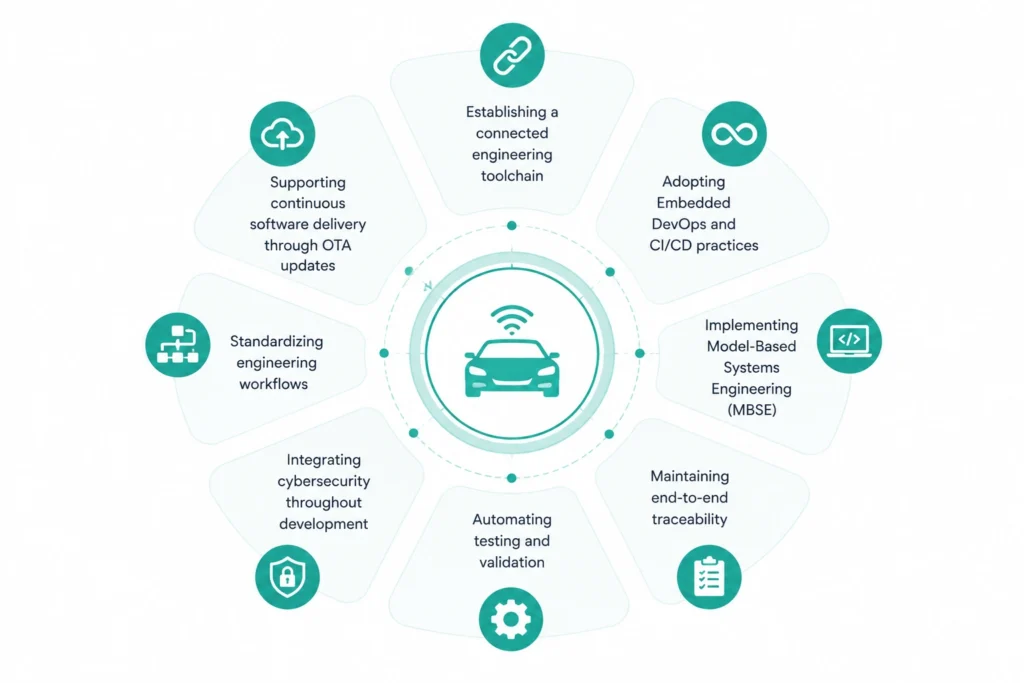
Successfully developing Software Defined Vehicles requires more than adopting new technologies—it demands a structured engineering approach supported by modern tools, automation, and cross-functional collaboration.
Organizations should focus on:
- Establishing a connected engineering toolchain
- Adopting Embedded DevOps and CI/CD practices
- Implementing Model-Based Systems Engineering (MBSE)
- Maintaining end-to-end traceability
- Automating testing and validation
- Integrating cybersecurity throughout development
- Standardizing engineering workflows
- Supporting continuous software delivery through Over-the-Air (OTA) updates
Together, these best practices help improve engineering efficiency, reduce development risks, accelerate software delivery, and enable the successful deployment of secure, scalable, and future-ready Software Defined Vehicles.
For organizations planning to strengthen engineering maturity, adopting ASPICE requires more than documentation, it requires a structured implementation strategy. Our ASPICE Implementation Roadmap provides practical guidance on assessment, process design, toolchain integration, team enablement, and continuous improvement.
Organizations building standardized engineering workflows often compare process improvement frameworks before beginning transformation initiatives. Our ASPICE vs CMMI guide explains the key differences between these frameworks and why ASPICE has become the preferred choice for automotive software and systems engineering.
How MicroGenesis Helps Solve SDV Engineering Challenges
MicroGenesis helps automotive OEMs and Tier 1 suppliers overcome Software Defined Vehicle engineering challenges through integrated engineering consulting and implementation services.
Addressing these engineering challenges requires more than adopting new development tools, it demands a connected engineering ecosystem that integrates requirements management, systems engineering, software development, verification, and lifecycle governance.
Successfully addressing Software-Defined Vehicle engineering challenges requires a holistic digital engineering strategy that brings together Engineering Lifecycle Management (ELM), Model-Based Systems Engineering (MBSE), Embedded DevOps, Functional Safety, Automotive Cybersecurity, ASPICE, and Digital Thread practices.
For an automotive-specific perspective, explore our MBSE for Automotive: A Complete Guide to understand how MBSE supports vehicle architecture, requirements management, systems integration, and validation in complex automotive programs.
Explore our comprehensive Digital Engineering for Automotive Guide to understand how these capabilities work together to accelerate software-driven automotive innovation.
This holistic approach is a key component of digital engineering for automotive, enabling OEMs and Tier-1 suppliers to accelerate innovation while maintaining quality, safety, and compliance.
Our expertise includes:
- Embedded DevOps for CI/CD, Continuous Testing, and release automation
- Model-Based Systems Engineering (MBSE) to manage system complexity and enable digital thread implementation
- Automotive Process Consulting aligned with ASPICE, ISO 26262, and ISO/SAE 21434
- Engineering Lifecycle Management (ALM/ELM) using IBM ELM, PTC Codebeamer, Jira, and integrated engineering platforms
- Engineering Toolchain Integration to connect requirements, development, testing, and compliance across the SDV lifecycle
With over 25 years of engineering transformation experience, MicroGenesis enables organizations to improve engineering collaboration, accelerate software delivery, strengthen compliance, and build secure, scalable, and future-ready Software Defined Vehicle ecosystems.
Frequently Asked Questions
Why are Software Defined Vehicles more difficult to develop?
Overcoming these challenges requires engineering teams to manage software across every phase of product development, from requirements and architecture to validation, deployment, and over-the-air (OTA) updates. Understanding the complete Software Defined Vehicle development lifecycle helps organizations establish repeatable engineering practices that support continuous software innovation throughout the vehicle’s operational life.
What is the biggest challenge in SDV engineering?
Managing software complexity while maintaining safety, compliance, engineering collaboration, and end-to-end traceability remains one of the biggest challenges for automotive organizations.
How does Embedded DevOps help SDV development?
Embedded DevOps automates software builds, testing, integration, and deployment, enabling faster development cycles, improved software quality, and more reliable software releases.
Why is traceability important in SDV engineering?
Traceability connects requirements, development, testing, validation, and release activities, helping organizations improve software quality, demonstrate regulatory compliance, and accurately assess the impact of engineering changes.
Conclusion
Software Defined Vehicles (SDVs) are transforming automotive engineering by shifting innovation from hardware to software. However, this transformation also introduces significant challenges related to software complexity, engineering toolchains, compliance, cybersecurity, and continuous software delivery.
Organizations that invest in connected engineering practices, Embedded DevOps, Model-Based Systems Engineering (MBSE), integrated lifecycle management, and automated testing will be better equipped to deliver secure, scalable, and future-ready Software Defined Vehicles. By adopting a modern engineering approach, automotive manufacturers can accelerate innovation while maintaining the safety, quality, and reliability expected in next-generation mobility solutions.