The automotive industry is undergoing a fundamental transformation driven by software rather than mechanical innovation. As vehicles become increasingly connected, autonomous, and intelligent, manufacturers are shifting from hardware-centric engineering to Software Defined Vehicles (SDVs). This evolution is changing how vehicles are designed, developed, updated, and maintained throughout their lifecycle, redefining the future of automotive software engineering.
Unlike traditional vehicles, where functionality is largely fixed once production is complete, a Software Defined Vehicle can continuously evolve through software updates, cloud connectivity, artificial intelligence, and centralized computing platforms. New features, performance improvements, cybersecurity updates, and even safety enhancements can be delivered remotely through Over-the-Air (OTA) updates, eliminating the need for physical modifications to the vehicle.
Leading automotive manufacturers including Tesla, Mercedes-Benz, BMW, Volkswagen, General Motors, Volvo, and numerous electric vehicle startups are investing heavily in Software Defined Vehicle (SDV) platforms. This shift enables faster innovation, enhanced customer experiences, reduced development cycles, and new business models based on software-driven services. It also supports modern engineering practices such as continuous engineering, Engineering Lifecycle Management (ELM), and Model-Based Systems Engineering (MBSE) to accelerate software delivery while maintaining quality and compliance.
This guide explains what a Software Defined Vehicle is, how it works, the technologies behind it, and why it is becoming the foundation of next-generation automotive engineering and connected mobility.
What Is a Software Defined Vehicle?
A Software Defined Vehicle (SDV) is a vehicle where software controls and manages the majority of vehicle functionality instead of relying primarily on hardware components. In an SDV, software determines how the vehicle behaves, communicates, operates, and evolves throughout its lifecycle.
A Software Defined Vehicle is much more than a connected car, it represents a fundamental shift toward software-driven product innovation across the automotive industry. As vehicles become increasingly dependent on software, manufacturers must modernize engineering processes, integrate hardware and software development, and enable continuous delivery throughout the vehicle lifecycle.
One of the key engineering approaches supporting this transformation is Model-Based Systems Engineering (MBSE), which helps teams manage system architecture, requirements, interfaces, and verification using connected digital models. Learn more in our MBSE Explained: A Complete Guide. These capabilities form the foundation of digital engineering for automotive, helping OEMs and Tier-1 suppliers accelerate innovation while maintaining safety, quality, and regulatory compliance.
Instead of adding new capabilities by replacing hardware, manufacturers can introduce new features through software updates. This allows vehicles to improve long after they leave the factory.
While this software-first approach unlocks continuous innovation, it also introduces new complexities in software integration, cybersecurity, functional safety, system validation, and lifecycle management. Understanding these Software Defined Vehicle engineering challenges is essential for organizations developing scalable and secure next-generation vehicles.
Software in an SDV controls systems such as:
- Advanced Driver Assistance Systems (ADAS)
- Autonomous driving capabilities
- Battery management
- Powertrain optimization
- Infotainment systems
- Vehicle connectivity
- Cybersecurity
- Climate control
- Diagnostics
- Predictive maintenance
- Fleet management
Delivering these advanced capabilities requires more than software development alone. Automotive manufacturers depend on an integrated SDV toolchain architecture that connects requirements management, model-based systems engineering (MBSE), embedded software development, DevOps, automated testing, cybersecurity, and Product Lifecycle Management (PLM). A connected toolchain improves traceability, collaboration, and software quality across the entire engineering ecosystem.
This software-first approach transforms vehicles into continuously improving digital platforms rather than static mechanical products.
Why Is the Automotive Industry Moving Toward Software Defined Vehicles?
Several technological and market trends are driving the rapid adoption of Software Defined Vehicles.
1. Rising Software Complexity
Modern vehicles contain millions of lines of software code controlling everything from engine performance to driver assistance systems. Future autonomous vehicles are expected to contain more than 300 million lines of code, making software one of the most critical engineering assets.
2. Customer Expectations
Consumers expect their vehicles to function like smartphones, with:
- Over-the-air feature updates
- Personalized experiences
- Intelligent navigation
- Connected services
- Remote diagnostics
- Mobile app integration
Software Defined Vehicles enable manufacturers to continuously meet these expectations without requiring dealership visits.
3. Faster Innovation
Traditional automotive development cycles could take several years before new features reached customers.
With SDVs, manufacturers can deploy:
- Performance improvements
- User interface enhancements
- Navigation updates
- Security patches
- Battery optimization
- New driver assistance capabilities
- through secure Over-the-Air (OTA) updates.
4. Electric Vehicles and Autonomous Driving
Electric Vehicles (EVs) and autonomous driving technologies require highly integrated software platforms that coordinate multiple systems simultaneously.
Software Defined Vehicles provide the architecture necessary to manage:
- High-performance computing
- Sensor fusion
- Artificial intelligence
- Battery optimization
- Real-time decision making
How Does a Software Defined Vehicle Work?
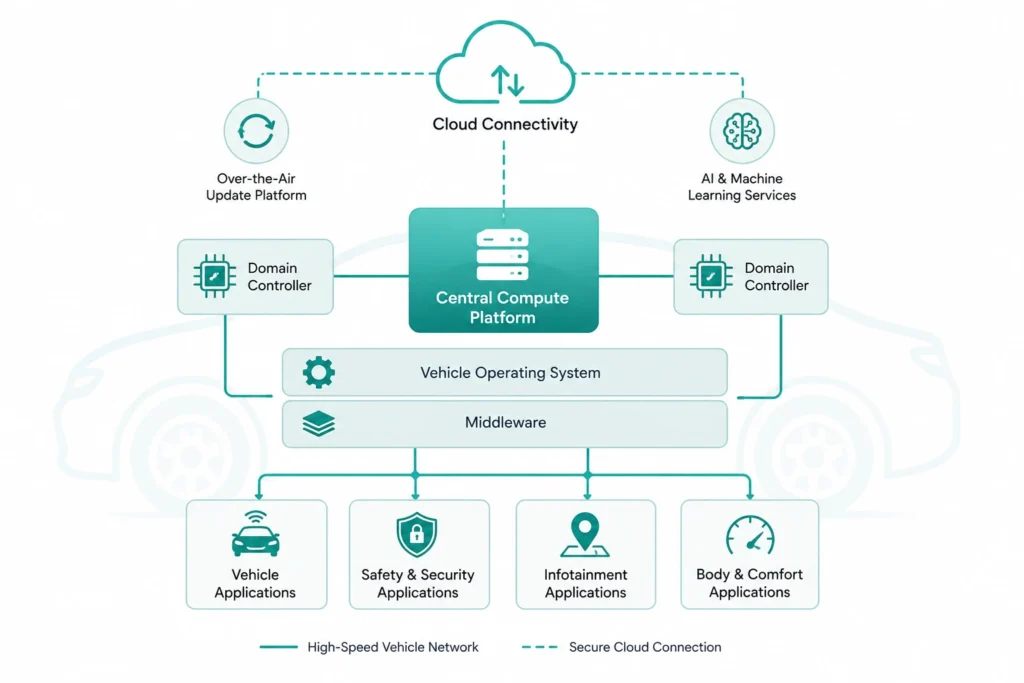
Unlike traditional vehicles that rely on numerous independent Electronic Control Units (ECUs), Software Defined Vehicles use centralized computing platforms connected through high-speed vehicle networks.
Instead of dozens of isolated systems, software applications communicate through common operating systems and middleware layers.
A simplified SDV architecture consists of:
- Central Compute Platform
- Domain Controllers
- Vehicle Operating System
- Middleware
- Cloud Connectivity
- Over-the-Air Update Platform
- Vehicle Applications
- AI & Machine Learning Services
This architecture allows software components to communicate efficiently while maintaining security, scalability, and reliability.
Supporting this architecture with an effective software delivery process requires an automotive-specific DevOps approach. The Automotive DevOps Framework explains how CI/CD, automated testing, release management, quality gates, and engineering collaboration can be integrated for modern automotive software development.
This becomes especially important when organizations adopt continuous software delivery practices. DevOps for ISO 26262 explains how DevOps automation, CI/CD, testing, and release practices can be aligned with the safety requirements of ISO 26262.
Key Components of a Software Defined Vehicle
Centralized Computing Platform
Traditional vehicles often use over 100 separate ECUs.
Software Defined Vehicles consolidate many of these functions into centralized high-performance computers capable of managing multiple vehicle domains simultaneously.
Benefits include:
- Reduced hardware complexity
- Faster processing
- Easier software maintenance
- Simplified system integration
- Lower manufacturing costs
Vehicle Operating System
The Vehicle Operating System serves as the foundation that manages hardware resources and software applications.
It provides:
- Resource management
- Communication services
- Security
- Application execution
- Hardware abstraction
Common automotive operating systems include AUTOSAR Adaptive, Linux-based platforms, and proprietary OEM operating systems.
Domain Controllers
Rather than assigning one ECU to every function, SDVs organize functionality into domains such as:
- Powertrain
- Chassis
- Body electronics
- Infotainment
- Autonomous driving
Each domain controller manages multiple vehicle functions while communicating with the centralized computing platform.
Cloud Connectivity
Cloud platforms enable vehicles to exchange information securely with backend systems.
Cloud connectivity supports:
- Fleet management
- Vehicle diagnostics
- Remote monitoring
- Data analytics
- OTA updates
- Predictive maintenance
Cloud-native architectures are becoming a core capability of Software Defined Vehicles.
Over-the-Air (OTA) Updates
OTA technology allows manufacturers to deploy software updates remotely.
Benefits include:
- Security improvements
- Feature enhancements
- Performance optimization
- Bug fixes
- Compliance updates
OTA updates significantly reduce the need for dealership visits while enabling continuous product improvement.
Software Defined Vehicle Architecture
Software Defined Vehicle architecture is built around centralized software platforms instead of isolated hardware components.
A typical architecture includes:
Application Layer
Driver assistance
Navigation
Infotainment
Diagnostics
↓
Middleware Layer
Communication services
APIs
Data exchange
↓
Vehicle Operating System
↓
Central Compute Platform
↓
Hardware Layer
Sensors
Cameras
Radar
LiDAR
Actuators
ECUs
This layered architecture enables software teams to develop applications independently while maintaining compatibility across vehicle platforms.
For automotive organizations implementing model-based engineering, MBSE for Automotive: A Complete Guide explains how MBSE can support vehicle architecture, requirements management, system integration, and validation across complex automotive programs.
Traditional Vehicles vs Software Defined Vehicles
| Traditional Vehicle | Software Defined Vehicle |
| Hardware-centric architecture | Software-centric architecture |
| Fixed functionality | Continuously evolving functionality |
| Numerous independent ECUs | Centralized computing |
| Manual updates | OTA updates |
| Siloed engineering | Connected engineering |
| Hardware upgrades required | Software feature deployment |
| Limited connectivity | Cloud-native connectivity |
| Reactive maintenance | Predictive maintenance |
The transition to SDVs represents a shift from mechanical engineering dominance to software-driven innovation.
Benefits of Software Defined Vehicles
Software Defined Vehicles provide advantages for both manufacturers and vehicle owners.
Faster Innovation
Manufacturers can release new capabilities without waiting for new vehicle models.
Improved Customer Experience
Drivers benefit from continuous improvements through software updates.
Enhanced Safety
Security patches and safety improvements can be deployed immediately.
Reduced Recall Costs
Many software-related issues can be resolved remotely instead of requiring physical recalls.
Better Engineering Efficiency
Centralized software platforms simplify development, testing, and lifecycle management.
New Revenue Opportunities
Manufacturers can introduce subscription-based features and software-enabled services throughout the vehicle’s lifetime.
Technologies Powering Software Defined Vehicles
Software Defined Vehicles (SDVs) are built on a combination of advanced automotive software platforms, high-performance computing (HPC), cloud technologies, artificial intelligence (AI), and connected engineering practices. Unlike traditional vehicles that depend primarily on hardware, SDVs rely on an integrated technology ecosystem that enables continuous innovation throughout the vehicle’s lifecycle. This software-first architecture supports capabilities such as Over-the-Air (OTA) updates, Vehicle-to-Everything (V2X) connectivity, centralized computing, and continuous engineering, allowing automotive manufacturers to deliver new features, improve performance, and enhance cybersecurity without hardware modifications.
Artificial Intelligence and Machine Learning
Artificial Intelligence (AI) has become a core capability of modern Software Defined Vehicles. AI algorithms continuously process data collected from sensors, cameras, radar, and LiDAR to help vehicles understand their surroundings and make intelligent decisions.
AI enables capabilities such as:
- Advanced Driver Assistance Systems (ADAS)
- Autonomous driving functions
- Driver behavior analysis
- Predictive maintenance
- Route optimization
- Battery performance optimization
- Intelligent energy management
- Personalized driver experiences
Machine learning models improve continuously as new vehicle data becomes available, allowing manufacturers to enhance performance through Over-the-Air (OTA) updates.
Vehicle-to-Everything (V2X) Communication
Software Defined Vehicles are designed to communicate with their surrounding environment through Vehicle-to-Everything (V2X) technology.
V2X communication enables interaction between:
- Vehicle-to-Vehicle (V2V)
- Vehicle-to-Infrastructure (V2I)
- Vehicle-to-Pedestrian (V2P)
- Vehicle-to-Cloud (V2C)
This connectivity improves road safety, traffic management, and autonomous driving capabilities by allowing vehicles to exchange real-time information.
For example, an SDV can receive warnings about road hazards, traffic congestion, or changing weather conditions before the driver encounters them.
High-Performance Computing (HPC)
Traditional vehicles rely on dozens of distributed Electronic Control Units (ECUs), each performing specific functions.
Software Defined Vehicles replace many of these ECUs with centralized High-Performance Computing (HPC) platforms capable of managing multiple vehicle domains simultaneously.
Benefits include:
- Reduced hardware complexity
- Faster software execution
- Simplified maintenance
- Easier software deployment
- Improved system scalability
This centralized architecture is essential for supporting autonomous driving, real-time analytics, and complex AI workloads.
Cloud Computing
Cloud platforms play a significant role throughout the Software Defined Vehicle lifecycle.
Cloud infrastructure supports:
- Software distribution
- OTA updates
- Vehicle diagnostics
- Fleet management
- Engineering collaboration
- Big data analytics
- Remote monitoring
- Digital twin synchronization
Cloud-native engineering also enables manufacturers to accelerate software development while maintaining secure communication between vehicles and backend systems.
Digital Twins
A Digital Twin is a virtual representation of a physical vehicle that mirrors its current condition, performance, and operational state.
Digital twins allow manufacturers to:
- Simulate software changes
- Predict component failures
- Test engineering updates
- Optimize vehicle performance
- Improve maintenance planning
Instead of waiting for issues to occur in the real world, engineering teams can evaluate software behavior within virtual environments before deployment.
Edge Computing
Many Software Defined Vehicle functions require immediate decision-making.
Examples include:
- Emergency braking
- Lane keeping
- Obstacle avoidance
- Steering control
Since cloud communication introduces latency, these operations are processed locally using edge computing within the vehicle.
Only selected data is transmitted to the cloud for long-term analysis and continuous improvement.
Real-World Examples of Software Defined Vehicles
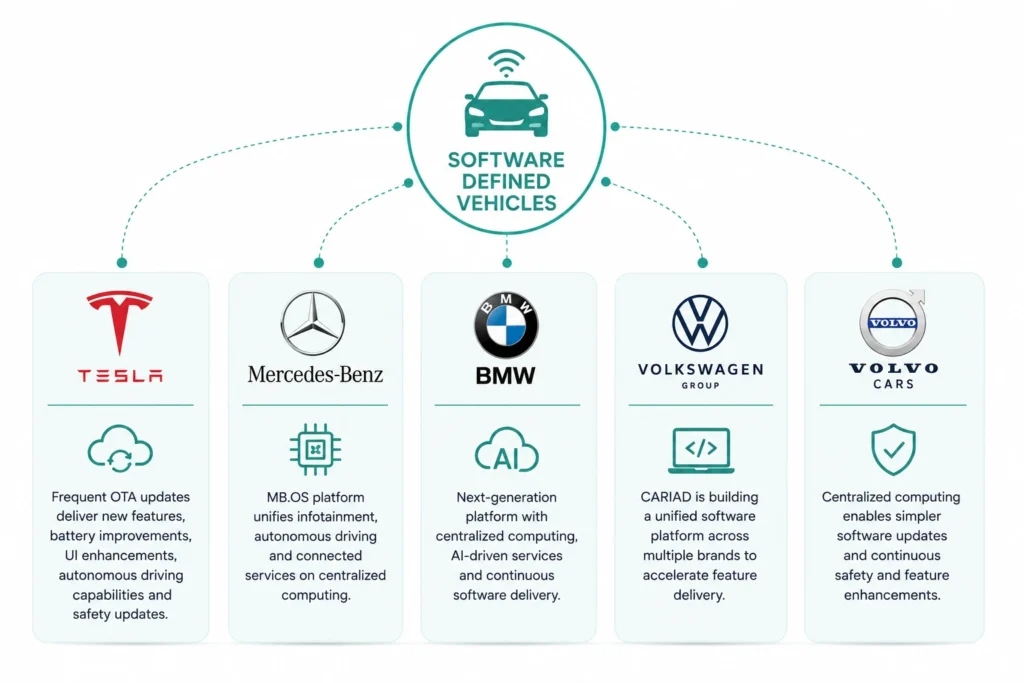
Several automotive manufacturers have already embraced Software Defined Vehicle architectures as the foundation of their future mobility strategies.
Tesla
Tesla is widely recognized as one of the pioneers of Software Defined Vehicles.
Its vehicles receive frequent OTA updates that introduce:
- New driving features
- Battery improvements
- User interface enhancements
- Autonomous driving capabilities
- Safety updates
Rather than waiting for new vehicle models, Tesla continuously enhances existing vehicles through software.
Mercedes-Benz
Mercedes-Benz has invested heavily in its MB.OS platform, a software-defined architecture designed to unify infotainment, autonomous driving, and connected vehicle services.
The company aims to reduce software fragmentation while improving customer experiences through centralized computing platforms.
BMW
BMW’s next-generation vehicle platform integrates centralized computing, AI-driven services, and cloud-native software development.
The company is transitioning toward continuous software delivery rather than traditional release cycles.
Volkswagen Group
Volkswagen’s CARIAD software division focuses on developing a unified software platform that supports multiple vehicle brands.
The objective is to create standardized software architectures across the Volkswagen ecosystem while accelerating feature delivery.
Volvo Cars
Volvo has adopted centralized computing architectures that simplify software updates and improve vehicle safety through continuous engineering practices.
Its next-generation vehicles are designed to receive ongoing enhancements throughout their operational life.
Future Trends in Software Defined Vehicles
Software Defined Vehicles will continue evolving as automotive technology advances.
Several trends are expected to shape the next generation of intelligent mobility.
AI-Driven Engineering
Artificial Intelligence will increasingly automate engineering activities such as:
- Code generation
- Test automation
- Requirements analysis
- Defect prediction
- Release planning
AI-assisted engineering will significantly reduce development cycles while improving software quality.
Fully Autonomous Driving
As sensor technologies and AI algorithms mature, Software Defined Vehicles will enable higher levels of autonomous driving.
Future vehicles will integrate:
- Advanced perception systems
- Sensor fusion
- Real-time AI decision making
- Continuous learning models
Autonomous capabilities will continue improving through OTA software updates.
Connected Engineering Ecosystems
Engineering organizations are moving toward connected digital engineering environments where every artifact is linked through an end-to-end digital thread.
Requirements, source code, models, tests, releases, and operational data will become fully traceable across the engineering lifecycle.
This connected engineering approach improves collaboration while supporting compliance with standards such as ASPICE, ISO 26262, and ISO/SAE 21434.
Continuous Engineering
Software Defined Vehicles require continuous engineering rather than traditional project-based development.
Engineering teams increasingly adopt practices such as:
- Continuous Integration
- Continuous Testing
- Continuous Deployment
- Continuous Verification
- Continuous Compliance
These practices enable organizations to release software faster while maintaining safety and reliability.
Continuous engineering in Software-Defined Vehicles is made possible through CI/CD for Embedded Systems, which combines Continuous Integration (CI), automated testing, release automation, and lifecycle traceability for embedded software. Read our What Is Embedded DevOps? guide to learn how automotive organizations modernize software delivery while maintaining safety and compliance.
Cybersecurity by Design
As vehicles become more connected, cybersecurity will become an even greater priority.
Future Software Defined Vehicles will incorporate:
- Secure software supply chains
- Zero Trust architectures
- Runtime security monitoring
- Secure OTA updates
- Automated vulnerability management
Cybersecurity will be integrated throughout the engineering lifecycle instead of being treated as a separate activity.
How MicroGenesis Helps Accelerate Software Defined Vehicle Development
MicroGenesis helps automotive OEMs and Tier 1 suppliers accelerate Software Defined Vehicle (SDV) development by integrating engineering processes, modern toolchains, and continuous software delivery practices.
Our expertise includes:
- Embedded DevOps for CI/CD, Continuous Testing, and release automation
- Model-Based Systems Engineering (MBSE) for system architecture and digital thread enablement
- Automotive Process Consulting for ASPICE, Functional Safety (ISO 26262), and Automotive Cybersecurity (ISO/SAE 21434)
- Engineering Lifecycle Management (ALM/ELM) using IBM ELM, PTC Codebeamer, Jira, and integrated engineering toolchains
- Engineering Traceability to connect requirements, development, testing, and compliance across the SDV lifecycle
With 25+ years of engineering transformation experience, MicroGenesis enables organizations to reduce development complexity, improve traceability, accelerate software releases, and build secure, scalable Software Defined Vehicle platforms.
Frequently Asked Questions
What is a Software Defined Vehicle?
A Software Defined Vehicle (SDV) is a vehicle where software controls most vehicle functions and enables continuous improvements through software updates instead of hardware replacements.
How is an SDV different from a traditional vehicle?
Traditional vehicles rely primarily on hardware and fixed functionality. Software Defined Vehicles use centralized software platforms that continuously evolve through Over-the-Air updates, cloud connectivity, and intelligent computing.
Why are Software Defined Vehicles important?
SDVs enable manufacturers to deliver new features, improve safety, reduce recalls, accelerate innovation, and provide personalized customer experiences throughout the vehicle lifecycle.
What technologies enable Software Defined Vehicles?
Key technologies include:
- Artificial Intelligence
- Cloud Computing
- High-Performance Computing
- Vehicle-to-Everything (V2X)
- Digital Twins
- Edge Computing
- Over-the-Air Updates
- Centralized Computing Platforms
Are electric vehicles always Software Defined Vehicles?
Not necessarily. While many electric vehicles are Software Defined Vehicles, an EV can still use a traditional hardware-centric architecture. An SDV is defined by its software-first design rather than its propulsion system.
What engineering practices support Software Defined Vehicles?
Organizations developing SDVs commonly adopt:
- Continuous Integration and Continuous Testing
- Requirements Traceability
- Functional Safety Engineering
- Automotive Cybersecurity
Developing an SDV is an ongoing engineering process rather than a one-time product release. From requirements definition and system architecture to software development, validation, deployment, and over-the-air (OTA) updates, every stage plays a critical role in delivering reliable software-driven vehicles. Understanding the complete Software Defined Vehicle development lifecycle helps organizations build vehicles that can continuously evolve after production.
Conclusion
Software Defined Vehicles (SDVs) are redefining how modern vehicles are engineered, delivered, and maintained. By placing software at the center of vehicle functionality, manufacturers can innovate continuously, respond quickly to evolving customer expectations, and enhance safety, performance, and the overall driving experience throughout the vehicle’s lifecycle. This software-first approach is driving the next wave of automotive digital transformation and connected mobility.
Organizations preparing for OEM evaluations or process improvement initiatives can also explore our ASPICE Level Assessment guide to understand assessment preparation, capability evaluation, and evidence collection.
If you’re evaluating process improvement frameworks, our ASPICE vs. CMMI comparison explains the differences, advantages, and ideal use cases for automotive software engineering organizations.
For organizations planning to adopt Automotive SPICE, our ASPICE Implementation Roadmap provides a step-by-step approach to process improvement, toolchain alignment, training, and continuous engineering transformation.
As vehicle software continues to grow in complexity, technologies such as centralized computing, AI-driven engineering, cloud-native development, Embedded DevOps, and Model-Based Systems Engineering (MBSE) will become fundamental to developing scalable, secure, and future-ready automotive platforms. These capabilities not only accelerate innovation but also help manufacturers meet evolving industry standards such as ISO 26262, ASPICE, and ISO/SAE 21434.
If you’re new to Automotive SPICE, our What Is ASPICE? guide explains its process framework, capability levels, and how it helps organizations improve software quality and engineering maturity.
For organizations beginning their Software Defined Vehicle journey, investing in an integrated engineering toolchain, continuous engineering practices, and collaborative software development is essential to accelerating innovation while maintaining quality, traceability, cybersecurity, and regulatory compliance. Businesses that embrace these technologies today will be well positioned to lead the future of intelligent, connected, and software-defined mobility.