
The automotive industry is rapidly transitioning to Software Defined Vehicles (SDVs), where software powers everything from infotainment and connectivity to Advanced Driver Assistance Systems (ADAS) and autonomous driving. As vehicles become increasingly software-centric, manufacturers are shifting away from isolated engineering processes toward integrated, data-driven development environments that support continuous innovation throughout the vehicle lifecycle.
Unlike traditional automotive development, where hardware and software teams often worked independently, SDV engineering requires seamless collaboration across systems engineering, software development, testing, cybersecurity, compliance, and release management. Every engineering decision—from defining requirements to deploying Over-the-Air (OTA) updates—must remain connected to ensure quality, safety, and regulatory compliance.
This interconnected engineering environment is known as the Software Defined Vehicle (SDV) Toolchain Architecture.
An effective SDV toolchain integrates engineering tools, teams, and processes into a unified ecosystem where information flows seamlessly across the entire development lifecycle. By establishing a connected engineering environment, organizations can improve collaboration, achieve end-to-end traceability, automate testing, and accelerate software delivery while managing the growing complexity of modern automotive software.
An integrated SDV toolchain is one of the core building blocks of modern digital engineering for automotive. It connects requirements management, systems engineering, embedded software development, testing, DevOps, cybersecurity, and compliance into a unified engineering ecosystem. Explore our Digital Engineering for Automotive Guide to learn how these capabilities work together to support Software-Defined Vehicles (SDVs) and next-generation mobility.
In this guide, we’ll explore what an SDV toolchain is, why it matters, its core components, common implementation challenges, and the best practices for building a scalable, future-ready engineering ecosystem.
What Is an SDV Toolchain?
An SDV toolchain is an integrated ecosystem of engineering tools, platforms, and processes that supports the complete Software Defined Vehicle development lifecycle—from requirements engineering and systems design to software development, validation, deployment, and long-term lifecycle management.
Rather than relying on disconnected applications that create information silos, an SDV toolchain enables engineering data to flow continuously between teams, disciplines, and development stages. This creates a digital thread that connects every engineering artifact, ensuring complete visibility and traceability throughout the product lifecycle.
A modern SDV toolchain typically supports:
- Requirements Management
- Systems Engineering
- Software Development
- Source Code Management
- Continuous Integration & Continuous Delivery (CI/CD)
- Test Management
- Configuration Management
- Release Management
- Compliance Management
- Engineering Traceability
Instead of treating each discipline as a separate activity, an integrated toolchain enables engineering teams to collaborate within a single connected ecosystem, improving productivity and reducing development risks.
A modern SDV toolchain is designed to support every aspect of software-driven vehicle development, from requirements management and system design to software implementation, testing, deployment, and continuous updates. To fully appreciate why these integrated tools are essential, it’s helpful to first understand What Is a Software Defined Vehicle (SDV)? and how software has become the primary driver of innovation in modern automotive engineering.
Why SDV Toolchain Architecture Matters
Modern Software Defined Vehicles contain millions of lines of software code developed by geographically distributed engineering teams working across multiple disciplines. Managing this complexity requires far more than individual engineering tools—it demands a connected architecture that enables every team to work from the same source of truth.
Without an integrated SDV toolchain, organizations often face challenges such as:
- Fragmented engineering workflows
- Duplicate engineering data
- Manual information transfer
- Poor cross-team visibility
- Slow software release cycles
- Limited traceability
- Increased compliance risks
These issues not only slow development but also make it difficult to maintain software quality, demonstrate compliance, and respond quickly to changing requirements.
An integrated SDV toolchain addresses these challenges by creating a unified engineering ecosystem where information is automatically synchronized throughout the development lifecycle.
Benefits of an Integrated SDV Toolchain
A connected engineering environment enables organizations to:
- Accelerate engineering collaboration
- Improve software quality
- Automate repetitive engineering workflows
- Achieve end-to-end traceability
- Simplify regulatory compliance
- Accelerate software delivery
- Reduce development risks
- Improve engineering visibility across teams
Ultimately, a well-designed toolchain helps automotive organizations deliver innovative software faster while maintaining the safety, quality, and reliability expected in modern vehicles.
Core Components of an SDV Toolchain Architecture
Every successful Software Defined Vehicle program relies on a connected engineering toolchain made up of several interconnected components. Each component contributes to a different stage of the engineering lifecycle while sharing information across the broader development ecosystem.
1. Requirements Management
Every Software Defined Vehicle begins with well-defined requirements. Requirements management forms the foundation of the entire engineering lifecycle by ensuring that customer needs, regulatory obligations, and technical specifications are captured accurately and managed throughout development.
Engineering teams use requirements management tools to organize and maintain:
- Functional requirements
- Safety requirements
- Cybersecurity requirements
- Regulatory requirements
- Customer expectations
- Engineering specifications
Modern requirements management platforms keep requirements connected to architecture models, source code, testing activities, and validation results. This end-to-end traceability simplifies change management and supports compliance with automotive standards.
Common Tools
- IBM DOORS Next
- PTC Codebeamer
- Siemens Polarion
2. Systems Engineering
As Software Defined Vehicles become increasingly complex, traditional document-based engineering is no longer sufficient. Engineering teams must manage interactions between software, electronics, sensors, communication networks, and cloud services across multiple vehicle domains.
Model-Based Systems Engineering (MBSE) replaces static documentation with intelligent system models that improve collaboration and enable early validation. If you’re new to MBSE, explore our MBSE Explained: A Complete Guide to understand its core concepts, system modeling approach, benefits, and role in modern engineering.
Systems engineering platforms help teams:
- Define system architecture
- Model vehicle behavior
- Validate system interactions
- Simulate performance
- Improve cross-domain collaboration
- Reduce design errors before implementation
By identifying potential issues early in the development process, MBSE helps organizations reduce rework, accelerate development, and improve engineering quality.
For an automotive-specific perspective, explore our MBSE for Automotive: A Complete Guide to learn how MBSE supports vehicle architecture, requirements management, systems integration, and validation across complex automotive programs.
Common Tools
- IBM Rhapsody
- Cameo Systems Modeler
- Enterprise Architect
3. Source Code Management
Modern SDVs involve thousands of software components developed simultaneously by distributed engineering teams. Managing these codebases efficiently requires centralized Source Code Management (SCM) platforms that support collaboration while maintaining version control and software integrity.
SCM platforms provide:
- Version control
- Branch management
- Code reviews
- Merge requests
- Team collaboration
- Complete audit history
By maintaining a single source of truth for software assets, source code management enables teams to collaborate effectively, track changes, and integrate new features with confidence.
Common Platforms
- Git
- GitLab
- GitHub Enterprise
- Azure Repos
4. Continuous Integration and Continuous Delivery (CI/CD)
Modern Software Defined Vehicles (SDVs) require rapid software development without compromising quality, safety, or compliance. Unlike traditional automotive development, where software updates were infrequent, SDVs rely on continuous software delivery to introduce new features, improve performance, and address security vulnerabilities throughout the vehicle’s lifecycle.
Continuous Integration and Continuous Delivery (CI/CD) enables engineering teams to automate repetitive development tasks, reducing manual effort while accelerating software releases.
For embedded automotive software, implementing CI/CD requires additional considerations such as hardware dependencies, simulation environments, and continuous validation. Explore our CI/CD for Embedded Systems guide to learn how automated builds, testing, and deployment can be adapted for embedded development.
A typical CI/CD pipeline automates:
- Software builds
- Automated testing
- Static code analysis
- Security scanning
- Deployment preparation
- Release automation
By integrating automation into every stage of development, organizations can identify defects earlier, improve software quality, and shorten release cycles.
Common CI/CD Platforms
- Jenkins
- GitLab CI/CD
- Azure DevOps
- GitHub Actions
For automotive environments, Embedded DevOps extends CI/CD by integrating hardware validation, simulation environments, and compliance activities into the software delivery pipeline, making continuous delivery practical for embedded systems.
To understand how DevOps practices are adapted for embedded automotive software, explore our What Is Embedded DevOps? guide. It explains how Continuous Integration, automated testing, release automation, and compliance-driven workflows help engineering teams accelerate software delivery while maintaining quality, safety, and traceability.
5. Test Management
Testing is one of the most critical phases of the Software Defined Vehicle development lifecycle. As vehicle software becomes increasingly sophisticated, organizations must validate every software component before deployment to ensure functionality, safety, security, and regulatory compliance.
An effective test management strategy helps engineering teams organize and track:
- Test plans
- Test cases
- Test execution
- Defect management
- Regression testing
- Validation reports
Rather than relying on manual testing alone, modern engineering organizations adopt automated testing frameworks that provide faster feedback and improve release confidence.
In safety-critical automotive environments, automated testing and continuous delivery must also support functional safety requirements. Our DevOps for ISO 26262 guide explains how DevOps practices, CI/CD, automated testing, and release workflows can be aligned with ISO 26262.
Centralized test management also enables better collaboration between development, testing, and quality assurance teams while ensuring complete traceability between requirements and test results.
Common Test Management Platforms
- IBM Engineering Test Management
- Vector vTESTstudio
- dSPACE AutomationDesk
6. Configuration Management
Managing multiple software versions across different vehicle variants can quickly become complex without a structured configuration management process.
Configuration Management ensures that every engineering artifact remains synchronized throughout the development lifecycle by maintaining consistent versions, baselines, and dependencies across hardware and software components.
Engineering teams typically manage:
- Software versions
- Hardware configurations
- System baselines
- Product releases
- Dependencies
- Configuration changes
Effective configuration management reduces integration issues, supports change control, and provides a reliable foundation for compliance audits and release management.
As Software Defined Vehicles continue to evolve through Over-the-Air (OTA) updates, maintaining accurate configuration records becomes increasingly important for ensuring compatibility and long-term software maintainability.
7. Engineering Traceability
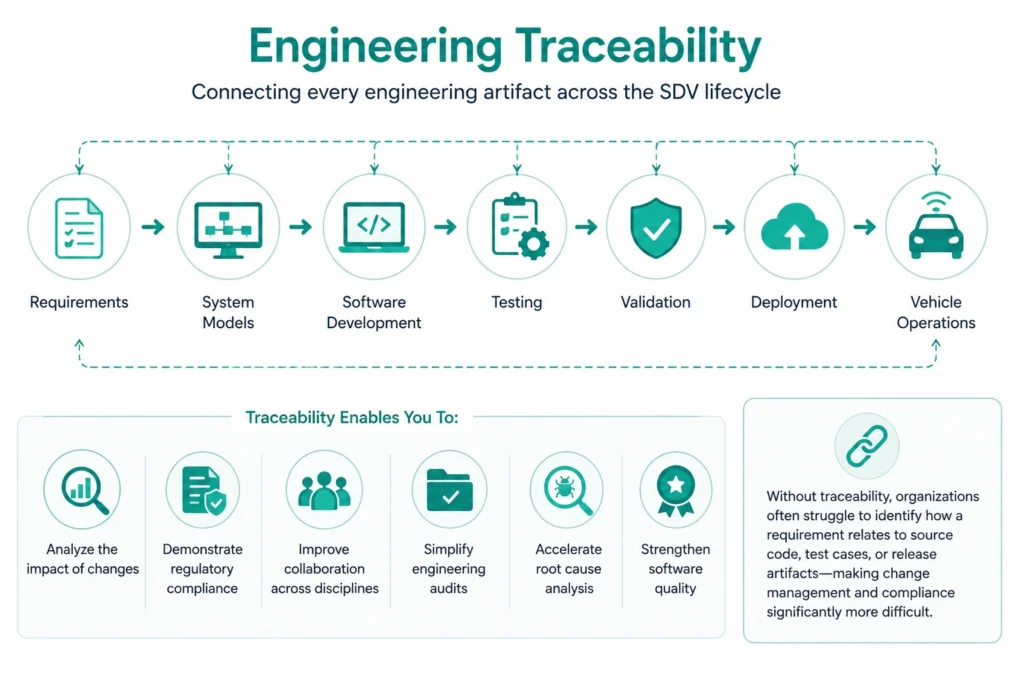
One of the defining characteristics of an effective SDV Toolchain Architecture is end-to-end engineering traceability.
Traceability connects every engineering artifact across the development lifecycle, allowing organizations to understand how requirements evolve into software, how software is validated, and how every change impacts the final product.
A complete digital engineering workflow typically connects:
Requirements
│
▼
System Models
│
▼
Software Development
│
▼
Testing
│
▼
Validation
│
▼
Deployment
│
▼
Vehicle Operations
This continuous flow of information enables engineering teams to:
- Analyze the impact of changes
- Demonstrate regulatory compliance
- Improve collaboration across disciplines
- Simplify engineering audits
- Accelerate root cause analysis
- Strengthen software quality
Without traceability, organizations often struggle to identify how a requirement relates to source code, test cases, or release artifacts—making change management and compliance significantly more difficult.
8. Release Management
Software development doesn’t end when coding is complete. Engineering teams must ensure that every software release is properly planned, validated, approved, and deployed across multiple vehicle platforms.
Release Management coordinates the final stages of software delivery while minimizing operational risk.
Typical release activities include:
- Release planning
- Version management
- Build approvals
- Deployment scheduling
- OTA preparation
- Rollback planning
For Software Defined Vehicles, release management has become increasingly important because vehicles continue receiving software enhancements long after production.
A structured release management process enables manufacturers to deliver secure, reliable software updates while maintaining customer trust and ensuring uninterrupted vehicle performance.
Digital Thread: The Foundation of SDV Toolchain Architecture
One of the most valuable outcomes of an integrated Software Defined Vehicle Toolchain is the creation of a Digital Thread.
A Digital Thread establishes continuous connectivity between engineering artifacts, creating a single source of truth throughout the vehicle development lifecycle. Instead of managing isolated documents and disconnected engineering activities, every requirement, model, code change, test result, and release remains linked within a unified engineering ecosystem.
This connected approach allows organizations to trace every engineering decision from the initial customer requirement through system design, software development, validation, deployment, and ongoing vehicle operations.
Benefits of a Digital Thread
A well-implemented Digital Thread helps organizations:
- Improve engineering visibility
- Strengthen collaboration across teams
- Simplify change management
- Accelerate impact analysis
- Demonstrate regulatory compliance
- Improve decision-making
- Support continuous engineering practices
As Software Defined Vehicles continue to increase in complexity, implementing a Digital Thread is becoming a strategic requirement rather than simply a technology improvement. It provides the transparency, traceability, and collaboration needed to deliver high-quality software while meeting evolving automotive safety and cybersecurity standards.
Common SDV Toolchain Challenges
While the benefits of an integrated SDV toolchain are significant, implementing one is not without challenges. Many automotive organizations still rely on legacy engineering environments, disconnected tools, and manual workflows that make collaboration and lifecycle management increasingly difficult.
Recognizing these challenges early helps organizations build a more resilient and scalable engineering ecosystem.
1. Tool Silos
Engineering teams often use specialized tools for different activities such as requirements management, systems engineering, software development, testing, and release management. When these tools operate independently, information becomes fragmented, making collaboration more difficult.
This often leads to:
- Duplicate engineering data
- Manual information sharing
- Inconsistent project information
- Reduced engineering visibility
- Slower decision-making
Best Practice
Integrate engineering tools into a unified ecosystem where information flows automatically between teams, reducing manual effort and improving collaboration.
2. Limited Traceability
As Software Defined Vehicle development becomes more software-centric, maintaining complete traceability across the engineering lifecycle becomes increasingly challenging.
Without a connected engineering ecosystem, organizations often struggle with disconnected workflows, inconsistent data, limited traceability, and inefficient collaboration across software and systems teams. These are among the most common Software Defined Vehicle engineering challenges, making toolchain integration a critical success factor for modern automotive programs.
Disconnected engineering activities make it difficult to answer critical questions such as:
- Which requirement changed?
- Which software modules are affected?
- Which test cases need to be executed?
- Does the change impact Functional Safety or Cybersecurity?
- Which vehicle release contains the updated software?
Without complete traceability, organizations face higher compliance risks and increased engineering effort during audits and change management.
Best Practice
Implement end-to-end traceability by connecting requirements, system models, source code, testing activities, and release artifacts within a single engineering environment.
3. Manual Engineering Processes
Many engineering organizations still depend on manual processes to transfer information between tools, update documentation, or coordinate releases. These repetitive activities consume valuable engineering time and increase the likelihood of human error.
Examples include:
- Manual status updates
- Spreadsheet-based tracking
- Manual test execution
- Email-based approvals
- Manual release coordination
These activities slow development and reduce overall engineering efficiency.
Best Practice
Automate repetitive workflows wherever possible, including builds, testing, validation, reporting, approvals, and release management. Automation improves consistency while allowing engineering teams to focus on innovation rather than administrative tasks.
4. Supplier Collaboration
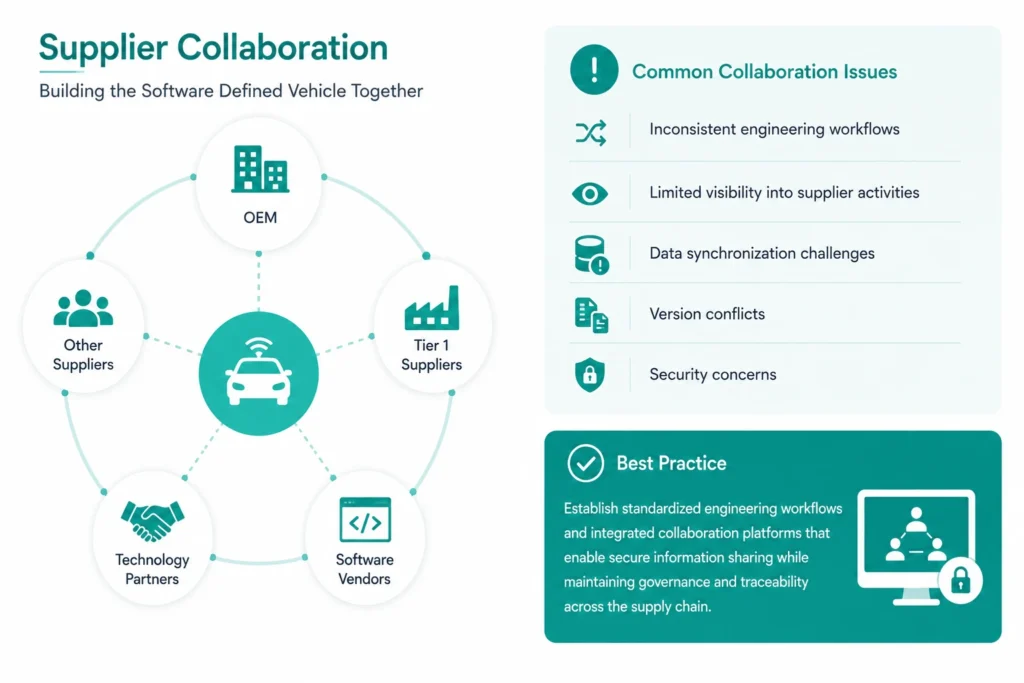
Developing a modern Software Defined Vehicle involves collaboration between automotive OEMs, Tier 1 suppliers, software vendors, and technology partners. Each organization may use different engineering tools and processes, creating challenges in sharing information securely and efficiently.
Common collaboration issues include:
- Inconsistent engineering workflows
- Limited visibility into supplier activities
- Data synchronization challenges
- Version conflicts
- Security concerns
Best Practice
Establish standardized engineering workflows and integrated collaboration platforms that enable secure information sharing while maintaining governance and traceability across the supply chain.
5. Compliance Management
Meeting automotive standards such as ASPICE, ISO 26262, and ISO/SAE 21434 requires complete visibility into engineering activities. Organizations must demonstrate that every requirement has been implemented, tested, validated, and approved.
Automotive SPICE (ASPICE) provides the framework for assessing and improving software and systems engineering processes across the automotive lifecycle. If you’re new to the standard, read our What Is ASPICE? guide to understand its process areas, capability levels, and role in building high-quality automotive software.
Many OEMs and Tier-1 suppliers also expect organizations to demonstrate engineering process maturity through formal assessments. Our ASPICE Level Assessment guide explains how capability levels are evaluated, what assessors look for, and how engineering teams can prepare for successful assessments.
Without an integrated toolchain, compliance activities often become time-consuming and resource-intensive.
Best Practice
Embed compliance into everyday engineering workflows rather than treating it as a separate activity. Automated traceability, digital documentation, and centralized lifecycle management simplify audits and reduce compliance risks.
Best Practices for Building an SDV Toolchain
Building an effective SDV Toolchain Architecture requires more than selecting the right engineering tools. Success depends on creating a connected ecosystem where people, processes, and technology work together seamlessly.
The following best practices help organizations maximize the value of their engineering toolchain.
Integrate Engineering Tools
Avoid isolated engineering environments by connecting requirements management, systems engineering, software development, testing, configuration management, and release management into a single engineering ecosystem.
A connected toolchain eliminates duplicate work, improves visibility, and strengthens collaboration across engineering teams.
Establish a Digital Thread
A Digital Thread ensures every engineering artifact remains connected throughout the lifecycle.
This allows organizations to:
- Understand the impact of changes
- Improve engineering visibility
- Simplify compliance
- Strengthen collaboration
- Accelerate root cause analysis
Rather than managing disconnected documents, engineering teams gain a continuous flow of information across every stage of development.
Automate Engineering Workflows
Automation plays a critical role in modern Software Defined Vehicle development.
Organizations should automate activities such as:
- Software builds
- Testing
- Validation
- Security scanning
- Compliance reporting
- Deployment
A structured Automotive DevOps Framework brings these automation practices together across CI/CD, continuous testing, release management, quality controls, and engineering collaboration. Explore the framework to understand how DevOps can be adapted to the requirements of modern automotive software development.
Automated workflows reduce manual effort, improve consistency, and enable faster software delivery without compromising quality.
Standardize Engineering Processes
Engineering teams often work across multiple business units, suppliers, and geographic locations. Standardized workflows ensure everyone follows consistent engineering practices regardless of team or location.
Selecting the right process improvement framework is equally important when standardizing engineering practices. Our ASPICE vs. CMMI guide compares both frameworks and explains why ASPICE has become the preferred model for automotive software and systems engineering.
Standardization improves:
- Collaboration
- Governance
- Engineering quality
- Compliance
- Knowledge sharing
Enable Continuous Engineering
Unlike traditional automotive programs, Software Defined Vehicles continue evolving long after production.
Organizations should support continuous:
- Development
- Integration
- Testing
- Deployment
- Monitoring
- Improvement
Continuous engineering enables manufacturers to deliver regular software enhancements, respond quickly to customer feedback, and maintain software quality throughout the vehicle lifecycle.
How MicroGenesis Helps Build SDV Toolchain Architecture
Building an integrated Software Defined Vehicle Toolchain requires deep expertise in engineering processes, toolchain integration, lifecycle management, and automotive compliance.
MicroGenesis partners with automotive OEMs and Tier 1 suppliers to design, implement, and optimize connected engineering ecosystems that support the entire SDV development lifecycle.
Our expertise includes:
- Engineering Toolchain Integration across IBM ELM, PTC Codebeamer, Jira, Git, Jenkins, and other engineering platforms
- Embedded DevOps implementation for CI/CD, Continuous Testing, and release automation
- Model-Based Systems Engineering (MBSE) to simplify system complexity and enable Digital Thread implementation
- Engineering Lifecycle Management (ALM/ELM) for end-to-end traceability, governance, and compliance
- Automotive Process Consulting aligned with ASPICE, ISO 26262, and ISO/SAE 21434
Organizations planning to adopt Automotive SPICE can benefit from a structured implementation strategy. Our ASPICE Implementation Roadmap outlines the key phases of implementation, from gap assessment and process definition to toolchain integration, training, and continuous process improvement.
With more than 25 years of engineering transformation experience, MicroGenesis helps organizations improve collaboration, accelerate software delivery, strengthen compliance, and build scalable engineering ecosystems that support next-generation Software Defined Vehicles.
Frequently Asked Questions
What is an SDV toolchain?
An SDV toolchain is an integrated engineering ecosystem that connects requirements management, systems engineering, software development, testing, deployment, and lifecycle management to support the complete development of Software Defined Vehicles.
Why is toolchain integration important?
Toolchain integration eliminates engineering silos, improves collaboration, enables end-to-end traceability, automates workflows, and accelerates software delivery while maintaining quality and compliance.
A well-integrated SDV toolchain supports every phase of product development, from requirements engineering and system architecture to software implementation, validation, deployment, and post-production maintenance. Learn how these engineering activities fit together throughout the Software Defined Vehicle development lifecycle and why lifecycle-wide traceability is essential for delivering safe, secure, and continuously evolving vehicles.
What is the Digital Thread?
A Digital Thread connects engineering artifacts throughout the development lifecycle, providing complete visibility and traceability from requirements and design through development, testing, deployment, and ongoing vehicle operations.
An effective SDV toolchain is more than a collection of engineering tools, it establishes a connected digital thread that links requirements, systems engineering, embedded software development, testing, DevOps, cybersecurity, and Product Lifecycle Management (PLM). This integrated approach is a fundamental pillar of digital engineering for automotive, enabling organizations to improve collaboration, traceability, software quality, and development efficiency across the vehicle lifecycle.
Which tools are commonly used in SDV development?
Commonly used engineering platforms include:
- IBM DOORS Next
- IBM Rhapsody
- PTC Codebeamer
- Jira
- Git
- Jenkins
- GitLab
- MATLAB/Simulink
- IBM Engineering Test Management
The right combination depends on an organization’s engineering processes, compliance requirements, and software development strategy.
Conclusion
As Software Defined Vehicles (SDVs) continue to redefine the automotive industry, engineering organizations must move beyond disconnected tools and traditional development approaches. An integrated SDV Toolchain Architecture provides the foundation for managing growing software complexity while improving collaboration, traceability, and engineering efficiency.
By connecting requirements, systems engineering, software development, testing, compliance, and release management within a unified engineering ecosystem, organizations can accelerate software delivery without compromising quality or safety. Combined with Digital Thread, automation, and continuous engineering practices, an integrated toolchain enables automotive manufacturers to build scalable, secure, and future-ready Software Defined Vehicles capable of supporting the next generation of connected and intelligent mobility.