

Organizations developing complex, software-intensive products need structured engineering processes to improve quality, reduce project risks, and deliver predictable outcomes. As products become more connected and software-driven, engineering teams must adopt standardized frameworks that improve collaboration, governance, and process maturity across the entire development lifecycle.
Two of the most widely recognized process improvement frameworks are Automotive SPICE (ASPICE) and the Capability Maturity Model Integration (CMMI). While both help organizations improve engineering and business performance, they were created to solve different challenges.
ASPICE is designed specifically for automotive systems and software engineering, whereas CMMI provides a broader framework for improving organizational processes across industries such as aerospace, defense, healthcare, manufacturing, financial services, and IT.
As organizations transition toward Software-Defined Vehicles, engineering complexity continues to increase, making structured process frameworks more important than ever.
A common question among engineering leaders is whether ASPICE is better than CMMI or whether both frameworks should be implemented together. The answer depends on the organization’s industry, customer requirements, and long-term engineering goals.
In this guide, we’ll compare ASPICE and CMMI, explain their similarities and differences, explore how each framework measures process maturity, and help you determine which approach best fits your organization.
What Is ASPICE?
Automotive SPICE (ASPICE) is a process assessment model developed specifically for the automotive industry. It evaluates the maturity and effectiveness of engineering processes used to develop automotive software and systems.
Derived from the ISO/IEC 15504 standard, ASPICE has become the preferred engineering framework for automotive OEMs and Tier 1 suppliers worldwide. Rather than evaluating only the final product, it measures how engineering activities are planned, executed, monitored, and continuously improved.
The primary objectives of ASPICE include:
- Standardizing engineering processes
- Improving software and systems quality
- Reducing engineering risks
- Strengthening supplier capability
- Enhancing engineering traceability
- Supporting compliance with automotive standards
ASPICE places significant emphasis on:
- Requirements Engineering
- Systems Engineering
- Software Engineering
- Verification and Validation
- Configuration Management
- Change Management
- Engineering Traceability
Modern automotive organizations often combine ASPICE with Automotive Process Consulting to establish standardized engineering workflows, improve assessment readiness, and accelerate process maturity.
What Is CMMI?
Capability Maturity Model Integration (CMMI) is a globally recognized process improvement framework developed by the Software Engineering Institute (SEI) at Carnegie Mellon University.
Unlike ASPICE, CMMI is not limited to a specific industry. It helps organizations improve project management, operational efficiency, governance, and organizational performance across multiple business functions.
CMMI provides guidance for improving:
- Project Management
- Product Development
- Service Delivery
- Supplier Management
- Risk Management
- Organizational Governance
- Process Improvement
Because of its flexibility, CMMI is widely adopted across industries that require consistent project execution and continuous improvement.
While ASPICE focuses primarily on engineering excellence within automotive development, CMMI helps organizations strengthen enterprise-wide business processes.
Why Were ASPICE and CMMI Developed?
Although ASPICE and CMMI both promote process improvement, they were developed to address different business needs.
Why ASPICE Was Created
As automotive software became increasingly complex, manufacturers needed a consistent way to evaluate the engineering capabilities of suppliers.
Different suppliers followed different development methodologies, making it difficult for OEMs to compare engineering maturity or ensure consistent software quality.
ASPICE was introduced to provide:
- Standardized engineering processes
- Consistent supplier evaluations
- Better software quality
- Reduced vehicle defects
- Improved engineering collaboration
- Automotive-specific governance
Today, ASPICE is considered the industry standard for assessing software and systems engineering maturity in automotive organizations.
Why CMMI Was Created
Organizations across multiple industries required a framework that could improve organizational performance, project delivery, and operational consistency.
CMMI was developed to help organizations:
- Standardize business processes
- Improve project predictability
- Enhance customer satisfaction
- Reduce operational inefficiencies
- Support continuous improvement
- Strengthen organizational governance
Unlike ASPICE, which focuses on engineering activities, CMMI provides a broader business process improvement framework that can be applied across different industries and organizational functions.
ASPICE vs CMMI: Key Differences
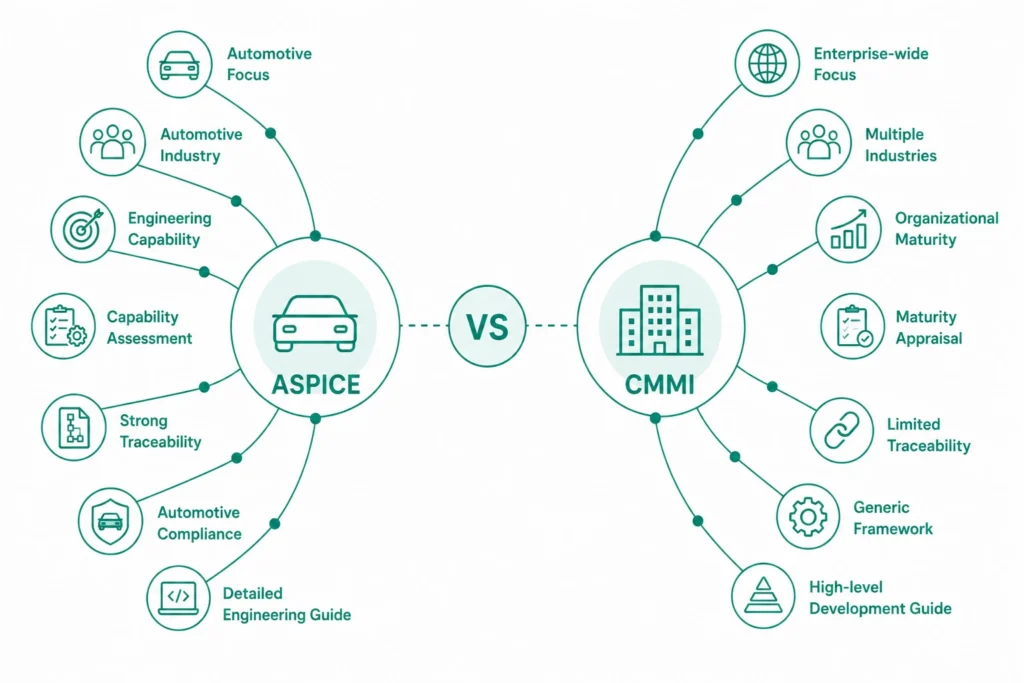
Although both frameworks improve organizational maturity, they differ significantly in their objectives, scope, and implementation.
| Feature | ASPICE | CMMI |
|---|---|---|
| Primary Focus | Automotive engineering process maturity | Enterprise-wide process improvement |
| Industry | Automotive | Multiple industries |
| Developed For | Automotive OEMs and suppliers | Organizations across all industries |
| Origin | ISO/IEC 15504 | Software Engineering Institute (SEI) |
| Assessment Method | Capability assessment | Maturity appraisal |
| Primary Objective | Engineering process capability | Organizational process maturity |
| Requirements Engineering | Extensive guidance | General guidance |
| Engineering Traceability | Strong emphasis | Limited emphasis |
| Automotive Compliance | Designed specifically for automotive | Generic process framework |
| Software Engineering | Detailed engineering processes | High-level development guidance |
The biggest difference is that ASPICE evaluates engineering process capability at the process level, while CMMI measures the overall maturity of an organization.
For automotive companies developing software-intensive products, ASPICE provides significantly more detailed guidance for engineering disciplines such as requirements management, software development, testing, and lifecycle traceability.
Scope of ASPICE
ASPICE is designed specifically for automotive systems and software engineering. It evaluates the engineering processes involved in developing reliable, safe, and high-quality automotive products throughout the product lifecycle.
Rather than focusing on a single engineering discipline, ASPICE covers multiple process groups that work together to ensure consistent development practices.
The primary ASPICE process groups include:
- Customer-Supplier Processes
- System Engineering
- Software Engineering
- Supporting Processes
- Management Processes
- Process Improvement
- Reuse Engineering
Together, these process areas establish a structured framework for managing requirements, architecture, software development, testing, configuration management, quality assurance, and continuous improvement.
As automotive products become increasingly software-centric, organizations are adopting Digital Engineering for Automotive to integrate engineering disciplines, improve collaboration, and maintain end-to-end lifecycle visibility.
Scope of CMMI
Unlike ASPICE, CMMI is not limited to engineering or the automotive industry. It provides a comprehensive framework for improving organizational performance across different business functions.
CMMI supports process improvement in areas such as:
- Project Planning
- Project Monitoring and Control
- Risk Management
- Supplier Management
- Process and Product Quality Assurance
- Organizational Process Definition
- Organizational Training
- Measurement and Analysis
- Configuration Management
- Decision Analysis
The framework focuses on improving organizational consistency, operational efficiency, and project predictability regardless of industry.
For organizations serving multiple industries, CMMI provides a flexible process improvement model that can be adapted to different business environments.
ASPICE Capability Levels vs CMMI Maturity Levels
One of the most significant differences between ASPICE and CMMI is the way they measure process maturity.
Although both frameworks use five progressive levels, they evaluate organizations differently.
ASPICE Capability Levels
ASPICE measures the capability of individual engineering process areas rather than assigning a single maturity rating to the organization.
Each process receives its own capability level.
| Capability Level | Description |
|---|---|
| CL0 | Incomplete Process |
| CL1 | Performed Process |
| CL2 | Managed Process |
| CL3 | Established Process |
| CL4 | Predictable Process |
| CL5 | Innovating Process |
For example, an organization may achieve:
- SWE.1 Software Requirements Analysis: CL3
- SYS.2 System Architecture Design: CL2
- SUP.8 Configuration Management: CL3
This detailed evaluation helps organizations identify strengths and improvement opportunities within specific engineering disciplines.
CMMI Maturity Levels
CMMI evaluates the maturity of the organization as a whole rather than assessing individual engineering processes.
The maturity levels include:
| Maturity Level | Description |
|---|---|
| Level 1 | Initial |
| Level 2 | Managed |
| Level 3 | Defined |
| Level 4 | Quantitatively Managed |
| Level 5 | Optimizing |
Instead of measuring engineering capability for individual process areas, CMMI assesses how effectively organizational processes are implemented across the enterprise.
This broader perspective makes CMMI suitable for organizations seeking enterprise-wide operational improvements.
Assessment Methodology
Both ASPICE and CMMI use structured assessment methodologies, but their evaluation approaches differ considerably.
ASPICE Assessments
ASPICE assessments focus on engineering execution and objective evidence.
Assessors typically perform:
- Engineering interviews
- Work product reviews
- Requirements traceability verification
- Engineering artifact evaluation
- Capability scoring
Rather than reviewing documentation alone, assessors evaluate whether engineering activities are consistently performed across projects.
Organizations developing modern vehicle platforms often align assessment activities with the SDV Development Lifecycle to ensure engineering processes support continuous software delivery and lifecycle management.
CMMI Appraisals
CMMI assessments, commonly known as appraisals, evaluate organizational practices through documented evidence and interviews.
Typical evidence includes:
- Organizational policies
- Standard operating procedures
- Project documentation
- Performance metrics
- Process records
- Interviews with stakeholders
The emphasis is placed on organizational governance and process maturity rather than detailed engineering execution.
Engineering Traceability
Engineering traceability is one of the most significant differences between ASPICE and CMMI.
ASPICE requires complete traceability throughout the engineering lifecycle, enabling organizations to understand how every requirement is implemented, verified, and maintained.
A typical ASPICE traceability chain includes:
Customer Requirements
↓
System Requirements
↓
Software Requirements
↓
Architecture
↓
Implementation
↓
Testing
↓
Validation
↓
Release
Maintaining this level of traceability becomes increasingly important as organizations address complex SDV Engineering Challenges, including frequent software updates, growing system complexity, and cross-functional collaboration.
Compliance Requirements
ASPICE is closely aligned with automotive engineering standards and regulatory expectations.
It complements standards such as:
- ISO 26262 Functional Safety
- ISO/SAE 21434 Road Vehicle Cybersecurity
- AUTOSAR
- Automotive software quality frameworks
Because of this alignment, ASPICE has become the preferred engineering framework for organizations developing safety-critical automotive systems.
CMMI, on the other hand, is designed as a generic organizational improvement framework and does not directly address automotive-specific compliance requirements.
Tool Support
Modern engineering organizations rely on integrated engineering platforms to support both ASPICE and CMMI implementations.
Common ASPICE Tools
- IBM Engineering Lifecycle Management (IBM ELM)
- IBM DOORS Next
- IBM Rhapsody
- PTC Codebeamer
- Siemens Polarion
- GitLab
- Jenkins
Organizations implementing IBM Engineering Lifecycle Management (IBM ELM) benefit from connected requirements management, lifecycle traceability, change management, testing, and reporting, making ASPICE compliance easier to achieve.
Similarly, PTC CodeBeamer provides an integrated Application Lifecycle Management platform that supports requirements management, risk management, quality assurance, and compliance for safety-critical automotive development.
Common CMMI Tools
Organizations implementing CMMI frequently use:
- Jira
- Azure DevOps
- ServiceNow
- Microsoft Project
- Confluence
- Enterprise Project Portfolio Management platforms
Although many tools support both frameworks, automotive organizations increasingly build integrated engineering environments that combine lifecycle management, systems engineering, DevOps, and collaboration to improve engineering efficiency.
Advantages of ASPICE
ASPICE has become the preferred process assessment framework for the automotive industry because it provides detailed guidance for developing safe, reliable, and high-quality software-intensive products. It helps organizations establish standardized engineering practices while improving process consistency across the entire development lifecycle.
Key benefits of ASPICE include:
- Automotive-specific engineering guidance
- Standardized systems and software development processes
- Strong requirements management and traceability
- Improved product quality and reliability
- Better supplier capability evaluation
- Enhanced compliance with automotive standards
- Reduced engineering risks
- Continuous process improvement
Organizations that adopt ASPICE are better equipped to manage growing software complexity, improve collaboration across engineering teams, and meet the expectations of automotive OEMs.
To strengthen systems engineering and model-based development, many organizations also invest in MBSE Consulting Services, enabling them to create consistent system models, improve requirement traceability, and streamline design validation.
Advantages of CMMI
CMMI provides a structured framework for improving organizational performance across multiple industries. Rather than focusing only on engineering processes, it helps organizations enhance governance, project management, and operational efficiency.
Some of the primary advantages of CMMI include:
- Enterprise-wide process improvement
- Better project planning and execution
- Improved organizational governance
- Increased operational efficiency
- Consistent process implementation
- Better risk management
- Scalable process framework for organizations of all sizes
- Support for continuous improvement initiatives
For organizations operating across multiple business units or industries, CMMI offers the flexibility to standardize processes while improving overall business performance.
Can Organizations Implement Both ASPICE and CMMI?
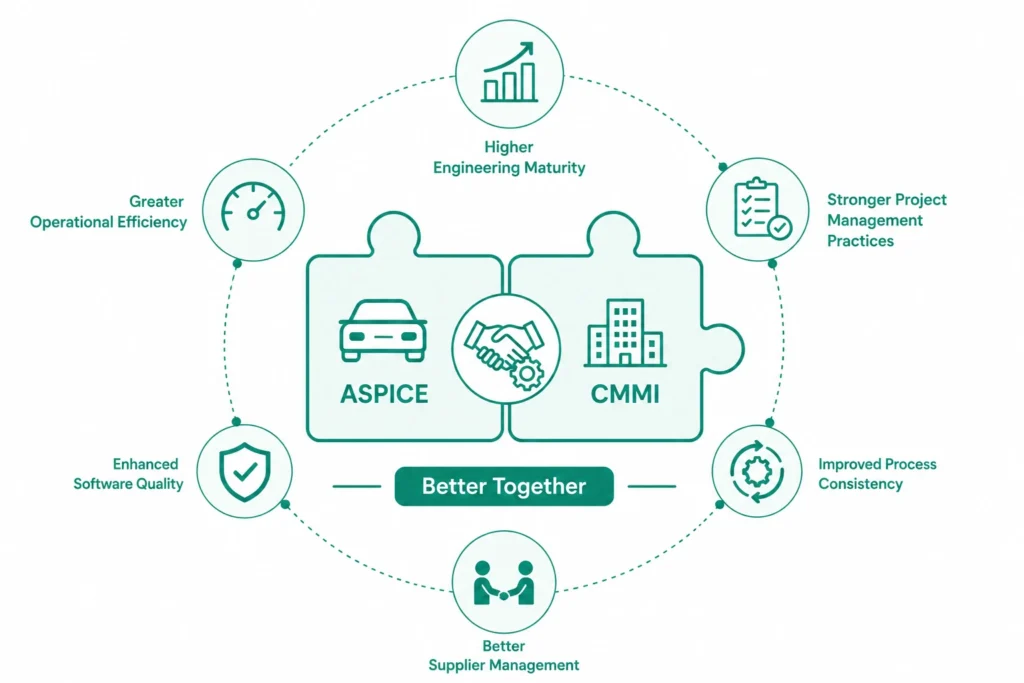
Yes. Many global automotive organizations successfully implement both ASPICE and CMMI because the two frameworks complement each other rather than compete.
ASPICE focuses on improving engineering execution, while CMMI strengthens organizational governance and business processes.
Combining both frameworks enables organizations to achieve:
- Higher engineering maturity
- Stronger project management practices
- Improved process consistency
- Better supplier management
- Enhanced software quality
- Greater operational efficiency
Organizations serving both automotive and non-automotive customers often benefit from this combined approach, as it supports technical excellence alongside enterprise-wide process improvement.
Which Framework Should You Choose?
The right framework depends on your industry, customer expectations, and long-term business goals.
Choose ASPICE if:
- You develop automotive software or embedded systems.
- Your customers are automotive OEMs or Tier 1 suppliers.
- ASPICE capability levels are a contractual requirement.
- End-to-end engineering traceability is essential.
- Functional Safety and Cybersecurity compliance are priorities.
Choose CMMI if:
- You operate outside the automotive industry.
- Your focus is enterprise-wide process improvement.
- Improving project management maturity is a primary objective.
- You require a framework that supports multiple business units.
Choose Both if:
- You are a large engineering organization serving multiple industries.
- You develop software-intensive products for automotive and other sectors.
- You want to improve both engineering execution and organizational governance.
- You aim to establish standardized processes across engineering and business functions.
Regardless of the framework you choose, integrating engineering processes with Embedded DevOps Services can improve collaboration, automate development workflows, accelerate software delivery, and strengthen lifecycle traceability.
How MicroGenesis Helps
MicroGenesis helps automotive organizations improve engineering maturity through consulting, process transformation, and integrated engineering solutions. Our experts work closely with engineering teams to establish standardized processes, implement modern engineering platforms, and prepare organizations for successful ASPICE assessments.
Our expertise includes:
- ASPICE consulting and readiness assessments
- Automotive Process Consulting
- IBM Engineering Lifecycle Management (IBM ELM) implementation
- IBM DOORS Next implementation
- PTC Codebeamer implementation
- Model-Based Systems Engineering (MBSE)
- Embedded DevOps implementation
- Engineering Toolchain Integration
- Engineering Traceability
- Digital Thread implementation
- Managed Engineering Services
Modern automotive development depends on a connected SDV Toolchain Architecture that links requirements management, systems engineering, software development, testing, DevOps, and release management. MicroGenesis helps organizations build integrated engineering ecosystems that improve productivity, quality, and compliance.
Frequently Asked Questions
Is ASPICE the same as CMMI?
No. ASPICE is an automotive-specific process assessment model focused on engineering maturity, while CMMI is a broader process improvement framework designed for organizations across multiple industries.
Which framework is better for automotive companies?
For automotive software and systems development, ASPICE is generally the preferred framework because it provides detailed guidance for engineering processes and is widely required by automotive OEMs and Tier 1 suppliers.
Can an organization implement both ASPICE and CMMI?
Yes. Many organizations adopt ASPICE to improve engineering processes and use CMMI to strengthen organizational governance, project management, and continuous improvement initiatives.
Does ASPICE replace CMMI?
No. ASPICE does not replace CMMI. Each framework serves a different purpose, and many organizations gain value by implementing both.
Which framework places greater emphasis on engineering traceability?
ASPICE places much stronger emphasis on end-to-end engineering traceability, making it well suited for safety-critical, software-intensive automotive development.
What tools are commonly used to support ASPICE?
Organizations commonly use solutions such as IBM Engineering Lifecycle Management (IBM ELM), IBM DOORS Next, IBM Rhapsody, PTC Codebeamer, GitLab, Jenkins, and other integrated engineering platforms to support ASPICE implementation and compliance.
Conclusion
ASPICE and CMMI are both proven frameworks for improving organizational performance, but they address different objectives. ASPICE focuses on engineering process capability for automotive systems and software development, while CMMI provides a broader approach to enterprise-wide process improvement.
For automotive organizations developing increasingly connected and software-driven products, ASPICE has become the industry standard because of its strong emphasis on requirements engineering, lifecycle traceability, verification, validation, and compliance with automotive standards.
Organizations seeking both engineering excellence and organizational maturity can benefit from implementing ASPICE alongside CMMI. By combining structured engineering processes, integrated toolchains, and continuous improvement practices, businesses can improve product quality, reduce development risks, strengthen customer confidence, and accelerate innovation in the evolving automotive landscape.