

The automotive industry is moving from mechanically dominated products toward highly connected, software-intensive systems. Modern vehicles combine embedded software, electronics, sensors, cloud platforms, artificial intelligence, advanced driver assistance systems, and complex communication networks.
As this complexity grows, engineering teams need more than traditional documents and spreadsheets to understand how thousands of requirements, system functions, interfaces, hardware components, and software elements relate to each other.
Model-Based Systems Engineering (MBSE) provides a structured way to manage this complexity. Instead of treating documents as the primary representation of the system, MBSE uses connected digital models to represent requirements, architecture, behavior, interfaces, constraints, and verification relationships.
This approach is particularly relevant to the development of Software-Defined Vehicles (SDVs), where software and electronic systems increasingly determine vehicle functionality.
When MBSE is connected with Engineering Lifecycle Management, ASPICE, ISO 26262, engineering traceability, Embedded DevOps, and the Digital Thread, automotive organizations can create a more connected engineering environment.
This guide explains MBSE in automotive engineering, its lifecycle, core components, benefits, challenges, toolchain, implementation practices, and role in Software-Defined Vehicle development.
What Is MBSE in Automotive Engineering?
Model-Based Systems Engineering (MBSE) is a systems engineering methodology that uses digital system models as a primary means of representing, analyzing, communicating, and managing engineering information throughout a product’s lifecycle.
In traditional automotive development, teams may maintain separate documents for requirements, architecture, interfaces, design decisions, testing, and verification.
MBSE connects these engineering elements through structured models.
An automotive system model can represent:
- Stakeholder needs
- System requirements
- Functional requirements
- Functional architecture
- Logical architecture
- Physical architecture
- System behavior
- Interfaces
- Dependencies
- Constraints
- Verification relationships
- Traceability
The objective is not simply to create more diagrams. The objective is to create a consistent engineering representation of the vehicle and its relationships.
For organizations looking at the broader transition toward digital engineering, the Digital Engineering for Automotive guide provides additional context on model-centric engineering and modern automotive development.
Why Does the Automotive Industry Need MBSE?
Vehicle architecture has changed significantly. A modern vehicle can contain more than 100 Electronic Control Units, millions of lines of embedded software, hundreds of software-enabled functions, thousands of requirements, and multiple communication networks.
Common challenges include:
- Requirement inconsistencies
- Fragmented engineering information
- Limited system-level visibility
- Manual documentation
- Weak traceability
- Difficult change impact analysis
- Late integration problems
- Complex supplier coordination
- Safety and compliance requirements
MBSE addresses these challenges by representing system information through connected models. Instead of asking engineers to manually determine how a requirement affects architecture, software, hardware, and testing, relationships can be represented within the engineering environment.
This becomes particularly important for Software-Defined Vehicles. To understand the underlying concept, see What Is a Software-Defined Vehicle?
Traditional Automotive Engineering vs MBSE
| Traditional Engineering | MBSE |
| Document-centric | Model-centric |
| Manual synchronization | Connected engineering information |
| Separate engineering artifacts | Connected system relationships |
| Limited traceability | End-to-end traceability |
| Late analysis | Earlier analysis and validation |
| Manual impact assessment | Relationship-based impact analysis |
| Static documentation | Evolving digital models |
| Siloed engineering activities | Collaborative systems engineering |
MBSE does not mean that documents disappear. Specifications, reports, compliance evidence, and other controlled documents may still be required. Instead, the digital model provides a structured engineering foundation from which information can be managed and communicated.
Automotive MBSE Lifecycle
Stakeholder Needs → Requirements Engineering → System Analysis → Functional Architecture → Logical Architecture → Physical Architecture → Hardware and Software Allocation → Simulation and Verification → Software Development → System Integration → Testing and Validation → Production → Vehicle Operations and OTA Updates
The model evolves throughout these activities. A change made during development can therefore be evaluated against related requirements, architecture elements, interfaces, software functions, hardware components, and verification activities.
Core Components of MBSE for Automotive Engineering
Requirements Engineering
Requirements define what the vehicle or subsystem must accomplish. MBSE provides a structured environment for capturing and relating requirements to other system elements.
Examples and activities include:
- Vehicle functions
- Performance
- Safety
- Cybersecurity
- Reliability
- Diagnostics
- Communication
- Regulatory requirements
- User expectations
Functional Architecture
Functional architecture describes what the system needs to do, without initially focusing on the physical implementation.
Examples and activities include:
- Adaptive Cruise Control
- Automatic Emergency Braking
- Lane Keeping Assistance
- Battery Management
- Energy Optimization
- Vehicle Diagnostics
- Thermal Management
Logical Architecture
Logical architecture explains how functions interact and exchange information.
Examples and activities include:
- Functional decomposition
- Data-flow analysis
- Interface definition
- Communication modeling
- Functional allocation
- Dependency analysis
Physical Architecture
Physical architecture connects system responsibilities with actual vehicle components.
Examples and activities include:
- Electronic Control Units
- Sensors
- Actuators
- Domain Controllers
- Vehicle networks
- Embedded processors
- Communication gateways
Behavioral Modeling
A vehicle does not simply contain components. Those components interact and change state in response to inputs and events. Behavioral modeling helps engineers represent these dynamic interactions.
Examples and activities include:
- State machine models
- Activity models
- Sequence models
- Timing models
Interface Modeling
Modern vehicles contain multiple communication technologies and interfaces. Interface modeling helps teams understand how system elements communicate.
Examples and activities include:
- CAN
- LIN
- FlexRay
- Automotive Ethernet
- SOME/IP
- Diagnostics interfaces
MBSE and Software-Defined Vehicles
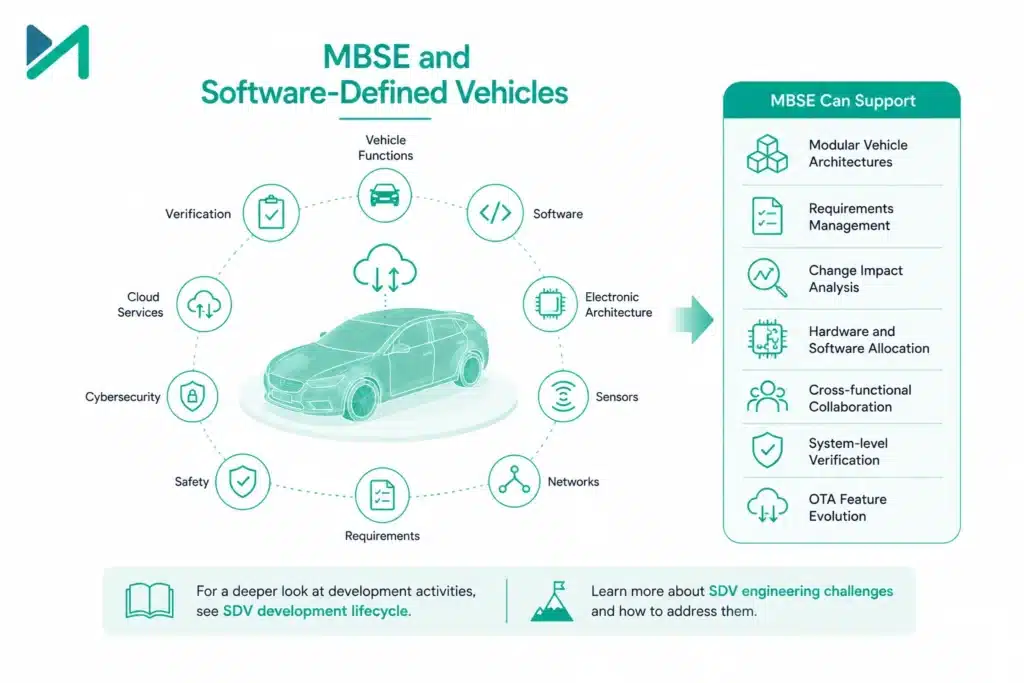
Software-Defined Vehicles are changing the way automotive products are engineered. Vehicle functionality is increasingly delivered and enhanced through software. Features may evolve after production through software releases and Over-the-Air updates.
MBSE provides a structured way to represent relationships between:
- Vehicle functions
- Software
- Electronic architecture
- Sensors
- Networks
- Requirements
- Safety
- Cybersecurity
- Cloud services
- Verification
It can support:
- Modular vehicle architectures
- Requirements management
- Change impact analysis
- Hardware and software allocation
- Cross-functional collaboration
- System-level verification
- OTA feature evolution
For a deeper look at development activities, see the SDV development lifecycle.
Organizations also need to address the engineering complexity created by SDVs. The SDV engineering challenges article explores these challenges in more detail.
MBSE and ASPICE
Automotive organizations increasingly need disciplined engineering processes alongside technical development. Automotive SPICE (ASPICE) provides a process assessment framework used to evaluate software and systems engineering processes in automotive development.
MBSE can complement ASPICE by providing structured engineering models and relationships. Relevant activities may include:
- System requirements analysis
- System architecture design
- System design
- Software requirements allocation
- Verification
- Validation
- Traceability
However, MBSE and ASPICE serve different purposes. MBSE is a systems engineering methodology, while ASPICE is a process assessment framework. Organizations should therefore avoid treating MBSE adoption as automatic ASPICE compliance.
For an introduction to the framework, read What Is ASPICE?.
Organizations evaluating process capability can also use an ASPICE level assessment to understand their current maturity.
For teams planning implementation, the ASPICE implementation roadmap provides additional guidance.
MBSE and ISO 26262 Functional Safety
Functional safety is a critical consideration in automotive engineering. ISO 26262 addresses functional safety for electrical and electronic systems in road vehicles.
MBSE can support safety engineering by connecting safety-related information with system architecture and engineering activities.
Potential applications include:
- Hazard analysis
- Safety requirement allocation
- Safety architecture
- Failure analysis
- Safety mechanisms
- Verification relationships
- Traceability
A connected system model can help engineers understand how safety requirements relate to system elements and how design changes may affect safety-related functions.
MBSE does not itself establish ISO 26262 compliance. Instead, it can provide an engineering structure that supports the activities and evidence required by an organization’s safety process.
MBSE and Engineering Lifecycle Management
MBSE becomes more powerful when system models are connected with Engineering Lifecycle Management.
An integrated engineering environment can connect:
Requirements → System Models → Architecture → Software → Test Cases → Defects → Change Requests → Releases
This creates stronger relationships between systems engineering and downstream engineering activities. For example, a requirement can be connected to a system model element, software implementation, test case, and verification result.
This creates a more complete engineering traceability chain.
MBSE and the Digital Thread
The Digital Thread connects engineering information across the product lifecycle.
Requirements → System Model → Architecture → Software and Hardware → Testing → Validation → Production → Operations → OTA Updates
MBSE contributes the system-level models and relationships that form an important part of this connected environment. The objective is to maintain useful engineering context as information moves between disciplines, lifecycle stages, and tools.
Benefits of MBSE for Automotive Engineering
Better Engineering Collaboration
Systems, software, hardware, safety, cybersecurity, and other teams can work from a common system representation.
Improved Requirements Quality
Requirements can be connected with system elements, architecture, and verification activities.
Earlier Problem Identification
System behavior and dependencies can be analyzed before physical implementation is complete.
Better Change Impact Analysis
Relationships between system elements help engineers investigate potential effects of proposed changes.
Stronger Traceability
Requirements can be connected to architecture, implementation, testing, and verification.
Reduced Rework
Finding inconsistencies earlier can reduce expensive late-stage engineering changes.
Better Supplier Collaboration
Structured system models can provide suppliers with clearer information about interfaces, responsibilities, and system relationships.
Improved Compliance Readiness
A connected engineering environment can make it easier to identify relationships and evidence relevant to safety and process assessments.
Common Challenges When Implementing MBSE
Legacy Engineering Data
Existing programs may rely heavily on documents, spreadsheets, and disconnected engineering tools.
Lack of Modeling Expertise
Engineers need knowledge of system modeling, modeling standards, and the selected MBSE environment.
Organizational Resistance
Moving from familiar document-based processes to model-centric engineering requires organizational change.
Tool Integration
Modeling environments may need to connect with requirements, ALM, PLM, simulation, testing, and software development platforms.
Model Governance
Large engineering programs require clear rules for model ownership, naming, versioning, reuse, access, and review.
Cross-Functional Adoption
MBSE delivers greater value when multiple engineering disciplines participate rather than treating the model as the responsibility of a small specialist team.
A phased implementation approach can reduce these risks.
Best Practices for Implementing MBSE in Automotive
Start With a Defined Engineering Problem
Do not begin by purchasing a tool and then searching for a use case. Identify a specific problem such as requirements traceability, architecture complexity, safety analysis, product variant management, SDV architecture, or supplier coordination.
Begin With a Pilot
Select a manageable subsystem or project and establish measurable objectives.
Establish Modeling Standards
Define consistent conventions for model structure, naming, relationships, versioning, reviews, and ownership.
Connect Requirements Early
Avoid creating an isolated system model. Connect requirements and architecture from the beginning.
Build Traceability
Define relationships between requirements, system elements, software, hardware, tests, and verification activities.
Integrate the Engineering Toolchain
MBSE should be considered part of the broader engineering environment rather than an isolated application.
Train Engineering Teams
Training should cover both the modeling technology and the engineering processes surrounding it.
Continuously Improve the Model
Models should evolve as engineering understanding, requirements, architecture, and product features change.
Automotive MBSE Toolchain
| Engineering Activity | Example Tools |
| Systems Modeling | IBM Rhapsody, Cameo Systems Modeler |
| Requirements Management | IBM DOORS Next, Jama Connect |
| Engineering Lifecycle Management | IBM ELM, PTC Codebeamer |
| Product Lifecycle Management | Siemens Teamcenter, PTC Windchill |
| Simulation | MATLAB/Simulink |
| DevOps | GitLab, Jenkins |
| Work Management | Jira, IBM EWM |
The objective is not to use every available tool. The toolchain should be selected based on engineering requirements, existing processes, integration requirements, traceability needs, safety and compliance requirements, scalability, team capabilities, and product complexity.
For Software-Defined Vehicle programs, toolchain architecture becomes especially important because engineering data must move between multiple lifecycle environments. The SDV toolchain architecture article provides a deeper look at this topic.
How to Implement MBSE in an Automotive Organization
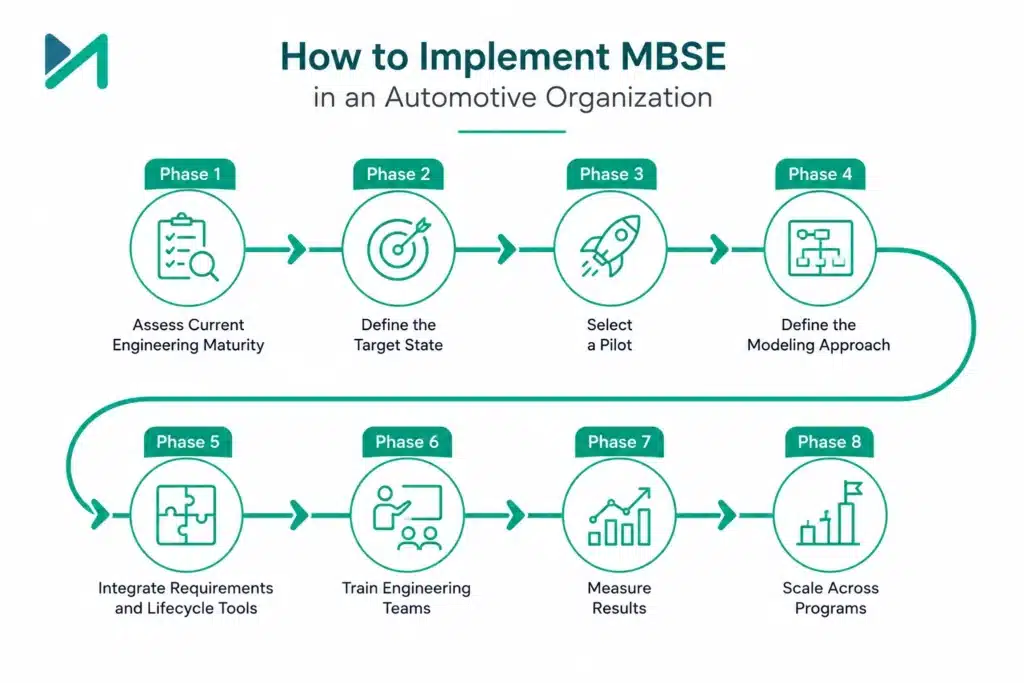
Phase 1: Assess Current Engineering Maturity
Evaluate existing requirements processes, architecture practices, toolchain, traceability, documentation, and engineering workflows.
Phase 2: Define the Target State
Establish what the organization wants to improve through MBSE.
Phase 3: Select a Pilot
Choose a project where the value of model-based engineering can be measured.
Phase 4: Define the Modeling Approach
Establish modeling standards, governance, roles, and workflows.
Phase 5: Integrate Requirements and Lifecycle Tools
Connect the model with relevant engineering systems.
Phase 6: Train Engineering Teams
Develop both modeling and process capabilities.
Phase 7: Measure Results
Track improvements such as traceability coverage, review efficiency, defect discovery, change analysis effort, rework, and engineering cycle time.
Phase 8: Scale Across Programs
Use lessons from the pilot to expand MBSE to additional products and engineering teams.
How MicroGenesis Helps With Automotive MBSE
Implementing MBSE requires alignment between methodology, engineering processes, tools, integration, and organizational capabilities.
MicroGenesis helps automotive OEMs and Tier 1 suppliers develop connected engineering environments around systems engineering and digital engineering.
Its capabilities include:
- MBSE consulting and implementation
- IBM Rhapsody implementation
- IBM Engineering Lifecycle Management
- IBM DOORS Next implementation
- Engineering traceability
- Engineering toolchain integration
- ASPICE process alignment
- Functional safety support
- Embedded DevOps enablement
- PTC Codebeamer implementation
- Managed engineering services
With over 25 years of engineering transformation experience, MicroGenesis works with organizations looking to modernize systems engineering, strengthen engineering collaboration, improve traceability, and support Software-Defined Vehicle development.
The focus is not simply on introducing another engineering tool. The objective is to help organizations establish an engineering environment in which requirements, models, architecture, development, testing, and verification can work together.
Frequently Asked Questions About Automotive MBSE
What is MBSE in automotive?
MBSE in automotive is a systems engineering approach that uses digital models to represent vehicle requirements, architecture, behavior, interfaces, and verification relationships throughout development, helping teams manage increasing hardware, software, safety, and integration complexity.
Why is MBSE important for Software-Defined Vehicles?
MBSE helps represent relationships between vehicle functions, software, electronics, requirements, interfaces, safety, and verification, providing engineers with a structured system view as vehicle functionality increasingly depends on software and continuously evolving electronic architectures.
How does MBSE support ASPICE?
MBSE can provide structured requirements, architecture information, traceability, and engineering relationships that support disciplined automotive development processes. However, MBSE itself does not establish ASPICE compliance because ASPICE evaluates defined engineering process capabilities.
What is the difference between MBSE and ELM?
MBSE focuses on modeling and analyzing complex systems, including architecture, behavior, interfaces, and relationships. Engineering Lifecycle Management manages broader lifecycle information such as requirements, development, testing, defects, changes, and releases.
Does MBSE replace traditional engineering documents?
No. MBSE does not necessarily eliminate specifications, reports, or controlled documents. Instead, digital models provide a structured engineering foundation from which information can be analyzed, maintained, traced, and used to produce required documentation.
Which tools are commonly used for automotive MBSE?
Automotive MBSE environments may include systems modeling platforms such as IBM Rhapsody or Cameo Systems Modeler, requirements tools such as IBM DOORS Next, lifecycle platforms such as IBM ELM, and simulation environments such as MATLAB/Simulink.
How should an automotive company start MBSE?
A practical starting point is to assess current engineering processes, select a specific problem, establish a pilot, define modeling governance, connect requirements, train engineers, measure outcomes, and gradually expand MBSE across additional programs and disciplines.
Conclusion
The increasing software and electronic complexity of modern vehicles is changing how automotive products need to be engineered.
Traditional document-centric approaches can become difficult to manage when requirements, architecture, software, hardware, interfaces, safety activities, and verification must remain synchronized across large engineering organizations.
Model-Based Systems Engineering provides a model-centric foundation for managing this complexity.
By connecting requirements, architecture, behavior, interfaces, implementation, testing, and verification, MBSE can improve engineering visibility and provide stronger traceability across the automotive lifecycle.
Its value becomes even greater when it is connected with Engineering Lifecycle Management, ASPICE, ISO 26262, Embedded DevOps, and the Digital Thread.
For automotive organizations moving toward Software-Defined Vehicles, MBSE can provide the system-level structure needed to manage increasing interactions between software, electronics, vehicle functions, and engineering processes.
The most effective MBSE programs do not begin with a tool. They begin with an engineering problem, define measurable objectives, establish the right modeling practices, connect the relevant toolchain, and gradually scale the approach across the organization.