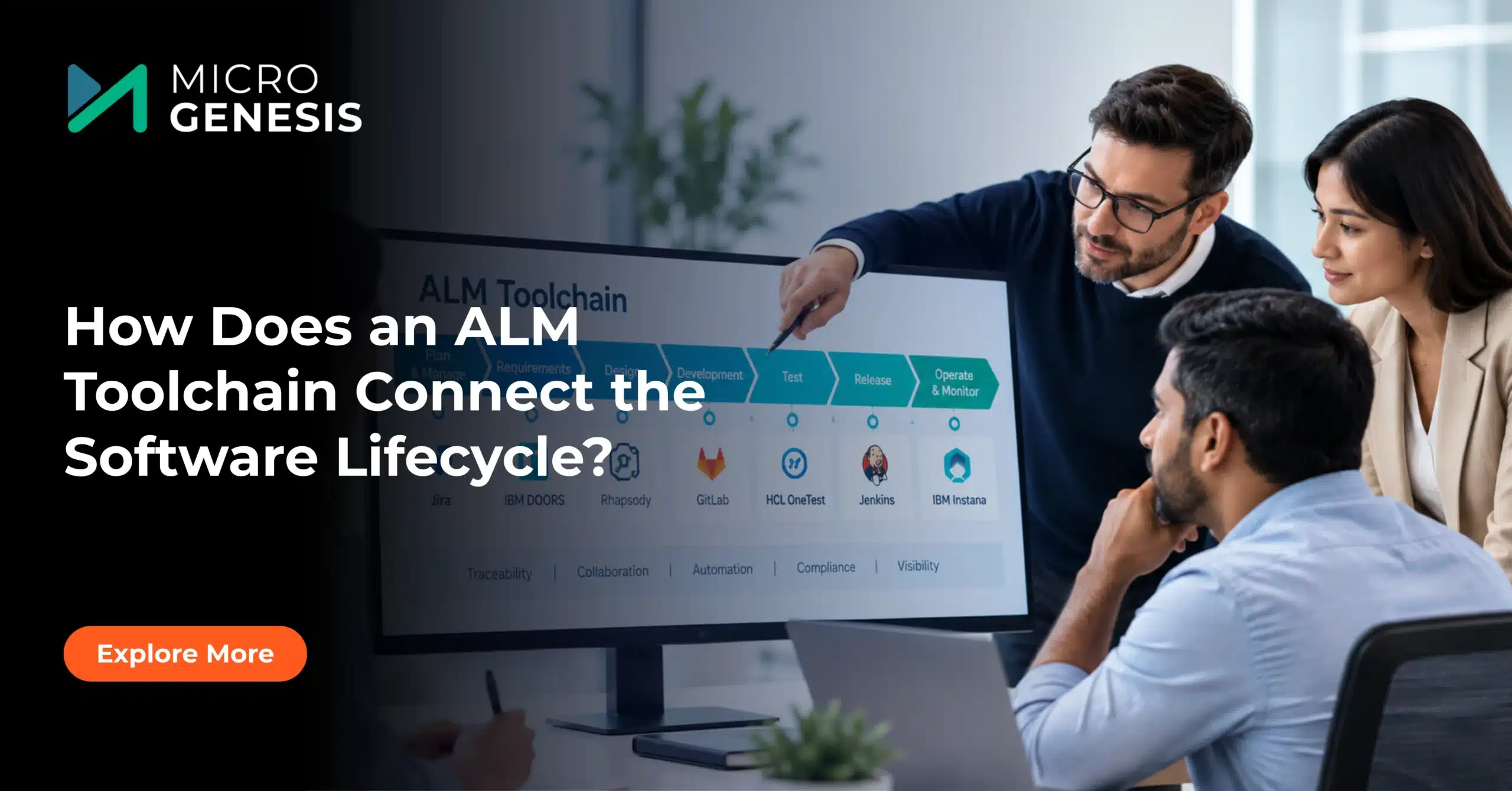
Application Lifecycle Management (ALM) is often described as a way to manage requirements, development, testing, and releases across the software lifecycle. But in real engineering environments, especially regulated and safety-critical industries, ALM is rarely about one tool doing everything.
Instead, organizations typically rely on an ALM toolchain, a connected set of tools and engineering systems that support different lifecycle activities while allowing information to move between them.
A requirements team may work in one environment, testers in another, developers in source control, and release teams in CI/CD platforms. The value comes from connecting these activities so teams can understand how a requirement becomes a tested, approved, and released product.
For organizations working in automotive, aerospace, defence, medical devices, and other regulated industries, this connected approach becomes especially important because traceability, change control, evidence, and accountability are part of the engineering process, not afterthoughts.
What Is an ALM Toolchain?
An ALM toolchain is a collection of connected tools used to manage different activities across the application or software lifecycle.
While an ALM platform may provide many capabilities within one environment, a toolchain can also include specialized systems for:
- Requirements management
- Architecture and design
- Risk management
- Test management
- Source code management
- Build and continuous integration
- Defect management
- Release management
- Configuration management
- Compliance and reporting
The important distinction is that these tools should not operate as isolated systems.
For example, a change to a safety requirement may affect a design element, test case, defect, risk assessment, and ultimately a release. A connected ALM toolchain helps teams understand these relationships without manually searching through spreadsheets, emails, and disconnected databases.
This is closely related to the concept of an engineering digital thread across the product lifecycle, where information remains connected as engineering work progresses.
ALM vs an ALM Toolchain
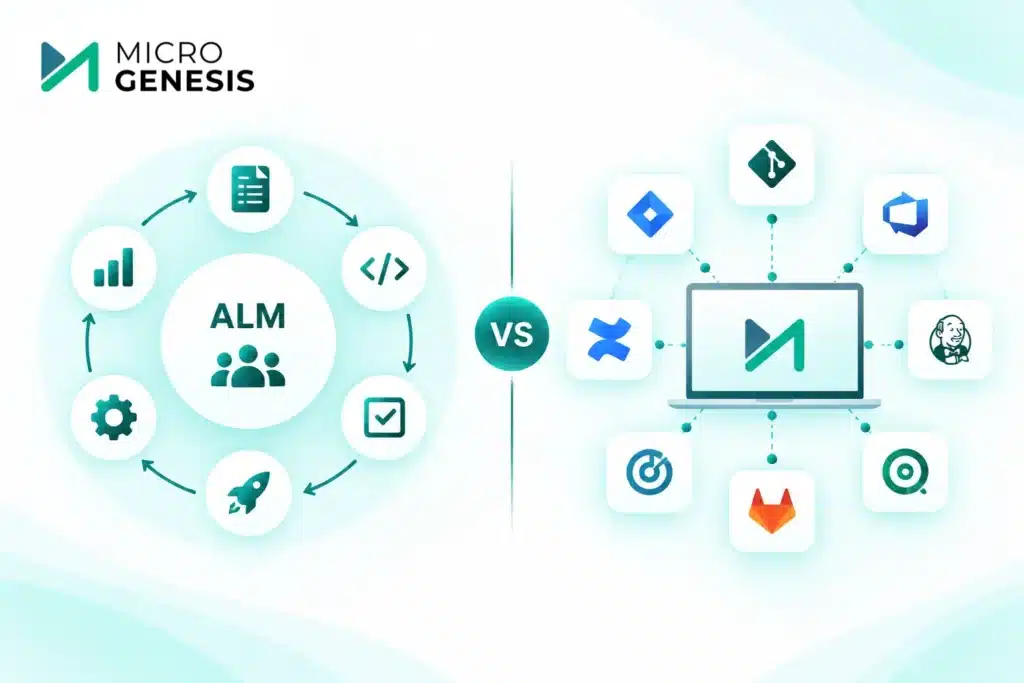
It is useful to distinguish between ALM as a discipline and an ALM toolchain as the technology supporting that discipline.
ALM covers the processes used to manage software from initial requirements through development, testing, release, maintenance, and retirement.
An ALM toolchain provides the tools and integrations that support those processes.
For example:
Lifecycle activity | Typical toolchain capability |
Requirements | Requirements management |
Architecture | System and software modeling |
Risk | Risk and hazard management |
Development | Source code and development tools |
Testing | Test management and automation |
Defects | Issue and defect management |
Build | CI and build automation |
Release | Release and deployment management |
Compliance | Traceability, reporting, and evidence |
The exact combination depends on the organization, product, regulatory environment, and existing technology landscape.
For a broader understanding of how ALM differs from the software development lifecycle, see ALM vs SDLC.
What Tools Make Up an ALM Toolchain?
There is no single toolchain architecture that works for every organization. However, most enterprise engineering environments contain several common layers.
1. Requirements Management Tools
Requirements are typically the starting point of the lifecycle.
Requirements management tools help teams capture, structure, review, baseline, version, and approve requirements.
A typical hierarchy might include:
Business requirements → System requirements → Software requirements → Verification requirements
The goal is not simply to store requirements. Teams need to understand where each requirement came from, what it affects, and whether it has been verified.
This is why requirements traceability becomes an important part of an ALM toolchain.
When requirements are still maintained in spreadsheets while testing and development happen elsewhere, traceability can quickly become difficult to maintain. Why requirements still live in Excel after buying an ALM tool explores this common problem in more detail.
2. Risk Management Tools
In regulated engineering, requirements cannot always be separated from risk.
Risk management activities may include:
- Hazard identification
- Risk assessment
- Failure analysis
- Risk mitigation
- Safety requirements
- Risk acceptance
- Verification of mitigation measures
A connected toolchain allows risk information to remain associated with the requirements, design decisions, and verification activities that address it.
This becomes particularly valuable in safety-critical development, where teams need evidence that identified risks have been addressed and verified.
3. Test Management Tools
Testing provides evidence that requirements and expected behaviors have been verified.
Test management capabilities typically cover:
- Test planning
- Test case creation
- Test execution
- Defect tracking
- Test results
- Regression testing
- Verification status
- Test reporting
A requirement might therefore connect to one or more test cases, while a failed test could generate a defect that must be resolved before release.
For a deeper look at this relationship, see Integrating Test Management with Requirements Tools.
You can also explore what test management involves across the software lifecycle.
4. Development and Source Control Tools
Development teams typically use source control and development platforms to manage code, branches, builds, pull requests, and changes.
The ALM toolchain becomes more valuable when development activity can be associated with lifecycle information.
For example:
Requirement → Development task → Code change → Build → Test → Release
This creates greater visibility into how engineering work moves from a requirement toward a deliverable.
Integration with DevOps platforms is particularly important for organizations adopting continuous delivery. Learn more about DevOps integration with ALM.
5. Release and Deployment Tools
Release management connects completed engineering work with actual product delivery.
Release-related capabilities can include:
- Release planning
- Version management
- Build management
- Deployment tracking
- Approval workflows
- Configuration baselines
- Release evidence
In a regulated environment, release information may need to be connected back to the requirements and tests that were completed for that release.
This makes release management part of the broader traceability chain rather than a completely separate activity.
Mapping the ALM Toolchain to Lifecycle Stages
A useful way to understand an ALM toolchain is to map tools to the stages they support.
1. Define
Requirements + Risk
Teams capture business, system, software, safety, and regulatory requirements while identifying relevant risks.
2. Design
Architecture + Modeling + Requirements
Engineering teams translate requirements into system and software designs.
For complex products, modeling tools may become part of the wider toolchain. Organizations working with model-based engineering can explore MBSE in automotive engineering for additional context.
3. Develop
Source Control + Development + Build
Developers implement approved requirements while source code and engineering changes are managed through development systems.
4. Verify
Test Management + Automation + Defect Management
Teams execute tests, record results, manage defects, and demonstrate that requirements have been verified.
5. Release
Release + Configuration + Deployment
Approved software is packaged and released with the appropriate baselines, approvals, and evidence.
6. Maintain
Change Management + Requirements + Defects + Releases
Changes are assessed, implemented, tested, approved, and incorporated into subsequent releases.
This lifecycle connection is what turns a collection of engineering tools into a meaningful ALM toolchain.
Why a Connected ALM Toolchain Matters for Regulated Software
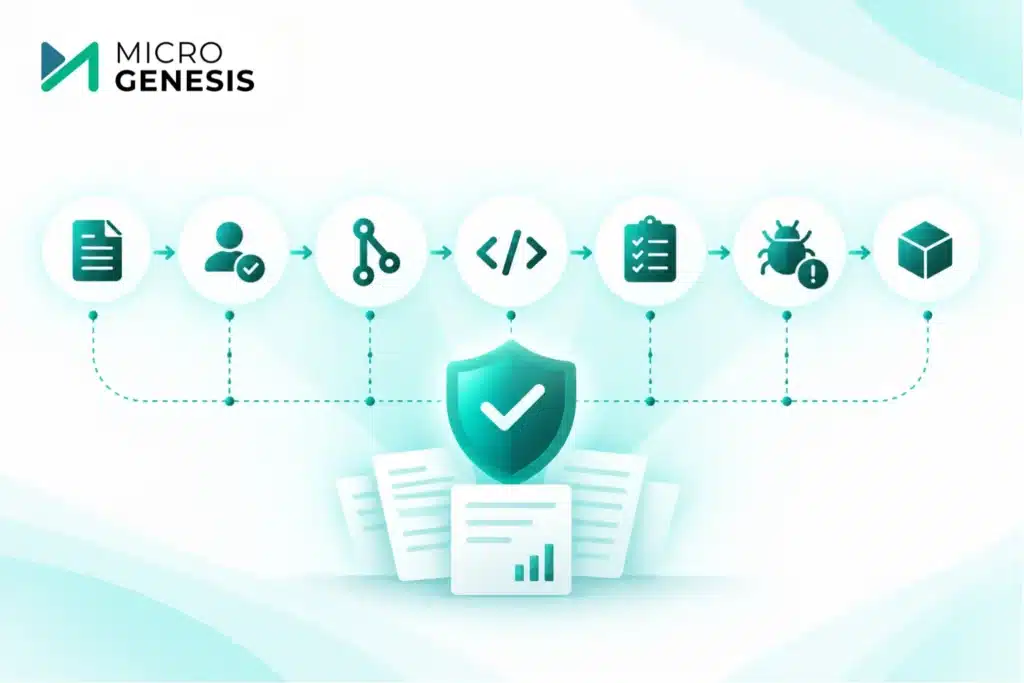
In a simple software project, disconnected tools can already create inconvenience.
In regulated software development, the consequences can be much more serious.
Engineering teams may need to demonstrate:
- Where a requirement originated
- Who approved it
- What changed
- Which risks it addresses
- How it was implemented
- Which tests verify it
- What the test results were
- Which defects were associated with it
- Which release contains the change
If this information exists across disconnected systems, teams may spend significant time manually collecting and reconciling evidence.
A connected ALM toolchain can make these relationships easier to maintain.
This is one reason compliance and traceability in ALM are closely connected.
Traceability becomes part of daily engineering
Instead of creating a traceability report only before an audit, teams can maintain relationships throughout the development lifecycle.
For example:
Requirement → Risk → Design → Code → Test → Result → Defect → Release
When these relationships are maintained consistently, engineering teams have better visibility into the impact of change and the status of verification.
What Happens When the ALM Toolchain Is Fragmented?
A fragmented toolchain does not necessarily mean an organization has too many tools.
The bigger problem is when those tools cannot effectively exchange the information teams need.
Common warning signs include:
Requirements are maintained separately from testing
Requirements may exist in one system while test cases are maintained somewhere else, requiring manual reconciliation.
Teams rely heavily on spreadsheets
Spreadsheets often become temporary bridges between systems. Over time, they can become difficult to control, version, and maintain.
Engineers manually duplicate information
When the same requirement, defect, or release information has to be entered into multiple systems, inconsistencies become more likely.
Change impact analysis takes too long
A seemingly small requirement change may require teams to search multiple systems to determine what else could be affected.
Audit preparation becomes a major project
If evidence must be manually collected from several tools, compliance activities can consume significant engineering time.
Teams cannot see end-to-end status
Project managers may know that requirements are complete, while testers see incomplete verification and developers see unresolved implementation tasks.
This lack of shared visibility is one of the clearest signs that the toolchain needs better integration.
For organizations dealing with these challenges, ALM integration solutions can provide a useful starting point for evaluating integration strategies.
Native ALM Platforms vs Integrated Toolchains
Not every organization needs to connect dozens of separate applications.
Some ALM platforms provide requirements, test management, change management, risk management, and reporting within one environment.
Other organizations have established tools that need to remain in place.
In that situation, integrations can connect specialized systems while allowing teams to continue using the tools they already depend on.
For example, an organization may connect requirements management with a separate testing platform or integrate an ALM environment with development and DevOps tools.
The right approach depends on:
- Existing tools
- Engineering processes
- Regulatory requirements
- Integration capabilities
- Data ownership
- Team structure
- Future scalability
Open standards can also play a role in connecting lifecycle tools. Open Services Lifecycle Collaboration provides useful context on how lifecycle information can be shared across tools.
What Does a Modern ALM Toolchain Look Like?
A modern ALM toolchain does not necessarily mean replacing every existing engineering system.
Instead, the goal is to create meaningful connections between the systems that matter.
A simplified architecture might look like:
Requirements → Risk → Architecture → Development → Build → Test → Defect → Release
The important part is not the number of tools. It is the quality of the relationships between them.
For organizations evaluating an enterprise ALM platform, Codebeamer ALM is one example of an ALM environment designed to support connected lifecycle management across requirements, risks, tests, and other engineering activities.
If your organization is evaluating how to create a more connected lifecycle environment, explore our Codebeamer ALM services to understand how the platform can support your engineering processes.
How to Start Building a Connected ALM Toolchain
Organizations do not need to integrate everything at once.
A practical approach is to start with the lifecycle relationships that create the most business and compliance value.
Step 1: Map the current toolchain
Identify:
- What tools are being used
- Which teams use them
- What information each tool owns
- Where information is duplicated
- Where manual handoffs occur
Step 2: Identify critical traceability relationships
Determine which relationships are essential.
For example:
Requirements → Tests
or:
Requirements → Risks → Tests → Releases
Step 3: Identify integration gaps
Look for areas where teams rely on spreadsheets, email, manual exports, or duplicate data entry.
Step 4: Define ownership
Every major data object should have a clear system of record.
Step 5: Integrate incrementally
Start with high-value connections rather than attempting to connect every system simultaneously.
Step 6: Measure the outcome
Track improvements in:
- Traceability
- Change impact analysis
- Reporting
- Audit preparation
- Engineering visibility
- Duplicate data entry
- Release confidence
A structured ALM tool implementation approach can help organizations avoid treating integration as purely a technology project.
When Should You Consider an ALM Toolchain Assessment?
An assessment can be useful when:
- Your organization uses several disconnected engineering tools
- Requirements and test teams maintain separate information
- Engineers rely heavily on spreadsheets
- Change impact analysis is difficult
- Audit preparation requires significant manual work
- Release status is difficult to track
- Multiple teams use different engineering processes
- Your organization is moving toward DevOps
- You are evaluating a new ALM platform
The goal should not be to integrate tools simply because integration is technically possible. The goal is to create a lifecycle environment where information flows reliably between the teams and systems that need it.
Why Businesses Choose MicroGenesis
Building a connected ALM toolchain requires more than selecting an ALM platform. Organizations also need the right implementation approach, integration strategy, engineering expertise, and understanding of their existing development processes.
Businesses choose MicroGenesis because we combine ALM consulting, implementation, integration, and engineering lifecycle expertise to help organizations build connected and scalable engineering environments.
ALM and Toolchain Expertise
Our teams understand the relationships between requirements, risk, development, testing, defects, releases, and compliance, helping organizations design ALM environments around their actual engineering workflows.
Experience with Enterprise ALM Platforms
MicroGenesis works with enterprise ALM technologies including IBM Engineering Lifecycle Management and PTC Codebeamer, helping organizations evaluate, implement, configure, and integrate platforms based on their lifecycle requirements.
Requirements-to-Test Traceability
We help organizations connect requirements with development and verification activities, improving visibility across the lifecycle and supporting stronger engineering traceability.
Integration Across Engineering Tools
A modern ALM toolchain often needs to connect with DevOps, source control, testing, modeling, and other engineering systems. MicroGenesis helps organizations plan and implement these integrations while maintaining clear ownership of lifecycle data.
Support for Regulated and Safety-Critical Engineering
For industries such as automotive, aerospace, defence, and medical devices, lifecycle visibility and traceability are critical. Our approach focuses on creating engineering workflows that support compliance, change management, verification, and audit readiness.
Practical, Process-Focused Implementation
We do not treat ALM as simply a software installation. We look at how engineering teams actually work, identify process gaps, and configure the ALM environment to support practical day-to-day workflows.
Final Thoughts
An ALM toolchain is more than a collection of engineering tools. It is the connected environment that allows requirements, risks, development, testing, defects, and releases to work together across the software lifecycle.
For regulated software organizations, this connection becomes especially important because traceability, change control, verification evidence, and compliance need to be maintained throughout development.
A fragmented toolchain can create duplicate work, weak traceability, slow impact analysis, and difficult audit preparation. A connected toolchain gives engineering teams greater visibility into how changes move through the lifecycle and how requirements are ultimately verified and released.
The right approach does not always mean replacing every tool. In many organizations, the better strategy is to identify the most important lifecycle relationships and connect the systems around them.
If you are evaluating your current ALM environment or planning an integrated engineering toolchain, explore MicroGenesis ALM Solution for support across ALM implementation, integration, configuration, and lifecycle processes.
For organizations already working with IBM technologies, IBM Engineering Lifecycle Management services can help connect requirements, development, testing, and engineering governance within an enterprise lifecycle environment.
And if you are considering a modern ALM platform for requirements, risk, testing, and traceability, explore Codebeamer ALM to evaluate how a connected lifecycle platform can fit your engineering environment.