

Embedded systems are becoming increasingly intelligent, connected, and software driven. From automotive Electronic Control Units (ECUs) and industrial automation systems to medical devices and IoT products, embedded software has become a critical component of modern products. As development complexity grows, engineering teams need faster release cycles, higher software quality, and stronger collaboration across hardware and software disciplines.
Traditional embedded development often follows sequential workflows where hardware, firmware, testing, and validation operate independently. This approach can result in delayed releases, lengthy integration cycles, and increased engineering costs.
Embedded DevOps addresses these challenges by bringing modern DevOps practices into embedded software development. By integrating continuous integration, continuous testing, automation, collaboration, and continuous delivery with hardware-aware engineering workflows, organizations can accelerate development while maintaining product quality and reliability.
Organizations implementing Embedded DevOps Services can automate engineering workflows, improve software quality, strengthen collaboration between development teams, and accelerate product delivery without compromising safety or compliance.
As industries continue moving toward Software-Defined Vehicles, connected devices, and intelligent products, Embedded DevOps has become an essential capability for managing increasingly complex software lifecycles.
This guide explains what Embedded DevOps is, how it differs from traditional DevOps, its key benefits, implementation strategies, and best practices for building scalable embedded engineering environments.
What Is Embedded DevOps?
Embedded DevOps is the practice of applying DevOps principles to the development, testing, deployment, and maintenance of embedded software running on dedicated hardware platforms.
Unlike enterprise or cloud applications, embedded systems combine software with hardware components that often operate under strict performance, memory, power, and real-time constraints. Embedded DevOps adapts modern software engineering practices to these unique environments while maintaining the reliability and safety required for embedded products.
Examples of embedded systems include:
- Automotive Electronic Control Units (ECUs)
- Smart home and IoT devices
- Industrial automation controllers
- Medical devices
- Consumer electronics
- Aerospace and defense systems
- Robotics and autonomous platforms
Embedded DevOps integrates development, testing, deployment, monitoring, and feedback into a continuous engineering process, enabling organizations to deliver high-quality firmware and embedded software more efficiently.
How Embedded DevOps Differs from Traditional DevOps
Although Embedded DevOps shares the same core principles as traditional DevOps, the engineering environment is significantly different.
| Traditional DevOps | Embedded DevOps |
|---|---|
| Applications run on cloud or virtual infrastructure | Software runs on dedicated hardware platforms |
| Testing is largely virtualized | Testing often requires physical hardware and hardware simulators |
| Deployment occurs over cloud infrastructure | Deployment involves firmware flashing or secure OTA updates |
| Minimal hardware dependencies | Hardware and software are tightly integrated |
| Few hardware resource limitations | Strict memory, CPU, storage, and power constraints |
| General software quality requirements | Often subject to functional safety and regulatory standards |
Because of these differences, Embedded DevOps requires specialized engineering workflows, integrated hardware testing, and closer collaboration between hardware, firmware, testing, and operations teams.
Core Principles of Embedded DevOps
Successful Embedded DevOps implementations are built around several key principles that improve engineering efficiency and product quality.
Continuous Integration
Developers integrate code changes frequently into a shared repository where automated build systems compile firmware and identify integration issues early.
Continuous Testing
Automated unit tests, integration tests, Hardware-in-the-Loop (HIL) testing, and regression testing help identify software and hardware integration issues before deployment.
Automation
Automating repetitive engineering tasks such as firmware builds, testing, static code analysis, deployment, and reporting improves consistency while reducing manual effort.
Collaboration
Embedded DevOps encourages close collaboration between hardware engineers, firmware developers, quality assurance teams, systems engineers, and operations teams throughout the product lifecycle.
Continuous Feedback
Telemetry, diagnostics, and operational monitoring provide valuable feedback from deployed devices, enabling engineering teams to improve future software releases.
Why Embedded DevOps Is Becoming Essential
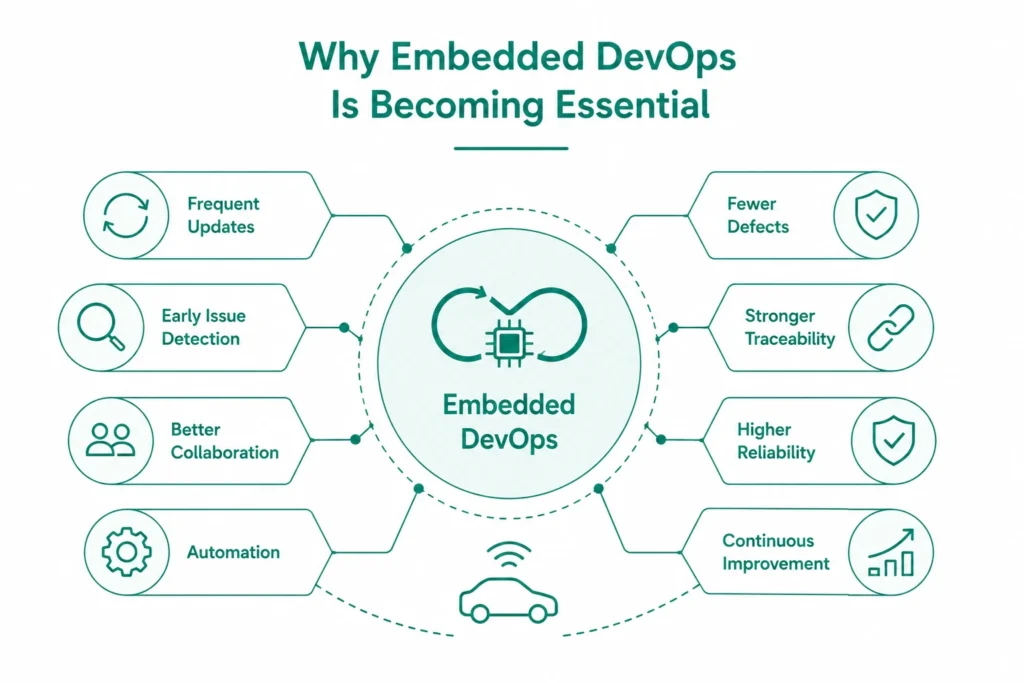
Modern embedded products require frequent software updates, rapid feature enhancements, and shorter development cycles. Traditional development models often struggle to meet these demands because software and hardware development are performed independently.
Embedded DevOps enables organizations to:
- Deliver software updates more frequently
- Detect issues earlier in the development cycle
- Improve engineering collaboration
- Automate testing and deployment
- Reduce software defects
- Strengthen engineering traceability
- Improve product reliability
- Support continuous product improvement
Organizations developing intelligent automotive platforms often align Embedded DevOps practices with the SDV Development Lifecycle to support continuous software integration, validation, deployment, and lifecycle management.
Key Components of an Embedded DevOps Pipeline
An effective Embedded DevOps pipeline integrates multiple engineering activities into a continuous workflow.
Typical pipeline stages include:
- Requirements Management
- Source Code Management
- Automated Build
- Static Code Analysis
- Unit Testing
- Hardware-in-the-Loop Testing
- Integration Testing
- Security Testing
- Continuous Deployment
- Device Monitoring and Feedback
Each stage contributes to faster development cycles while ensuring software quality and compliance throughout the engineering lifecycle.
Benefits of Embedded DevOps
Organizations adopting Embedded DevOps gain far more than faster software releases. A well-implemented Embedded DevOps strategy improves engineering collaboration, enhances software quality, strengthens security, and simplifies long-term product maintenance. These advantages help engineering teams respond quickly to changing market requirements while maintaining the reliability expected from embedded products.
Faster Time-to-Market
Traditional embedded software projects often follow sequential development cycles where hardware, firmware, integration, and testing are completed one after another. This approach can significantly delay product releases, especially when defects are discovered late in development.
Embedded DevOps accelerates delivery by enabling continuous engineering practices throughout the product lifecycle.
Key capabilities include:
- Incremental firmware development
- Continuous Integration (CI)
- Automated firmware builds
- Parallel hardware and software development
- Hardware simulation and emulation
- Continuous validation
These practices allow development teams to identify issues earlier, reduce manual effort, and deliver new features more frequently.
Organizations building intelligent automotive platforms often integrate Embedded DevOps into the SDV Development Lifecycle, enabling continuous software integration, automated validation, and faster release cycles.
Example
An IoT device manufacturer previously released firmware updates only twice a year because development and testing depended on final hardware availability. After introducing Continuous Integration pipelines and hardware simulation, the organization reduced its release cycle to six weeks, allowing new features and bug fixes to reach customers much faster.
Higher Software Quality
Quality is essential in embedded systems where software failures can affect product safety, reliability, and customer trust.
Embedded DevOps improves software quality by automating validation throughout the development lifecycle.
Common quality practices include:
- Automated unit testing
- Integration testing
- Hardware-in-the-Loop (HIL) testing
- Regression testing
- Static code analysis
- Continuous quality monitoring
Because every code change is automatically verified, engineering teams receive immediate feedback, allowing defects to be identified and resolved before they reach production.
Example
An automotive supplier replaced manual ECU testing with automated Hardware-in-the-Loop test benches integrated into its DevOps pipeline. The result was significantly higher test coverage, faster validation cycles, and a substantial reduction in software defects before production.
Improved Collaboration Across Engineering Teams
Embedded development requires close coordination between hardware engineers, firmware developers, systems engineers, test engineers, and quality teams. When these groups operate independently, communication gaps can delay projects and increase integration issues.
Embedded DevOps promotes a collaborative engineering culture by connecting teams through shared processes, tools, and engineering data.
Key collaboration practices include:
- Shared source code repositories
- Unified issue tracking
- Automated build notifications
- Common engineering dashboards
- Shared test results
- Integrated engineering workflows
Organizations adopting MBSE Consulting Services can further improve collaboration by using model-based engineering techniques that provide a common view of system architecture, requirements, and design across multidisciplinary teams.
Example
A medical device manufacturer adopted an integrated engineering environment where hardware designs, firmware, and validation activities were managed collaboratively. Automatic notifications ensured engineering teams remained aligned whenever design changes affected software implementation.
Easier Product Maintenance
Maintaining embedded products after deployment has traditionally been expensive because firmware updates often required physical access to devices.
Embedded DevOps simplifies long-term maintenance through automated deployment and remote update capabilities.
Typical maintenance capabilities include:
- Secure Over-the-Air (OTA) updates
- Automated firmware deployment
- Version management
- Rollback functionality
- Remote diagnostics
- Device health monitoring
These capabilities reduce service costs while allowing organizations to deliver new features and security updates without disrupting customers.
Example
A network equipment manufacturer implemented secure OTA updates within its Embedded DevOps pipeline, allowing thousands of deployed devices to receive firmware updates remotely within hours instead of requiring on-site maintenance.
Improved Security
As embedded devices become increasingly connected, cybersecurity has become a critical engineering requirement.
Embedded DevOps integrates security throughout the software development lifecycle rather than treating it as a separate activity.
Common security practices include:
- Static Application Security Testing (SAST)
- Dependency vulnerability scanning
- Secure firmware signing
- Automated security testing
- Secure configuration management
- Continuous vulnerability monitoring
Integrating security into Continuous Integration pipelines helps organizations identify vulnerabilities early while accelerating remediation.
Example
An industrial automation company incorporated automated security scanning into its firmware build pipeline. Vulnerabilities were detected during development rather than after deployment, reducing remediation time and improving overall product security.
Better Compliance and Engineering Traceability
Industries such as automotive, aerospace, healthcare, and industrial automation require detailed engineering evidence to demonstrate compliance with industry regulations and customer requirements.
Embedded DevOps simplifies compliance by automatically connecting engineering activities throughout the product lifecycle.
Organizations can establish traceability between:
- Requirements
- System design
- Software implementation
- Test execution
- Validation
- Product releases
Engineering platforms such as IBM Engineering Lifecycle Management (IBM ELM) help organizations manage requirements, testing, change management, and engineering traceability within a single integrated environment.
Similarly, PTC Codebeamer supports requirements management, risk analysis, quality management, and lifecycle traceability, making it well suited for safety-critical embedded software development.
Organizations implementing Digital Engineering for Automotive can further improve lifecycle visibility by connecting engineering data, development tools, and validation activities into a unified engineering ecosystem.
Challenges of Embedded DevOps
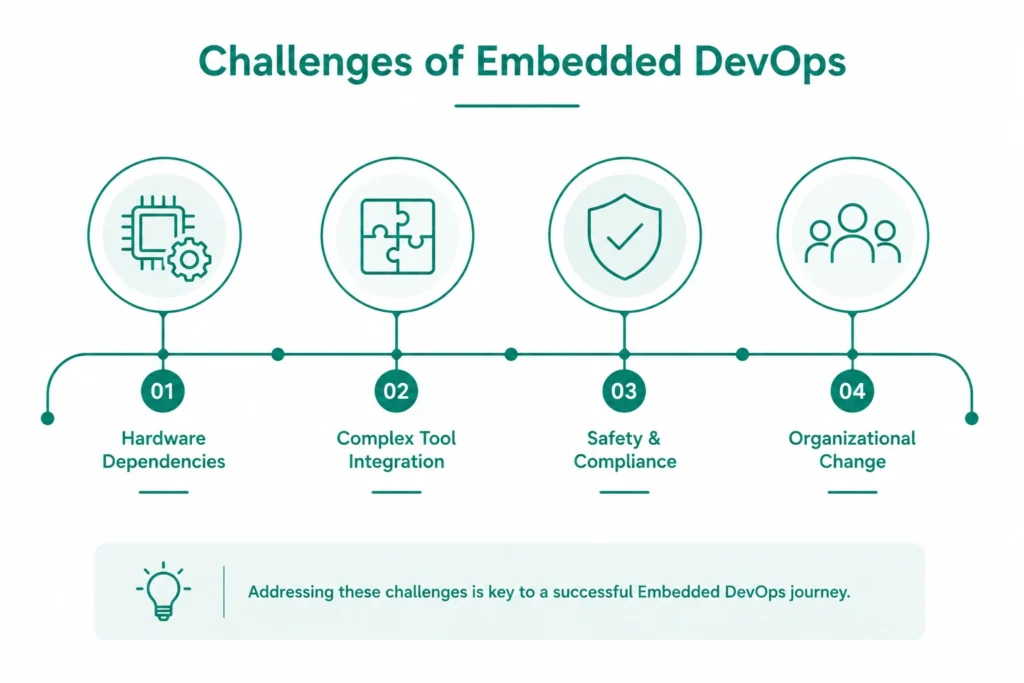
While Embedded DevOps offers significant advantages, implementing it successfully requires organizations to address several technical and organizational challenges. Unlike traditional software development, embedded systems involve tight integration between hardware and software, making automation and continuous delivery more complex.
Understanding these challenges helps engineering teams build a more effective and sustainable Embedded DevOps strategy.
Hardware Dependencies
One of the biggest challenges in embedded development is the dependence on physical hardware for validation.
Unlike cloud applications that can be deployed instantly to virtual environments, embedded software often requires:
- Development boards
- Electronic Control Units (ECUs)
- Sensors and actuators
- Custom hardware platforms
- Hardware-in-the-Loop (HIL) environments
Limited hardware availability can slow testing and delay releases. Organizations often address this challenge by combining hardware simulators, emulators, and automated test benches with physical validation.
Complex Tool Integration
Embedded software development involves multiple engineering tools for requirements management, software development, testing, version control, and deployment.
Without proper integration, engineering teams may experience:
- Duplicate data
- Manual handoffs
- Limited traceability
- Inconsistent reporting
- Poor collaboration
Building an integrated engineering ecosystem helps eliminate silos and improves lifecycle visibility.
Modern engineering organizations increasingly adopt an SDV Toolchain Architecture to connect systems engineering, software development, testing, DevOps, and release management into a unified workflow.
Managing Safety and Compliance
Many embedded products operate in highly regulated industries where engineering processes must comply with standards for safety, cybersecurity, and quality.
Engineering teams must demonstrate:
- Complete requirements traceability
- Verified test results
- Controlled configuration management
- Documented design reviews
- Audit-ready engineering evidence
Automating compliance activities within the DevOps pipeline reduces manual effort while improving consistency.
Organizational Change
Successful Embedded DevOps adoption requires more than implementing new tools.
Organizations must encourage collaboration between:
- Hardware engineers
- Firmware developers
- Systems engineers
- Test engineers
- Quality teams
- Operations teams
Changing long-established development practices often requires leadership support, structured training, and continuous improvement initiatives.
Best Practices for Successful Embedded DevOps
Organizations that achieve the greatest success with Embedded DevOps typically follow a structured implementation strategy.
Recommended best practices include:
- Automate firmware builds and testing wherever possible.
- Use Continuous Integration to validate every code change.
- Combine simulation with real hardware testing.
- Implement secure Over-the-Air (OTA) update mechanisms.
- Integrate engineering tools to establish end-to-end traceability.
- Monitor software quality using automated metrics.
- Incorporate security testing throughout the development lifecycle.
- Encourage collaboration across multidisciplinary engineering teams.
- Continuously review and improve engineering workflows.
Following these practices helps organizations improve software quality while reducing development time and operational risk.
Recommended Embedded DevOps Toolchain
An effective Embedded DevOps environment combines engineering, testing, automation, and deployment tools into a connected workflow.
Typical tool categories include:
| Engineering Activity | Common Tools |
|---|---|
| Requirements Management | IBM DOORS Next, PTC Codebeamer |
| Systems Engineering | IBM Rhapsody, Cameo Systems Modeler |
| Version Control | Git, GitLab |
| Continuous Integration | Jenkins, GitLab CI/CD |
| Static Code Analysis | SonarQube, Coverity |
| Test Automation | Robot Framework, TestRail |
| Hardware-in-the-Loop Testing | dSPACE, Vector, NI TestStand |
| Artifact Management | JFrog Artifactory, Nexus Repository |
| Monitoring | Grafana, Prometheus |
Selecting the right combination of tools depends on product complexity, regulatory requirements, and organizational goals.
How MicroGenesis Helps
MicroGenesis enables organizations to accelerate Embedded DevOps adoption through consulting, engineering transformation, and integrated lifecycle management solutions.
Our expertise includes:
- Embedded DevOps implementation
- Engineering Lifecycle Management
- Engineering Toolchain Integration
- Continuous Integration and Continuous Delivery (CI/CD)
- Model-Based Systems Engineering (MBSE)
- Requirements Management
- Engineering Traceability
- Test Automation
- Application Lifecycle Management (ALM)
- Digital Engineering transformation
Many organizations begin their transformation with Automotive Process Consulting to evaluate existing engineering workflows, identify process gaps, and build a roadmap for adopting modern Embedded DevOps practices.
Frequently Asked Questions
What is Embedded DevOps?
Embedded DevOps is the application of DevOps principles to embedded software development. It integrates continuous integration, automated testing, deployment, monitoring, and collaboration to improve the development and maintenance of software running on embedded hardware.
How is Embedded DevOps different from traditional DevOps?
Traditional DevOps primarily focuses on cloud and enterprise applications, while Embedded DevOps addresses the unique requirements of hardware-dependent systems, including firmware development, hardware validation, real-time constraints, and regulatory compliance.
What are the main benefits of Embedded DevOps?
Organizations implementing Embedded DevOps can achieve:
- Faster software delivery
- Higher software quality
- Improved collaboration
- Better security
- Simplified maintenance
- Enhanced engineering traceability
- Greater compliance readiness
Can Agile and Embedded DevOps work together?
Yes. Agile methodologies and Embedded DevOps complement each other by enabling iterative development, continuous testing, and frequent software delivery while maintaining engineering discipline and product quality.
Which industries benefit from Embedded DevOps?
Embedded DevOps is widely adopted in industries such as:
- Automotive
- Aerospace and Defense
- Medical Devices
- Industrial Automation
- Consumer Electronics
- Telecommunications
- Internet of Things (IoT)
Conclusion
Embedded DevOps is transforming how organizations develop, test, deploy, and maintain embedded software. By combining automation, continuous integration, collaborative engineering practices, and lifecycle management, organizations can deliver reliable software faster while maintaining the quality and compliance required for embedded products.
Although implementing Embedded DevOps presents challenges such as hardware dependencies, tool integration, and organizational change, these obstacles can be addressed through a structured engineering strategy, integrated toolchains, and continuous process improvement.
As embedded systems become more intelligent, connected, and software intensive, Embedded DevOps will continue to play a critical role in accelerating innovation. Organizations that embrace this approach will be better positioned to improve engineering efficiency, reduce development risks, respond quickly to changing market demands, and deliver high-quality products with confidence.