

Choosing the right IT Service Management (ITSM) platform is one of the most important technology decisions for growing organizations. The platform you select impacts service delivery, employee experience, operational efficiency, automation capabilities, reporting, and long-term scalability.
For years, ServiceNow has been considered the enterprise standard for ITSM. Meanwhile, Jira Service Management (JSM) has rapidly evolved from a ticketing solution into a comprehensive service management platform used by organizations worldwide.
As mid-market organizations evaluate their ITSM strategies, a common question emerges:
Should we choose Jira Service Management or ServiceNow?
The answer depends on your business requirements, team size, budget, operational complexity, and long-term digital transformation goals.
While ServiceNow remains a powerful enterprise platform, many mid-market organizations are increasingly choosing Jira Service Management because of its lower total cost of ownership, faster implementation, stronger integration with development teams, and greater flexibility.
In this article, we’ll compare Jira Service Management and ServiceNow across key areas including implementation, usability, automation, reporting, integrations, scalability, cost, and overall value for mid-market IT teams.
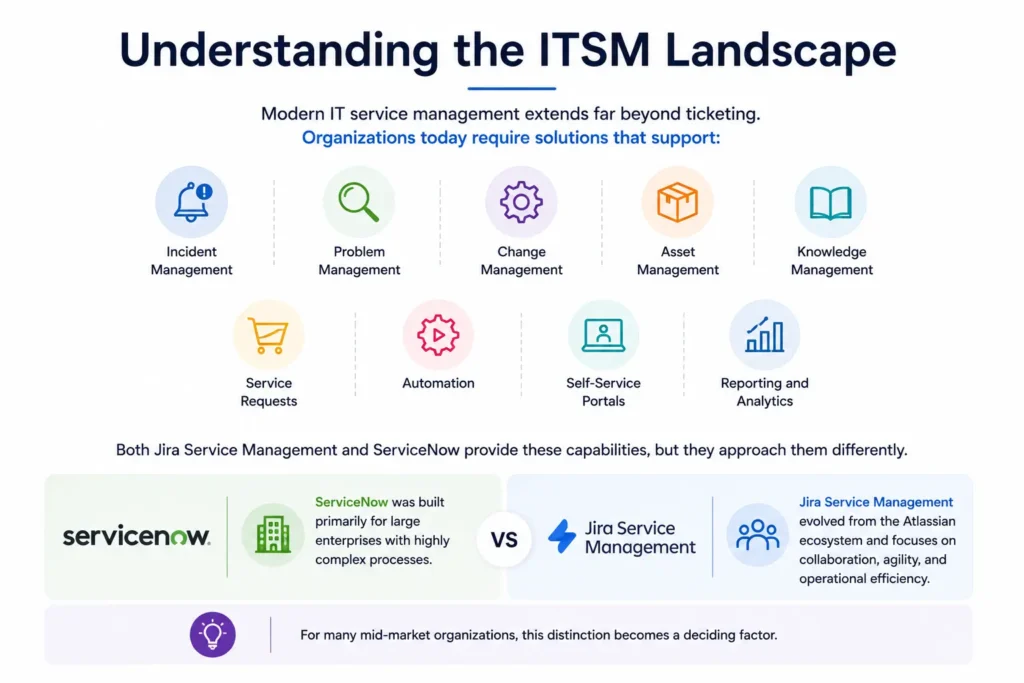
Modern IT service management extends far beyond ticketing.
Organizations today require solutions that support:
- Incident Management
- Problem Management
- Change Management
- Asset Management
- Knowledge Management
- Service Requests
- Automation
- Self-Service Portals
- Reporting and Analytics
Both Jira Service Management and ServiceNow provide these capabilities, but they approach them differently.
ServiceNow was built primarily for large enterprises with highly complex processes.
Jira Service Management evolved from the Atlassian ecosystem and focuses on collaboration, agility, and operational efficiency.
For many mid-market organizations, this distinction becomes a deciding factor.
Ease of Implementation
One of the biggest differences between the platforms is implementation complexity.
ServiceNow
ServiceNow implementations typically involve:
- Extensive planning
- Significant customization
- Dedicated consulting resources
- Long deployment timelines
Many ServiceNow projects take several months before organizations realize value.
Jira Service Management
Jira Service Management is generally much faster to deploy.
Organizations can often implement core ITSM processes within weeks rather than months.
Teams already familiar with Jira Software benefit from immediate adoption because the interface and workflows feel familiar.
Organizations looking to accelerate implementation frequently leverage specialized Jira Service Management Services to streamline deployment, workflow design, and process optimization.
For mid-market organizations seeking rapid time-to-value, Jira Service Management often has a significant advantage.
User Experience and Adoption
User adoption is critical to ITSM success.
Even the most powerful platform will fail if employees find it difficult to use.
ServiceNow
ServiceNow offers extensive functionality but can sometimes feel overwhelming for occasional users.
The platform often requires role-specific training and ongoing administration.
Jira Service Management
JSM benefits from Jira’s simplicity and familiarity.
Users can quickly learn:
- Ticket creation
- Workflow navigation
- Approvals
- Collaboration
- Reporting
Organizations already using Jira often experience significantly faster adoption rates.
Teams transitioning from legacy platforms frequently find that it’s easier to switch to Atlassian Jira than maintain highly customized enterprise systems that require extensive administration.
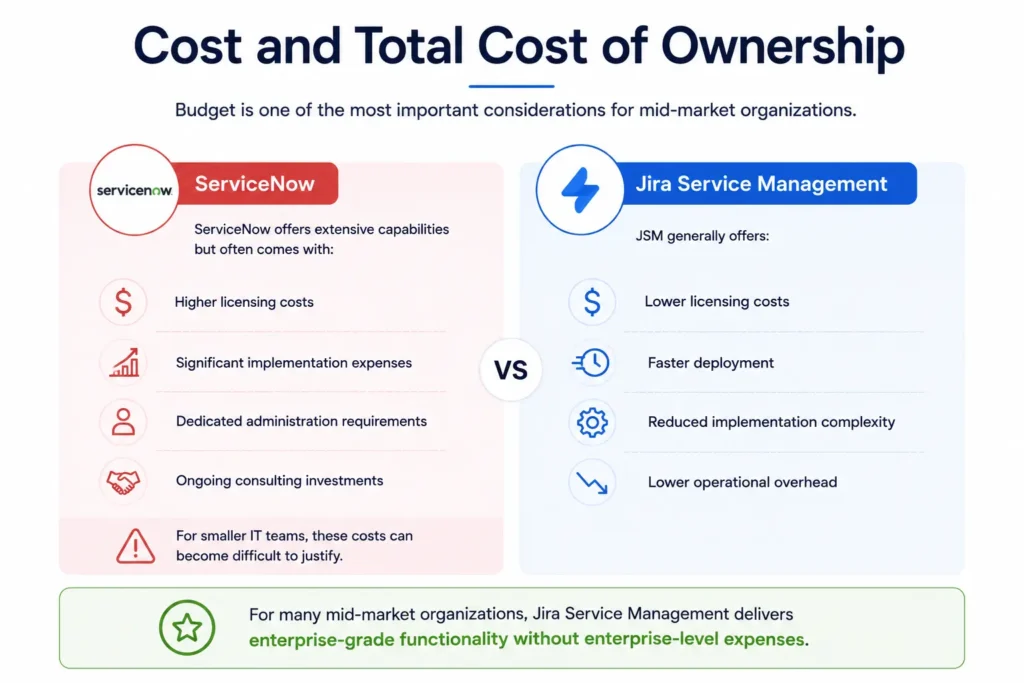
Budget is one of the most important considerations for mid-market organizations.
ServiceNow
ServiceNow offers extensive capabilities but often comes with:
- Higher licensing costs
- Significant implementation expenses
- Dedicated administration requirements
- Ongoing consulting investments
For smaller IT teams, these costs can become difficult to justify.
Jira Service Management
JSM generally offers:
- Lower licensing costs
- Faster deployment
- Reduced implementation complexity
- Lower operational overhead
For many mid-market organizations, Jira Service Management delivers enterprise-grade functionality without enterprise-level expenses.
Development and IT Collaboration
Modern organizations increasingly require closer alignment between development and operations teams.
ServiceNow
ServiceNow supports DevOps workflows but often requires additional integration efforts.
Jira Service Management
This is where Jira Service Management shines.
Because it is built within the Atlassian ecosystem, JSM integrates naturally with:
- Jira Software
- Confluence
- Bitbucket
- Compass
- Atlassian Analytics
Development and support teams can collaborate within a shared environment.
This eliminates silos and improves incident resolution speed.
Reporting and Analytics
Visibility drives better decision-making.
ServiceNow
ServiceNow offers powerful reporting capabilities and enterprise-grade dashboards.
However, advanced reporting often requires specialized expertise.
Jira Service Management
JSM provides flexible dashboards, reports, and metrics that are easier for many teams to configure and maintain.
Organizations seeking deeper insights can further enhance visibility through advanced Jira Reporting and Analytics capabilities.
For most mid-market organizations, Jira reporting offers the right balance of power and usability.
Automation Capabilities
Automation has become essential for modern IT operations.
ServiceNow
ServiceNow provides extensive workflow automation and orchestration capabilities.
These are particularly valuable in highly regulated or complex enterprise environments.
Jira Service Management
JSM includes powerful no-code automation features that allow teams to automate:
- Ticket routing
- Escalations
- Approvals
- Notifications
- Service requests
Most mid-market organizations find JSM automation sufficient for their needs without requiring extensive development effort.
Integrations and Ecosystem
No ITSM platform operates in isolation.
ServiceNow
ServiceNow offers a large integration ecosystem.
However, integrations often require additional configuration and investment.
Jira Service Management
The Atlassian Marketplace provides thousands of integrations and extensions.
Organizations can easily enhance functionality through:
- Reporting apps
- Asset management tools
- Test management solutions
- Monitoring integrations
- Collaboration platforms
Teams looking to maximize platform value often explore strategies for maximizing Jira integrations and add-ons.
Additionally, organizations can extend capabilities using many of the best tools for Jira teams available through the Atlassian ecosystem.
Scalability
One common misconception is that Jira Service Management cannot scale.
ServiceNow
ServiceNow was designed for large enterprise environments and scales exceptionally well.
Jira Service Management
Modern JSM deployments support:
- Thousands of users
- Global service teams
- Enterprise workflows
- Large-scale operations
Organizations migrating to Atlassian Cloud frequently discover substantial scalability improvements.
A great example is this successful Atlassian Jira Cloud migration case study, which demonstrates how organizations can modernize their Jira environments while improving scalability and operational efficiency.
For most mid-market organizations, scalability is rarely a limiting factor for Jira Service Management.
Flexibility Beyond IT
Many organizations want their service management platform to support non-IT teams.
ServiceNow
ServiceNow can support enterprise service management but often requires significant customization.
Jira Service Management
JSM integrates naturally with broader Jira workflows.
Organizations can extend service management principles across:
- HR
- Facilities
- Finance
- Procurement
- Legal
This flexibility often makes Jira more attractive for growing organizations.
Project Management Alignment
IT service management increasingly intersects with project delivery.
Organizations benefit when service management and project management platforms work together seamlessly.
Teams evaluating broader work management strategies may also benefit from reviewing an ultimate guide to project management tools to understand how service management fits into larger organizational workflows.
Because Jira Service Management shares the same foundation as Jira Software, organizations often achieve better alignment between operational support and project execution.
Jira Service Management vs Zendesk: Another Perspective
Some organizations evaluate multiple service desk solutions before making a decision.
While Zendesk excels in customer support environments, many IT organizations prefer Jira Service Management because of its stronger ITSM capabilities, deeper development integrations, and greater operational flexibility.
Organizations comparing service desk platforms may find it useful to explore a detailed comparison of Jira Service Management vs Zendesk.
Pros and Cons of Jira Service Management
Advantages
- Lower total cost of ownership
- Faster implementation
- Strong Atlassian ecosystem
- Excellent developer collaboration
- Flexible automation
- Extensive integrations
- Scalable cloud architecture
Limitations
- Less enterprise-specific functionality than ServiceNow
- Advanced reporting may require additional tools
- Governance becomes important as environments grow
Many of these considerations align closely with the broader pros and cons of Jira software that organizations should evaluate before making platform decisions.
Making Jira Easier for Teams
One reason organizations achieve faster adoption with Jira is the abundance of resources available for users.
Teams can significantly improve productivity by applying proven Jira tips and tricks and understanding fundamental Jira concepts such as Stories, Epics, and Tasks.
These resources help teams maximize value without requiring extensive training programs.
Which Platform Wins for Mid-Market IT Teams?
The answer depends on organizational priorities.
Choose ServiceNow if:
- You operate at large enterprise scale.
- You require extensive enterprise workflows.
- Budget is less of a concern.
- You have dedicated administration teams.
Choose Jira Service Management if:
- You want faster deployment.
- You need lower total cost of ownership.
- You already use Jira Software.
- You prioritize collaboration between IT and development.
- You want a flexible and scalable platform without excessive complexity.
For most mid-market organizations, Jira Service Management provides a stronger balance of functionality, usability, cost-effectiveness, and implementation speed.
How MicroGenesis Can Help
Selecting and implementing the right ITSM platform requires more than software evaluation.
Through specialized Jira Service Management Services, MicroGenesis helps organizations design, deploy, optimize, and scale Jira Service Management environments aligned with business objectives.
MicroGenesis supports organizations with:
- Jira Service Management implementation
- Workflow design and optimization
- ITSM process consulting
- Cloud migration
- Automation strategy
- Reporting and analytics
- Integration services
- Atlassian ecosystem optimization
Whether you’re evaluating ServiceNow, migrating from another platform, or expanding your Jira environment, MicroGenesis helps organizations maximize the value of their ITSM investment.
Conclusion
Both ServiceNow and Jira Service Management are powerful ITSM platforms capable of supporting modern service delivery.
ServiceNow remains an excellent choice for large enterprises with highly complex requirements and dedicated administration teams.
However, for many mid-market organizations, Jira Service Management offers a more compelling combination of speed, flexibility, scalability, integration capabilities, and cost efficiency.
The platform’s seamless connection with the broader Atlassian ecosystem, lower total cost of ownership, and ease of adoption make it particularly attractive for growing organizations seeking to modernize IT service management without introducing unnecessary complexity.
Ultimately, the best ITSM platform isn’t the one with the most features.
It’s the one your teams will actually use, adopt, and scale successfully as your business grows.