
Engineering organizations today are developing products that are more connected, software-driven, and intelligent than ever before. Industries such as automotive, aerospace, medical devices, industrial manufacturing, electronics, and rail must coordinate thousands or even millions of engineering artifacts across multiple teams, disciplines, and software tools.
Requirements, system models, source code, test cases, change requests, compliance documentation, and product configurations are often managed in separate applications. When this information is disconnected, engineering teams spend more time searching for data, manually updating records, and validating changes than delivering innovation. The result is reduced visibility, slower decision-making, duplicated work, and increased compliance risk.
A Digital Thread addresses these challenges by creating a connected flow of engineering information throughout the entire product lifecycle. Instead of treating engineering artifacts as isolated documents, it links people, processes, and tools into a single, traceable engineering ecosystem. Every requirement, model, design decision, software change, test result, and release becomes part of one continuous source of truth.
As organizations adopt Engineering Lifecycle Management, Model-Based Systems Engineering (MBSE), and modern DevOps practices, the Digital Thread has become a key enabler of digital engineering transformation. If you’re new to Engineering Lifecycle Management, our comprehensive Engineering Lifecycle Management Guide provides an excellent starting point.
What Is a Digital Thread?
A Digital Thread is an integrated flow of engineering data that connects every stage of the product lifecycle, ensuring that information remains linked across people, processes, and engineering tools. Rather than storing engineering artifacts in isolated systems, a Digital Thread establishes end-to-end connectivity, allowing teams to trace information from initial requirements through design, development, testing, compliance, deployment, and ongoing product support.
As organizations adopt Engineering Lifecycle Management (ELM), Model-Based Systems Engineering (MBSE), and modern DevOps practices, the Digital Thread has become a key enabler of digital engineering transformation. If you’re wondering how ELM differs from traditional application lifecycle practices, explore our comparison of ELM vs ALM.
A well-implemented Digital Thread connects engineering artifacts such as:
- Customer requirements
- System requirements
- Architecture models
- Design documents
- Source code
- Test cases
- Defects
- Change requests
- Validation results
- Compliance evidence
- Release artifacts
- Operational data
Because every artifact remains connected, engineering teams gain complete visibility into how decisions made in one phase affect the rest of the product lifecycle. This improves collaboration, simplifies change management, and provides continuous traceability across engineering activities.
The Digital Thread enables organizations to answer critical questions quickly, including:
- Which requirements are impacted by a design modification?
- Which test cases validate a specific requirement?
- Which software release introduced a defect?
- Which components are affected by a cybersecurity issue?
- What evidence supports compliance with industry standards?
Unlike traditional document-based engineering approaches, a Digital Thread ensures engineering information remains synchronized throughout development, helping teams make faster and more informed decisions.
To better understand how connected engineering platforms enable this level of traceability, read our article on What Is Engineering Lifecycle Management.
Why Is the Digital Thread Important?
Modern engineering programs involve multiple disciplines working together across complex development environments. A Software-Defined Vehicle, advanced medical device, or aerospace system may involve systems engineers, embedded software developers, hardware engineers, cybersecurity specialists, quality engineers, manufacturing teams, suppliers, and compliance experts, all contributing to the same product.
Without a connected engineering framework, information becomes fragmented across different applications and repositories. Teams often struggle with:
- Duplicate engineering work
- Inconsistent documentation
- Poor visibility across departments
- Manual data transfer between tools
- Slow engineering decisions
- Difficult impact analysis
- Regulatory compliance challenges
- Limited collaboration
A Digital Thread eliminates these issues by connecting engineering information across the complete lifecycle. Instead of relying on disconnected spreadsheets and documents, teams work with continuously linked engineering data that improves transparency and collaboration.
Organizations implementing a Digital Thread typically experience:
- Better engineering collaboration
- Faster product development
- Improved change impact analysis
- Higher product quality
- Reduced manual effort
- Stronger compliance and audit readiness
- Complete lifecycle traceability
- Faster engineering decision-making
As products become increasingly software-driven, the Digital Thread is becoming a foundational capability for organizations pursuing digital engineering and continuous product development.
Core Components of a Digital Thread
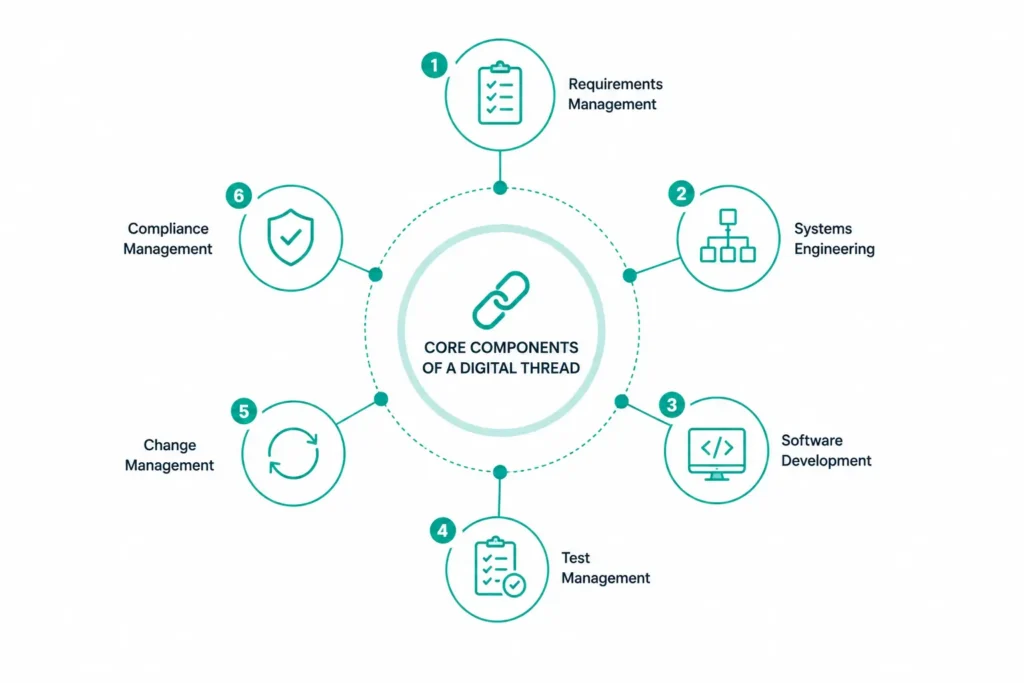
A Digital Thread is built by connecting engineering activities throughout the product lifecycle. Instead of allowing engineering information to remain isolated within individual tools, it creates relationships between requirements, system models, software development, testing, compliance, and product releases. This connected approach ensures that every engineering decision can be traced back to its source while maintaining complete lifecycle visibility.
1. Requirements Management
Every Digital Thread begins with well-defined requirements. These requirements establish the foundation for all downstream engineering activities and provide the baseline against which products are designed, developed, verified, and validated.
Organizations typically manage multiple types of requirements, including:
- Business requirements
- Customer requirements
- Functional requirements
- System requirements
- Safety requirements
- Cybersecurity requirements
- Regulatory requirements
Rather than storing these requirements in disconnected documents, a Digital Thread keeps them linked to design decisions, software development, testing activities, and compliance evidence. This improves traceability while making it easier to understand the impact of requirement changes throughout the engineering lifecycle.
2. Systems Engineering
Systems engineering transforms requirements into system architecture, functional behavior, interfaces, and design models.
Within a Digital Thread, systems engineering activities are connected to:
- System architecture
- Functional models
- Behavioral models
- Interface definitions
- System simulations
Maintaining these connections ensures that engineering teams can trace every architectural decision back to the original requirements while understanding how system changes affect downstream activities. It also supports collaboration between systems engineers, software developers, hardware teams, and validation engineers throughout product development.
Organizations implementing Model-Based Systems Engineering as part of their Digital Thread can also benefit from understanding the differences between ELM vs MBSE, as both play complementary roles in modern engineering environments.
3. Software Development
As products become increasingly software-defined, software engineering forms a critical part of the Digital Thread.
Modern engineering environments connect software activities such as:
- Source code
- Version control
- Build automation
- Continuous Integration
- Code reviews
- Release management
When software development is connected to requirements and system models, engineering teams gain complete visibility into which requirements are implemented in each software release and how code changes affect system functionality. This improves collaboration, accelerates development, and simplifies change management across the engineering lifecycle.
Organizations looking to modernize software delivery alongside Engineering Lifecycle Management often integrate Digital Thread initiatives with Embedded DevOps Services to automate development, testing, and deployment while maintaining complete engineering traceability.
4. Test Management
Testing verifies that engineering requirements have been implemented correctly and that products perform as intended.
Within a Digital Thread, testing activities remain connected to:
- Test plans
- Test cases
- Automated tests
- Defects
- Verification reports
- Validation evidence
This creates complete requirement-to-test traceability, allowing organizations to quickly determine whether every requirement has been properly verified. Connected testing also simplifies audit preparation because validation evidence remains linked to the corresponding engineering artifacts throughout the product lifecycle.
5. Change Management
Engineering changes are inevitable during product development. New customer needs, design improvements, software updates, and regulatory requirements continuously introduce modifications across engineering projects.
A Digital Thread enables engineering teams to:
- Analyze change impact
- Identify affected engineering artifacts
- Track approvals
- Maintain engineering baselines
- Monitor downstream dependencies
Instead of manually searching across multiple systems to understand the effects of a change, teams can immediately identify the requirements, models, source code, tests, and documentation influenced by a specific engineering decision. This significantly reduces manual effort while improving engineering accuracy.
6. Compliance Management
Many engineering-driven industries operate under strict regulatory standards that require complete lifecycle traceability.
Examples include:
- ASPICE
- ISO 26262
- ISO/SAE 21434
- IEC 62304
- DO-178C
- EN 50128
A Digital Thread automatically connects engineering evidence across the product lifecycle, making it easier to demonstrate compliance during assessments and audits. Rather than collecting documents manually, organizations maintain continuously updated engineering records that link requirements, development activities, testing, approvals, and validation evidence. This not only simplifies compliance but also improves confidence in engineering processes.
Organizations implementing Digital Thread initiatives often combine them with platforms such as IBM Engineering Lifecycle Management or PTC Codebeamer ALM to establish end-to-end engineering governance, lifecycle traceability, and compliance management.
💡
Digital Thread Across the Engineering Lifecycle
A Digital Thread connects every stage of product development into a continuous flow of engineering information. Rather than treating each engineering phase as an isolated activity, it ensures that data generated at one stage remains connected throughout the lifecycle.
A typical Digital Thread spans:
Customer Requirements
↓
System Requirements
↓
System Architecture
↓
MBSE Models
↓
Software Development
↓
Continuous Integration
↓
Testing & Validation
↓
Compliance
↓
Release
↓
Operations & Maintenance
↓
Engineering Changes
↓
Next Product Release
By maintaining these connections, organizations create a continuous engineering record that supports collaboration, improves traceability, accelerates decision-making, and enables continuous product improvement across multiple product generations.
Digital Thread vs Digital Twin
The terms Digital Thread and Digital Twin are often used together, but they serve different purposes within digital engineering. While both support smarter product development and lifecycle management, they address different aspects of the engineering process.
A Digital Thread focuses on connecting engineering information across the entire product lifecycle. It establishes relationships between requirements, system models, software, testing, manufacturing, and operational data, ensuring complete traceability from concept through deployment and maintenance.
A Digital Twin, on the other hand, is a virtual representation of a physical product, system, or asset. It uses real-time operational data from sensors and connected devices to simulate product behavior, monitor performance, predict failures, and support maintenance decisions.
Think of the Digital Thread as the information backbone that connects every engineering activity, while the Digital Twin uses that connected information to represent and optimize a physical asset throughout its operational life.
| Digital Thread | Digital Twin |
|---|---|
| Connects engineering information across the product lifecycle | Represents a virtual model of a physical product or system |
| Focuses on lifecycle traceability | Focuses on operational monitoring and simulation |
| Connects requirements, design, software, testing, and compliance | Uses real-time operational data from deployed products |
| Supports engineering collaboration | Supports predictive maintenance and performance optimization |
| Improves engineering decision-making | Improves operational decision-making |
Both technologies complement each other. A well-established Digital Thread provides the engineering data needed to create accurate Digital Twins, while operational insights from Digital Twins can feed back into the Digital Thread to improve future product designs.
Benefits of Implementing a Digital Thread
Organizations adopting a Digital Thread gain far more than improved document management. By connecting engineering information throughout the lifecycle, they create a collaborative environment where every stakeholder has access to accurate, up-to-date information.
Improved End-to-End Traceability
One of the greatest advantages of a Digital Thread is complete lifecycle traceability.
Every engineering artifact remains connected, allowing teams to trace:
- Requirements to architecture
- Architecture to implementation
- Source code to requirements
- Test cases to verification
- Defects to root causes
- Changes to affected components
- Compliance evidence to regulatory requirements
This significantly reduces manual effort while improving engineering confidence.
Better Cross-Functional Collaboration
Modern products are developed by multidisciplinary teams spread across different departments, locations, and organizations.
A Digital Thread enables:
- Systems engineers
- Software developers
- Hardware engineers
- Quality teams
- Compliance specialists
- Manufacturing teams
- Suppliers
to collaborate using connected engineering information rather than isolated documents.
Because everyone works with the same engineering data, communication improves and engineering decisions become more consistent.
Faster Change Impact Analysis
Engineering changes are unavoidable during product development.
Without connected engineering information, understanding the impact of a requirement or design change often requires manual investigation across multiple systems.
A Digital Thread automatically identifies related:
- Requirements
- Models
- Source code
- Test cases
- Documentation
- Product configurations
This enables engineering teams to evaluate change impacts much faster while reducing project risk.
Higher Product Quality
Connected engineering information improves product quality by ensuring that every requirement is implemented, verified, and validated.
Engineering teams can quickly identify:
- Missing requirements
- Unverified functionality
- Incomplete testing
- Outstanding defects
- Documentation gaps
This reduces the likelihood of engineering errors reaching production.
Simplified Regulatory Compliance
Organizations operating in regulated industries spend significant time preparing evidence for compliance assessments.
A Digital Thread simplifies this process by maintaining continuous links between:
- Requirements
- Design decisions
- Test evidence
- Validation reports
- Risk assessments
- Change history
Rather than manually collecting documentation, compliance teams can retrieve engineering evidence directly from connected lifecycle data.
Improved Engineering Productivity
Engineers frequently spend valuable time searching for information stored across multiple applications.
A Digital Thread reduces this overhead by creating a unified engineering environment where information is easier to locate, understand, and reuse.
Benefits include:
- Less manual documentation
- Reduced duplicate work
- Faster engineering reviews
- Improved collaboration
- Better project visibility
- Faster release cycles
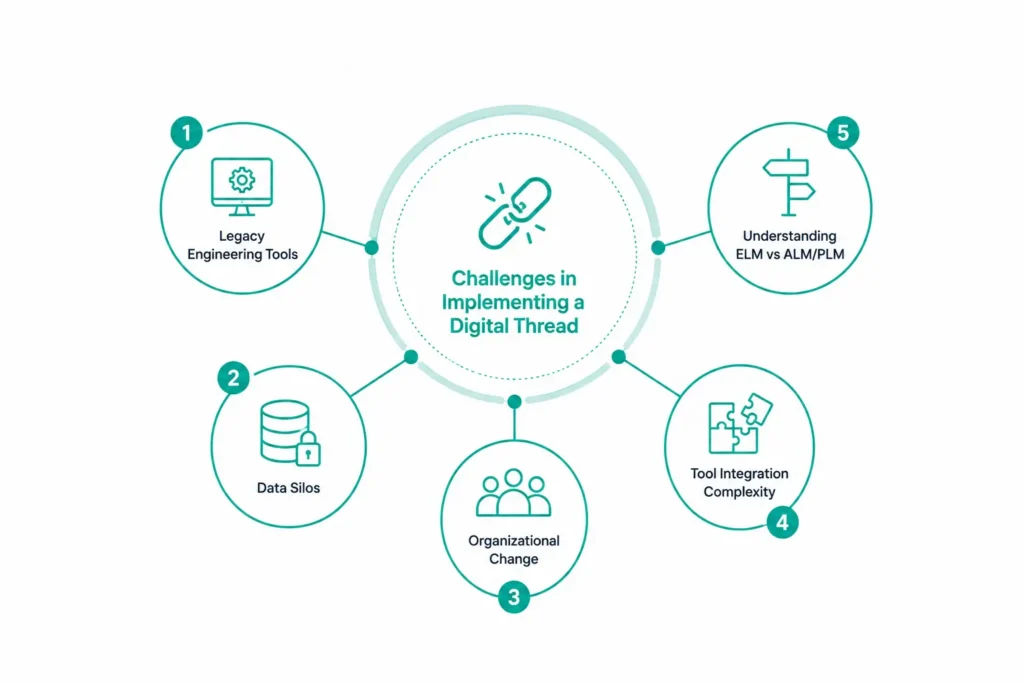
Common Challenges When Implementing a Digital Thread
Although the benefits are significant, implementing a Digital Thread requires careful planning.
Organizations commonly encounter several challenges during their digital engineering transformation.
Legacy Engineering Tools
Many organizations still rely on disconnected legacy applications that were never designed to share engineering information.
Connecting these systems often requires integration platforms, data migration, or lifecycle management solutions that support open standards.
Data Silos
Engineering information is frequently scattered across multiple repositories, making it difficult to establish complete lifecycle traceability.
Breaking down these silos requires standardized engineering processes and integrated toolchains.
Organizational Change
Implementing a Digital Thread is not only a technology initiative but also a business transformation.
Success depends on:
- Executive sponsorship
- Cross-functional collaboration
- Process standardization
- User adoption
- Continuous training
Without organizational alignment, even the best technology platforms may fail to deliver expected business outcomes.
Tool Integration Complexity
A Digital Thread typically connects multiple engineering tools, including:
- Requirements management
- MBSE platforms
- ALM solutions
- PLM systems
- Test management
- DevOps platforms
- Configuration management
- Compliance tools
Selecting platforms that support open integrations and lifecycle traceability significantly reduces implementation complexity.
Understanding how Engineering Lifecycle Management differs from ALM and PLM can help organizations choose the right architecture for connected engineering.
Best Practices for Building a Digital Thread
Organizations that successfully implement a Digital Thread typically follow several best practices:
- Define a clear digital engineering strategy before selecting tools.
- Establish standardized engineering processes across teams.
- Connect requirements, design, software, testing, and compliance through lifecycle traceability.
- Adopt open integration standards to reduce tool silos.
- Automate traceability wherever possible instead of relying on manual documentation.
- Continuously monitor engineering data quality and governance.
- Train teams to work within connected engineering environments rather than isolated functional tools.
- Start with high-value engineering processes before expanding across the full product lifecycle.
For organizations in regulated industries such as automotive, implementing these practices alongside Automotive Process Consulting services helps align engineering processes with standards like ASPICE and ISO 26262 while supporting scalable Digital Thread adoption.
How MicroGenesis Helps Organizations Build a Connected Digital Thread
Implementing a Digital Thread requires more than deploying engineering tools. It involves connecting people, processes, and technologies so that information flows seamlessly across the entire engineering lifecycle. Organizations must establish traceability, integrate multiple engineering applications, standardize workflows, and ensure compliance with industry regulations.
MicroGenesis helps organizations achieve these objectives by delivering engineering consulting, lifecycle management solutions, and digital engineering services tailored to complex product development environments.
With expertise across Engineering Lifecycle Management (ELM), Application Lifecycle Management (ALM), Model-Based Systems Engineering (MBSE), and Embedded DevOps, MicroGenesis supports organizations in building connected engineering ecosystems that improve collaboration, traceability, and product quality.
Its capabilities include:
- Engineering Lifecycle Management implementation and consulting
- IBM Engineering Lifecycle Management solutions
- PTC Codebeamer ALM implementation
- MBSE consulting and integration
- Requirements management and traceability
- Embedded DevOps implementation
- Engineering toolchain integration
- Compliance and regulatory support
- Engineering process consulting
- Digital engineering transformation
By connecting engineering disciplines through an integrated Digital Thread, MicroGenesis enables organizations to improve engineering visibility, accelerate product development, reduce manual effort, and strengthen compliance across the entire product lifecycle.
Frequently Asked Questions (FAQs)
1. What is a Digital Thread?
A Digital Thread is a connected flow of engineering information that links requirements, design, development, testing, compliance, manufacturing, and operations throughout the product lifecycle. It provides end-to-end traceability and enables better collaboration across engineering teams.
2. What is the purpose of a Digital Thread?
The primary purpose of a Digital Thread is to eliminate disconnected engineering data by creating a continuous flow of information across people, processes, and engineering tools. This helps organizations improve collaboration, reduce errors, accelerate product development, and maintain complete lifecycle traceability.
3. What is the difference between a Digital Thread and a Digital Twin?
A Digital Thread connects engineering information throughout the product lifecycle, while a Digital Twin is a virtual representation of a physical product or system that uses operational data to simulate, monitor, and optimize real-world performance.
4. Which industries benefit from a Digital Thread?
Digital Thread adoption is particularly valuable in industries developing complex and regulated products, including:
- Automotive
- Aerospace and Defense
- Medical Devices
- Industrial Manufacturing
- Electronics
- Rail Transportation
- Energy
- High-Tech Engineering
5. How does a Digital Thread improve traceability?
A Digital Thread creates relationships between engineering artifacts such as requirements, architecture models, software, test cases, defects, and compliance documentation. These connections make it possible to trace every engineering decision throughout the product lifecycle.
6. How is a Digital Thread related to Engineering Lifecycle Management (ELM)?
Engineering Lifecycle Management provides the processes and platforms used to manage engineering activities, while a Digital Thread connects the engineering information generated throughout those lifecycle processes. Together, they enable complete lifecycle visibility, collaboration, and traceability.
7. What technologies support a Digital Thread?
Organizations typically implement a Digital Thread using integrated engineering platforms such as:
- Engineering Lifecycle Management (ELM)
- Application Lifecycle Management (ALM)
- Model-Based Systems Engineering (MBSE)
- Product Lifecycle Management (PLM)
- Requirements Management
- DevOps platforms
- Configuration Management tools
- Test Management solutions
8. What are the biggest challenges when implementing a Digital Thread?
Common challenges include integrating legacy engineering tools, eliminating data silos, standardizing engineering processes, managing organizational change, and ensuring consistent lifecycle traceability across multiple teams and engineering disciplines.
Conclusion
As products continue to become more software-driven, connected, and complex, organizations need more than isolated engineering tools to manage development effectively. A Digital Thread provides the foundation for connected engineering by linking requirements, system models, software development, testing, compliance, and operations into a single, traceable flow of information.
By breaking down data silos and connecting engineering activities across the product lifecycle, organizations gain better visibility, faster decision-making, improved collaboration, and stronger regulatory compliance. Whether developing automotive systems, aerospace platforms, medical devices, or industrial equipment, a Digital Thread enables engineering teams to respond more quickly to change while maintaining quality and traceability.
When combined with modern Engineering Lifecycle Management, Model-Based Systems Engineering, and DevOps practices, a Digital Thread becomes a key enabler of digital engineering transformation and continuous product innovation.
Organizations looking to accelerate this transformation can benefit from integrated engineering solutions such as IBM Engineering Lifecycle Management, PTC Codebeamer ALM, Embedded DevOps Services, and Automotive Process Consulting. By adopting the right technologies and engineering practices, businesses can build a scalable Digital Thread that supports faster product development, higher engineering efficiency, and long-term business success.