
Key Takeaways
- Engineering Change Management provides a structured process for evaluating, approving, and implementing engineering changes.
- End-to-end traceability and standardized workflows reduce risks, improve collaboration, and simplify compliance.
- Engineering Lifecycle Management and the Digital Thread enable faster, more controlled change management.
Engineering projects rarely follow a fixed path from concept to release. Customer expectations evolve, product requirements change, defects are discovered during testing, suppliers update components, and new regulatory standards continue to emerge. As products become more connected and software-driven, engineering teams must be able to manage change efficiently without compromising quality, compliance, or delivery schedules.
Every engineering change, whether it’s a design improvement, a software update, or a regulatory requirement, can have a ripple effect across multiple teams and systems. A single modification may impact requirements, system architecture, embedded software, hardware design, testing, manufacturing, documentation, and product configurations. Without a structured approach, these changes can lead to delays, increased development costs, rework, compliance issues, and reduced product quality.
This is where Engineering Change Management (ECM) becomes essential.
Engineering Change Management provides a controlled framework for identifying, evaluating, approving, implementing, and validating engineering changes throughout the product lifecycle. Instead of reacting to changes individually, organizations establish standardized processes that ensure every modification is reviewed, documented, and fully traceable before it is incorporated into the product.
As organizations adopt connected engineering practices, Engineering Change Management works closely with Engineering Lifecycle Management (ELM) to maintain visibility and traceability across engineering activities. If you’re new to the concept of ELM, the Engineering Lifecycle Management Guide provides a comprehensive overview of how modern engineering organizations manage complex product development.
What Is Engineering Change Management?
Engineering Change Management (ECM) is the structured process of identifying, evaluating, approving, implementing, verifying, and documenting changes to engineering artifacts throughout the product lifecycle. Rather than allowing changes to occur in an uncontrolled manner, ECM ensures that every modification is assessed for its technical, operational, financial, and regulatory impact before implementation.
Engineering changes can affect many aspects of product development, including:
- Customer requirements
- Product specifications
- System architecture
- Mechanical design
- Embedded software
- Electronic hardware
- Test cases
- Manufacturing processes
- Compliance documentation
- Product configurations
The objective of Engineering Change Management is not to eliminate change but to manage it in a controlled, transparent, and traceable way. A structured change process helps organizations maintain product quality while ensuring that every stakeholder understands why a change was introduced, how it affects the product, and whether it has been successfully verified before release.
A well-managed Engineering Change Management process provides visibility into:
- Why the change is required
- Which engineering artifacts are affected
- Who is responsible for reviewing and approving the change
- How the change will be implemented
- Whether validation activities have been completed
- How the change impacts compliance and product releases
Modern organizations often integrate Engineering Change Management within broader Engineering Lifecycle Management platforms to improve collaboration and maintain complete lifecycle traceability.
If you’d like to understand how Engineering Lifecycle Management supports connected engineering processes, read What Is Engineering Lifecycle Management.
Why Engineering Change Management Is Important
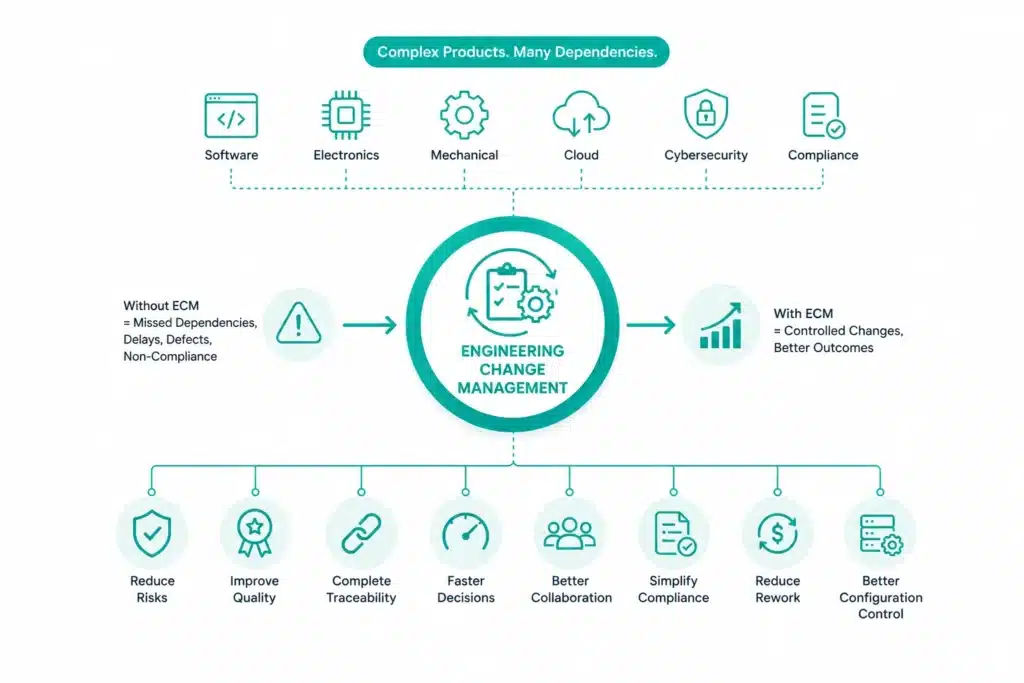
Modern engineering products combine software, electronics, mechanical components, cloud connectivity, cybersecurity, and regulatory requirements into a single development program. Multiple engineering disciplines work simultaneously, making even a small design modification capable of affecting numerous downstream activities.
For example, a software update to an automotive braking system may require:
- Updated customer and system requirements
- Modified system architecture
- Embedded software updates
- Hardware validation
- Functional safety assessments
- Cybersecurity reviews
- Regression testing
- Compliance documentation updates
- Manufacturing changes
Without a structured Engineering Change Management process, these dependencies are easy to overlook, increasing the risk of product defects, delayed releases, or regulatory non-compliance.
An effective Engineering Change Management process enables organizations to:
- Reduce engineering risks
- Improve product quality
- Maintain complete engineering traceability
- Accelerate engineering decision-making
- Improve collaboration across teams
- Simplify regulatory compliance
- Reduce costly rework
- Improve configuration control
As products become increasingly software-defined, Engineering Change Management has evolved from a documentation activity into a strategic engineering capability that supports faster innovation while maintaining governance and quality.
Common Reasons for Engineering Changes
Engineering changes occur throughout the product lifecycle for many different reasons. Some changes are driven by customers, while others result from technology updates, compliance requirements, testing activities, or business improvements. Understanding these drivers helps organizations establish better planning and change control processes.
Customer Requirements
Customer expectations often change after development has already begun. New functionality, improved performance, enhanced usability, or additional features may require engineering teams to update product requirements, designs, software, and testing activities.
Managing these requests through a formal Engineering Change Management process ensures that customer-driven modifications are evaluated for feasibility, cost, schedule, and downstream impact before implementation.
Regulatory Changes
Organizations operating in regulated industries must continually adapt products to comply with evolving standards and regulations.
Examples include:
- ISO 26262
- ASPICE
- ISO/SAE 21434
- IEC 62304
- FDA regulations
Engineering Change Management helps ensure that regulatory updates are consistently implemented across requirements, designs, software, testing, and compliance documentation while maintaining complete audit trails.
Product Defects
Testing activities frequently uncover software bugs, design issues, integration problems, or hardware failures that require engineering modifications.
Engineering Change Management ensures that corrective actions are properly reviewed, implemented, verified, and documented before being incorporated into future product releases.
Technology Upgrades
Engineering organizations regularly modernize development platforms, replace obsolete hardware components, update software libraries, or introduce new engineering tools.
A structured Engineering Change Management process minimizes disruption by evaluating the broader impact of these technology changes across the engineering lifecycle.
Supplier Changes
Changes introduced by suppliers, such as component updates, discontinued parts, or material substitutions, often require corresponding engineering modifications.
Engineering teams must assess how these supplier-driven changes affect product design, manufacturing, testing, and compliance before implementation.
Cost Optimization
Organizations also initiate engineering changes to improve manufacturing efficiency, simplify maintenance, reduce production costs, or enhance product performance.
Although these changes are often business-driven, they still require the same level of engineering governance to ensure quality and traceability throughout the lifecycle.
💡
The Engineering Change Management Process
Although every organization has its own workflow, most Engineering Change Management processes follow a structured sequence of activities. This ensures that every engineering change is carefully evaluated, approved, implemented, verified, and documented before becoming part of the product baseline. Following a standardized process reduces engineering risks while maintaining quality and traceability across the product lifecycle.
Engineering Change Request (ECR)
The Engineering Change Management process begins with an Engineering Change Request (ECR). An ECR is a formal proposal submitted when an engineering issue, improvement opportunity, or new requirement has been identified.
Engineering Change Requests commonly originate from:
- New customer requirements
- Product enhancements
- Software defects
- Regulatory updates
- Supplier modifications
- Manufacturing improvements
- Cost optimization initiatives
Each Engineering Change Request should clearly document:
- Description of the proposed change
- Business or technical justification
- Priority level
- Affected product or subsystem
- Request owner
- Expected business impact
Capturing this information early helps engineering teams evaluate whether the proposed change aligns with business objectives and product requirements before development begins.
Impact Analysis
Once an Engineering Change Request has been submitted, the next step is to determine how the proposed modification will affect the overall product.
Impact analysis is one of the most important stages because engineering changes often extend far beyond a single document or software component.
Engineering teams evaluate the impact on:
- Requirements
- System architecture
- Mechanical design
- Electronic hardware
- Embedded software
- System interfaces
- Test cases
- Product documentation
- Manufacturing processes
- Regulatory compliance
A connected engineering environment makes this activity significantly easier because engineering artifacts remain linked throughout the lifecycle. Instead of manually searching across multiple systems, teams can quickly identify affected requirements, designs, software modules, and validation activities.
Organizations using Model-Based Systems Engineering often perform faster and more accurate impact analysis because engineering models remain connected to downstream lifecycle artifacts. To understand how these disciplines complement each other, explore ELM vs MBSE.
Change Review and Approval
After completing the impact analysis, the proposed engineering change is reviewed by relevant stakeholders before approval.
Depending on the organization and industry, the review team may include:
- Systems engineers
- Software engineers
- Product managers
- Quality engineers
- Compliance specialists
- Manufacturing teams
- Project managers
During the review, stakeholders evaluate several factors, including:
- Technical feasibility
- Engineering effort
- Business value
- Cost implications
- Schedule impact
- Product quality
- Compliance risks
- Customer impact
Only after all necessary approvals have been obtained does the Engineering Change Request proceed to implementation. This structured review process ensures that engineering resources are focused on changes that deliver measurable value while minimizing unnecessary risks.
Change Implementation
Once approved, engineering teams begin implementing the required modifications across all affected engineering artifacts.
Depending on the scope of the change, implementation activities may include:
- Updating customer and system requirements
- Revising system architecture
- Modifying software components
- Updating hardware designs
- Revising engineering documentation
- Updating product configurations
- Synchronizing engineering databases
Version control and configuration management play a crucial role during this phase by ensuring every modification is properly recorded and traceable.
Organizations implementing continuous engineering practices often integrate Engineering Change Management with Embedded DevOps Services to automate software builds, testing, deployment, and change tracking across the engineering lifecycle.
Verification and Validation
Every engineering change must be verified before it becomes part of the official product baseline.
Verification confirms that the implemented change satisfies the approved Engineering Change Request without introducing new issues elsewhere in the product.
Validation activities typically include:
- Unit testing
- Integration testing
- System testing
- Regression testing
- Hardware validation
- Compliance verification
These activities provide confidence that the engineering change performs as expected while maintaining product quality and regulatory compliance.
Maintaining traceability between requirements, implementation, and validation also simplifies future audits and engineering reviews.
Release and Documentation
Once verification has been successfully completed, the approved engineering change is incorporated into the product baseline.
Organizations update several engineering records, including:
- Release documentation
- Configuration records
- Product documentation
- Compliance evidence
- Engineering reports
Maintaining complete engineering documentation ensures that every change remains fully traceable throughout the product lifecycle. This historical record supports future maintenance activities, engineering investigations, product updates, and regulatory audits.
Rather than treating documentation as a separate activity, modern Engineering Change Management processes integrate documentation directly into connected engineering workflows, ensuring that information remains accurate and synchronized across all lifecycle stages.
Types of Engineering Changes
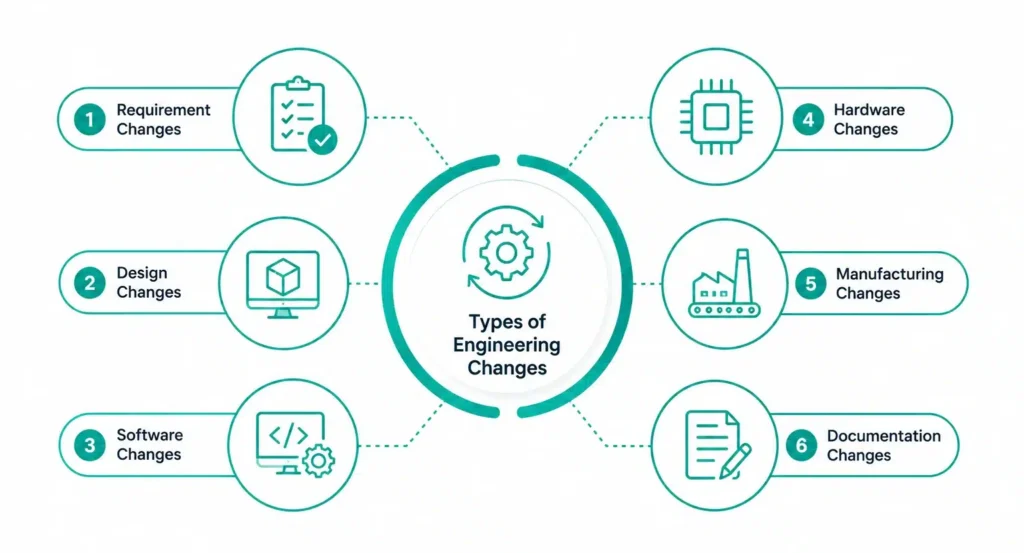
Requirement Changes
Requirement changes occur when customer expectations evolve or regulatory standards introduce new obligations. These updates often trigger downstream changes to system architecture, software development, testing, and compliance documentation.
Design Changes
Design changes involve modifications to system architecture, mechanical assemblies, interfaces, or product structure. These changes are typically introduced to improve performance, reliability, manufacturability, or maintainability.
Software Changes
Software-related engineering changes include:
- Bug fixes
- Feature enhancements
- Performance improvements
- Cybersecurity updates
- Software optimization
- Integration improvements
As products become increasingly software-defined, software changes represent a growing proportion of engineering modifications.
Hardware Changes
Hardware changes may involve:
- Electronic components
- Sensors
- Processors
- Circuit boards
- Mechanical assemblies
- Electrical systems
These modifications often require coordinated updates across engineering documentation, testing, manufacturing, and supplier management.
Manufacturing Changes
Manufacturing improvements may include updates to production processes, tooling, assembly procedures, suppliers, or quality control methods.
Engineering Change Management ensures these production changes remain synchronized with engineering documentation and product configurations.
Documentation Changes
Engineering documentation must evolve alongside the product.
Documentation changes commonly affect:
- Product specifications
- Engineering drawings
- User manuals
- Service documentation
- Regulatory evidence
- Compliance reports
Keeping documentation synchronized with engineering changes helps organizations maintain consistency, improve collaboration, and simplify regulatory audits.
💡
Challenges in Engineering Change Management
Engineering Change Management is essential for maintaining product quality and traceability, but implementing an effective change management process is not always straightforward. As engineering programs become more complex, organizations often encounter challenges that slow decision-making, increase costs, and reduce visibility across the product lifecycle. Identifying these obstacles early helps organizations build more efficient and resilient engineering processes.
Poor Traceability
One of the most common challenges is the lack of end-to-end traceability between engineering artifacts.
When requirements, system designs, software, test cases, and documentation are stored in separate tools, understanding the impact of a proposed change becomes difficult. Engineering teams may spend considerable time manually identifying affected components, increasing the risk of overlooking critical dependencies.
Maintaining connected lifecycle traceability enables organizations to evaluate changes more accurately and reduces the likelihood of engineering errors.
Manual Processes
Many organizations still rely on spreadsheets, emails, and manual approval processes to manage engineering changes.
Manual workflows often lead to:
- Delayed approvals
- Inconsistent documentation
- Duplicate engineering effort
- Limited visibility
- Higher administrative overhead
Automating Engineering Change Management workflows improves efficiency while ensuring that every engineering change follows a standardized approval process.
Tool Silos
Engineering information is frequently distributed across multiple specialized applications.
Examples include:
- Requirements Management tools
- Systems Engineering platforms
- ALM solutions
- Test Management software
- Configuration Management systems
- Product Lifecycle Management platforms
Without proper integration, engineering teams must manually synchronize information between these applications, resulting in duplicated work and inconsistent engineering data.
Organizations implementing connected engineering platforms can significantly reduce these challenges by integrating lifecycle information across all engineering disciplines. Understanding the differences between ELM vs PLM helps organizations determine how these platforms complement Engineering Change Management and broader engineering processes.
Regulatory Compliance Complexity
Industries such as automotive, aerospace, medical devices, and rail require complete documentation for every engineering modification.
Engineering teams must demonstrate:
- Why the change was introduced
- Who approved it
- Which requirements were affected
- Which tests validated the change
- Whether regulatory obligations were satisfied
Managing this evidence manually becomes increasingly difficult as product complexity grows.
Connected Engineering Lifecycle Management platforms simplify compliance by maintaining continuous traceability throughout the engineering lifecycle.
Cross-Functional Collaboration
Engineering changes often involve multiple departments working together.
These may include:
- Systems Engineering
- Software Development
- Hardware Engineering
- Quality Assurance
- Compliance
- Manufacturing
- Product Management
Without standardized workflows and shared engineering information, collaboration becomes slower, approvals take longer, and communication gaps increase the likelihood of engineering mistakes.
Best Practices for Engineering Change Management
Organizations that consistently manage engineering changes successfully typically adopt standardized processes supported by connected engineering platforms and lifecycle traceability.
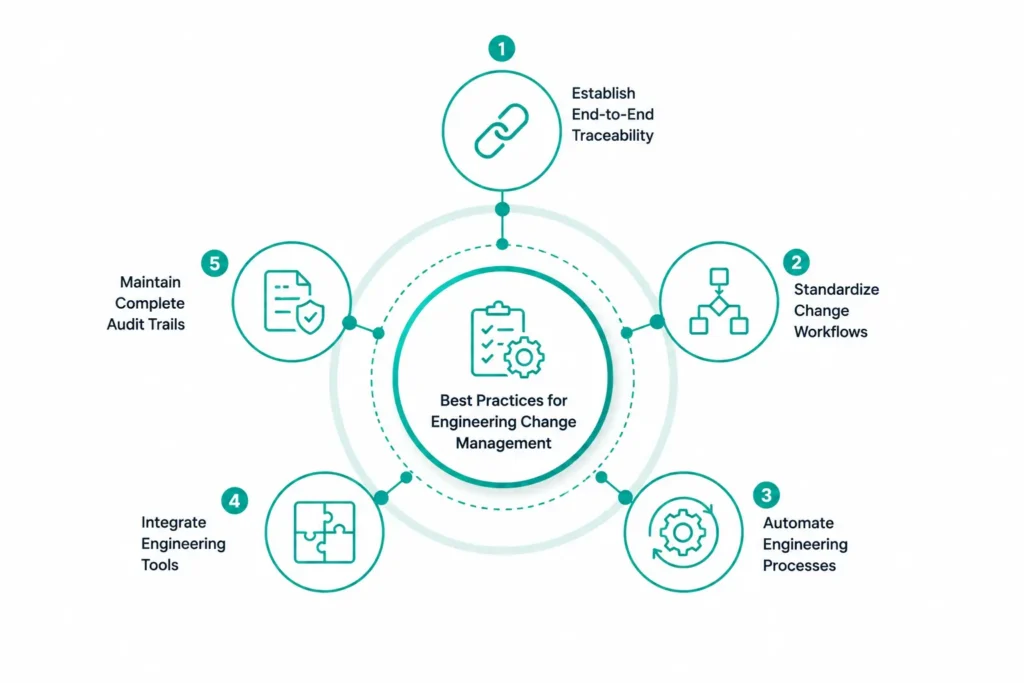
Establish End-to-End Traceability
Every engineering artifact should remain connected throughout the product lifecycle.
Requirements should be linked directly to:
- System models
- Software components
- Hardware designs
- Test cases
- Validation reports
- Product releases
Complete traceability allows engineering teams to understand the impact of every change while simplifying compliance and future maintenance activities.
Standardize Change Workflows
Clearly defined workflows help ensure every engineering change follows the same approval process.
A standardized workflow should define:
- Change request creation
- Impact analysis
- Review responsibilities
- Approval hierarchy
- Implementation activities
- Validation requirements
- Release procedures
Consistent workflows improve governance while reducing delays caused by unclear responsibilities.
Automate Engineering Processes
Automation helps eliminate repetitive manual tasks associated with Engineering Change Management.
Organizations should automate activities such as:
- Change request routing
- Approval notifications
- Workflow progression
- Status updates
- Compliance documentation
- Engineering reports
Workflow automation accelerates engineering decisions while reducing administrative effort.
Integrate Engineering Tools
Modern engineering organizations use multiple specialized applications across the product lifecycle.
Integrating tools such as:
- Requirements Management
- Systems Engineering
- Software Development
- Test Management
- Configuration Management
creates a connected engineering environment where information flows automatically between teams and engineering disciplines.
Organizations implementing Engineering Lifecycle Management platforms often achieve this integration through solutions such as IBM Engineering Lifecycle Management, which provides lifecycle traceability across engineering activities.
Maintain Complete Audit Trails
Every engineering change should capture a complete history of activities throughout its lifecycle.
An effective audit trail includes:
- Who requested the change
- Business justification
- Approval history
- Implementation details
- Validation evidence
- Release information
Maintaining this information improves engineering governance while simplifying regulatory assessments and customer audits.
Engineering Change Management in Regulated Industries
Engineering Change Management plays a particularly important role in industries where product quality, safety, and compliance are critical.
Automotive
Automotive manufacturers manage thousands of engineering changes throughout vehicle development.
Engineering Change Management supports compliance with standards such as:
- ASPICE
- ISO 26262
- ISO/SAE 21434
It also helps organizations developing Software-Defined Vehicles maintain complete traceability across hardware, software, cybersecurity, and safety engineering activities.
Organizations operating in the automotive sector often combine Engineering Change Management with Automotive Process Consulting to strengthen engineering governance and ensure compliance with industry standards.
Aerospace & Defense
Engineering Change Management supports certification, configuration management, safety-critical engineering, and lifecycle traceability throughout complex aerospace and defense programs.
Medical Devices
Medical device manufacturers rely on Engineering Change Management to maintain compliance with standards such as IEC 62304, ISO 13485, and FDA regulations while ensuring every engineering modification is fully documented and validated.
Rail & Transportation
Rail organizations use Engineering Change Management to support EN 50128 compliance, safety assessments, and long-term configuration management across complex transportation systems.
Industrial Manufacturing
Manufacturers benefit from Engineering Change Management by improving collaboration between mechanical, electrical, software, and manufacturing teams while maintaining complete visibility across engineering activities.
Engineering Change Management and the Digital Thread
Engineering Change Management becomes significantly more effective when it is supported by a Digital Thread. Instead of managing engineering changes through disconnected documents and isolated applications, a Digital Thread connects every engineering artifact across the product lifecycle, providing complete visibility into how a proposed change affects the entire product.
When a requirement is modified, engineering teams can immediately identify the related system models, software components, hardware designs, test cases, compliance documents, and release artifacts. This connected approach reduces manual effort, improves decision-making, and minimizes the risk of overlooking critical dependencies.
A Digital Thread also strengthens collaboration by ensuring that all stakeholders work from the same up-to-date engineering information. As changes move through review, implementation, testing, and release, every activity is automatically linked, creating a complete engineering history that supports future maintenance, audits, and continuous product improvement.
Organizations adopting Engineering Lifecycle Management platforms often combine Digital Thread capabilities with Engineering Change Management to create a fully connected engineering environment that improves productivity, quality, and compliance.
Choosing the Right Platform for Engineering Change Management
The success of an Engineering Change Management process depends not only on well-defined workflows but also on the technology used to support them.
Modern Engineering Lifecycle Management platforms provide capabilities such as:
- End-to-end requirements traceability
- Automated change workflows
- Version and configuration management
- Integrated review and approval processes
- Test management
- Compliance reporting
- Impact analysis
- Engineering collaboration
Solutions such as PTC Codebeamer ALM help engineering organizations manage complex change processes by connecting requirements, risk management, testing, and software development within a single lifecycle platform. This enables engineering teams to make informed decisions while maintaining complete traceability across the product lifecycle.
Organizations evaluating lifecycle management approaches should also understand the differences between ELM vs ALM. While ALM primarily focuses on software development, Engineering Lifecycle Management extends lifecycle governance across systems engineering, hardware, software, testing, compliance, and product engineering, making it more suitable for developing complex physical products.
How MicroGenesis Helps Organizations Improve Engineering Change Management
Successfully implementing Engineering Change Management requires more than defining approval workflows. Organizations need integrated engineering platforms, standardized processes, lifecycle traceability, and seamless collaboration across multidisciplinary teams.
MicroGenesis helps organizations modernize Engineering Change Management by implementing connected engineering environments that improve visibility, collaboration, and engineering governance across the product lifecycle.
As a trusted engineering consulting partner, MicroGenesis provides expertise in:
- IBM Engineering Lifecycle Management consulting
- PTC Codebeamer ALM implementation
- Engineering Change Management process consulting
- Requirements management and lifecycle traceability
- Engineering toolchain integration
- Embedded DevOps implementation
- Compliance and audit readiness
- Automotive engineering process consulting
- Digital engineering transformation
By integrating engineering data, automating workflows, and improving lifecycle traceability, MicroGenesis enables organizations to reduce engineering complexity, accelerate product development, and maintain compliance while delivering high-quality products faster.
Frequently Asked Questions (FAQs)
What is Engineering Change Management?
Engineering Change Management is the structured process of identifying, evaluating, approving, implementing, verifying, and documenting engineering changes throughout the product lifecycle while maintaining complete traceability and product quality.
What is an Engineering Change Request (ECR)?
An Engineering Change Request (ECR) is a formal proposal used to initiate an engineering modification. It describes the reason for the change, the affected product or system, the expected impact, and the business or technical justification before the change enters the review and approval process.
What is the difference between an Engineering Change Request (ECR) and an Engineering Change Order (ECO)?
An Engineering Change Request (ECR) is submitted to propose and evaluate a change. Once the request has been reviewed and approved, it becomes an Engineering Change Order (ECO), which authorizes the implementation of the approved engineering change.
Why is Engineering Change Management important?
Engineering Change Management helps organizations control product modifications, reduce engineering risks, improve collaboration, maintain regulatory compliance, strengthen lifecycle traceability, and ensure that every engineering change is properly evaluated before implementation.
Which industries use Engineering Change Management?
Engineering Change Management is widely used in industries that develop complex or regulated products, including:
- Automotive
- Aerospace and Defense
- Medical Devices
- Industrial Manufacturing
- Electronics
- Rail Transportation
- Energy
How does Engineering Lifecycle Management support Engineering Change Management?
Engineering Lifecycle Management provides a connected platform that links requirements, system models, software, testing, change management, and compliance activities. This enables engineering teams to perform faster impact analysis, maintain lifecycle traceability, and manage engineering changes more efficiently.
What are the biggest challenges in Engineering Change Management?
Common challenges include disconnected engineering tools, poor traceability, manual approval processes, cross-functional collaboration issues, regulatory compliance requirements, and understanding the downstream impact of engineering changes.
How can organizations improve their Engineering Change Management process?
Organizations can improve Engineering Change Management by standardizing workflows, automating approvals, integrating engineering tools, maintaining end-to-end traceability, adopting Engineering Lifecycle Management platforms, and continuously monitoring engineering processes for improvement.
Conclusion
Engineering Change Management is a critical capability for organizations developing complex products in today’s fast-changing engineering landscape. As customer expectations, regulatory requirements, and technologies continue to evolve, engineering teams need a structured approach to evaluate, approve, implement, and validate changes without affecting product quality or project timelines.
By adopting standardized Engineering Change Management processes, organizations can improve collaboration, reduce engineering risks, maintain complete lifecycle traceability, and simplify regulatory compliance. When integrated with Engineering Lifecycle Management, Digital Thread practices, and modern engineering platforms, Engineering Change Management becomes a strategic enabler for faster innovation and more efficient product development.
Whether you’re developing software-defined vehicles, aerospace systems, industrial equipment, or medical devices, investing in a connected Engineering Change Management approach helps ensure that every engineering decision is fully traceable, properly governed, and aligned with business objectives.
For organizations looking to modernize their engineering processes, platforms such as IBM Engineering Lifecycle Management and PTC Codebeamer ALM, combined with expert consulting from MicroGenesis, provide the foundation for building scalable, compliant, and future-ready engineering environments.