

Engineering organizations are developing products that are becoming increasingly complex. Modern systems often combine hardware, software, electronics, embedded systems, cloud services, artificial intelligence, and connected technologies into a single product. Whether it’s a Software Defined Vehicle (SDV), a medical device, an aircraft, or an industrial automation solution, successful development depends on hundreds of engineers working together across multiple disciplines.
As product complexity grows, so does the amount of engineering information generated throughout development. Requirements, system models, hardware designs, source code, test cases, compliance documents, change requests, and release artifacts are all interconnected. A change made to one engineering artifact can affect several others across the product lifecycle. Without a structured way to manage these relationships, organizations may face delays, quality issues, increased costs, and compliance risks.
This is where Engineering Traceability becomes essential.
Engineering Traceability establishes and maintains relationships between engineering artifacts from the earliest customer requirements through design, development, testing, validation, release, and maintenance. It enables engineering teams to understand dependencies, assess the impact of changes, improve collaboration, and maintain complete visibility across the product lifecycle.
Today, Engineering Traceability is a core capability of modern Engineering Lifecycle Management (ELM) strategies. Organizations that embrace connected engineering practices use traceability to improve product quality, accelerate development, and simplify compliance with industry standards. If you’re new to ELM, our Engineering Lifecycle Management Guide explains how connected lifecycle management supports modern product engineering.
What Is Engineering Traceability?
Engineering Traceability is the process of creating and maintaining relationships between engineering artifacts throughout the product lifecycle. Rather than managing engineering information in isolated systems, traceability connects every artifact so teams can understand how products evolve from initial requirements to final delivery.
Engineering artifacts commonly connected through traceability include:
- Customer requirements
- System requirements
- System architecture
- MBSE models
- Hardware design
- Embedded software
- Source code
- Test cases
- Defects
- Change requests
- Compliance documents
- Release artifacts
- Product configurations
Instead of existing independently, each artifact is linked to related engineering information, creating a complete engineering history.
For example, a customer requirement can be traced directly to:
- System architecture
- Software implementation
- Verification activities
- Validation reports
- Product releases
This complete visibility enables engineering teams to understand dependencies, identify affected components when changes occur, and maintain product quality throughout development. It also reduces manual effort by making engineering information easier to locate and validate across the lifecycle.
Modern organizations typically implement Engineering Traceability as part of an integrated Engineering Lifecycle Management environment. If you’d like to understand how Engineering Lifecycle Management supports connected engineering, read What Is Engineering Lifecycle Management.
Why Engineering Traceability Matters
As products become increasingly software-intensive, engineering teams must coordinate work across multiple disciplines, suppliers, and engineering platforms. Requirements, architecture, software development, testing, manufacturing, and compliance activities all depend on accurate engineering information flowing across the organization.
Without Engineering Traceability, organizations often experience:
- Duplicate engineering effort
- Poor collaboration between teams
- Incomplete impact analysis
- Delayed engineering decisions
- Compliance challenges
- Increased defects
- Difficult root cause analysis
Engineering Traceability addresses these challenges by connecting engineering activities across the entire product lifecycle. Rather than relying on disconnected documents and spreadsheets, teams work with linked engineering information that supports better decision-making and faster collaboration.
Organizations that implement Engineering Traceability can:
- Improve engineering collaboration
- Accelerate product development
- Simplify change management
- Reduce engineering risks
- Improve software quality
- Strengthen regulatory compliance
- Support continuous engineering
Engineering Traceability not only improves operational efficiency but also provides the visibility required to manage increasingly complex products while maintaining high standards of quality and governance.
What Can Be Traced?
One of the strengths of Engineering Traceability is its ability to connect virtually every engineering artifact involved in product development. These relationships provide complete visibility into how engineering decisions influence downstream activities and help teams quickly identify the impact of any modification.
Requirements Traceability
Requirements traceability connects business and customer needs to detailed engineering requirements.
Typical relationships include:
Customer Requirements
↓
System Requirements
↓
Software Requirements
This ensures that every customer expectation is translated into implementable engineering work.
Design Traceability
Engineering Traceability also links requirements directly to system and product design.
Typical traceability relationships include:
Requirements
↓
System Architecture
↓
MBSE Models
↓
Hardware Design
↓
Software Design
Organizations implementing Model-Based Systems Engineering often combine these relationships with Engineering Lifecycle Management to improve design consistency and lifecycle visibility. To understand how these disciplines work together, read ELM vs MBSE.
Development Traceability
Development traceability connects engineering requirements with implementation activities.
Typical relationships include:
Requirements
↓
Source Code
↓
Builds
↓
Software Versions
Maintaining these connections enables engineering teams to identify which software versions implement specific requirements and simplifies impact analysis whenever changes occur.
Testing Traceability
Testing traceability links engineering requirements directly to validation activities.
Typical relationships include:
Requirements
↓
Test Cases
↓
Test Execution
↓
Validation Reports
↓
Defects
This ensures that every requirement is verified before product release while providing complete evidence for audits and quality reviews.
Engineering Traceability Across the Product Lifecycle
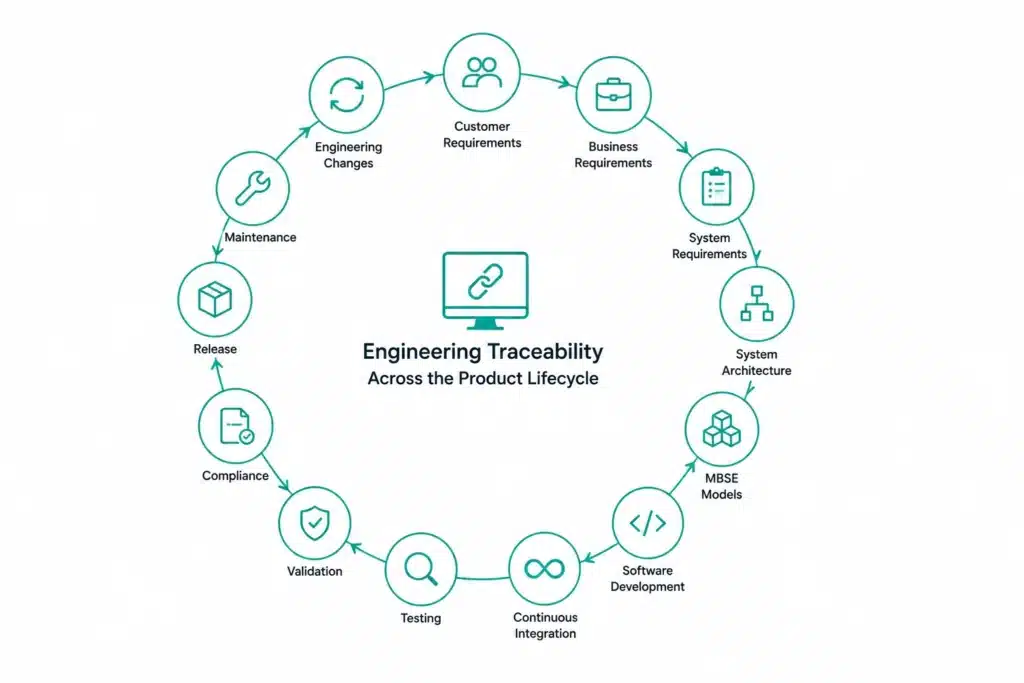
Engineering Traceability is not limited to a single phase of development. It extends across the entire product lifecycle, ensuring that every engineering activity remains connected from concept to maintenance. By linking engineering artifacts throughout development, organizations gain complete visibility into how decisions made at one stage influence downstream activities.
A typical Engineering Traceability flow includes:
Customer Requirements
↓
Business Requirements
↓
System Requirements
↓
System Architecture
↓
MBSE Models
↓
Software Development
↓
Continuous Integration
↓
Testing
↓
Validation
↓
Compliance
↓
Release
↓
Maintenance
↓
Engineering Changes
This connected lifecycle helps engineering teams maintain consistency, simplify change management, and improve collaboration across multidisciplinary projects.
💡
Types of Engineering Traceability
Different types of traceability support different engineering objectives. Together, they provide complete visibility throughout product development and enable organizations to manage changes more effectively.
Forward Traceability
Forward traceability follows engineering information from requirements through implementation and validation.
A typical forward traceability path looks like this:
Requirement
↓
Design
↓
Source Code
↓
Testing
↓
Release
This approach ensures that every approved requirement has been implemented, verified, and included in the final product. It also helps engineering teams identify missing functionality before product release.
Backward Traceability
Backward traceability begins with an implemented engineering artifact and traces it back to the original requirement or business need.
For example:
Defect
↓
Source Code
↓
Requirement
↓
Customer Need
Backward traceability helps engineering teams understand why a specific feature was developed, identify the original requirement behind a software component, and perform efficient root cause analysis when issues arise.
Bidirectional Traceability
Most organizations developing complex products adopt bidirectional traceability, as it combines the advantages of both forward and backward traceability.
With bidirectional traceability, engineering teams can move seamlessly between requirements, architecture, implementation, testing, and validation in either direction.
This supports:
- Impact analysis
- Compliance verification
- Engineering Change Management
- Root cause analysis
- Product quality improvement
- Lifecycle audits
Because of its ability to provide complete engineering visibility, bidirectional traceability is widely regarded as a best practice in regulated industries.
Benefits of Engineering Traceability
Engineering Traceability delivers measurable value throughout the product lifecycle by improving visibility, collaboration, quality, and compliance.
Complete Engineering Visibility
Engineering teams gain a clear understanding of how requirements, designs, software, testing, validation, and product releases are connected.
Instead of manually searching across multiple tools, engineers can quickly identify relationships between engineering artifacts and make better-informed decisions.
Faster Impact Analysis
One of the biggest advantages of Engineering Traceability is rapid impact analysis.
When a requirement changes, engineering teams can immediately determine:
- Which software components are affected
- Which MBSE models require updates
- Which test cases need to be re-executed
- Which compliance documents must be revised
This reduces manual effort while minimizing the risk of overlooking downstream dependencies.
Improved Collaboration
Engineering Traceability enables systems engineers, software developers, quality teams, compliance specialists, and product managers to work with connected engineering information rather than isolated documents.
This shared visibility improves communication, reduces misunderstandings, and helps teams coordinate engineering activities more efficiently.
Better Change Management
Engineering changes become easier to evaluate because all affected engineering artifacts remain connected.
Organizations can assess technical impact before implementation, reducing unnecessary rework and ensuring changes are reviewed systematically throughout the product lifecycle.
Many organizations combine Engineering Traceability with Embedded DevOps Services to automate software development, testing, and deployment while maintaining complete lifecycle traceability.
Simplified Regulatory Compliance
Regulated industries require organizations to demonstrate that engineering requirements have been properly implemented, verified, and validated.
Engineering Traceability automatically provides evidence by maintaining relationships between:
- Requirements
- Design
- Implementation
- Testing
- Validation
- Compliance documentation
This significantly simplifies audits and regulatory assessments while reducing manual documentation efforts.
Higher Product Quality
By connecting every requirement to testing and validation activities, Engineering Traceability helps ensure that no functionality is overlooked during development.
Complete traceability reduces the likelihood of missing requirements, improves verification coverage, and contributes to higher-quality products with fewer defects.
Reduced Engineering Risk
Engineering Traceability enables organizations to identify missing relationships, inconsistent engineering information, and incomplete validation activities much earlier in the development process.
Early visibility helps reduce costly rework, improve engineering confidence, and support more predictable product delivery.
Engineering Traceability in Regulated Industries
Engineering Traceability is especially important in industries where safety, reliability, and regulatory compliance are essential. These industries must demonstrate that every requirement has been implemented, tested, validated, and properly documented throughout the product lifecycle. A structured traceability process helps organizations maintain complete engineering records while reducing compliance risks.
Automotive
The automotive industry develops highly complex products that combine mechanical systems, embedded software, electronics, cybersecurity, and functional safety.
Engineering Traceability supports compliance with standards such as:
- ASPICE
- ISO 26262
- ISO/SAE 21434
It connects requirements, software implementation, testing, safety analysis, cybersecurity activities, and validation evidence, ensuring every engineering change is fully traceable throughout development.
Organizations implementing engineering traceability for automotive programs often strengthen their processes through Automotive Process Consulting, helping them align development practices with industry standards and improve engineering governance.
Aerospace & Defense
Engineering Traceability plays a critical role in aerospace and defense programs, where every engineering decision must be documented and verified.
Traceability helps organizations:
- Support product certification
- Maintain configuration control
- Connect requirements with verification activities
- Document safety and risk assessments
- Improve lifecycle governance
Maintaining these relationships simplifies audits and strengthens confidence in safety-critical engineering projects.
Medical Devices
Medical device manufacturers must comply with strict quality and regulatory requirements throughout product development.
Engineering Traceability supports compliance with standards such as:
- IEC 62304
- ISO 13485
- FDA regulations
By connecting requirements, risk analysis, testing, validation, and release documentation, organizations can demonstrate that every product requirement has been properly implemented and verified.
Rail & Transportation
Engineering Traceability supports safety-critical rail projects by maintaining complete visibility across requirements, system design, software development, verification, and compliance activities.
It also helps organizations comply with standards such as EN 50128 while improving engineering collaboration across multidisciplinary teams.
Industrial Manufacturing
Modern industrial equipment integrates software, automation, electronics, cloud connectivity, and intelligent control systems.
Engineering Traceability enables manufacturers to improve engineering governance by connecting product requirements, design information, software development, testing, manufacturing, and maintenance activities within a single engineering lifecycle.
Engineering Traceability and the Digital Thread
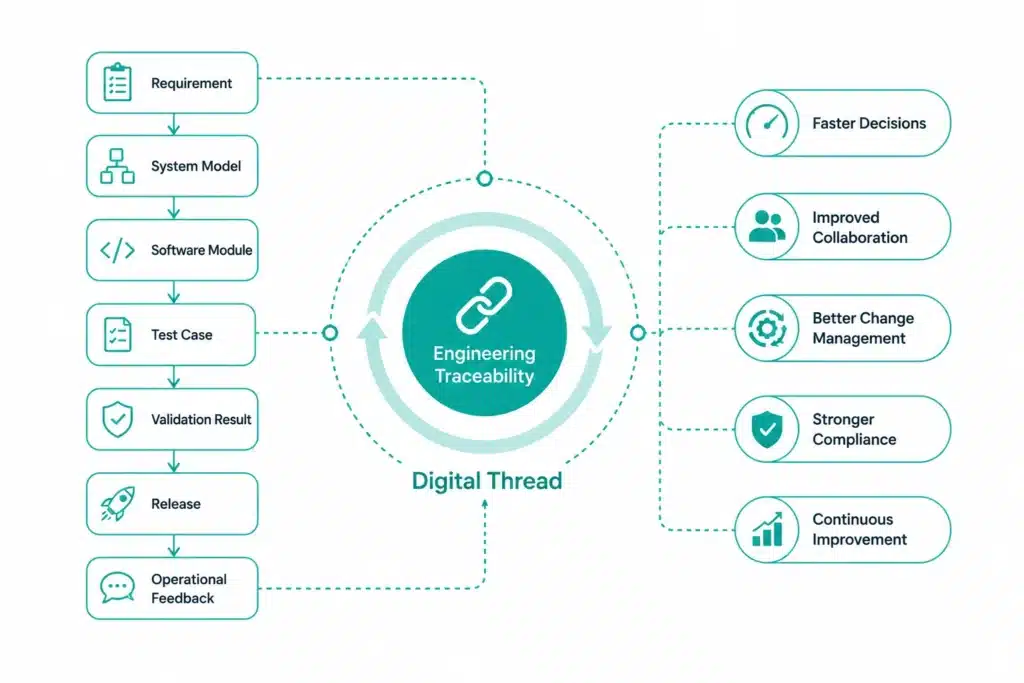
Engineering Traceability is one of the fundamental building blocks of a Digital Thread. While the Digital Thread connects engineering information across the entire product lifecycle, traceability provides the relationships that make those connections meaningful and actionable.
For example:
Requirement
↓
System Model
↓
Software Module
↓
Test Case
↓
Validation Result
↓
Release
↓
Operational Feedback
Because each engineering artifact remains connected, organizations gain complete lifecycle visibility. Teams can quickly determine how a requirement influences design decisions, software implementation, testing activities, and final product releases.
This connected approach enables:
- Faster engineering decisions
- Improved collaboration
- Better change management
- Stronger compliance
- Continuous product improvement
Engineering organizations implementing Digital Thread strategies typically combine traceability with integrated lifecycle platforms to eliminate disconnected engineering data and improve cross-functional collaboration.
Common Challenges Without Engineering Traceability
Organizations that do not implement Engineering Traceability often face challenges that affect productivity, product quality, and compliance.
Disconnected Engineering Tools
Requirements, software development, testing, documentation, and configuration management are often maintained in separate systems.
Without integration, engineering teams must manually correlate information, increasing the likelihood of errors and inconsistent data.
Manual Documentation
Many organizations continue to maintain traceability using spreadsheets or manually updated documents.
As projects grow, these records quickly become outdated, making it difficult to trust engineering information during reviews or audits.
Poor Change Visibility
When engineering artifacts are not connected, understanding the downstream impact of a change becomes time-consuming.
Teams may overlook affected requirements, software modules, or test cases, increasing the risk of defects and project delays.
Compliance Risks
Regulated industries require complete evidence showing that every requirement has been implemented, verified, and validated.
Without Engineering Traceability, preparing for compliance assessments often involves significant manual effort and creates unnecessary audit risks.
Delayed Root Cause Analysis
When defects occur, engineering teams need to identify their source quickly.
Without traceability, determining which requirements, software components, or design decisions contributed to a problem can take considerable time, delaying corrective actions and product releases.
Best Practices for Implementing Engineering Traceability
Organizations that successfully implement Engineering Traceability typically follow a structured and standardized approach.
Start with Requirements
Requirements should serve as the foundation for all traceability relationships.
Every downstream engineering artifact should remain connected to approved customer and system requirements, ensuring complete lifecycle visibility from the beginning of the project.
Integrate Engineering Tools
Engineering Traceability becomes far more effective when engineering tools are connected.
Organizations should integrate platforms used for:
- Requirements Management
- MBSE
- Source Control
- Test Management
- CI/CD
- Release Management
Integrated toolchains reduce manual effort while improving engineering collaboration and data consistency.
Organizations implementing enterprise engineering platforms often rely on IBM Engineering Lifecycle Management to establish connected engineering processes and maintain end-to-end lifecycle traceability.
Maintain Bidirectional Traceability
Engineering teams should be able to navigate seamlessly from requirements to implementation and from implementation back to the originating requirements.
Bidirectional traceability simplifies impact analysis, supports engineering reviews, and improves compliance readiness.
Automate Traceability
Manual spreadsheets become difficult to maintain as engineering projects grow.
Modern Engineering Lifecycle Management platforms automate traceability by maintaining relationships between engineering artifacts throughout the development process.
Continuously Validate Relationships
Engineering Traceability should not be treated as a one-time activity.
As products evolve, engineering relationships should be continuously reviewed and updated to ensure they remain accurate throughout development.
Organizations evaluating lifecycle management solutions often compare ELM vs PLM to understand how engineering lifecycle platforms complement product lifecycle management while supporting comprehensive engineering traceability.
Technologies That Enable Engineering Traceability
Modern Engineering Traceability depends on integrated engineering platforms that connect information across the entire product lifecycle. Rather than storing engineering data in isolated applications, these platforms create a connected engineering environment where requirements, designs, software, testing, and compliance activities remain linked from concept to product release.
Some of the most widely used technologies include:
Engineering Lifecycle Management
Engineering Lifecycle Management (ELM) platforms provide the foundation for managing engineering artifacts, collaboration, lifecycle traceability, and change management across complex product development programs.
Organizations evaluating lifecycle management strategies often compare ELM vs ALM to understand which approach best supports software-intensive and multidisciplinary engineering projects.
IBM Engineering Lifecycle Management (IBM ELM)
IBM Engineering Lifecycle Management provides an integrated platform for managing requirements, systems engineering, software development, testing, workflow management, and compliance.
By connecting engineering artifacts throughout the lifecycle, IBM ELM enables organizations to improve traceability, simplify impact analysis, and strengthen collaboration across engineering teams.
IBM DOORS Next
IBM DOORS Next is widely used for requirements management in complex engineering environments.
It enables organizations to:
- Capture and manage requirements
- Establish traceability relationships
- Perform impact analysis
- Support regulatory compliance
- Collaborate across engineering disciplines
Systems Engineering Tools
Model-Based Systems Engineering platforms play an important role in Engineering Traceability by linking system models with downstream engineering activities.
Common tools include:
- IBM Rhapsody
- Cameo Systems Modeler
These platforms help engineering teams maintain consistency between system architecture, requirements, software development, and validation activities.
Application Lifecycle Management
Application Lifecycle Management platforms support software planning, development, testing, and release management.
Examples include:
- Jira
- Azure DevOps
- GitLab
When integrated with Engineering Lifecycle Management, these tools extend traceability from engineering requirements into software implementation and testing.
DevOps Platforms
Modern DevOps platforms automate software development while maintaining traceability across the engineering lifecycle.
Examples include:
- Jenkins
- GitHub
- GitLab CI/CD
Organizations adopting continuous engineering often combine these technologies with Embedded DevOps Services to automate development, testing, deployment, and engineering workflows while preserving complete lifecycle traceability.
Product Lifecycle Management
Product Lifecycle Management platforms support manufacturing, product data management, and product configurations throughout the operational lifecycle.
Examples include:
- PTC Windchill
- Siemens Teamcenter
When integrated with Engineering Lifecycle Management solutions, PLM platforms provide complete engineering and product visibility from concept through production and maintenance.
Solutions such as PTC Codebeamer ALM further strengthen Engineering Traceability by connecting requirements, software development, testing, risk management, and compliance within a unified engineering platform.
How MicroGenesis Helps
Engineering Traceability requires more than implementing individual engineering tools. Organizations need a connected engineering ecosystem where requirements, system architecture, software development, testing, compliance, and product releases remain synchronized throughout the product lifecycle.
MicroGenesis helps organizations establish end-to-end Engineering Traceability by implementing integrated Engineering Lifecycle Management solutions that improve collaboration, visibility, compliance, and engineering efficiency.
Our capabilities include:
- IBM Engineering Lifecycle Management (IBM ELM)
- IBM DOORS Next implementation
- Engineering Traceability implementation
- Model-Based Systems Engineering (MBSE)
- Engineering Toolchain Integration
- Embedded DevOps implementation
- PTC Codebeamer ALM implementation
- Automotive Process Consulting
- Digital Thread implementation
With more than 25 years of engineering transformation experience, MicroGenesis helps organizations build connected engineering environments that improve lifecycle visibility, accelerate product development, reduce engineering risks, and simplify regulatory compliance.
Frequently Asked Questions
What is Engineering Traceability?
Engineering Traceability is the process of connecting engineering artifacts such as requirements, system designs, source code, test cases, validation reports, and product releases throughout the product lifecycle. It provides complete visibility into how engineering information is related and how products evolve over time.
Why is Engineering Traceability important?
Engineering Traceability helps organizations understand the impact of engineering changes, improve collaboration between teams, maintain regulatory compliance, reduce engineering risks, and ensure that every requirement is implemented, tested, and validated before product release.
What is bidirectional traceability?
Bidirectional traceability allows engineering teams to navigate from requirements to implementation and from implementation back to the original requirements. This supports impact analysis, change management, compliance, and root cause analysis.
Which industries require Engineering Traceability?
Engineering Traceability is widely used in industries developing complex and regulated products, including:
- Automotive
- Aerospace and Defense
- Medical Devices
- Rail Transportation
- Electronics
- Industrial Manufacturing
How does Engineering Traceability support compliance?
Engineering Traceability maintains documented relationships between requirements, implementation, testing, validation, and compliance evidence. This enables organizations to demonstrate conformity with standards such as ASPICE, ISO 26262, IEC 62304, and ISO/SAE 21434 while simplifying audits.
Conclusion
Engineering Traceability has become a fundamental capability for organizations developing today’s complex, software-driven products. By connecting requirements, architecture, software development, testing, validation, compliance, and product releases, it provides the visibility needed to manage engineering complexity while maintaining product quality and regulatory compliance.
Organizations that implement end-to-end traceability gain significant advantages, including improved collaboration, faster impact analysis, better change management, stronger compliance, and higher engineering efficiency. When combined with Engineering Lifecycle Management, Digital Thread practices, and Model-Based Systems Engineering, Engineering Traceability forms the foundation of connected engineering.
Whether you’re developing automotive systems, aerospace platforms, medical devices, or industrial equipment, investing in Engineering Traceability helps engineering teams make informed decisions, reduce risks, and accelerate product innovation.