

Engineering organizations today operate in one of the most regulated environments ever experienced. Whether developing Software Defined Vehicles (SDVs), medical devices, aerospace systems, industrial automation equipment, or railway signaling solutions, businesses must comply with numerous industry standards, safety regulations, cybersecurity requirements, and customer expectations throughout the product lifecycle.
Compliance is no longer something that engineering teams address just before a product release. Modern engineering organizations must build compliance into every stage of development, from capturing requirements and creating system architectures to software development, testing, validation, engineering changes, and long-term product maintenance. Every engineering decision must be documented, traceable, and supported by evidence that demonstrates adherence to applicable standards and regulations.
As products become more software-driven and engineering teams become increasingly distributed, traditional compliance methods based on spreadsheets, disconnected documents, and manual reviews are no longer sufficient. Organizations need connected engineering environments where compliance activities are integrated into everyday engineering workflows instead of being treated as a separate audit exercise.
This is where Compliance Management plays a critical role.
Compliance Management enables organizations to plan, monitor, document, and demonstrate adherence to regulatory requirements while improving engineering quality, reducing project risks, and accelerating product delivery. Rather than slowing development, an effective compliance strategy creates repeatable engineering processes that support both innovation and regulatory readiness.
Today, Compliance Management is closely integrated with Engineering Lifecycle Management (ELM), allowing engineering teams to maintain complete visibility across requirements, design, development, testing, validation, and release activities. If you’re looking to understand how modern lifecycle platforms support connected engineering, our Engineering Lifecycle Management Guide provides a comprehensive overview.
What Is Compliance Management?
Compliance Management is the structured process of ensuring that engineering products, development processes, documentation, and engineering activities comply with applicable industry standards, government regulations, contractual obligations, and internal organizational policies throughout the product lifecycle.
Instead of treating compliance as a final review before product release, Compliance Management integrates regulatory requirements into engineering workflows from the earliest stages of development. This ensures that compliance becomes part of everyday engineering activities rather than an isolated audit process.
A mature Compliance Management strategy typically includes:
- Regulatory requirements management
- Engineering governance
- Risk management
- Requirements traceability
- Verification and validation
- Change management
- Configuration management
- Audit preparation
- Documentation management
- Continuous compliance monitoring
The primary objective of Compliance Management is to ensure that every engineering activity contributes to regulatory compliance while maintaining complete visibility and traceability across the engineering lifecycle.
Modern organizations often implement Compliance Management within an integrated Engineering Lifecycle Management environment to improve collaboration, automate governance, and maintain continuous compliance throughout development. To understand how Engineering Lifecycle Management supports this approach, read What Is Engineering Lifecycle Management.
Why Compliance Management Matters
Engineering organizations face increasing pressure to deliver innovative products while complying with strict regulatory and industry requirements. As products become more connected, software-intensive, and safety-critical, maintaining compliance has become significantly more challenging.
Without an effective Compliance Management framework, organizations often encounter:
- Delayed product launches
- Costly product redesigns
- Failed regulatory audits
- Product recalls
- Increased engineering risks
- Manual documentation effort
- Poor engineering visibility
- Limited lifecycle traceability
Compliance Management addresses these challenges by embedding governance directly into engineering processes instead of relying on manual reviews at the end of development.
Organizations implementing integrated Compliance Management practices typically benefit from:
- Faster audit readiness
- Improved engineering quality
- Reduced compliance risks
- Better collaboration between engineering teams
- Faster engineering change impact analysis
- Reduced documentation effort
- Continuous visibility into regulatory requirements
By integrating compliance into daily engineering activities, organizations reduce project risks while improving development efficiency and maintaining confidence in product quality.
Engineering Compliance vs Corporate Compliance
Although the terms are sometimes used interchangeably, Engineering Compliance and Corporate Compliance serve different purposes within an organization.
| Engineering Compliance | Corporate Compliance |
|---|---|
| Focuses on engineering processes and products | Focuses on business operations and corporate governance |
| Ensures product safety, quality, and regulatory conformity | Ensures legal, financial, and organizational compliance |
| Manages engineering evidence and lifecycle documentation | Manages company policies and regulatory obligations |
| Supports product certification and approvals | Supports organizational governance and legal compliance |
| Integrated into product development | Integrated into overall business operations |
Engineering Compliance ensures that products are designed, developed, tested, verified, and maintained according to applicable engineering standards and regulatory requirements. It focuses on building safe, reliable, and compliant products throughout the engineering lifecycle rather than simply meeting corporate governance obligations.
Key Components of Compliance Management
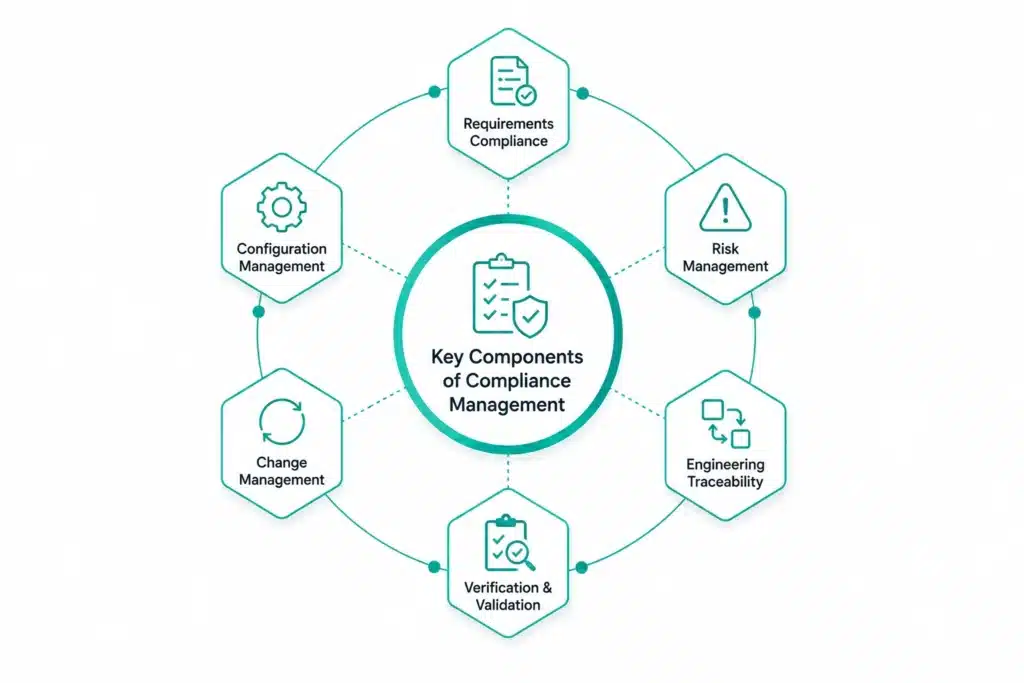
A successful Compliance Management strategy is built on several interconnected engineering processes that work together to ensure products meet regulatory and quality expectations throughout development.
Requirements Compliance
Every compliance initiative begins with clearly defined regulatory and customer requirements.
Engineering teams must capture and manage:
- Functional requirements
- Safety requirements
- Security requirements
- Regulatory requirements
- Customer requirements
These requirements become the foundation for downstream engineering activities, ensuring that every design decision, software implementation, and validation activity aligns with applicable compliance obligations.
Risk Management
Risk Management is a core component of Compliance Management because it helps organizations identify, evaluate, and reduce engineering risks before they affect product quality, safety, or regulatory compliance. Rather than reacting to issues after they occur, engineering teams proactively assess potential risks throughout the product lifecycle.
Typical risk management activities include:
- Hazard analysis
- Failure Mode and Effects Analysis (FMEA)
- Risk assessment
- Safety analysis
- Cybersecurity assessments
By integrating risk management into engineering workflows, organizations can make informed decisions, reduce project uncertainty, and ensure products remain safe and reliable under expected operating conditions.
Engineering Traceability
Engineering Traceability is one of the most important pillars of Compliance Management. It connects engineering artifacts across the product lifecycle, ensuring every regulatory requirement can be traced through implementation, testing, validation, and release.
A typical traceability flow looks like this:
Requirements
↓
System Design
↓
Software Development
↓
Testing
↓
Validation
↓
Release
↓
Maintenance
Maintaining these relationships allows engineering teams and auditors to verify that every compliance requirement has been implemented, tested, and approved. It also simplifies impact analysis whenever engineering changes occur.
Organizations adopting Model-Based Systems Engineering (MBSE) often strengthen engineering traceability by connecting system models with downstream engineering activities. To understand how these approaches complement one another, explore ELM vs MBSE.
Verification and Validation
Compliance requires clear evidence that engineering requirements have been correctly implemented and that the final product performs as intended.
Verification confirms that products have been developed according to approved specifications, while validation confirms they satisfy intended user needs and regulatory expectations.
Verification and validation activities commonly include:
- Unit testing
- Integration testing
- System testing
- Regression testing
- Safety testing
- Security testing
Maintaining links between requirements, testing activities, and validation evidence helps organizations demonstrate compliance while improving overall product quality.
Change Management
Engineering changes can significantly impact regulatory compliance, even when the modification appears small.
Compliance Management requires every engineering change to follow a structured process that evaluates technical, operational, and regulatory impacts before implementation.
Effective change management includes:
- Impact analysis
- Approval workflows
- Documentation updates
- Revalidation
- Configuration control
A controlled change process ensures that engineering modifications remain fully traceable and continue to satisfy applicable regulatory requirements throughout the product lifecycle.
Configuration Management
Configuration Management ensures that approved engineering artifacts remain consistent throughout development and product release.
It helps organizations control:
- Software versions
- Hardware revisions
- Engineering documentation
- Test baselines
- Product configurations
Maintaining accurate configuration records supports engineering consistency, improves collaboration, and simplifies regulatory audits by ensuring that released products match approved engineering baselines.
Common Engineering Compliance Standards
Different industries follow different regulatory standards depending on the products they develop. Compliance Management helps organizations implement the engineering processes required to meet these standards while maintaining complete traceability and audit readiness.
Automotive
Engineering organizations developing automotive products commonly comply with:
- ASPICE
- ISO 26262 (Functional Safety)
- ISO/SAE 21434 (Cybersecurity)
- UNECE WP.29
These standards require organizations to maintain engineering traceability, structured verification, controlled change management, and comprehensive documentation throughout development.
Organizations implementing these standards often strengthen their engineering processes through Automotive Process Consulting, ensuring alignment with industry best practices while improving engineering maturity.
Aerospace & Defense
Engineering organizations in aerospace and defense typically comply with standards such as:
- DO-178C
- ARP4754A
- DO-254
These standards govern software development, systems engineering, safety assessments, and certification activities for safety-critical products.
Medical Devices
Medical device manufacturers commonly follow:
- IEC 62304
- ISO 13485
- FDA 21 CFR Part 820
Compliance focuses on software lifecycle management, quality management systems, risk management, verification, validation, and complete engineering documentation.
Rail
Rail organizations frequently implement standards including:
- EN 50128
- EN 50126
- EN 50129
These standards support the development of safety-critical railway systems by requiring disciplined engineering processes and lifecycle traceability.
Challenges in Compliance Management
Although Compliance Management is essential for delivering safe, reliable, and high-quality products, implementing an effective compliance framework can be challenging. As products become more complex and engineering teams adopt modern development practices, organizations must manage growing volumes of engineering data while meeting evolving regulatory requirements.
Disconnected Engineering Data
Many organizations still manage engineering information across multiple independent tools. Requirements, system models, software development, testing, documentation, and compliance evidence often reside in separate repositories.
This fragmented approach creates several challenges:
- Duplicate documentation
- Inconsistent engineering records
- Limited visibility
- Manual data synchronization
- Slow impact analysis
A connected engineering environment eliminates these silos by linking engineering artifacts throughout the product lifecycle.
Manual Compliance Processes
Compliance activities are still managed manually in many organizations using spreadsheets, email approvals, and disconnected documents.
Manual processes often result in:
- Delayed reviews
- Missing documentation
- Inconsistent audit evidence
- Increased engineering effort
- Higher compliance risks
Automating compliance workflows allows engineering teams to spend more time on product development and less time managing administrative activities.
Frequent Regulatory Changes
Industry regulations continue to evolve as technologies advance.
Engineering organizations must continuously adapt to changes in:
- Safety standards
- Cybersecurity regulations
- Industry certifications
- Environmental requirements
- Customer-specific compliance obligations
Without structured Compliance Management, keeping engineering processes aligned with these evolving standards becomes increasingly difficult.
Limited Lifecycle Traceability
Compliance depends on the ability to demonstrate how requirements were implemented, tested, validated, and approved.
Without complete lifecycle traceability, organizations struggle to:
- Demonstrate regulatory compliance
- Perform impact analysis
- Validate engineering changes
- Prepare for audits
- Investigate engineering issues
Maintaining connected engineering information significantly improves visibility and reduces compliance risks.
Cross-Functional Collaboration
Compliance activities involve multiple teams working together throughout product development.
These teams may include:
- Systems Engineering
- Software Development
- Hardware Engineering
- Quality Assurance
- Functional Safety
- Cybersecurity
- Manufacturing
- Compliance specialists
Without standardized workflows and integrated engineering platforms, communication gaps and inconsistent documentation can delay projects and increase audit risks.
Best Practices for Effective Compliance Management
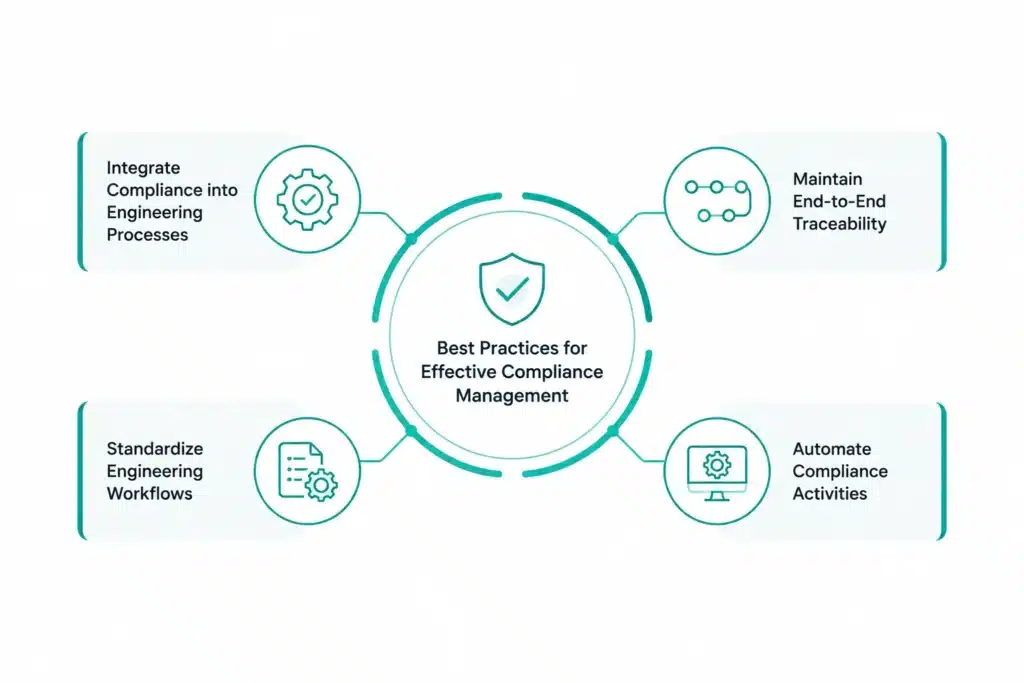
Organizations that consistently achieve successful compliance outcomes typically adopt structured engineering processes supported by integrated lifecycle management platforms.
Integrate Compliance into Engineering Processes
Compliance should be incorporated into engineering workflows from the beginning of product development rather than treated as a final approval activity.
Embedding compliance into requirements management, design, development, testing, and validation helps reduce project risks while improving engineering efficiency.
Maintain End-to-End Traceability
Every compliance requirement should remain connected to:
- System requirements
- Design decisions
- Software implementation
- Test cases
- Validation reports
- Engineering changes
- Product releases
Complete traceability simplifies regulatory audits while improving engineering visibility across the lifecycle.
Standardize Engineering Workflows
Organizations should establish consistent engineering workflows that define:
- Requirement management
- Risk assessments
- Review processes
- Change approvals
- Testing activities
- Compliance documentation
- Release management
Standardized processes improve governance while reducing inconsistencies across engineering teams.
Automate Compliance Activities
Automation improves efficiency by reducing manual effort throughout the compliance lifecycle.
Typical automation opportunities include:
- Workflow approvals
- Traceability updates
- Engineering notifications
- Compliance reporting
- Documentation generation
- Audit preparation
Automation also minimizes the risk of human error and helps organizations maintain accurate engineering records.
Use Integrated Engineering Platforms
Modern Engineering Lifecycle Management platforms provide centralized environments for managing engineering information, collaboration, traceability, and compliance.
Organizations implementing IBM Engineering Lifecycle Management gain connected workflows across requirements management, systems engineering, software development, testing, and engineering governance, making compliance easier to manage throughout the product lifecycle.
Compliance Management and Engineering Lifecycle Management
Compliance Management is most effective when it is integrated into an Engineering Lifecycle Management (ELM) strategy. Instead of managing compliance as a separate activity, ELM connects engineering processes, people, and tools throughout the product lifecycle.
An integrated ELM platform enables organizations to:
- Capture regulatory requirements
- Maintain engineering traceability
- Manage engineering changes
- Automate approval workflows
- Track verification and validation
- Generate compliance evidence
- Support continuous audit readiness
Organizations evaluating lifecycle management approaches often compare ELM vs PLM to understand how engineering lifecycle platforms differ from product lifecycle management solutions and how each contributes to regulatory compliance.
Solutions such as PTC Codebeamer ALM also support Compliance Management by integrating requirements management, risk management, test management, and lifecycle traceability within a single engineering platform.
How MicroGenesis Helps Organizations Achieve Compliance
Building and maintaining compliance across complex engineering programs requires more than documentation and periodic audits. Organizations need connected engineering processes, lifecycle traceability, integrated toolchains, and standardized workflows that support compliance throughout the product lifecycle.
MicroGenesis helps organizations establish a compliance-driven engineering environment by implementing Engineering Lifecycle Management solutions that integrate requirements, systems engineering, software development, testing, change management, and verification into a unified engineering ecosystem.
Our expertise includes:
- IBM Engineering Lifecycle Management consulting
- PTC Codebeamer ALM implementation
- Requirements Management and Traceability
- Compliance Management consulting
- Engineering Change Management
- Embedded DevOps implementation
- Model-Based Systems Engineering integration
- Automotive Process Consulting
- Digital engineering transformation
By connecting engineering artifacts and automating compliance workflows, MicroGenesis enables organizations to improve engineering visibility, reduce audit preparation time, strengthen regulatory compliance, and accelerate product development while maintaining high standards of quality.
Organizations modernizing software engineering alongside compliance initiatives can also benefit from Embedded DevOps Services, which help automate software delivery while maintaining governance, traceability, and quality throughout the engineering lifecycle.
Organizations evaluating different lifecycle management approaches should also understand the differences between ELM vs ALM. While Application Lifecycle Management primarily focuses on software development, Engineering Lifecycle Management extends governance across systems engineering, hardware, software, testing, compliance, and product lifecycle processes.
Frequently Asked Questions
What is Compliance Management?
Compliance Management is the structured process of ensuring that engineering products, processes, documentation, and development activities comply with applicable industry standards, regulations, customer requirements, and internal organizational policies throughout the product lifecycle.
Why is Compliance Management important?
Compliance Management helps organizations reduce regulatory risks, improve product quality, maintain engineering traceability, simplify audits, and ensure that engineering activities consistently meet industry and customer requirements.
Which industries require Compliance Management?
Compliance Management is essential in industries that develop regulated or safety-critical products, including:
- Automotive
- Aerospace and Defense
- Medical Devices
- Rail and Transportation
- Industrial Manufacturing
- Electronics
- Energy
How does Engineering Lifecycle Management support Compliance Management?
Engineering Lifecycle Management provides a connected engineering environment where requirements, design, development, testing, validation, engineering changes, and compliance evidence remain linked throughout the product lifecycle. This improves traceability, collaboration, and audit readiness.
What are the biggest challenges in Compliance Management?
Common challenges include:
- Disconnected engineering tools
- Manual documentation
- Limited traceability
- Frequent regulatory updates
- Cross-functional collaboration issues
- Time-consuming audit preparation
What is the role of Engineering Traceability in Compliance Management?
Engineering Traceability connects requirements, design, implementation, testing, validation, and release activities. These relationships provide the evidence required to demonstrate compliance during regulatory assessments and customer audits.
Which tools support Compliance Management?
Organizations commonly use Engineering Lifecycle Management platforms such as IBM Engineering Lifecycle Management and PTC Codebeamer ALM to manage requirements, engineering traceability, risk management, testing, change management, and compliance throughout the product lifecycle.
How can organizations improve Compliance Management?
Organizations can strengthen Compliance Management by integrating engineering tools, automating workflows, maintaining end-to-end traceability, standardizing engineering processes, and adopting Engineering Lifecycle Management platforms that support continuous compliance.
Conclusion
Compliance Management is no longer a standalone activity performed before audits or product releases. It has become an integral part of modern engineering, enabling organizations to build safe, reliable, and high-quality products while meeting increasingly complex regulatory requirements.
By integrating compliance into every stage of the engineering lifecycle, organizations gain greater visibility, stronger engineering governance, improved traceability, and faster audit readiness. Connected engineering practices also reduce manual effort, improve collaboration across multidisciplinary teams, and help organizations respond more effectively to changing regulations and customer expectations.
When combined with Engineering Lifecycle Management, Engineering Traceability, and Digital Thread strategies, Compliance Management becomes a strategic capability that supports innovation without compromising quality or regulatory compliance.
Whether developing automotive systems, aerospace platforms, medical devices, industrial equipment, or other safety-critical products, organizations that invest in structured Compliance Management are better positioned to accelerate product development, reduce engineering risks, and maintain long-term business success. Solutions such as IBM Engineering Lifecycle Management and PTC Codebeamer ALM, supported by MicroGenesis’ engineering expertise, provide the foundation for building connected, compliant, and future-ready engineering environments.